Brexit Quote of the Night: Labour and Immigration

Via The Guardian

Chuka Umunna, the London Labour MP, said that the referendum result highlighted “particular issues” for the Labour Party adding:

I don’t actually think for a lot of our supporters and voters sovereignty was quite the issue that immigration became. Why did it become such an overwhelming issue in spite of all the warnings of the experts? A lot of people said that you are saying this about the economy but we don’t actually feel we have a lot from that economy for the moment.

This is something, I think, we’re all learning not to underestimate. Economic issues matter enormously, but they matter this year, to an extent, in how they can reframed in an “us vs them” sort of way. The EU has been rent asunder by immigration, especially the Syrian crisis. This is a 100-yr fallout that isn’t just redefining the Middle East, but redefining Europe for a generation. America’s massive annexations in the 1840s are becoming the turning point of today’s politics. The world as we knew it for all of most our lives isn’t falling apart, but it is changing quickly, and when that happens, scapegoats are to be found, and demagogues can rally the dislocated.

I don’t think what happens there is what happens here. Too many differences. But the same issues are coming to ugly play in much of the “developed” world.  We live in the flicker.

Brexit: The US Fallout

ap20512607534

Pictured: the face that millions of people want to be President.

Leave declares victory a few minutes ago, and already the Asian markets are tumbling. Some of this is correction from the huge upsurge in stocks earlier on Thursday as it looked like Remain would win. This proves, again, that the markets are insane and are based on the gut instincts of terrified and greedy children. But regardless.

In the US, this will play out interestingly. I think it will give Trump some ammunition. After all, he supported Leave (as we said, “Leave” is the heart of Trumpism), and Obama, as any sane US president would be, was against it. This will allow Trump to talk about how his vision is correct, how the English (and he’ll probably say English, because he doesn’t know the difference between England and Great Britain and the UK) love him, and how he was really the big factor, even though he was no factor at all. It’ll be a minor coup, mitigated by his arriving in Scotland tomorrow in a miasma of phony triumph, Scotland being the one place that was firmly Remain. I don’t think he’ll have a glowing reception.

(And meanwhile, can we get some coverage on how unbearably tacky it is for a US Presidential candidate to abscond so that he can brag about his new gilded golf course? It’s not entirely Presidential, right?)

But overall, despite the strength this will give the Leave movement in the US, we’re talking about two very different places, demographically. I don’t think the Welsh will turn be too terribly inspiring in Johnstown. Trump’s crowing will hurt him even more in groups in which he is already getting pummeled. If there is economic chaos, globally, due to this, that always hurts the incumbent party, of course, but I don’t think the ramifications will be big enough, quick enough. The EU won’t collapse, and Great Britain was always at an arm’s length, anyway.

It’s still a scary, ugly time.


Brexit, Trump, and The New Dislocation


Make Great Britain, well, great again!


As I type this, ITV (through C-Span) is reporting that the Leave campaign is cruising toward a victory, with an 85% chance at victory. By the time I’m done, it could be a done deal. All night- or in the wee hours, if you are reading this in the immediately impacted areas- the results started to trickle toward the red, toward Leave. Wales, which has benefited enormously from the EU, while still suffering thanks to its postindustrial wreckage, was almost entirely and passionately Leave. England, with a resurgence of nationalism, went heavily toward an exit. Only Scotland kept it from being a total rout.

ITV just called it. It’s over. Brexit is a reality, and the world is a far different place.

It’s been a season of weirdness, on both sides of the ocean, two countries tied umbilically together. For as much as we pretend to be different, and as much as we are, there are real similarities, and they are bubbling to the surface, like some kind of deeply buried and seismically awakened sludge, in this year of simmering discontent and atavistic anger.

It’s impossible to discount what is happening. Throughout the night, there were references to the “white working class”, in cities like Manchester and Cardiff and throughout Wales, and how the Remain camp failed to persuade them that they are better off in a united Europe. I honestly don’t know if that is true they would be, though I suspect it is. But the argument is the same as it is here.

In the US, Trump is essentially in the Leave camp. I mean, he very literally is, having supported it (once he was told what it was). But instinctively, even if he didn’t know what it was, he knew, in his dark heart. He knew that “Leave” encompassed his entire campaign. The heart of Trumpism is a desire to leave the modern world. It’s a desire to leave a world where what once seemed certain and permanent (even if it was only a few generations old) was rapidly changing. It’s a desire to leave the world of complexity and uncertainty and retreat toward blood and soil. It’s the call to retreat disguised as victory.

And yes, that is a powerful message for many, left out of the global economy, punished by market forces that are beyond their control, but clearly in control of those who benefit. It’s a message that resonates because, while it blames “elites”, it really turns anger on those who are weaker (immigrants, Muslims, etc). It’s an extremely seductive howl, a lowing, lusty battle dirge. It accepts failure, but gives in to the desire to burn the world down with it. It’s the truncheon of the race riot manifest in the ballot box.

Both campaigns- Trump and Leave- have had violence as their main currency, or, if not the actual currency, the silver and gold that gives it value. Because when you tell people their country is under attack, and not just from immigrants, but from their children, and their grandchildren (as Satelan chillingly documents), and that they are being enabled by what are essentially quisling politicians, well, then what choice does a patriot have. It’s what led to the murder of Jo Cox. It’s what drives Trump’s supporters, like this terrifying racist. It’s not a policy. It’s sheer emotion.

This emotion is driven by modern dislocation. Yes, we’ve had immigration and a shifting balance of power for decades (it’s still mostly white, and male, but it is shifting). And yes, the UK has been in the EU for decades. But this is still relatively new. Before really the end of WWII an actual political alliance with France would have been insane. Even WWI was more out of the inconsistent European alliances that formed in the wake of Napolean. You don’t have many Englishman who remember France as an enemy, and the Continent as a wholly foreign place, but the memory remains. The memory of Empire remains, as it does, in another form, in America. This loss of identity, tied in with the shifting balance of power through immigration, assimilation, and expanded civil rights, is coupled with the very real economic dislocation of globalization. It all feels like a loss of power, and the personal and political can intertwine easily.

The memory of being on top is still powerful, and can be reanimated up by canny politicians who know how to stir up the blood that has dried in the soil. With sweaty passion and crocodile tears they gift life back into the blood, making it rich and liquid in a suddenly loamy soil, from which can sprout thousands of pairs of thick-booted feet, marching in unison to an old-fashioned martial beat.

It’s transoceanic, baby. Donald Trump doesn’t know anything about the world, but we’re living in his image.
TRONC! Today is a TRONC Day. TRONC Today. TRONC Forever.

It’s somehow completely slipped this blog’s mind to talk about the Tribune Company rebranding itself as TRONC: Tribune Online Content. I don’t think I really wanted to think about it, or believe it, for while the Tribune has frequently lost its damn mind, I still wanted it to be, you know, a newspaper. But we are not! We are TRONC. TRONC. Say it loud and there’s music playing. Say it soft, and it’s almost like a robot staring unblinkingly at you while it dispassionately burns down your house.

How bad is it? Well, if you didn’t think it could get any worse than establishing itself as a “content curation and monetization engine”, then you haven’t been paying attention to the present. As Verge reported the other day, “the leaders of the Tronc empire unveiled phase two of their plan: the gradual transformation of the company into a series of video embeds.”

Does that not sound terrible? Then you haven’t watched the video.


Luxuriate in this hideousness. “The future of journalism. The future of content.” These two bloodless technobabblers are the vampiric  avatars of a joyless future. “Harness the power of local journalism. Feed it into a funnel. And then optimize it to reach the broadest global audience.” Sounds great! Except that it means “what’s trending on Reddit now? Trouble in Palestine? Waukesha? Nah, it’s a dog on a tricycle!”

Or, as The Verge puts it (and really, read their piece: it’s perfect).

The basic idea here is that Tronc will syndicate articles and videos across its properties. Which is fine! But there’s not much money in text, and so Tronc is leaning hard into video. Today, 16 percent of the company’s articles include an embedded video; that number will more than double to 50 percent next year. But what if the article I just wrote doesn’t make sense as a video, you might ask? Congratulations! You’ve just been laid off.

Look, it’s a different market. Video is important. We watch video, and it makes a profit. I totally get that. But the trick is not to gear journalism around video; it’s to make the video relevant to journalism. That’s what we’re losing. In a rush to be viral, to make every story “Seth Meyers CRUSHES Trump”, we lose something.

Basically, it’s this. At the end, the nice lady from the grimmest of all possible futures says, boldly, without any embarrassment, “We’re a content company. First. Last. And always.” Content. Content. In my day job, I am a “Senior Content Developer”, B2B and B2C. I work hard and try to write interesting articles, that help our clients but are also readable and engaging, and hopefully in which you can learn something. I try to do my best. But I know what content is. It’s marketing, plain and simple. To reduce everything to “content” is to erase what journalism is. To transform the Tribune papers, which include the excellent LA Times, is to damage our civic knowledge, our democracy, and probably our intelligence.

Luckily, it seems that other papers are trying to embrace the new world differently, letting Facebook be the guardian. It isn’t ideal, but it allows for journalism. TRONC is a way around that, trying to beat the reductors at their own game. Goddamn, I hope it fails.

Waukesha Gets Its Water

lake_michigan_sunrise

A Great Lakes sunrise for Waukesha. Image from North Country Public Radio

Previous Waukesha posts:

Governors from the eight Great Lakes states agreed Tuesday to allow a Wisconsin city to start pumping millions of gallons a day from Lake Michigan, marking the largest diversion of water from the lakes since Chicago reversed the flow of the Chicago River in 1900.

The unanimous decision favoring Waukesha, a Milwaukee suburb of 70,000 about 17 miles west of the lake, is the first test of a 2008 legal compact intended to prevent thirsty communities or countries outside the Great Lakes region from dipping into the world’s largest source of fresh surface water.

Chicago Tribune

There are two ways to look at this: one is that it is a disaster, a slippery slope, a sluice suddenly opened that’ll eventually compromise the Great Lakes. The other way to look at it is that it showed the Compact, essentially works. The Compact does have allowances, and Waukesha has possibly the strongest possible case: straddling the Basin, poisonous waters, a plan to divert 100% of the water back into the Lakes, etc. And yet they still spent years and years and millions of dollars trying to get the exemption, and their plan was shrunk and compromised. If a city with the best-case scenario for application can barely get it, what chance does Arizona have?

And yet, the flip side of this is that you always start with the easy one. Now don’t get me wrong; I don’t think there is some conspiracy here. But I do worry greatly about water, and the desire to privatize it, and anything that makes it easier to do so can be troublesome. Do you really trust Rick Snyder with your water?

For the most part, protecting the Great Lakes has had a surprising amount of bipartisan support for conservation. Being angry at environmentalists usually stops when it is your resources on the line, and the Lakes are one of America’s great treasures. It’s why staunch conservatives like Tommy Thompson were eagerly behind it. I worry about the new breed, though, who see it as a mission to put everything public in private hands. That Minnesota governor Mark Dayton approved, given the conditions, makes me feel better, but Walker, Rauner, Snyder, et all (including Cuomo) is worrisome. Approving the diversion might be right, and might be essentially apolitcial (it is supposed to be), but given the attempt to parcel off water to the highest bidder, caution is required. I do think Republicans of good faith want to protect the Lakes. I don’t trust those who believe the free market can do it on its own.

Given the need for vigilance, it is disheartening to see that neither the Times nor the Post saw fit to cover this. I know we’re just the Midwest, but this is actually a huge story.

Speaking of, I am working on a much longer non-blog piece about the diversion. If you are a publisher, or know any, and would be interested, drop me a line. Thanks!

Anti-Safety-Net Conservatives: Never Not Wrong


Lousy troublemaking veterans. Image from Chicago Tribune. 

In the Times morning brief, they always have a neat little “behind the news” section, called the “Back Story” pinned to a headline or an anniversary. I usually enjoy it, today more so than others. It starts with commemorations of WWI centennials (the 100th anniversary of the Somme starts in July), and mentions how the US is erecting a WWI memorial in Washington soon. We’re reminded that Great War vets had to march bloodily on Washington to demand rights, and how, to avoid a repeat of that, Roosevelt pushed the GI Bill, one of the great creators of equality in America, and one that, with the bracing comfort of Time, we assume was always universally loved. 


Right?

The G.I. Bill gave veterans low-interest loans to buy a home, farm or business; 52 weeks of unemployment insurance; job placement services; and up to four years of federal aid for learning.

When the legislation was introduced in Congress in January 1944, some lawmakers argued that the unemployment insurance would encourage veterans not to work. Others worried about the introduction of battle-hardened men to universities, at the time bastions of the rich.

Ignoring the predictable toffish bigotry of the latter (I’m sure the men of Harvard weren’t funding research into shellshock to mitigate war’s cruelty), doesn’t the first argument sound pretty familiar? It’s the battle cry of every conservative when faced with a program that might make people’s lives less miserable, that might protect them from the bitterness of the market. The “argument” that having basic protections will make people lazy, and is somehow antithetical to the magical free market, is still in play. It was for welfare, for Medicaid, for Medicare, and for Social Security. The argument carried into the Clintonian 90s, when welfare was slashed, to prevent lazy people from stealing from the rich.

Actually, don’t ignore the 2nd argument, because while I am sure it was also being made by ostensible liberals, or at least Wilsonian liberals, it is inherently conservative. These are “others”, the ones who are stealing from the makers so that they can be lazy, whether they are Jim Crowed blacks or brutish doughboys. One will note that the “guaranteed income makes you lazy” trope isn’t employed when it comes to the estate tax, but that’s because the worldview is that certain people are owed great fortune, and others should make do with a pittance. It’s basically mean, in the truest sense: small and base and vile, reducing any humans who aren’t us to gravel on the road. You see it in Scott Walker’s attempted evisceration of the Wisconsin Idea (in which the role of the university system becomes  “develop(ing) human resources to meet the state’s workforce needs.”).  And you see it in the Trump campaign, built on a snarling anger against everyone else, an anger all the more dangerous because it transcends class, and makes race the defining feature. It is a class-based argument as well, but one that says “you could be rich if it wasn’t for the others.”

That’s the thing about these arguments: they are always wrong. The GI Bill was one of the great achievements of the 20th-century. Social Security helps prevent the immiseration of the elderly. Welfare is a needed shield. The people arguing against them are always wrong, and are never arguing in good faith, but are preaching a twisted faith from a gilded altar in front of a bloody and charred sacristry.

A Cubs’ Fan In Summer


A not-terrible place to watch a baseball game


My good buddy Brett Max Kaufman, who by day is a national security lawyer at the ACLU, also has for a cause a group even more damned than the forgotten wretches in Gitmo: the Chicago Cubs, and their fans. Well, not this year, of course. They are legitimately great, and brain-breakingly fun. He has an excellent piece over at The Classical describing how strange it is to be on the cusp of something he never thought could happen.

This—this air of concrete possibility—is new, and accordingly the young Cubs season has required Cub fans to make an emotional adjustment. We’re having more fun than ever, stumbling around dazed and delirious, smiling at strangers, shaking our heads. But the stakes are no longer merely philosophical. Growing up, I did not see any “meaningful games” this early in the year; I just saw games. Generations of us have watched in dejected disbelief as the Cubs blew one (and then another, and another) in May, but we always did so with a knowing wink at a universe we knew drove an impossible bargain. Occasionally, the games became important later on, with the weighty, improbable momentum of an entire summer behind them, and those particular failures left their marks. But Cub fans’ overall exposure—game to game, season to season, generation to generation—has always been relatively limited.

This is no paean to losing, no panegyric to the benefits of misery. Them being good is clearly for the best. It’s a recognition though, of what it all means.

As a Sox fan, I’m happy for Brett. I’m happy for all Cubs’ fans, and even for most people who just claim to be fans. It’s not a Chicago thing, per se. It’s for the people in it who care, and for whom this would mean so much. Part of me hopes they don’t do it, just because it would be unbearable, but I hope they go all the way. It’ll be a hell of a story.

Clinton’s Money Advantage and Citizens United


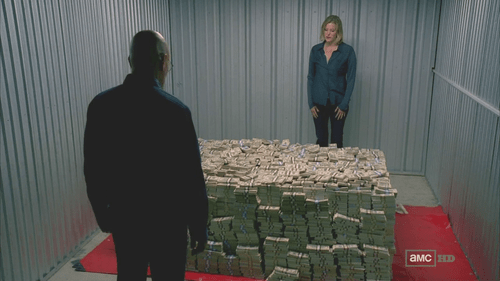
Pictured: Clinton campaign headquarters. Actually, you could probably write an essay on internet bros, Hillary Clinton, and Skyler White.


So, as everyone knows by now, Hillary Clinton is laying an absolute mollywhomping on Donald Trump in terms of fundraising, having over $42 million on hand to his $1.3 million. There are candidates for Water Reclamation boards that have more than $1.3 million.

The reasons are both obvious and not so obvious. Clinton, of course, is a very experienced fundraiser and knows how to play the game. Indeed, that’s the main thing that people don’t like about her: her comfort with big money. Trump’s pathetic fundraising is because he doesn’t want to do the work of being President, much in the same way he didn’t want to be an actual businessman, just a guy who could con suckers and take advantage of bankruptcy laws to make money. Or maybe that is an actual businessman. Regardless. It’s a weird combination of laziness, arrogance, and unsleeping avarice. It’s the spirit of his campaign.

Needless to say, there is a bit of an uncomfortable glee among Democrats, and obvious charges of hypocrisy. Democrats, in the main, don’t like the role of money, and loathe the Citizens United decision that opened the floodgates to jowly barbarians looking to destroy the social safety net, tear up any environmental legislation, and basically make the government little more than a tool for regulating sexual behavior. So it is weird to be dancing under a rain of money.

Hillary, in particular, has come under the most fire for this. It was in April that Glenn Greenwald argued that Clinton was undermining the anti-Citizens United front by saying that while she was accepting money, she was not being corrupted by it. On the surface, that makes a certain amount of sense. The argument is that money is inherently corrupting, which is a valid argument, but the option is to a) not take any money for an expensive campaign and lose or b) say “yup, I’m corrupt.”

It’s a weird and extremely leftier-than-thou argument, because it demands a kind of impossible purity that would rather lose elections, and have no chance at making better laws. Would I rather that there wasn’t this kind of money in politics? Of course- and that’s exactly why I’m voting for Hillary Clinton in the fall. I voted for Bernie in the primary, but millions of more people chose another candidate. An imperfect one (as was Bernie!) but someone who is far better on the issues I care about, including money in politics, than her opponent.

There is a thread of argument that says Hillary is insincere in her opposition to Citizen’s United, or at least sincere for the wrong reasons. This stemmed from a debate line about campaign finance.

And let’s remember, Citizens United, one of the worst Supreme Court decisions in our country’s history, was actually a case about a right-wing attack on me and my campaign. A right-wing organization took aim at me and ended up damaging our entire democracy. So, yes, you’re not going to find anybody more committed to aggressive campaign finance reform than me.

 As Slate’s excellent Mark Joseph Stern argued, after laying out three reasons to be opposed to Citizens United, “Clinton concocted a fourth: Citizens Unitedwas bad because it let a corporation attack my candidacy.” In a post on Washington’s Blog, Eric Zeusse furthered that argument, saying that it showed no actual commitment to overturning Citizen’s United, and was just a way to trick the “suckers” into voting for a fake Democrat. He added to that argument by saying that while her website pledges to overturn Citizens United, it doesn’t say how, making it “Yet more sucker bait.” (It actually does say how- appoint better justices, a constitutional amendment, etc. You just have to scroll down. However, these details might not have been there when Zuesse wrote his piece.)
This is, I think, an unfair charge, and sort of the price of being Hillary Clinton. With nearly any other politician, her answer would be seen as imperfect, but as a vehicle of passion. “Yes, I care about this. I understand what these people are capable of. I know how we got here.” It wasn’t a great answer, legalistically, but any good-faith reading of both the answer and other things she has said on the topic make it clear that she isn’t just rejecting Citizens United because of it attacking her. This was just a (inelegant) way of demonstrating that it is personal for her.
But she isn’t any other politician- indeed, there wouldn’t be this kind of movie made about anyone else, save for Obama. Republicans think she is a shrill liberal Balrog, summoned from the cruel depths of the 60s to fight back their reactionary victories. The left thinks she is a far-right fake Dem, tainted by her connection to Wall Street, and unbearably corrupt.
What she is is a professional politician, with all the attendant compromises, who is center-left, hawkish in many ways (though not all, as Fred Kaplan demonstrates), and someone who wants to win. And to win, you have to raise money. To overturn Citizens United, you have to get the votes. You have to win the Presidency. You have to take back the Senate. You have to have the money to make your case. It sucks, and it is uncomfortable, and yes, it demonstrates the awful power of money in politics. It isn’t a cause for joy that Hillary has all his money, and Trump has none. It’s just a cause for some relief.


In Which I Disagree With Paul Krugman

ap20512607534

Pictured: the face that millions of people want to be President.

Paul Krugman’s column today is about why the Republican Party was unable to stop Trump, but it seems like Hillary Clinton and the Democrats have been able to. There are a lot of structural and logical reasons: namely, he’s not running against 16 people who are scared of him, now. He’s the focus, and he’s massively, comically, underprepared. (A nationwide field staff of 30 people. 30!)  It’s the natural result of running a con- once it starts to get exposed, once the gilded walls turn out to be painted plaster, it all crumbles quickly.

The real question is why this particular bill of goods could be so easily sold during the primary, and I think that’s where Krugman’s analysis is revealed to a little off. The main point is that the Republican Party practices a top-down ideological form of control. I’d argue that the Republican Party is virtually leaderless, yes, but I still think he’s correct if you extend that to the blogs, to Fox, to talk radio, and all the snake-oil outlets. And he argues that because they are about one ideology, and that ideology is hollow and broken, it couldn’t offer any resistance. The Democratic Party is more “robust”, because it has a large number of interest groups that compete with each other.

But a big factor, I’d argue, is that the Democratic establishment in general is fairly robust. I’m not saying that its members are angels, which they aren’t. Some, no doubt, are personally corrupt. But the various groups making up the party’s coalition really care about and believe in their positions — they’re not just saying what the Koch brothers pay them to say.

This, I think is incorrect. To be sure, there are a lot of Republicans who only ask how high when told to jump, and not a single one of them hangs up when a Koch (or another rich winger) calls. But I don’t think it is as easy as that.  If David Koch decided tomorrow that he wanted to raise taxes and protect the environment, I don’t think you’d see Republicans start behaving better. Some, sure. But for the most part, these are true believers.

Guys like Cruz, and many more like them in the Senate and (especially) the House, and younger comers in the various ALEC-and-Koch-bought statehouses are absolutely products of the right-wing era, who grew up with Reagan and came of age with talk radio, Newt, and the Clintons. They do what the Kochs want, yes, but that’s because their interests and beliefs are aligned. If anything, these are people who are far more committed (and far meaner) then the Kochs. They are people who believe fiercely that the government should exist only to punish poor people and minorities, to impose a form of Christian sexual morality, and to bomb terrorists, and to bomb foreigners.

And more to the point, that’s not just the leaders. It’s the base. That’s why Trump won. It isn’t because right-wing ideology is in decline (though I think we see that it is), it’s because some people believe it, every word, and Trump played it perfectly. It’s an ideology built on mendacious machismo and hippie-punching ignorance. It’ll be here until it is driven away with loss after loss after loss, and the professional politicians finally see the writing on the wall. That’s part of why this election is important. If the True Believers, including Trump, who has no principles but is their avatar, get the nutstomping they deserve, it can make the less-committed professionals think twice.

A Data Point for the Con

gettyimages-524732160_wide-1951934875efc83bfeb5db5285f91a29052bffbb-s1100-c15

Mr. Perfect!

A key part of a long con, which is what Trump is running, is convincing the marks that the good stuff is just around the corner, that the payment is coming. You get them in too deep to pull out. It works well in business a lot, if you can rely on bankruptcy laws and rules that favor the already rich. Trump is hoping it works in elections.

“I’m four down in one poll, three and a half in another that just came out, and I haven’t started yet,” Mr. Trump, the presumptive Republican presidential nominee, said in a phone interview on Thursday night, a thought he volunteered as he dismissed concerns from Senate Republicans that he may be a drag on their candidacies in the fall.

“Haven’t started yet” is key to the con. So is fluffing numbers- he’s not down a lot (he’s down a historic amount), there are just a couple of itsy-bitsy polls that have him down a tiny amount, and anyway, we haven’t gotten going yet, ok? Things look bad now but only because I haven’t tried, and when I do, so much winning you’ll beg me to stop, you’ll scream and cry and gnash your teeth to make the hurricane-like winning cease, you’ll literally drown your best friend in tar and mud, watching them beg for breath as the person who they trusted the most in the world betrayed them, because you just can’t handle all the winning. That’s how much winning we’ll do. Just you wait.

You can see him doing the same thing in one of his bullshit businesses. Oh yeah, the casino is a little under now, but it’s got so much gold and glitz it will do great soon, and then I’ll pay you for your work. Trust me, once we get this going, it’s going to be amazing, and all bondholders will get twice- no, 864 times their investment. Trust me.

It’s questionable if this can work in an election. I mean, electorally it almost certainly won’t, but the question is if he can keep this up without it blowing up in his face, without everyone catching on that his campaign is being run the same way as a con. It’s a sham campaign, a flat shampaign, but it isn’t (just) about money. It’s about getting people to go along with what he wants without having to make any actual investment. It’s how he’s run every business in his entire life. And it’s gotten him close, though still very far, from the Presidency.