Wednesday Good Reads: SETI, El Faro, and Labor


FREE BOOKS! | Forever Free | Georgia Pathway to Language  Literacy

“Go to the one about organized labor, Madison


A few good reads from the last few days. What’s stopping you? You have nothing to lose, and everything (or, well, three things) to gain.

Searching the Skies for Alien Laser Beams, Marina Koren, The Atlantic

Some scientists believe that the best way to find alien life is to look for pulses of laser beams shot out across the dark eons. While SETI doesn’t always get priority for telescope use (understandably), researchers have found a workaround: poring through data collected by other observations and looking for anomalies. Of course, this presupposes that aliens have seen our planet, want to send some form of contact, and have also decided that laser pulses are the best way, but that makes some sense. It’s easier than sending, like an expedition, and it isn’t really committal (“Oh, jeez, sorry, we were sending that to Rigel 7.”), but there’s something very romantic about it. It’s like being at camp and blinking your flashlight across the lake, wondering if there were campers over there, wondering if you were somehow making a connection through the darkness.

(Granted, I doubt the aliens are hoping, as we campers did, just to make contact with girls, but the general principle holds.)

Democrats and Labor: Frenemies Forever, Erik Loomis, Boston Review

I don’t think there is anyone concerned with labor and with unions (the only thing that can bring back any form of rough economic equality) that isn’t frustrated with the Democrats. Even a very pro-labor government like Obama’s saw labor decline. But as Loomis argues, deciding the abandon the Democrats is ridiculous. A labor-driven third party can’t work, and the Republicans are fully committed to destroying what’s left of unions.

Loomis diagnosis how, oddly, the grassroots/progressive liberal wing helped to strip unions of their power, which accelerated the Democrats no longer needing them as much for votes, and relying on small donors/huge corporate cash, which pushed them toward unfettered free trade, which helped destroy the unions. It’s a complicated story where good guy/bad guy is pretty blurry, but there are ways to get back. The alliances that shattered unions can be used to build them back up.

Other unions have embraced grassroots activism to elect liberal and friendly Democrats. The latter is unions’ best answer if combined with committing as many resources as possible to organizing. Because, paradoxically, unions have little choice but to continue tying their fate to the Democratic Party. Indeed it is even more important now than five decades ago. Even though Democrats have helped create their demise, unions’ only chance against a full-on war with the Republican Party is a moderately favorable relationship with the Democrats acting as a kind of political bulwark.

The whole thing is worth the read.

‘I’m a Goner’: El Faro’s Last Hours as Ship Sails Into StormJason Dearen, AP

The El Faro was nearly 800 feet long and could carry 31,000 tons. It wasn’t one of the neo-Panamax megaliners that are transforming global shipping, but it was a beast. It also had bad boilers which could hurt its engine, and old-fashioned lifeboats that were essentially useless in a big storm. On Oct 1st, 2015, it

On Oct 1st, 2015, it rushed headlong into a big storm. Hurrican Jaoquin, near the Bahamas, a Category 3 with winds up to 130 mph. Battered by waves, unable to turn, the ship broke up and sank, taking its crew of 33 with it to the bottom.

In the AP, Jason Dearen crafts a story out of transcripts recorded on the bridge, and they tell a harrowing story of calm professionalism over growing terror. The list of things that went wrong is terrifying and maddening. The ship listed a bit, which meant the parts that brough oil to the engines didn’t quite reach the reserves, which made the pumps not work, which brought on more water. It couldn’t steer into the waves, and so was pummeled by them, hundreds of feet high. They couldn’t even call for help, since the company that owned the boat (the one that signed off on the boilers and the lifeboats) had an answering service set up after hours. There was no way to contact them directly (though it might not have mattered in the face of a hurricane, that’s still pretty cold).

They do their jobs and try to figure it out. But eventually, there is no way out. The ship is sinking. Some panic, some try to just find the next way to survive. None do. It’s a terrible story, written with a modest and removed reserve, which heightens the true natural terror. And that boat, that human immensity, carrying with it the dreams and memories of dozens, disappears, swallowed unremarkably by a roiling sea.


A Couple of Rainy Day Thoughts on How We’ve Altered the Landscape

Image result for chicago rain

It’s been a gloomy rainy sort of day here in Chicago. The White Sox opener has been postponed, which is fine. I don’t mind delaying this 95-loss season another day. It’s not spring yet, anyway.  It’s the sort of April rain that feels like the lingering of March, the whole month of which felt gray and wet, a Smarchian sort of slog.

You look out the windows and see the dull and lumpy sky wrinkle itself in a thousand plinging puddles, and watch the puddles grow and slink off toward the sewer, and its hard to remember that it’s only been a few hundred years that rain has been allowed to land that way. It used to fall on the ground, and slowly make its way across whatever basin it found itself in, if it weren’t used up or simply evaporated, reimagining its particles into invisibility so it could fall again.

But that’s not the way it is, anymore. It’s a profound change, and the short-term effects have been, in some ways, disastrous. To build our cities, we’ve altered to way water has distributed itself around the world. We’ve paved over floodplains and changed rivers. We’ve manipulated drainage.

Look at a very minor example, the North Branch of the Chicago River. Patti Welti of DNA Info has the story.

A total of 1.67 inches fell, a record for March 30.

It wasn’t enough to push the North Branch of the Chicago River to flood, but the water did rise more than two feet during the morning and early afternoon.

How does less than two inches translate into more than two feet?

Before the Chicago area was extensively settled, the river meandered across a marsh-like geography, dispersing water over a greater space. Precipitation was absorbed by vegetation and stored in the ground, wetlands and flood plains, according to the report.

As the area became more urban, green space was paved over, wetlands were drained and the river was straightened to better collect runoff that would have previously seeped into the ground. The result is a watershed with very little stormwater capacity, the report explains.

So much of urban history has been about how to drain marshes and swamps. There were enormous struggles in England in draining The Fens, which led to political upheaval, revolutions, and other intrigues. These were enormous marshes, the “sink of thirteen counties”, as Daniel Defoe described them. But the English managed to straighten the rivers and turn the Fens into farmland.


Or one could look at the Great Black Swamp that used to cover much of Northeast Ohio, a terrible oozy wasteland that slowed down water flowing into Lake Erie. This was a swamp that was nearly impassable by anyone who didn’t know exactly how to transverse its deep sludgy waters, and was frequently a refuge for natives, who could get through it faster than European-Americans could get around it. Draining it was an enormous accomplishment that led to the creation of cities like Toldeo, not to mention millions of acres of farmland.

Funny thing, though. It turns out the swamp helped keep Lake Erie clean, serving as a natural filter for whatever came through the basin’s rivers. The enormous runoff that resulted, combined with chemicals from the regions farms (which the swamp would have filtered) is one of the main reasons why Lake Erie has died several times. The swamp helped keep away the algae blooms that have decimated the lake.

So we don’t know. We don’t know how these experiments will end. The Chicago River was slow and windy, often more marsh than river. It wasn’t meant to be a straight channel. Maybe straightening it was the price of the city. Maybe paving over its wetlands is how we were built. And maybe it will be fine.

But a rapidly rising and fast moving Chicago River, devoid of any drainage, is, in a very literal sense, unnatural. The short-term effects of how completely we’ve altered our landscape are only beginning to show. The long-term effects are unknown. But, with the rushing clarity of a springtime flood, we know one thing: water always wins.

El Salvador Believes Water is Worth More Than Gold


Image result for gold miner

Different people might have different ideas about this picture


I was just reading this book that came out last year, An Indigenous People’s History of the United States, which isn’t so much a telling of the US from the native point of view, but rather looking at US history as essentially being about Indian removal. There’s a passage where the author, Roxanne Dunbar-Ortiz, talks about the gold rush, and the enormous depredations inflicted on the indigenous people in the European-American rush for gold. Some of the worst slaughters of the Indian Wars were to remove natives from their land, so that the Americans could get gold. (Remember, Custer was in the Black Hills to drive out the Sioux so newfound gold fields would be safe for Americans.)

In talking about the actions of the gold bugs, who brought torture and rape and disease and death to the natives, and who fought and killed each other over it, she mentions, almost as an aside, that for the natives, “gold was irrelevant.” Which is wild when you think about it: it had always been there, but was just sort of an interesting rock, until some other people came for whom it had imaginary value, and then it suddenly became death.

And that’s just the first-level horror. The miners choked the streams with silt, and of course, runoff from mining pollutes water supplies all around, leeching into aquifers, into the bodies of fish and anything that eats fish, and throughout whatever path the dirty water flows. That’s one of the lingering effects of mining, and it is why the US has been trying to regulate the industry as part of the Clean Water Act. That’s going away with the Trump administration, but there are some places which show us it is possible.

In this case, El Salvador.

SAN SALVADOR — Lawmakers in El Salvador voted overwhelmingly on Wednesday to prohibit all mining for gold and other metals, making the country the first in the world to impose a nationwide ban on metal mining, environmental activists said.

Declaring that El Salvador’s fragile environment could not sustain metal mining operations, legislators across the political spectrum approved the ban, which had broad support, particularly from the influential Roman Catholic Church.

Supporters said the law was needed to protect the country’s dwindling supply of clean water.

“Today in El Salvador, water won out over gold,” Johnny Wright Sol, a legislator from the center-right Arena party, wrote on Twitter.

Now look: I’m not going to sit here and, you know, romanticize life in El Salvador. In some respects, it seems like a crummy place to live. But that’s sort of the point. Gold is really valuable, and I’m sure it could be used, but El Salvador is looking at long-term (and short-term) consequences of putting profit over elemental needs. It seems like the smart thing to do, and the obvious thing to do, which is why it is all the more bewildering that the dominant political party in the United States doesn’t seem to think so.

It’s essentially a continuation of the consistent project, which has been a 500-yr struggle to turn the indigenous land into capital.  It’s a past and present we can’t reckon with, and increasingly, it makes the future a more shaky proposition.

Monday Quick Hits: Robots, Water, and Keystone


robot-1

“So I says to Mabel, I says…”


Did everyone have a good weekend? I had a great weekend. Lots of family, and lots of toast to Trump’s and Ryan’s failure to devastate the lives of millions of people. But this victory is, I think, just a pause. The battle will be to pressure Republicans, who seem to be a bit nervous about ruining the lives of their constituents, to make positive changes to the ACA, rather than repeal it.

Admittedly, they’re in a bind. The Times reported some anecdotes about people in GOP districts shocked that their reps would even think about such a thing, and might not vote Republican again. But then, there are also lots of GOP voters who, having been told that Obamacare was basically the forward thrust of creeping Bolshevism, are mad that it wasn’t repealed. So they are caught in a dilemma, namely: how do we do the things we’ve been saying we were going to do now that people have learned exactly what it is?

So now the question for Democrats is: how much should they work with Republicans? They are, thankfully, not eager to make some kind of “grand bargain” in order to help out the Republicans. The goal should be to fix Obamacare, working where you can to lower costs and make sure that insurance companies stay in. The talk of the “death spiral”, always exaggerated, is made possible by the threat of repeal. With that out of the way, for now at least, it could be possible to woo nervous Republicans to fix the bill at the margins, essentially working around Paul Ryan. That’s why the continued pressure from the outside is the only way to heighten their fear, and maybe force their hand to do the right and sensible thing and fix Obamacare.

Or, you could be like the President, who seems eager to watch the whole thing spiral out of control.

The “do not worry” is an especially nice touch.  He’s got a plan!

-Re/Code had a little story today about how PwC estimates, offhand, that the US could lose 40% of its jobs over the next 15 years thanks to automation. While there would of course be jobs created by automation (engineer, repair, etc) most of these will be high-skill jobs for people with advanced education. This is more than an unemployment trend; even if PwC’s numbers aren’t strictly accurate, this is economic devastation. This is something that can fundamentally alter society.

Massive unemployment of that sort needs to be ameliorated with something like a Universal Basic Income, or, failing that, an effort to create new work around infrastructure, tourism, or more. But there needs to be a collective effort grouped around the ideas that 1) the common good actually exists; and 2) that self-government is a good thing.

This isn’t something private markets can fix alone; indeed, it is the private market that will be at fault. There needs to be collective action to help the less educated and more vulnerable people in the new economy–the same ones who have been hurt for decades by market forces. That many of these are your stereotypical Trump voters (though they will be joined by millions of white collar types as well) represents an opportunity to convince them that the government is not the enemy, and that, in fact, this kind of intervention is the heart of the American experiment.

Of course, we’re debating whether or not it is ok if people just, you know, die because they don’t have employer-based insurance, so consensus on this seems a long way off.

-But we do have an answer on Keystone! That answer, of course, is “yes”. Trump signed off on Keystone on Friday, saying in a signing ceremony that:

It’s a great day for American jobs and a historic moment for North American and energy independence.  This announcement is part of a new era of American energy policy that will lower costs for American families — and very significantly — reduce our dependence on foreign oil, and create thousands of jobs right here in America.

It’s important to note, in the interest of being strictly accurate, that none of this is true. And it is just weird to talk about reducing “our dependence on foreign oil” right before you introduce the President of TransCanada, above and beyond the fact that this isn’t how the oil markets work. The sludge pumped over the largest underground aquifer isn’t going to be shuttled to your car. It goes into the global markets. I honestly don’t know if Trump understands this. I also wonder how he would reconcile the “lower costs” with the fact that, while Keystone was blocked, gas prices plummeted.

It is also good to note that this isn’t a done deal. As the TransCanada President reminded the United States President, they face resistance and lawsuits in Nebraska, where people don’t want a Canadian pipeline bringing dangerous material across their lands and into their water. That led to this exchange.

Trump: So we put a lot of people to work, a lot of great workers to work, and they did appreciate it.  And they appreciated it, Russ, very much at the polls, as you probably noticed.  And so we’re very happy about it.

So the bottom line — Keystone finished.  They’re going to start construction when?

MR. GIRLING:  Well, we’ve got some work to do in Nebraska to get our permits there —

THE PRESIDENT:  Nebraska.

MR. GIRLING:  — so we’re looking forward to working through that local —

THE PRESIDENT:  I’ll call Nebraska.  (Laughter.)  You know why?  Nebraska has a great governor.  They have a great governor.

MR. GIRLING:  We’ve been working there for some time, and I do believe that we’ll get through that process.  But obviously have to engage with local landowners, communities.  So we’ll be reaching out to those over the coming months to get the other necessary permits that we need, and then we’d look forward to start construction.

THE PRESIDENT:  Okay.  I’m sure Nebraska will be good.  Peter is a fantastic governor who’s done a great job, and I’ll call him today.

Remember that the head of an oil company is talking about working with local communities and landowners, and the President of the US is saying he’ll call the governor to get it done. That’s a true populist man of the people right there.

Yemen’s “Areas of Active Hostilities”: A Tautology for the 21st Century

86875470_yemen_sanaa_rubble_g

Remember that things can somehow always get worse. Image from BBC

WASHINGTON — The Trump administration is exploring how to dismantle or bypass Obama-era constraints intended to prevent civilian deaths from drone attacks, commando raids and other counterterrorism missions outside conventional war zones like Afghanistan and Iraq, according to officials familiar with internal deliberations.

Already, President Trump has granted a Pentagon request to declare parts of three provinces of Yemen to be an “area of active hostilities” where looser battlefield rules apply. That opened the door to a Special Operations raid in late January in which several civilians were killed, as well as to the largest-ever series of American airstrikes targeting Yemen-based Qaeda militants, starting nearly two weeks ago, the officials said.

“Areas of active hostilities” is an interesting phrase, one that is both clinical and carries within it a depth of soon-to-be-explored horrors. It’s a holdover from the Obama administration (whose worst legacy will be handing over a set of dangerous tools to a madman), and one that looks to be exploited by Donald Trump and his band.

Essentially, declaring an area to be one of active hostility means that there doesn’t need to be a Presidential-level approval for missions, and that the rules of engagement regarding civilians are loosened. The Times described it as “open(ing) the throttle” on counterterrorism activities.

The main problem with this, aside from the increased casualties in civilians and military personnel, is that it essentially becomes a self-fulfilling prophecy, a tautology. If you declare an area to be actively hostile, and treat it as such, and say, lose a Navy Seal while killing a dozen children, then it becomes more hostile, and the question of whether or not there is conflict becomes self-answering (if the area wasn’t hostile, we wouldn’t have lost a Seal, right?)

In Yemen, this sort of policy will almost certainly be a disaster. Let’s look at the confluence of forces. Many of these came under the Obama administration, and have been exacerbated by Trump.

  • The support for Saudi Arabia’s scorched earth campaign against the Huthis. Expect this support to increase, even vocally, as the administration tries to work a grand bargain of anti-Iran Arab nations (part of its Israel/Palestine plan, led by noted regional expert Jared Kushner).
  • The relentless viewing of Yemen through a strict counterterrorism lens, which leads to more militancy, and a strengthening of AQAP and, to an extent, ISIS (though I think AQAP will prove to be stronger in Yemen).
  • The confluence of Yemen with Iran, never entirely true, and now wildly and dangerously exaggerated.
  • An increase in boots-oriented and civilian-dismissing CT activities, designed so that a know-nothing President can appear tough. I don’t expect US military commanders and personnel to go Kilgore in Yemen, but the loosening of the rules will lead to more conflict, with its higher chances of casualties and civilian deaths. The fact that it is common knowledge that the Administration approves of this only makes America and American intentions look worse.
  • And speaking of American intentions, the hateful illogic of the travel ban solidifies the AQ/ISIS narrative that the West has declared war on Islam, and Islam has to protect itself. That the huffing and bloated face of Islamaphobia is now the face of the nation is an incredible gift to our enemies, and all his actions so far have proven their point.
  • One of his other actions is to gut foreign aid and the State Department. Due to the war, continued drought, and decades of mismanaged resources, Yemen is on the brink of a catastrophic famine. ISIS can’t feed everyone; nor can AQAP. This is an area where the US, and the West, can actually make a difference. But instead, we are going to cut aid, which barely makes a dent on our budget, to appeal to xenophobes.

It’s hard to overstate how crazy that is (not to mention bleakly immoral). Donald Trump and the Republicans are the only people in the world who think there is a purely military solution to radical Islamic terrorism. The idea that on the brink of a hideous humanitarian catastrophe the right course of action is to 1) reduce aid and 2) increase military activity is madness. It’s the best way to ensure that you are seen as the enemy for generations to come.

Don’t get me wrong: I don’t think sending grain is going to “solve” Yemen. This is a long-term internal issue that partly has to answer the question of what Yemen really is, and whether a unified Yemen is possible or desirable. But the US and the West have a role to play, and the only way to do that is build trust with political and tribal leaders on all sides.

Backing war criminals, demonizing Muslims at home, turning your back on suffering Muslims around the world, ignoring famine, and treating a country entirely as a problem for bombs and guns will is the exact opposite of what we want to do. It guarantees Yemen stays a war zone. The massive human suffering will radiate around the peninsula and across the sea. It’s the best way to make every area actively hostile.

Water Wednesday: Wisconsin’s Walker Woes and Things That Don’t Begin With W. Like Lake Erie


1351278762-picture_2025

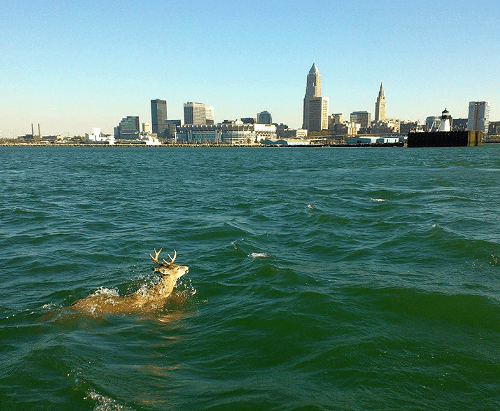
I’m sure there’s a metaphor here somewhere, but my first thought is: whoa! A deer in Lake Erie? What the hell? Image (and explanation) from Cleveland Scene

A quick rundown of some top water stories, which remind us that while we can impact nature, we’re really not in charge. 

I realize that there is a weird-seeming contradiction in saying that we can bring great change to nature, but that we’re still at its mercy. But when we say “great change”, we don’t mean permanent. The earth will eventually repair itself, and time will smooth over our cataclysms. We just won’t be here. But you want the real image? Imagine a 7-yr-old jamming a hatpin into his mother’s ankle. He can do that, and cause great damage, but really, the storm will redound upon him.

So let’s start this week’s “hey, who cares about clean water?” news with Wisconsin.

Continue reading