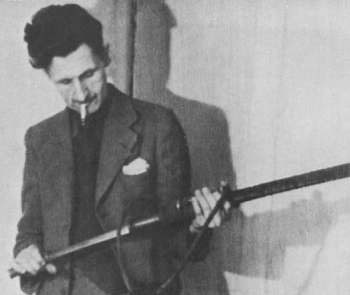
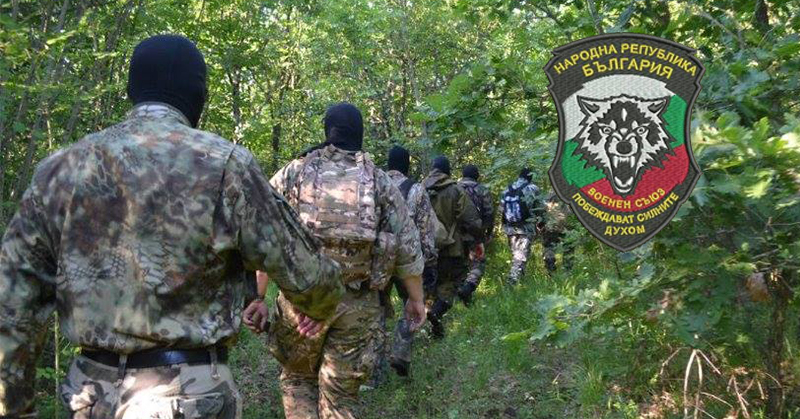
Trees are the only thing that differentiate Bulgarian border militias from American ones.
The historical roots of the refugee crisis in Europe follow the same lines as the immigration debate here, and have had the same atavistic reaction.
Trees are the only thing that differentiate Bulgarian border militias from American ones.
The historical roots of the refugee crisis in Europe follow the same lines as the immigration debate here, and have had the same atavistic reaction.

Amazing image from doomsteaddiner.net
A court ruling over the religious impact of DAPL reveals another look at American history.
This is very not normal, and it shouldn’t be forgotten.
Trumps baseless accusations of unprecedented high crimes, and the way the government was forced to contort themselves to his rage-filled lunacy, is a clear demonstration of being unable to discharge his duties.

When the first “Travel Ban” executive order was announced a week into the Trump administration some 4600 years ago, some of the key pillars of a free society made their impact felt in a way that shocked even the most optimistic observer. The legal system had a two-pronged effort. Organizations like the ACLU protected the victims of the order’s cruelty and brought their cases to an independent judiciary, which treated the order as what it was: a legal measure subject to review; not the blessed fiat of a New Dawn.
The other pillar, of course, was public protest, which stunned anyone who expected obsequiousness after the snowflakes of the women’s march melted. It is doubtful that legislators, and possibly even the courts, would have reacted with the swiftness they did were in not for spontaneous acts of disobedience, compassion, and righteous fury. Protests were shown again to not be movements of self-expression or sideshows to politics; they are a vital part of civil society.
So, the reaction to the travel ban, and its being held up by the courts, led to the rollout of a newly revised order yesterday. This was supposed to be rolled out last week, but it was delayed so that news of it wouldn’t step on the reception to Trump’s Congressional address last week.
Now, it is a good demonstration of how deeply dumb the President and his people are that they genuinely thought the rest of the week–month?–should revolve around him garnering praise for clearing the lowest possible bar. Trump was reportedly livid that the news of Sessions misleading Russian testimony and subsequent recusal took away from what I promise you he believes is regarded as the finest speech in American history. That’s partly what led to this weekend’s insanity.
But more importantly, as everyone pointed out, the delay for some good ol’ self-gratification contradicted the fierce urgency with which the initial rollout happened, and made Trump’s truly dangerous tweets about how judges were making our country less safe even more reckless. But that hypocrisy is just one of the many contradictions that shows how pointlessly self-defeating (not to mention cruel and un-American) these travel bans really are.
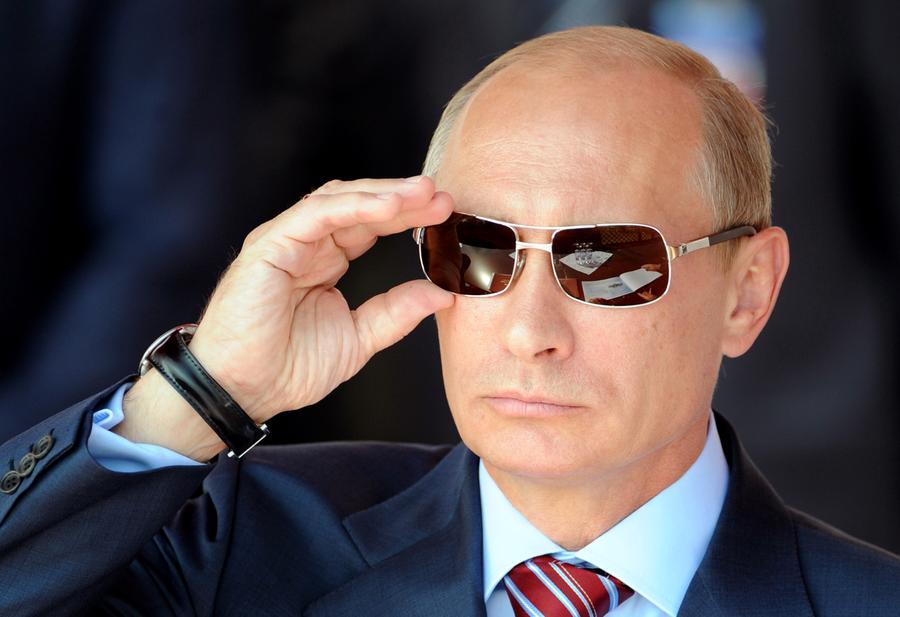
This week’s must-read story is The New Yorker’s exhaustive piece on Russian propaganda machine and how it influences elections around the world. The article, a joint production by Evan Osnos, David Remnick, and Joshua Yaffa, filters the rise of Putinism through the first post-Soviet decade the Putin’s personal need to avenge slights against Russia. They demonstrate how Russia has been trying to reshape the world, in an asymmetric way, for most of last decade, culminating in working to elect Donald Trump (something they didn’t think would actually work).
It’s a great read on its own, but one thing that is highlights is what the Obama Administration knew, and why they didn’t act on it.
Remarkably, the Obama Administration learned of the hacking operation only in early summer—nine months after the F.B.I. first contacted the D.N.C. about the intrusion—and then was reluctant to act too strongly, for fear of being seen as partisan. Leaders of the Pentagon, the State Department, and the intelligence agencies met during the summer, but their focus was on how to safeguard state election commissions and electoral systems against a hack on Election Day.
That caution has embittered Clinton’s inner circle. “We understand the bind they were in,” one of Clinton’s senior advisers said. “But what if Barack Obama had gone to the Oval Office, or the East Room of the White House, and said, ‘I’m speaking to you tonight to inform you that the United States is under attack. The Russian government at the highest levels is trying to influence our most precious asset, our democracy, and I’m not going to let it happen.’ A large majority of Americans would have sat up and taken notice. My attitude is that we don’t have the right to lay blame for the results of this election at anybody’s feet, but, to me, it is bewildering—it is baffling—it is hard to make sense of why this was not a five-alarm fire in the White House.”
The Obama circle, which criticizes Clinton’s team for failing to lock down seemingly solid states like Wisconsin, Michigan, and Pennsylvania, insists that the White House acted appropriately. “What could we have done?” Benjamin Rhodes said. “We said they were doing it, so everybody had the basis to know that all the WikiLeaks material and the fake news were tied to Russia. There was no action we could have taken to stop the e-mails or the fake news from being propagated. . . . All we could do was expose it.”
Remember this when right-wing friends talk about how Obama “illegally wiretapped Trump!” When presented with unassailable (and not even covered up!) Russian interference in the election, they played it as close to the vest as possible. You have to believe that they would do this, in order not to be seen as partisan, but at the same time personally engineer a massive criminal scheme, and at the same time not do anything afterwards. It’s insane.
(It’s also a reminder that Putin hated Obama because he thought Obama interfered too much in Russian greatness, which might be accurate. And if anything, he hated Hillary more. Remember that when people say Obama and Hillary were weak on Russia.)

What happens when we have a vain lunatic in charge?
There is limitless insanity in the President of the United States accusing his predecessor of illegal wiretaps. Former FBI man and counterterrorism expert Clint Watts (who seems to be having himself a well-deserved moment) broke some of them down over the weekend. These include:
But, to me, what this shows as much as anything is how Trump serves as a force amplifier for the democracy-eroding paranoia of the far-right/alt-right (which differ only in messaging), the movement that has now entirely consumed the Republican Party.
Their hatred of Barack Obama was bottomless, an endlessly replenished well of racism and always-waxing lunacy. And the way it would operate is that a story, equal parts reprehensible and laughable, would be invented in someone’s twitter feed or gibbered on Alex Jones or published in Breitbart or even a personal blog. It would then filter its way up to Beck or Rush.
This would start to get amplified in the echo chamber, building up steam, until a producer for Fox or a blogger at NRO or one of the most “respectable” voices of the right-wing media started bringing up this thing that “people are talking about.” That, of course, legitimized the whole affair, and at this point, liberal blogs and liberal twitter would start to refute and make fun of it, and, if all went well, it got picked up by the real news, who had to “report the controversy.” This made whatever the story was unquestioned in the minds of those predisposed to believe it. More importantly, it was a virus for borderline voters, low-information types, who heard something about the President being a Muslim, so it might be true.
Don’t get me wrong. These kinds of things getting mainstreamed was a low-percentage affair. But that was ok. As long as you had a constant stream of vitriol for the initiates, and the occasional breakthrough, it was worth it. The strategy is a constant stream of hatred to keep the faithful worked up, and an attempt to sew confusion for everyone else.
But the far-right has received the greatest gift anyone could ever give them, in Donald Trump. As the Times deconstructed, the illegal wiretapping accusations went from 1) talk radio to 2) Breitbart to 3) the leader of the free world, who promptly said them out loud.
The impact of this was clear. Once the President said it, it was all anyone could talk about. And because he said it, the machinery of government has to throw itself behind him, with mouthpieces like Sean Spicer and Sarah Huckabee Sanders and Hope Hicks promising investigations, and Republicans being unable to completely refute it.
This is perfect, if you’re a Steve Bannon, who seems to believe very strongly in the “firehose of falsehood” Russian propaganda model. You put distractions in your friendly media, and almost immediately, they will be known everywhere, because the President has an endless persecution complex, an unquenchable desire for vindication, limitless credulity when it comes to hearing things that make him feel better about himself, and no impulse control.
I don’t think that Trump did this as a distraction, at least not deliberately. As everyone has pointed out, this isn’t a dodge from the Russian stuff; this is the Russian stuff. If it turns out that there was sufficient reason for a federal judge to approve a wiretap, that’s damning.
But they might not have found anything, which would be a “victory” for Trump. It wouldn’t explain all the other Russian connections, but it could be used to tarnish everything else as fake news. And more importantly, by Thursday 35-40% of the country is going to believe that Barack Obama personally installed a bug in Trump Towers. That will be part of the story. There will continue to be conflicting realities, and an inability to agree on even basic facts.
A democracy can’t work that way. That’s long been the goal of rightist propagandists, to erode the foundations of self-government. That they have a family-based authoritarian, and one who will immediately mainstream their wildest falsehoods, is a possible death-knell for our democracy.

I sort of feel like this dude. “Welp, this gonna suck.”
As I mentioned yesterday, one of this blog’s main ways of analyzing policy under Trump is to understand the ways the man’s own pathologies and self-image feed perfectly into the goals of those around him, who have actual goals and long-held beliefs. Steve Bannon wants to “deconstruct the administrative state” (i.e. stop having a functioning government)? Who better to do that through than a man who think that he, his kids, and that guy who married his daughter are the only ones with brains?
(By the way, “deconstructing the administrative state” has gotten a lot of press, but it’s just a scary-sounding Bannonism for what Republicans have been trying to do for decades, ever since they merged with the far right. It means destroying the idea of a self-governing nation. It’s an old game tricked out by his cheapjack revolutionary shtick. This isn’t new; it’s just now very powerful.)
This plays out in foreign policy in an interesting way as well. As we know, in terms of policy, Trump has very few beliefs. The only ones that are consistent are that “we’re getting screwed” in our deals, both economic and security, and that everyone is taking advantage of us. Part of that belief lies in some of his other unshakeable ideas: that he’s the world’s greatest deal-maker, and that the US was stupid not to have him negotiate everything. His sense of self and his limitless sense of victimization and injury have led him to believe that every deal is bad because the idiots in Washington didn’t let him do it.
And, happily, the far-right and the “alt-right” (which really aren’t different, and are essentially mainstream Republicanism), also hate all those “deals”. They hate multilateralism, as we talked about yesterday. It isn’t because of Agenda 21 or anything, though that’s good to frighten the rubes (and a frightening amount of those scared-rabbit rubes are in Congress).
It’s mostly because multi-lateral institutions were founded after WWII as a way to constrain the power of any individual nation, especially Germany. And while it is easy to say that this didn’t really work, since the US and the USSR forced every nation in the world to pick a side, they were still constrained.
Look at the terrible actions done by both sides. Chile, Iran, Guatemala, Vietnam on the US side. Hungary, Czechoslovakia, Afghanistan, Poland on the USSR. This just scratches the surface of foreign interventions, but even in those, there is a pattern. Only in Vietnam and Afghanistan (and Korea, but that was also part of WWII) was there active warfare, and even then both nations were “invited in” by governments to help fight/save Communism. The quotation marks in the last sentence obviously imply arm-twisting, but still: there was at least a hypocritical tribute to the idea of national sovereignty.
None of this was good, per se, but it observed the idea that you couldn’t just go in and plant your flag into someone else’s dirt through the skulls of the natives. I mean, the US and USSR did so, but pretended they weren’t, and weirdly, that pretending means something. It slowly shifted ideas. It isn’t absurd to think that, I don’t know, Botswana should have a say in international politics and the fate of their nation. It helped create the still-foaling idea that the “Global south” isn’t just the playground of empires, but people who have a say.
Needless to say, the right-wing hates that. One of the reason the Iraq War was supported so much on the right wasn’t any particular issue, but the idea that the US was going to do something, by god, without the UN or NATO or anyone who didn’t fall in goddamn line. That we acted without these multilaterals was not just a feature, for many, it was the whole point.
Multilateral obligations mean that you can’t just do whatever you want. Even George W. Bush recognized that the US had some obligations. But not Trump.
Remember, Trump’s entire sense of worth is wrapped up in the idea that he has the right to do whatever he wants. Businesses going bad? Declare bankruptcy and screw over his creditors. Don’t feel like paying contractors? Force them to accept pennies on the dollar or else be tied up in court for years. Woman not putting out? Move on her like a bitch. (Remember: that’s an actual quote from our President.)
This is perfect for the far right. Trump believes we’re getting screwed by these “deals” (he considers joining a global multilateral institution a “deal”, remember) and that he can get us much better ones, working country by country. And the heart of this is that, like contractors and creditors, he’s perfectly willing to screw over any country, to go back on deals, and to do whatever he needs to “win”.
And that’s perfect. That’s the US unconstrained. In theory, making numerous bilateral deals is really difficult, since you have to take into account shifting alliances, sides playing against each other, local concerns, and more. Look at how complicated Azerbijan is, and how important it is to Russia, Iran, and Turkey, and how complex their relationship is.
So, to play this right would take great diplomatic skill, or the belief that you don’t need diplomacy at all. Or, in a way, both. It takes some knowledge to negotiate, but it also takes the belief that if you don’t like what’s happening, or you have a better chance at succeeding by breaking a deal, you break the deal. You screw them over. And the willingness to do so, to break any rule for personal gain, has been the one consistent part of Donald Trump’s life.
This will make the world a far more dangerous place. As much as his ties with Russia and white supremacy, the abdication of the United States from multilateralism is how the liberal world order can collapse. Trump wants that to happen so that he can negotiate with important people who have to kiss his ass. The right wants that to happen so that the US can act unconstrained. They have found their vessel in a truly empty man, who has nothing but a skin of vanity.
It’s a perfect mix. And over the next couple of weeks, we’ll look at how this plays out in the world, starting with (of course) Yemen.
The plus side is maybe we’ll get more cartoons like this
Trying to figure out Trumpism, as it relates to foreign policy, is in many ways a mug’s game. After all, it seems, he doesn’t really think deeply about the world, or even much at all. Just as a place to screw people over or where America gets screwed. To imagine Trump with a unified theory is to imagine him really considering an issue, and that’s laughable.
But that doesn’t mean he doesn’t have opinions, and half-baked self-centered beliefs. And one of this blog’s long-standing principles is that Trump’s personal pathologies perfectly fit the goals of the far and alt-right, which makes him the perfect vehicle. His empty faith that he is the world’s best negotiator allow for the breaking up of the multilateral order, and his own roiling racism dovetails perfectly for their anti-Muslim and white supranationalism fervor.
And, through that, we’re beginning to get an idea of what the foreign policy will look like. The Soufan Group watched his Fate of the Nation speech, and weren’t thrilled with what they saw.
In theory, there might be something refreshing about a US President who doesn’t give grandiloquent speeches about how we’re a shiny beacon on the hill and how our endless struggle and god-given mission is to let freedom bloom around the globe. After all, in doing so, the United States have fomented or had its hands in a dozen bloody and grubby coups, started of perpetuated civilian-slaughtering wars in places as distant as Vietnam and Guatemala, and has generally run unchecked while acting like self-righteous.
But that’s not what Trump is doing. He isn’t wrestling with a tortured history in an attempt to be more decent. He’s saying that America’s problem was that it viewed itself as the guarantor of the international order, and that it hasn’t been aggressive enough.
The essential policy is that we deal from strength, running over those who are weaker, and forming alliances with those that are strong. There will be ideological alliances, of course, but only if they are suitable. If Le Pen wins, then France is a friend; if not: Paris isn’t Paris. To say that this is distasteful, and the opposite of what the post-war world has been like is to say that water is wet.
One doesn’t even have to bring in the Russian angle on this, though Putin’s Russia is the model, the inspiration, and maybe the daddy of it all. This has been the project of the right for a long time. The distaste in multilateral institutions isn’t that they take away American freedom–they really, really don’t–but that they constrain America from acting like a classic imperial power. From “cutting deals” to exploit weaker countries, from forcing our economic interests at the barrel of a gun (well, not really, but in theory), and from carving up the world in a great game.
Where do Mattis and McMasters fit in? Who knows? They probably see it as their duty to check this. The question is if they’ll be able.
As they say, hypocrisy is the tribute that vice plays to virtue. It’s fair to say that has been the essence of US foreign policy while upholding the world order that has gone a long way toward preventing catastrophic war after the fires of last century. Trump, though, isn’t even decent enough to be a hypocrite. For him, and for the team that channels his sicknesses toward their own ends, vice is the virtue unto itself.

Would you know this is Baku? I totally wouldn’t have. But Iran does.
This post is about Azerbaijan, but also Russia and Iran and Turkey, as well as a Sunni/Shi’a split. No clever intro; just want you to know what you’re getting into.
Continue reading
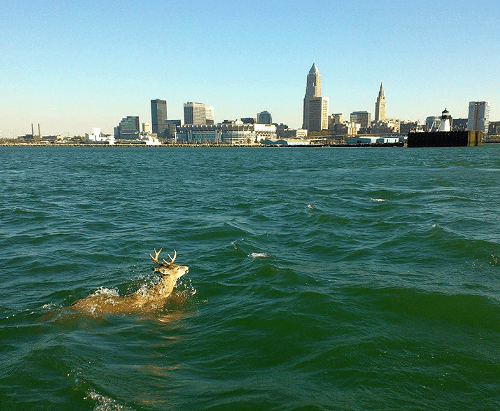
I’m sure there’s a metaphor here somewhere, but my first thought is: whoa! A deer in Lake Erie? What the hell? Image (and explanation) from Cleveland Scene
A quick rundown of some top water stories, which remind us that while we can impact nature, we’re really not in charge.
I realize that there is a weird-seeming contradiction in saying that we can bring great change to nature, but that we’re still at its mercy. But when we say “great change”, we don’t mean permanent. The earth will eventually repair itself, and time will smooth over our cataclysms. We just won’t be here. But you want the real image? Imagine a 7-yr-old jamming a hatpin into his mother’s ankle. He can do that, and cause great damage, but really, the storm will redound upon him.
So let’s start this week’s “hey, who cares about clean water?” news with Wisconsin.
 Shooting Irrelevance