AQAP vs. ISIS in Yemen: The Battle For the Soul of Jihad

Note: I’ll be out of town between the 4th and the 15th, in a wilderness repast, with little to absolutely zero connection to the internet or my phone. Posts during this time, written in advance, will be bigger-picture, or more idiosyncratic, rather than directly pegged to the news. If events happen that supersede or negate anything I say, think of these as a more innocent time capsule. Try not to let the country burn down while I’m gone, ok? 

8500c362-15a9-4e0b-929f-35a72c4dfd41_16x9_788x442

ISIS appears in Yemen in 2015. Image from al-Arabiya English.

A little more than 10 years ago, in early February of 2006, there was a massive jailbreak in from a Yemeni prison, in which 23 Islamic militant tunneled out of their cells and into the women’s bathroom of a nearby mosque, from which they disappeared into the San’a morning (for a detailed look at this, buy Greg Johnsen’s The Last Refuge).  Among the 23 were old militants, like Jamal al-Badawi, one of the masterminds of the USS Cole bombing. He was the big name. Others, like the al-Raymi brothers, weren’t as known.

That was soon to change. What we didn’t realize immediately was that the jailbreak wouldn’t be seen as part of the old battle against al-Qaeda in Yemen, but a new phase with a new group. Over the next few years, and through various names, the younger generation of jihadists took over the organization, before unveiling, the day of the Obama inauguration in 2009, al-Qaeda in the Arabian Peninsula. They had shown themselves to be a patient, smart, and to-the-vest group, and that paid off by becoming the dominant al-Qaeda branch in the heartland of Islam.

For years, people in the know were warning about how dangerous they were, because they were patient and smart, because they kept it close to the vest. They saw the carnage of al-Zarqawi in Iraq and realized you couldn’t build a coalition like that. Their whole goal was to build coalitions, attract foreign fighters through audacious but targeted strikes agaisnt the far enemy, defeat the near enemy (Salih, secular southerners), and eventually have enough land where they could expand unmolested.

That was then. Now they are the old guard, fighting off the ravening, cannibalistic tide of ISIS, which has brought their particular brand of violence to a land destroyed by war, ravaged by poverty, and stalked by hunger. What is happening between the groups is a battle for the very idea of the future of Islamic militancy. It is the horrible past versus the unimaginable future.

Continue reading

Friday Jihad Reading

665003303001_5057982825001_5057959426001-vs

A rebranding and personnel announcement by the CEO of a newly independent franchise. Image from al-Jazeera

1). Jabhat al-Nusra made an important move yesterday when they officially decoupled themselves from al-Qaeda, establishing an independent group. Charles Lister of Foreign Policy says that this shouldn’t make anyone think they are somehow more moderate or less dangerous.

Nobody should be confused by this maneuver: Jabhat al-Nusra, which is also known as the Nusra Front, remains as potentially dangerous, and as radical, as ever. In severing its ties to al Qaeda, the organization is more clearly than ever demonstrating its long-game approach to Syria, in which it seeks to embed within revolutionary dynamics and encourage Islamist unity to outsmart its enemies, both near and far. In this sense, the Nusra Front (and now Jabhat Fateh al-Sham) differ markedly from the Islamic State, which has consistently acted alone and in outright competition with other Islamist armed factions. Instead of unity, the Islamic State explicitly seeks division.

Ultimately, while this may be a change in name and formal affiliation, Jolani’s group will remain largely the same. Therefore, this is by no means a loss to al Qaeda. In fact, it is merely the latest reflection of a new and far more potentially effective method of jihad focused on collective, gradualist, and flexible action. Its goal is to achieve recurring tactical gains that one day will amount to a substantial strategic victory: the establishment of an Islamic emirate with sufficient popular acceptance or support.

This is what we talked about when discussing them last week: that they are smart enough to work in small local gains as a way to expand. It’s why they can outlast ISIS (which isn’t going away anytime soon). It’s also a really good sign of what is happening: we’re not at the beginning of the end, or the midpoint, of the Islamic extremist phenomenon. It’s probably much closer to the beginning. It is shaking itself out, and adjusting to new political realities (many of which are themselves an adjustment to the phenomenon). It will continue to mutate and evolve and operate in a variety of competing and complementary ways for decades.

2). This is a long, detailed, and amazing demographic report about what we know on ISIS foreign fighters, by Nate Rosenblatt at the International Security project of New America. Called All Jihad Is Local, it goes into what makes someone leave to fight for a group like ISIS. It’s a combination of their message and, of course, of local conditions that drive the fighter to leave. There is a lot to absorb in this report, which came out last week, and I’ll be doing a deeper dive into it next week, with its lessons and what it means for the next wave. In the meantime, Bethan Mckernan at The Independent pulled out some charts and info from it to look at.

All in all, what we’re seeing is a time of transition and regrouping. And, blogtimes aside, it is a long process without a clear path. An unexpected military setback by Asad could butterfly-wing the dynamic of jihad in 10 countries. But I think we’re really seeing the clear delineation between two different models: current-period Qaeda and ISIS. There are a lot of in-group differences of course, and there is also a lot of crossover, but for now, that seems to be the helpful model, and something we’ll come back to here. The way these models compete (because it would be reductive to say the “groups” are competing, because both models have incredible amounts of locally-driven varietals), and the way they influence each other, will shape our world for a long time to come.

Anyway, happy Friday.


Tomorrow’s Jihad: How Foreign Fighters Can Reshape The World


Where you going next?


In the late 50s and early 60s, there was a TV show called Have Gun, Will Travel. I’ll be honest: I don’t know if I ever have seen a single episode. Maybe on Channel 50 when I was a kid, on a TV that still had a dial, but there are no clear memories. Still, the name always stuck out. In my imagination, it captured a desolate and sad American west, where if you were a violent man, or at least someone willing to do violence, you could travel the vast landscape and keep order. Or at least someone’s version of order. Whether lawman or outlaw, and the two sides could shift back and forth, if you had a gun, you were always needed somewhere.

That might seem a flippant way to talk about the next stage of jihadism, but that is the spirit. Because the next stage is going to be the vast spread of foreign fighters, stateless men who have been trained in war, that will come when ISIS crumbles or partially crumbles in Iraq and Syria. Yesterday, in a speech overshadowed by Trump and the convention, FBI director James Comey laid it out: we’re going to see “a terrorist diaspora out of Syria like we’ve never seen before.” But what does that mean? Who are they?

While for years, the massive impact of suicide attacks, whether in Beirut or Tel Aviv or New York, dominated the news. That was our idea of jihad. And to be sure, it was terrifying, terrorism in the true sense. But with some exceptions, it was also always the short game. Suicide bombers were, by definition, expendable, regardless of their courage or conviction. The real force of jihad was the battle-tested soldiers who might not have been afraid to die, but who were more useful alive. These were men who were comfortable with violence, and with gun, traveled.

Continue reading

The Hazara Suicide Bombing And The Hint of Normal Life

97a525d7c0df45eea3f59d7a281daa7b_18

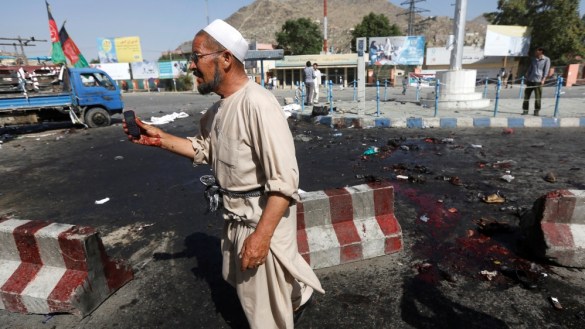
Image from al-Jazeera

The week after the horrors in Nice was another brutal one, a visceral slog through the depths of today’s insanity, focused mainly on Germany.  An axe attack in Germany. A suicide bombing by a Syrian refugee in Germany. Another German tragedy, an American-style mass shooting, was (seemingly) not directed or inspired by ISIS or al-Qaeda, or any militancy at all, save for the militancy of a disturbed criminal mind (which: same with Nice, and Munich, and Orlando. Same mindset; barely-different justifications).

There was also a massive suicide bombing in Afghanistan, in which 80 people were killed and another 230 were wounded. It’s a strange number, 80. On the day of the Nice attack, as the number kept spiraling upward, 80 seemed unimaginable. It feels different in Afghanistan, though. It feels almost normal. We’re inured to violence there, in a way that dehumanizes the victims of ISIS. Even when lip-service is paid, even (especially) when politicians say that “ISIS kills more Muslims than anyone else”, there’s a feeling that those lives don’t matter. They certainly don’t grab the headlines.

That’s partly a man-bites-dog thing, of course: Afghanistan has been in a state of near-constant war for nearly 40 years, and we’re fatigued. Same with Iraq and Syria and Lebanon and Yemen and anywhere else where people are seemingly constantly being killed. It seems like part of normal life, just the regular course of things. We have trouble extending empathy to imagine them feeling the same kind of pain we can envision in France or Germany.

The thing is though, one of the grossest tragedies of the Afghanistan suicide bombing is who the targets were, and why they were there. The targets were the Hazara, Persian-speaking Shi’ites, a minority based mainly in Afghanistan who are the frequent target of the Taliban, of ISIS, of al-Qaeda, of the Pashtun, and others. They are frequently kicked around, and struggle for protection. Iran is the one constant friend.

So, then, why were they all in a group, able to be targeted?

Guardian

The protesters were marching against government plans for a major power project to bypass Bamiyan, a predominantly Hazara province in the central highlands. Following similar protests in May, Afghanistan’s president, Ashraf Ghani, established a commission to look into the issue but government attempts to find a compromise failed. On 19 June, a contract was signed to build a smaller electricity line through Bamiyan, which did not placate Hazara activists.

Al-Jazeera

The 500-kilovolt TUTAP power line, which would connect the Central Asian nations of Turkmenistan, Uzbekistan and Tajikistan with electricity-hungry Afghanistan and Pakistan, was originally set to pass through the central province.

But the government re-routed it through the mountainous Salang pass north of Kabul, saying the shorter route would speed up the project and save millions of dollars.

Electricity. Power. Zoning. The desire to be economically and literally connected. The decision to bypass them might have been to save money, or it might have been to further put the screws on the Hazara, or it may have been both. The former might have been an excuse for the latter, or maybe just a coverup for it. The reasons are part of Afghan history and politics, and I don’t feel comfortable speaking to them.

But the protest? That’s normal life. That’s a group of people who are tired of their situation, who feel oppressed, and who want something that is normal. Take away the historical oppression, and imagine it as anything else: a potentially lucrative and life-bettering development was going to happen (imagine it if you want a railroad or a dam or a base to build the newest military joint-strike hybrid disaster) and then it was taken way. The hydroelectric plant was supposed to go near this town but the TVA shifted it away. There are a million parallels around the world. Anyone would be mad, and anyone would protest.

That’s exactly the point: this is normal life, or at the very least, the desire for it, taken away in a energy-filled pulse, that pulverizes organs and rends limbs and makes the face of life unrecognizable. These are (and were) human beings, who despite living in a land of war, many of whom have known war and terror their whole lives, who are willing to stand outside and protest electrical lines. They petition for surveyors and government project planners to look over their notes again and maybe try something new. They are standing up in the city council meeting of a mid-sized Illinois town and asking for the baseball diamond on 4th to be maintained.

There’s no simple answer for terrorism, and the extension of empathy (which can’t just be willed, not even for someone who tries) won’t end it. The recognition that Muslim lives are real won’t stop ISIS, especially when they are the ones taking Muslim lives like a joyless Queen of Hearts. But the dehumanization of Muslim lives, whether that is in the headlines or in the speeches of politicians who treat refugees like a murderous and faceless horde, serves the recruitment purposes of our enemies. It can help a non-political, non-active, and not-even-particularly-religious immigrant decide that they are going to move from petty crimes and personal abuse to a mass killing, in the vague name of some group they barely know. It’s a cycle that will take a generation to break out of. But that doesn’t mean we don’t have a duty to start.

Trump Did Not Defend The LGBTQ Community


Not the roots of a new coalition, ok?


In his excellent and lacerating takedown of the inherent un-Americanness of Trump’s acceptance speech, Franklin Foer strikes a strange note.

Aside from his quite striking defense of the LGBTQ community, there was nothing that hinted at expanding freedom to new quarters of the country.

I’ve seen that in a few places, described as “surprising” or “heartwarming” or some other such terms, that seemed to describe his outreach and inclusion to the one community. That was in response to this.

Only weeks ago, in Orlando, Florida, 49 wonderful Americans were savagely murdered by an Islamic terrorist. This time, the terrorist targeted our LGBT community. As your President, I will do everything in my power to protect our LGBT citizens from the violence and oppression of a hateful foreign ideology.

(When delivered, Trump added “Q”)

It got applause, and Trump said how glad he was to hear a room full of Republicans applaud that. But come on. It is entirely about pitting that community against the Muslim hordes. To be sure, Islam, especially Wahabbi-influence, are terrible to the LGBTQ community. Murderously so. But this was not a defense of the LGBTQ community at all.

This wasn’t a pledge to overturn the overtly retrograde and dehumanizing GOP platform. He didn’t promise to work to overcome prejudice, hatred, and the staunch opposition to civil rights inherent in the party he took over. He didn’t say that he would fight to make sure that people in the LGBTQ community could lead lives unencumbered by the hatred they face, by the bullying and tormenting. He didn’t call the suicide rate among transgendered people a national tragedy. Remember, he alone can solve all our problems, but these problems are outside his concern.

The tell is obviously “hateful foreign ideology”. That’s all that matters. The yolwing jackals in Cleveland, with their gay conversion therapy fetishes and their emotional inability to recognize any “non-straight” for of love as real don’t have to adjust at all. It was all about recruiting new people in his war against everyone else.

Omar Mateen’s swirl of confused insanity, which surely had multiple sources, manifested itself in a hurricane of violence against a community. To Trump, that means that LGBTQ Americans only have one enemy. His exploitation of that is one of his most cnical and hateful maneuvers. I don’t think it is going to persuade anyone though. They are smart enough, and know the long history of oppression against them, to know that his phony compassion is insincere. I’m not worried about the media convincing them. But in looking for a reed to try to grasp onto, to find some sliver of sanity and decency in an outwardly apocolpytic speech, they inadvertnetly grabbed the thinnest one of all.


Out of the Maw: Slahi Cleared For Release

America is a carceral state. There’s no disputing the statistics; we house nearly a quarter of the world’s prisoner, have the largest prison population in the world, and the second-highest rate per capita (behind Seychelles, which has a total prison population of 735). It’s one of the hallmarks of American history: we have a fierce desire to lock people up and throw away the key, and it has often been bipartisan, and always steeped heavily in race. Black lives have been fodder for free labor in prisons across the country, and more recently, as a way to pad the profits of private enterprises. It’s how we’ve dealt with the end of slavery and the expansion of civil rights; we’ve undercut those gains through prison.

And that desire for incarceration, that deference toward rough justice, is reflected by the fact that exonerating the wrongfully convicted, through programs like the Medill Justice Project, are seen as squishy and self-interested and grandstanding, instead of the backbone of true justice. We’d rather 50 innocent were convicted than a guilty person going free. It’s part of our national character.

After 9/11, that character became global. Our system of mass imprisonment swallowed the world, reaching into every country for anyone who might have done wrong. The people who were sucked up were tortured in black sites, tortured by their own governments, and tortured by the United States. They disappeared into obscure bases, and were locked up in Guantanamo Bay, cut off from the world.

It was part and parcel of our normal way of handling justice: wrap up anyone who might be guilty, or who might look like they are guilty (often because a disputatious neighbor dropped a dime), and never look back. To be sure, many people who were captured were dangerous terrorists. But not all. And that was the problem. It tooks years for many of them to be released, and after Obama took office, the whole idea of releasing them began to be seen as some sort of liberal weak-on-terror-weak-on-crime synthesis, and the wheels of justice slowed down again. Nativism, and our native tendencies, created an atmosphere where the dominant feeling was “if they aren’t guilty then why are they in jail?”

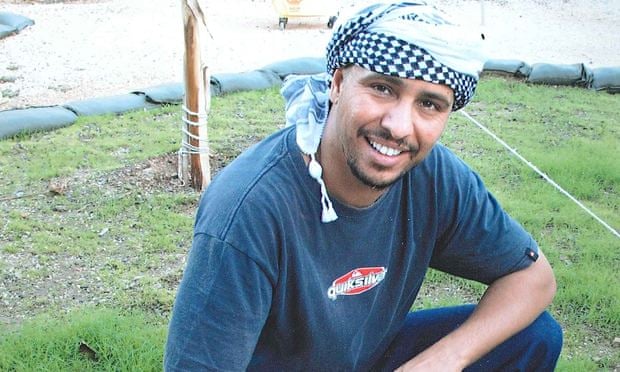
But some good news, finally, if you can describe “end of terrible” as being good. Mohamedou Ould Slahi, whose memoirs described in great detail the suffering and torture he went through, was yesterday cleared for release after a 13-year nightmare. His release has long been a cause celebre, as he was a symbol of everything that went wrong, but it was also a real cause for the dedicated and heroic lawyers of the ACLU.

You should read his book, Guantanamo Diary, (and the legal fight to have it released and see the light of day was equaly heroic), but in brief: he fought for al-Qaeda against the Afghan Communists, which we were cool with, went to Germany where he “crossed paths” with one of the 9/11 planners, and then went home to Mauritania. No evidence he was active, none that he was a plotter. But after 9/11, everyone who might be a baddie, or who was loosely connected to one, was swept up by countries who wanted to be on the good side of the US. Slahi was arrested in 2001, sent to Jordan for torture, and would up in Gitmo after a stop at Bagram, a bloody map of the worst excesses of the “war on terror”. As Hina Shamsi of the ACLU writes, talking about what happened in Guantanamo:

Slahi was one of two so-called “Special Projects” whose brutal treatment then-Secretary of Defense Donald Rumsfeld personally approved. The abuse included beatings, extreme isolation, sleep deprivation, sexual molestation, frigid rooms, shackling in stress positions, and threats against both Slahi and his mother. In Slahi’s habeas challenge, the federal judge determined Slahi’s detention was unlawful and ordered him released in 2010. The U.S. government successfully appealed that decision, and the habeas case is still pending.

He’s no less guilty of anything today than he was 15 years ago. But today he finally gets to see the light of day, or at least the hope for it.

There are still 76 people in Guantanamo, 31 of whom have been cleared pending security conditions in their home countries. This isn’t for their safety; but to guarantee they can be monitored. Think about that: we’re telling these people we have no reason to hold you any longer, but we’re going to until we can be sure that your life is nearly as circumscribed as it is now.

The problem is that they aren’t seen as people. They are by the ones closest to them, even those in charge of the system, who actually have to interact with them. But there is no public pressure; if anything, it is appealing to say “keep em locked up!” That means there is no political will. Not shutting down Guantanamo became a rallying cry of the right as soon as Obama was sworn in, even though many had believed in it before, since it was common sense. But the Obama era mutated that, and now the prisoners are back to who they were: faceless terrorists, guilty by dint of being not-American.

This isn’t surprising. We have no problem locking away innocent Americans, because, they’re probably thugs anyway, right? That’s why this delayed justice for Slahi, who lost so much of his life, is bittersweet. The injustice hasn’t stopped. It’s part of who we are, whether it is in Lousiana or the Cook County Jail or around the world. We lock people up, and then assume the shadows of the bars are a tatoo reading guilty.

Jabhat al-Nusra and Post-ISIS “Syria”


Meet the new boss- not quite the same as the old boss. 


Syria and The Success of Smarter Militants

Interesting WaPo article by David Ignatius about Jabhat al-Nusra, the Qaeda affiliate in Syria. They’ve bascially bided their time during the rise of ISIS, gaining reputations as good fighters and building alliance with relatively more-moderate groups, and they seem poised to emerge successful out of the wreckage when the more apocalyptic jihadist group enters its post-Caliphate stage (which could be loosely described as “A caliphate of the mind”).

Jabhat al-Nusra has played a clever waiting game over the past four years, embedding itself with more moderate opposition factions and championing Sunni resistance to Syrian President Bashar al-Assad. The group has mostly avoided foreign terrorist operations and has largely escaped targeting by U.S. forces. Meanwhile, it has developed close links with rebel organizations such as Ahrar al-Sham that are backed by Turkey, Qatar and Saudi Arabia.

But the global jihadist ambitions of Osama bin Laden remain part of Jabhat al-Nusra’s DNA. U.S. officials report increasing evidence that the group is plotting external operations against Europe and the United States. Its operatives are said to have tried recently to infiltrate Syrian refugee communities in Europe.

A stark warning of the danger ahead comes from the Institute for the Study of War, which closely follows events in Syria. In a forthcoming forecast, the institute argues that by January 2017, “Jabhat al-Nusra will have created an Islamic emirate in northwestern Syria in all but name” and will merge with the supposedly more moderate Ahrar al-Sham.

And that’s the smart way to do it. It’s one of the reasons why AQAP in Yemen has been so successful for so long, even so far resisting an ISIS takeover (more on that coming soon). There are certain organizations which are “lessons learned” oriented, who can take the success and mistakes of the past and integrate them into the local situation from which they are emerging. They don’t try to jam a rigid system into a fluid situation. You can have short-term success doing that, but it is far more difficult to maintain, as ISIS is finding out.

(That said, of course, ISIS isn’t halfway out the door. I am as guilty as this as anyone: because the outline of the end, or at least the end of this phase, can be roughly seen, it shouldn’t be assumed that it will play out the way we imagine, and shouldn’t be so quick to act like we are already in the next phase. Analysts and bloggers are, I think, more guilty of that than actual military people, so I’m not too worried.)

This is part of the mutation of the jihadist threat, and why it needs to be treated as a generational problem, one that requires supple and strategic thinking, on all levels, and not be treated as a eopochal failure when it isn’t met with “unconditional victory” during, say, a Presidential term.

It’s almost inevitable that, if not al-Nusra, another AQ or ISIS-like group emerges in whatever comes out of Syria, whatever post-state shape it is in. That isn’t a clarion call to give up, but more that we have to be realistic about what can be accomplished, and to me, that means not trying to force Syria back together again.

I think the Kerry plan, which Ignatious describes as a “three-cushion shot”, is a good outline. “Kerry’s plan would include joint U.S.-Russian operations against the group, as well as the Islamic State. Kerry also hopes to reduce Assad’s attacks on moderate rebel forces so that they (rather than Jabhat al-Nusra) can gain ground in a post-Islamic State Syria.” That’s probably the best outcome that can be hoped for: increased moderation, though not perfection, in post-Syria areas. The more we try to maintain a 20th-century fiction, the more other fictions, like that of the glorious caliphate or the purity of fanaticism, will tell the story.

What the RNC Gets Wrong About ISIS and al-Qaeda

33968

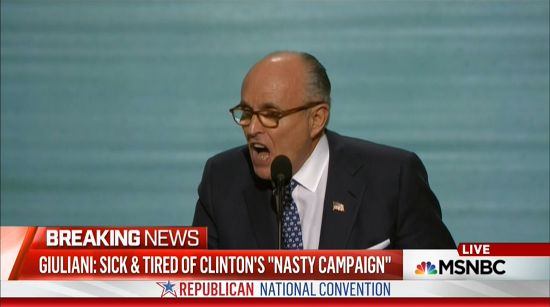
Being tired of the nasty campaign run by “crooked Hillary Clinton who should be in prison” is actually one of the less-misleading things Giuliani said.

So, “Make America Safe Day” is over, and I don’t know about you, but I feel much safer already! I know that all we have to do is elect Trump, and we’ll be fine. Or, as Mike McCaul, the inexplicable Chairman of the House Committee on Homeland Security said, “It’s time to take back our country and make America safe again!”

That’s a good jumping-off point for not just the emotional reaction, of which there was plenty, but the substantive one as well. Because that was sort of the heart of the night: argument through assertion. That’s common in politics, but it was common in a very dangerous way last night, which perfectly encapsulates the right’s unflinching commitment to not understanding the threat of jihad while spittling that they are the only ones who get it.

Because let’s start with the biggest lie of the night, the one that was the driving theme: Hillary Clinton can’t keep as safe (whatever that actually means), and Donald Trump can. That’s pretty normal, and I think you can argue pro or con on the first half of that, as long as you don’t use “Benghazi” as a data point, because come on.

What you can’t really argue, or, more to the point, that no one actually did argue, is that Trump can keep us safe. It was all just assumed that because Trump talks big, and says he’s going to go get them, he will. McCaul even said he’ll make the ground tremble under the terrorists’ feet. It’s actually amazing that all these people who ostensibly care about national security can bring themselves to pretend that Trump has any genius, expertise, competence, o even basic knowledge of these issues.

But that’s really the problem. He doesn’t need to have any knowledge, because their understanding of ISIS is reduced to talking point about “political correctness” and not calling the enemy by it’s name. Rudy Guliani, who gave the most effective speech of the night, was the clearest on this (all Rudy quotes come from What The Folly).

(On The Fort Hood shooting): The only person who couldn’t figure out this was an Islamist terrorist extremist attack was Barack Obama, who called it workplace violence. This is why our enemies see us as weak and vulnerable!

Donald Trump has said the first step in defeating our enemies is to identify them properly and see the connections between them so we can find them and catch them.

To defeat Islamic extremists, we must put them on the defense.

If they are at war against us, as they have declared, we must commit ourselves to unconditional victory against them!

(Wild applause, baying at the moon, a general sense of punchiness)

Rudy used this to segue into the Iran deal, misreading it entirely (as Kaplan points out), and pretending that the money going there is funding ISIS and AQ. Which he didn’t say explicitly, and may or may not believe, but these were his phantom “connections.”

And that’s really the heart of the right’s idea on terrorism: a monolithic enemy that can be defeated merely through the brawny use of strength and the exact right words*. They believe that there is such a thing as “unconditional victory”, which is a strange and grandiose and entirely misleading turn of phrase, since it implies that there is a scenario where conditions would be accepted or not, and that there would even be someone to whom you could deliver the conditions.

The jihadist threat is not one that can be bombed out of existence, nor one that can actually be defeated in a conventional sense. The problem that the right wing has is that they want to fight a war against an enemy that doesn’t exist. They can defeat “ISIS”, in its current incarnation, but have no answer for 1) what comes next in the wreckage of Syria and Iraq, 2) what happens to affiliates around the globe, and 3) what to do with the next mutation. They can’t see this because they are unable to understand that there are root causes of jihadattraction that go beyond good and evil. As Scott Atran said in the NYRB this weekend,

Are we again dangerously underestimating ISIS’s will to fight, and its ability to endure and expand? Although military defeat in Iraq, Syria, and Libya could help make it more difficult for the group to recruit, we will not be able to defeat ISIS itself until we find a way to reconnect the neighborhoods, online communities, and other particularly susceptible social and political settings where attacks like what occurred in Nice continue to find inspiration and support.

“Reconnecting the neighborhoods” isn’t something I heard last night. I don’t think Barack Obama has all the answers, clearly. I don’t think Hillary does, either. But I think they both actually recognize the complex nature of the threat, and are seeing the world as it is. The party of realism is completely unmoored, and want to take our entire national security apparatus along with them.


* Everyone points out their weird and childish fixation with saying “Islamic terrorism”. It’s hard to say if they actually think that will defeat ISIS; it’s entirely possible that anti-PC cognitive dissonance has taken over, and they actually believe it’s a big deal, and that Obama is actively hurting the US by not saying it. What’s weirder is the “define the enemy” thing. It’s very post-modern: you’ll become what words are used to define to. It’s the mutability of the self in the face of the observer. Gombrowicz would totally dig their platform.
Well, Newt, You Gave It Your Best Shot!


Lwox1ixjwzrbhpbbevn5

Pictured: the face of a man who isn’t going to get to be the leader (possibly) of the civilizing forces. (Screengrab from TPM)


This is a man who isn’t getting the VP nod.

“A great deal of the coverage of what I said on Fox last night has been distorted,” Gingrich said. “The news media went into a hysteria overnight trying to over-exaggerate what I was saying. This is not about targeting a religion.”

“This is about looking for certain characteristics that painfully, we have learned time after time, involve killing people,” he elaborated.

But he seemed to take a different tack while discussing how to deal with a pattern of terrorist activity from American citizens, saying that it would be “impossible” to deport them.

“With an American citizen, deportation is impossible,” he said. “It’s not appropriate under the Constitution and there, historically we’ve always said, if you fought against the United States, that the correct answer were basically jail as opposed to deportation. I think we have to talk through what should be the right way of handling people who are here, but are not citizens.

And this was the man who still thought he had a chance.

“Western civilization is in a war. We should frankly test every person here who is of a Muslim background and if they believe in sharia they should be deported,” Gingrich told Fox News’ Sean Hannity.

Or, in the words of Hollywood Mark Perrone, “Once again the liberal media’s unabridged replay of the video of everything I said on a national broadcast just last night is dividing this nation.”

It’s a testament to Newt’s incredible mendacity and absolute lack of principle’s that he’s willing to disagree with his 12-hours-ago-self once he realized that being hatefully anti-American and totally fascistic wasn’t enough to get him a job he wanted. But he sure gave it the ol’ college try, if the college is the University of East Berlin. The man needs a team of Sherpas just to reach the moral basement.

How Not To Keep A Free Society: Newt Gingrich Edition

0eeba-newtgingrichgiantlaugh

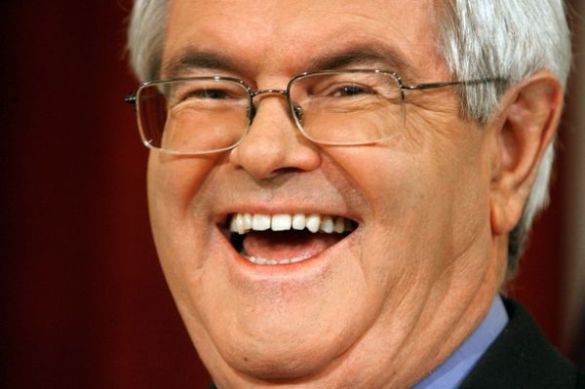
“I’m a really deep thinker, frankly.”

In the last post, we talked about how the kind of mutating terrorist attacks like we saw in Nice will happen in a free society. Newt Gingrich, whose VP dreams have yet to be crushed, eschews all talk of free society.

“Western civilization is in a war. We should frankly test every person here who is of a Muslim background and if they believe in sharia they should be deported,” Gingrich told Fox News’ Sean Hannity.

“Sharia is incompatible with western civilization. Modern Muslims who have given up sharia, glad to have them as citizens. Perfectly happy to have them next door,” he added.

There’s no real need to point out everything that is wrong with this, right? Forget how hideously unconstitutional and un-American it is to have everyone of a single faith line up for loyalty testing. That’s standard Newt: he knows it is what Trump wants to hear, so he’ll say it. (Bonus Newtism: he always says “frankly” when he’s about to say something really dumb, because he feels it gives it intellectual heft. Once you notice that, you’ll see it is always true.)   Let’s also forget for the moment that believing in Sharia is not, in and of itself, against the law. There are a lot of people who don’t believe in the Constit

Let’s also forget for the moment that believing in Sharia is not, in and of itself, against the law. There are a lot of people who don’t believe in the Constitutional order, and as long as they aren’t acting on it, that’s ok. Let’s also ignore the insanity of someone saying that a belief is “incompatible with western civilization” when he’s literally proposing mass expulsion based on a religious-based ideological litmus test, which seems pretty goddam incompatible with Western civilization, to me.

No, what’s really stupid– what makes Newt so world-historic dumb at times — is that he proposes this as the realistic and tough-guy way of dealing with a threat. Tthe attacks at Nice were the “fault of Western elites who lack the guts to do what is right, to do what is necessary,” he told Hannity, and between the two, the perfumed machismo must have been through the roof.  This is, frankly, incredible. How exactly does he imagine this is going to go down? Does he actually think that people dedicated to the destruction of America and the death of all its citizens are also incapable of lying? That after waiting in line for hours, after the Muslim Registration Act, which won’t do much to change their attitude toward the US, they won’t be able to plot a complicated web of deceit, i.e., saying “no” when asked if they are a terrorist?

The most charitable interpretation of this is that Newt actually believes this will work, and that it will allow good Muslims to stay in the US and have everyone be happy. It’s barking madness, of course, and deeply antithetical to the kind of free society that is at the end the final bulwark against radicalism. But if he believed this would work, or was a good idea, at least you could argue from there.

But he probably doesn’t, at least not in any way that doesn’t require the cognitive dissonance that is the heart of the modern right wing. He decided this sounded good, and would appeal to Trump, who appeals to millions and millions of voters. They want the tough guy who will trample our values, because it feels good. In less than a week the GOP is going to nominate someone who brags about his willingness to employ torture. They are appealing because their idea of America is one of soil and blood and steel, and not the actual values that make this country great. They have the same boot-stomping atavistic lure of LePen and Orban and the Brexiters.

ISIS and al-Qaeda want a civilizational clash. They are experts at provoking one. It’s their great good fortune that they have enemies who want to give it to them. What Newt said wasn’t in a vacuum. It’s the direction in which the whole world is lurching.