Just a Normal Day on The Campaign Trail

Donald Trump

Let’s look at what happened in the 24 hours following the Orlando shooting.

  • Donald Trump gave a speech proposing a ban for immigrants from any Muslim country, and any country that has ever committed terrorism against the US and its allies (Ireland?), because, if you follow the logic of it, their children, or their children’s children might do something bad.
  • He suggested, to multiple outlets, that President Obama might in fact be in league with ISIS, or at least sympathetic to it. “He doesn’t get it or he gets it better than anybody understands — it’s one or the other, and either one is unacceptable.” Now, in his lying way, he said that he believes Obama just doesn’t get it, but you know, people might think otherwise, and it’s really unbelievable, and it’s also hard to believe. To recap: a Presidential candidate is repeating, and heightening, the idea that the sitting President is actively helping, or at least hoping for, and ISIS victory.
  • When a major publication called him out on it, he revoked their credentials. Nixon didn’t revoke the credentials of the Post during Watergate. Nixon! And they aren’t the first. “Among the news organizations whose reporters have been blacklisted: Gawker, BuzzFeed, Foreign Policy, Politico, Fusion, Univision, Mother Jones, the New Hampshire Union Leader, the Des Moines Register, the Daily Beast and Huffington Post.” That these bans are haphazardly enforced doesn’t make them any less scary.

To recap: this is not normal. The blood-and-soil race-hatred, the wild paranoia, the fiercely shouted conspiracy theories, the dismissing of noncompliant press. There is no way to normalize this. This is not a campaign strategy. It’s exactly how he’d govern, as the tinpot strongman of our nightmares.

I actually think the Post thing will backfire, as the mainstream media, who have been desperate to  treat this as a normal race, albeit one with an unusual candidate, will finally see it happening to one of their own. It was easy when it was local papers like the Union-Leader or the Register. And what’s this BuzzFed? And didn’t Gawker do the Hogan? Mother Jones? Fuck you.

But it’s different with the Post. As much as it has fallen, it is still the Post, the paper that brought down Nixon. I hope that this is when they realize that telling both sides and covering the debate is enabling an authoritarian the likes of which this country has never seen. I worry, and will worry until proven wrong, that the press will self-censor so they can stay in bed with the campaign. Access! That’s what most tyrants want. Self-censorship out of fear and preservation is so much more effective than having to line people up against the wall. Voices that are compliant in their own silence are usually too ashamed to ever speak up. That’s what Trump wants.

But maybe this will be different. Maybe this is so outrageous that they’ll push back. Maybe they’ll be fully awakened to the danger of this American monster.

A Confused and Angry Man With A Gun: An American Portrait

Orlando Sentinel:

At least four regular customers at the Orlando gay nightclub where a gunman killed 49 people said Monday that they had seen Omar Mateen there before.

“Sometimes he would go over in the corner and sit and drink by himself, and other times he would get so drunk he was loud and belligerent,” Ty Smith said.

Washington Post:

Further confusing matters, Comey also revealed that in “inflammatory and contradictory” comments to co-workers in 2013, Mateen had claimed to be a member of Hezbollah, the Shiite militia based in Lebanon.

 Now, it’s possible, I suppose, that Pulse just had great drink specials, good enough for a man with outward revulsion toward homosexuality to overcome his loathing and get some Bud. It’s also possible, I suppose, that a man whom no one described as particularly concerned with religion had a sophisticated conversion wherein he moved from Shi’ism to Sunnism, perhaps based on some actions taken by Hezbollah of which he disapproved, revoking his membership and transferring to Hezbollah’s rival, ISIS (and doing this, meanwhile, while frequently getting drunk at a gay nightclub).
In the absence of those not too terribly likely scenarios, though, we need to look at this as what it was: a deeply confused, possibly closeted man, twisted by a culture (both much of Islam and many strains of Christian American life) that has a fierce hatred of homosexuality. He’s someone who hated himself, and hated others, especially those who reminded him of what he possibly actually was, even as he was drawn to them.
An angry and boastful man, who wanted people to think he was something that he wasn’t, in many ways. A manly married man, a tough Muslim with a dangerous background.  With just a few puzzle pieces moved around, a few name substitutions, this could be any of our mass shooters (and many of our non-mass-shooters, and some people who somehow don’t shoot anyone at all).
That he pledged to ISIS is no more indicative of their global reach than was the Newtown Massacre. There is little doubt that he was “inspired” by them, but not in the way we commonly understand. They just gave him an outlet for his rage, and a justification for his actions. But he would have found one anyway. It doesn’t seem he was radicalized by ISIS: he was radicalized by his hate, by something in his personality, and possibly something lurking deep within him. He let ISIS be his final reason, but the reasons were always there. ISIS was, at best, the proximate justification.
That’s what we don’t seem to understand, and the cheap and dangerous political demagoguing coming from the Republican candidate is making matters worse. As Masha Gessen said in the NYRB, declaring “war” on people like Mateen only empowers them, empowers ISIS, and gives the next confused and small and angry man a reason to act. It makes them seem like a great and powerful force, exactly the kind of thing that someone like Mateen wants to be a part of. It isn’t Islam, although there is no doubt that Islam played a role. It’s the roaring anger that exists in so many men, a self that is curdled by tradition and loathing. In his case, it was heightened by the rank homophobia that exists in many parts of American culture, including Islam. (As Chotiner pointed out at Slate, in his speech, Trump clearly separated Muslims from Americans, even saying “them” and “us”, even when talking about citizens. This hideous bigotry is exactly what ISIS wants, and it feeds any angry teenager who identifes with Islam).
It’s this yell, this cancerous rage, that is rampant across the country, no matter the pledged allegiance. Mateen was a product of his won twisted pathologies, but they were heightened by the society in which he lived.
And he had easy and unfettered access to combat weaponry.

The Waukesha Diversion: Geology in Human Affairs

Waukesha Diversion Week. Part I: The Great Lakes And the Future Water Wars

glacier

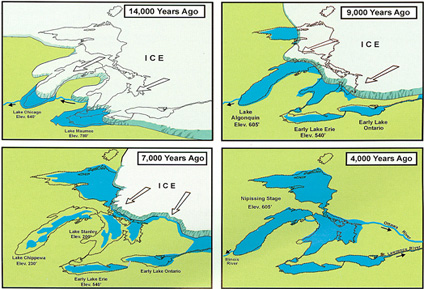
The formation of the lakes. See that 9000 years ago it was draining south. Image from glerl.noaa.gov


I type this late at night, after an evening of losing softball near the shores of Lake Michigan, which has seen us lose more than a little. It’s a warm night, on the stilled brink of a storm, and like many nights, I can hear the clacking rattle of a skateboard. There’s a kid who lives down the street, who nearly every night, walks his skateboard to the hill at the corner, and goes down.  Last year we heard him fall nearly every time, and were impressed by his ability to get back up. A cold-winded winter, in which he practiced most nights, made him better, and after he goes to the top of the hill, he shimmers down with ever more reckless speeds.

I wonder if he knows why, in this flat part of Illinois, in one of the flattest areas in the country, the street has a small hill, no more than 15 feet and low-angled, but for this area, substantial. Why his skateboarding has improved because his parents decided to live on this street, in this town. How the ancient geology of lakes affects his life, and in a real way, the interests that will shape him. If he lived two blocks down skateboarding would have basically been as interesting as cross-country skiing, which is to say: not at all.

But that’s sort of the point of this week’s series on Waukesha: the unseen role of geology, from the crisp edge of a basin to the smallest hill in Illinois. We are beholden to it, and it shapes our politics. It predates us, and it will outlast us, and our little human concerns have to find a way to propitiate geology. Becuase it doesn’t care if we do or not; it’ll keep on shaping out lives, vast and unseen, down to the water we’re allowed to drink.

Continue reading

The Borges Retrospective: “The Secret Miracle”

The Borges Retrospective: Part I: Intro.  (I know I said we’d begin with “The Aleph”, but how stupid a thought is that? We’ll end at the Aleph. We were always going to end at the Aleph.)


The great genuis


Think first of the carpenter who picks up a plank, and lays it perpendicular on another one. With careful skill and a substantial brutality, he hammers a cross, setting in motion thousands of years of ecstasy and pain. He unwittingly, doing a job, lays the groundwork for Pere Brébeuf ‘s agony at the roasting pole, and Kateri Tekawitha’s sublime conversion. He sets into motion dramas in lands which he could never imagine.

Think then of the builder who attaches a wooden mane on a great horse, which bears in its womb countless Greeks with a berserk desire for murder. These are the creators of our great dreams, and our great dramas. They build the stage on which we tell our tales. But in one of the greatest stories Borges ever tells, he steps back, and tells the tale not of our great builders, or our blood-covered warriors, but of a man who fell victim to Hannibal, to the Druidic gods, to the madness of Hitler. In “The Secret Miracle”, he tells the story of creation, the story of telling our stories, and makes it more sad and more heroic than any of the great tales.

Continue reading

Mateen’s Terrorist Ties and the Gun Argument

There’s a good chance that you’ve heard (or made) a comment about how the Orlando shooter, Omar Mateen, had been investigated for ties to terrorism, but was still able to buy a gun. I know I did, when I heard it: a gnashing of teeth at how easy it is to get an semi-automatic rifle, how insane it is that we have decided, as a country, that these kind of killings are the price of freedom, and just something with which we have to deal, and anger at Republicans for talking about being tough on terror but refusing to close the loophole which allows people on terrorism watchlists to buy guns. That he was investigated is true, of course. Here’s from the Times: 

The F.B.I. investigated Mr. Mateen in 2013 when he made comments to co-workers suggesting he had terrorist ties, and again the next year, for possible connections to Moner Mohammad Abusalha, an American who became a suicide bomber in Syria, said Ronald Hopper, an assistant agent in charge of the bureau’s Tampa Division. But each time, the F.B.I. found no solid evidence that Mr. Mateen had any real connection to terrorism or had broken any laws.

But see: these aren’t real ties. A bragging 26-year old, looking to sound tough or maybe even joking, or whatever combination of swagger, anger, and insecurity a 26-yr-old will have (I barely remember). The other is that he might have possibly known someone who joined ISIS.

Even if he did know Abusalha, that isn’t enough to put him on a list. These are the kind of blanket connections that can ruin lives. You’re a Muslim, and you went to school with a Muslim who may be a bad guy, so you’re on the list. We’ll make it harder to fly, harder to rent a house, harder to do most everything. That it isn’t harder to buy guns is inhuman hypocrisy, of course, but that doesn’t mean these terrorism watch lists aren’t over-broad and inherently anti-liberal.

Mateen of course is a monster, a twisted wreck of hate and a poisoned culture- both the culture of ISIS and the rampant homophobia that still exists in the US. That he had the right to buy a gun that can easily kill dozens is a crime. That those rights exist easily for anyone is sickening. But the idea that any rights can be curtailed because of blanket suspicion and the merest whiff of connections is also a crime. Mateen isn’t innocent. But many innocent people are on these lists, and we shouldn’t just complain that they can get guns. We should be outraged by their overbroad existence.

Racism and Obama’s Legacy: African-American Turnout in 2016


Grant Park, 2008


There are few things more annoying than when a white commentator starts to talk about “the black vote”, not in terms of numbers (which can be captured objectively), but in terms of psychology, because it not only assumes a familiarity with every black voter, but assumes that they think en masse. It certainly isn’t intentional racism, but it is a thrown blanket in ways we don’t do with other groups. The “white working class” is probably the broadest market segment for non-minorities, which shows the subtle racial distinction at play. We have “soccer moms” and “NASCAR dad” and so on, and then “the black vote”, and the “Hispanic vote”.  It’s pernicious, and assumes a group mentality in the place of actual examination.

That said, there’s no way Trump is going to get the black vote.

Lauren Fox at Talking Points Memo has an article this morning exploring how analysts don’t really expect a dropoff in the African-American vote, after the highs of Obama. That’s hugely important, because it can negate Trump’s perceived advantage in Ohio, Pennsylvania, and a few other rusty states where he hopes to get high turnout among the (white) economic dispossessed.

There are a couple of reasons for this. TPM talks about how this election is also about Obama’s legacy, which is accurate in a few ways. An election is always partly about the incumbent, whether he is running for another term or finishing up. 2008 was partly a repudiation of Bush; 2000 was about Clinton’s moral failings (the majority of the country still picked Gore, but he lost 5-4), 1988 was about Reagan, etc. In this case, where Republicans have made no bones of their desire to tear down any social progress made by the President, the legacy is even starker. They want to erase everything Obama has done.

It goes slightly deeper than that: they want to erase not just his policies, but his very existence. They want to destroy the thought that there was a successful black President, to make him a footnote. That’s been their driving goal, and there is no one more suited to that than Trump.

You couldn’t have picked a better candidate to remind everyone who cares about racial justice the huge stakes of this election. Trump of course rose to political fame for being the country’s top birther. He has demanded not just to see proof that Obama was born in America, which is flagrantly racist (he’s got dark skin! He’s not one of us!) but also, even more disgustingly, waged a campaign to demand Obama’s college transcripts. In a way, that is far more racist. Obama, of course, isn’t the brilliant and hyper-intelligent person most people see him as, see? He got into college through affirmative action, taking a spot away from “someone” who deserves it. He’s just another dumb…well, you know, right folks?

That’s the kind of campaign that Trump runs, that made him famous. He’s the one who says everything that can be said, everything that people who hate Obama not-so-secretly believe. He’s negating not just Obama’s political accomplishments, but his every achievement. He’s saying, plainly, that Obama doesn’t deserve to be here, that he’s President because of affirmative action, essentially. He runs a campaign of negation, making plain what other Republicans have been trying to do for eight years.

So there is that. But there is also something that Elijah Cummings, who might know more about this than I do, told TPM. “I think Trump helps drive black voter turn out. I really do,” says Rep. Elijah Cummings (D-MD) “He has created more unforced errors than any politician I’ve ever seen…People question his judgement.”

Oh yeah, one thinks. That’s right: the “black vote” isn’t just about black issues, obviously. That’s what we were talking about up above. The “black vote” is made up of millions of humans, many of whom can see that a Trump presidency is terrifying. It isn’t just about Obama’s legacy or any of those issues. It’s about being an engaged voter. Maybe, at the end of the day, Trump’s legacy will be that we recognize that every voting bloc contains multitudes, and they can’t be reduced. That they contain humans. Humans who are horrified that such an unqualified ill-temepered racist chump could be President.

Tigers and Mirrors and Labyrinths: Borges 30 Years After His Death


(oddly fitting accompaniment to post)

30 years ago, on June 14th, 1986, in Geneva, Jorge Luis Borges slipped into one of his own infinite labyrinths, that terrifying maze without a center: death. The Argentine, one of the great writers of the century whose timespan he almost matched, was just shy of his 87th birthday. On his deathbed, one wonders, did he dream of walking on a riverbank, and coming across his younger self, and talking about the great mystery into which he was entering, treating his death as gently banal, and quoting Chesterton or an obscure Arabic medievalist? And did the younger self somehow have the same dream, that same night?

With Borges, such questions make sense. They are a reflection of his fiction, that great body of short stories, fragments of invented books, reviews of imaginary essays, tattered journals from explorers who never existed wandering lands that fall in the gap between myth and reality. They are tales of gauchos on the pampas and knife fights in dingy bars and Homer being found in the city of the immortals. They are about buying the memory of Shakespeare or seeing the tigers that inspired poets.

And they are about time. They deal with the way history repeats itself, with the same stories playing out time and again, in Greek corridors or South American battlefields. As he said, “It also occurred to him that throughout history, humankind has told two stories: the story of a lost ship sailing the Mediterranean seas in quest of a beloved isle, and the story of a god who allows himself to be crucified on Golgotha.”

Continue reading

The Waukesha Diversion: The Great Lakes and the Future Water Wars

lake_michigan_from_big_sable_point_lighthouse

Endless and beautiful Lake Michigan

In 1998, a permit was accepted by the government of the Canadian province of Ontario, following a lightly-remarked-upon 30-day public comment session, to approve a ridiculous and pointless money-making scheme. This approval set in motion a multi-national effort to protect one of the great natural treasures of the world, one that could decide the future of water on an increasingly parched planet, and one that will shape the fate of a harmless Milwaukee suburb, whose destiny lies on its placement just east of the slight bend of a continent, a product of ancient and mute geological forces. It’s a story about our distant past, and one about our every-drawing future.

It was in 1998 that a businessman,  John Febbraro, applied for a permit to have giant tankers scoop up water from the Great Lakes– specifically the giant of the group, the vast and violent Superior– and sail them through Sault St. Marie, down through Windsor, up through Erie and Ontario, into the vast river of the St. Lawrence Seaway, and then to Asia, where a thirsty market would gobble fresh water. (This is detailed excellently in Peter Annin’s Great Lakes Water Wars, a must-read for anyone interested.)

It was an amazing plan, and a ridiculous one, born of a good idea that made absolutely no sense. Febbraro planned to scoop up 427,000 gallons a day, which comes up to around 155,885,000 million gallons a year. That seems like a lot, until, as we see, that comes to about what an average-sized suburb of Milwaukee would need in a 6-month period. That…won’t solve any Asian water problems.

But still, it proved a catalyst. There was a Great Lakes Charter signed in 1985, by the eight US states and two Canadian provinces the have land bordering the states (which yes, includes Indiana). But it turned out that the Charter wasn’t very strong, which is why a plan to take water from the Lakes and ship it around the world could be approved.

The plan provoked outrage, and incredibly enough, action. Pressure- and honestly, the economic infeasibility and ridiculousness of the plan- destroyed Febbraro’s dream. But more than that, it spurred people, Democrats and Republicans, Labor and Conservative, into recognizing that the Great Lakes weren’t permanent, and could be destroyed. Just because the plan to have boats take water to Asia was absurd- and anyone who has watched giant ships sail by, dwarfed by the enormity of this water, could tell you it was absurd- didn’t mean the writing wasn’t on the wall.

After all, if a ship could take water, why couldn’t hundreds? Why couldn’t thousands? Why couldn’t pipelines be built to replenish barren reservoirs in Western deserts? While there was never a plan to make it economically feasible to do so (and many tried, both public and private), it didn’t mean it couldn’t be done. At some point, an economy of scale could take over, and it would make sense to trickle water out of the lakes.

But apres trickle, le deluge? That was, and is, the big fear, which is why in 2008 the Great Lakes Compact was signed. This was a guarantee that no one outside of the Great Lakes Basin could use water without the permission of every state and province in the region. The problem is– one of the problems is– that with the exception of Michigan, none of these states or provinces lie wholly within the Basin. Which means politics takes over.

And that leads us to Waukesha, a city the is a suburb of the Basin-included Milwaukee, but one that is just outside. Waukesha has spent years applying for a diversion, claiming that their source of water, underground wells, is dirty and mostly poisoned, and anyway won’t last them very long, and anyway, besides, they are so close. A swift walk can get you to the Basin; a decent bike ride to Lake Michigan; if you are driving, a day at the lake is like going down the street.

Most of the obstacles to their application have fallen. Last month, the Great Lakes Compact group voted 9-0 (with Minnesota abstaining) to approve the diversion, with serious conditions. Next week in Chicago, the final governor-level meeting will take place, to decide its ultimate fate.

So, this is Great Lakes water week here at Shooting Irrelevance. It’s a story of politics and the environment. It’s a story of the future of water, and how we’ll use it, and most importantly, who owns it. After all, if the Lakes are a public good, why should greedy Chicago (who has the mother of all diversions) luxuriate while citizens in Nevada parch? It’s a story about political geology, and how these ancient forces shape our present. It’s a story of competing activism, in which every side has moral ground. Mostly though, and fully, it’s a story of the Great Lakes, this gorgeous and perfect and tempestuous system. It’s a story about their strength, and their fragility.

When you stand on the southernmost edge of the system, as I often do, at that sweeping curve that defines Chicago, they seem infinite, overwhelming, almost impossible in their magnificence. You can drive for hours and hours, up the coast of Wisconsin, and around the UP, and still have barely covered half the shoreline. They are amazing, and they are not like the ocean, which are essentially inhuman in size. The Lakes, though enormous, are human. We’ve paddled across them for millennia, traded across them, sent great ships to ply them, but also to sink. To sink in their temper, in their violence, in their sudden reminder that they are not ours to do with what we like. It’s a warning, a reminder that there are enormous ships on the bottom of these lakes, the Edmund Fitzgerald and the Carl Bradley, that were swallowed whole. But it is also a fearful warning. There is no consciousness in lakes, but if there were, they would look at the tragedy of the Aral, and ask us to stop and think. They’d remind us that, in our tempers and ill-humors, in our short-sightedness, we can ruin a great gift.

That’s what we’ll be talking about this week; ultimately, the tragedy of competing and rational human interests in the face of unconcerned nature. Hope you’ll enjoy. Here’s a rough schedule.

  • Tuesday: the political geology and geography of Waukesha and the Lakes
  • Wednesday: an analysis of the Waukesha proposal and its opposition
  • Thursday: Activism and the Great Lakes: A Model for Environmental Impact
  • Friday: What it all means; or, the future of water.
A brief note on “politicizing tragedy”

A lesson we’re all going to learn again in the next few days is that a tragedy can’t be “politicized”, or at least that it is ok to do so, if the shooter involved is Muslim and says “ISIS” before killing people, even if he has nothing to do with actual terrorism, even if that is just the thin reed to which he clings in the tidal wave of his own hatred and madness.  Then it is ok to call out political opponents for being weak on terror, and not being manly enough. Then it is ok to score points. Not when a mentally unstable kid shoots up a schoolhouse, killing 20 kids, or a theater or a black church. Then we are politicizing tragedy.

It’s always correct to bring politics into tragedy. Politics, in a society like ours, is the result of our collective action and will. It’s the outcome of our ideas and beliefs. It is messy and angry and at times like these stained with bitter tears. But to not be political, to not try to find reason in the face of horror, is to give up, to abdicate our duties as citizens. There should be, and will be, fights about this. And that is good and healthy. We just need to make sure that we always have these fights, because that is the only way things will get changed. “Politicizing” the shooting at Emmanuel African helped bring down a flag of treason and slavery. It does make a difference.

As we said in regards to FlintBut any human-caused tragedy is inherently political, and response to it needs to be. Accusations of politicizing events are a dodge, an intellectual grift, designed to keep whatever policies caused the tragedy in place. It’s better to just say “it’s a terrible thing”, as if there was some kind of free-floating miasmatic tragedy fog that just happened to land on a place. 

As citizens of a democracy, it is our duty to create a political response to the actions of human, especially when those actions target a group vilified by so many. That’s not to take advantage of the dead, or turn them into unwitting martyrs. We don’t- I certainly don’t- speak in anyone’s name. We just need to be able to try to turn an unimaginable massacre into a better place, where it is harder and harder to kill so many people, to destroy so many lives, simply because you want to.


A Wild Howling Madness: It Does, and Doesn’t, Matter That Orlando Gunman Pledged to ISIS

croporlandoallegedgunman2a1465750030

Omar Mateen, the alleged Orlando shooter. Image from The Washington Post

At least 50 dead. At least 50 more wounded. As the staggering numbers gutpunched their way in this morning, and America woke to the reality that in a violent nation, we reached another grim milestone, people struggled not just with the enormity of pain and sorrow, but with what to call this. Was it a hate crime, targeted as it was at an LGBT club? Was it an act of terrorism, as we learned that the shooter had a Muslim-sounding name? Was it a mass shooting?

The last two seemed like they could be in opposition, while a hate crime can apply to both. The problem is that it is (most likely) all three. While this is (as of the writing) unconfirmed, it seems that Omar Mateen called 911 to pledge allegiance to ISIS shortly before the shooting started.

A few things about this make it less an act of international terrorism, and more the actions of a sick and depraved man influenced by many factors, including the religious nihilism of ISIS. But there doesn’t seem to be any training, and certainly not any real membership in ISIS. Not to be glib, but one doesn’t join ISIS by calling 911. They generally don’t relay the message. You have to actually join.

(Obviously, there is a real danger of people actually joining ISIS and receiving training, and possibly using it in the homeland. Foreign fighters are a key part if ISIS strategy. This isn’t that. It’s a different danger.)

This idea is furthered by Mateen’s father, who said that the crime was more motivated by a hatred of homosexuals.

“We were in Downtown Miami, Bayside, people were playing music. And he saw two men kissing each other in front of his wife and kid and he got very angry,” Mir Seddique, told NBC News on Sunday. “They were kissing each other and touching each other and he said, ‘Look at that. In front of my son they are doing that.’ And then we were in the men’s bathroom and men were kissing each other.”

Seddique added, “This had nothing to do with religion.”

But…of course, it does. ISIS is explicitly opposed to homosexuality, and punishes it by death, as does al-Qaeda, the Taliban, and even “friendly” regimes in many Islamic countries.  Christian ones, too, if you look at Uganda. And you barely have to twist the radio dial to hear religious-based (or at least justified) hatred of gays throughout the country. Liberal laws about transgender rights have sparked an upswing of hate speech about them as well, with Republican candidates tripping over each other to issues the loudest condemnation. A hatred of gays is both created by, and justified by, religion.

And that, to me, is why it does and it doesn’t matter that he “pledged” himself to ISIS. For years, terrorism experts and laypeople alike were wondering why there weren’t mere lone wolf attacks in the name of Qaeda or ISIS. Now, that door has fully opened, and the number of people carrying out mass shootings in the name of ISIS is going up. I think it will certainly increase. But let’s not say that this is a sign that ISIS is getting powerful, or more absurdly, that it means we are “losing” in struggle against radical fundamentalism. We may be, but these are not signs of it.

What they are signs of is that it is extremely easy to kill a lot of people in America. It happens all the time. There is a sickness and violence in our culture, a roiling anger at immigrants or gays or Muslims or Southerners or just fucking life in general, just the dispossession of a post-industrial and unequal society, where binds are breaking, and every day we hear the snapping tendons of what once held us together.

Some of these people will identify as Muslim, and decide to tell 911 or Twitter that they love ISIS before billowing out into a hurricane of murderous insanity. Some will tell a Mens’ Rights message board. Some won’t tell anyone but the diary they keep next to a dog-eared copy of misread Nietzsche.

Of course, this is what ISIS wants, by telling anyone that they are “part” of ISIS if they pledge allegiance in public. But that’s even more to the point: they are taking advantage of a sickness, of people who feel weak and helpless and want to be part of something bigger. It’s little different than Eric Harris or Adam Lanza or Jared Loughner or Dylan Roof.

At the end of the day, it doesn’t matter which imaginary idol is being propitiated by violence, whether that is white pride, Jesus, or Allah. The slaughtered are no more or less dead due to which angry god is invoked. The suffering of the families is no more or less real. We will argue, in the days and weeks, as to whether this is terrorism, or a hate crime. Liberals will hear smug lectures about how we should now see that terrorism is bad, as if we didn’t already know that. That he pledged to ISIS will be a data point in people’s absurd spreadsheets about winning or losing, and we won’t look at the main question, the one that is truly about ourselves, about the dark heart thumping madly in the center of this nation.