

Irrigated land in what was once Syria’s primary agricultural valley
Wars are caused by resources, and wars exacerbate resource scarcity. A new study shows just how much, and highlights the dangerous future
Irrigated land in what was once Syria’s primary agricultural valley
Wars are caused by resources, and wars exacerbate resource scarcity. A new study shows just how much, and highlights the dangerous future
We’ll finish the morning with good news.
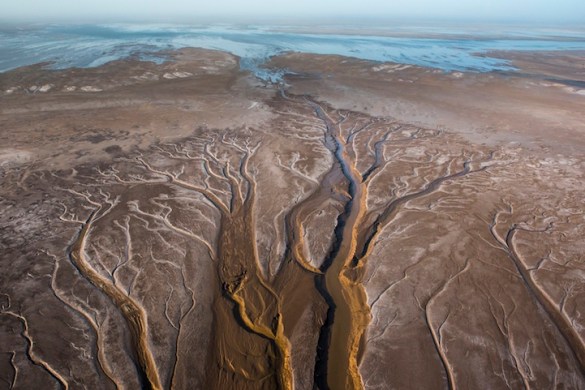
In 2014, people were very excited about a trickle of the Colorado reaching the sea. To recap, this should be something normal; not a cause for excitement.
No matter who wins, there are enormous issues that aren’t even around the corner, but are rushing directly at us. That’s why is matters who wins.

East Chicago, 1972, around when the present began to crumble. Image from blog.hemmings.com
East Chicago is one of those strange places that most of us only glimpse while driving past it, along its southern end, on a road trip that takes us through the rundown broken-factory grime of northwestern Indiana. If we’re going toward Chicago, it’s the last in a string of scary and polluted cities before you approach the rusted majesty of the Skyway, looming at imposing and strange angles, like a bridge out of Hell. More recently, East Chicago is the home of a booming casino. You get off 90 to get there, on what is essentially a designated highway, skirting the town itself. East Chicago just exists as a string of industrial lights and smoke glowing through the darkness.
It isn’t that, of course. It is a real city, where people live. It’s still a fairly-thriving Lake Michigan port, a beneficiary of this vast body of water, so crucial to the American experiment. It’s proximity to the lake, and to the Calumet and Chicago rivers, gave East Chicago some prominence in the steel industry, and its factories provided jobs and a living, even if a dirty and difficult one. Other industries bloomed in the area, in the days where Gary was a town to behold. But that legacy crumbled, leaving poison in its wake. This poison is metaphorical, but also terribly literal: East Chicago is facing a massive crisis in its drinking water, the weight of the past seeping into the present and darkening the future. It’s a reckoning with which we all have to deal.
Waukesha Diversion Week!

Image from Milwaukee Journal Sentinel
To the city of Waukesha, that unassuming Milwaukee suburb, the request seemed like a no-brainer, and coming as it did before the Great Lakes Compact was signed, seemed like a sure bet. The aquifer from which it drew its water contained naturally-occurring radium, and the growing community of 70,000 felt that they needed a cleaner and safer source. Reasonably, they looked not-very-far-east, some 20 miles, to the shores of Lake Michigan, which contains some six quadrillion gallons of water, and provides more than a billion gallons a day for drinking. The initial Waukesha request, at less than 20 million gallons a day, seemed reasonable.
And certainly, it made sense. They were a “collar county”, straddling the Basin, with the eastern part of the county firmly within its natural borders. The Compact provides exceptions for straddling cities and counties, provided that they can meet a strict set of standards.


(Images from Waukeshadiversion.org)
Now, if you were the town fathers of Waukesha, you would feel that there is a certain didactic madness to any opposition, a sort of pecksniff tyranny not just of geology, but of pedagogy as well.
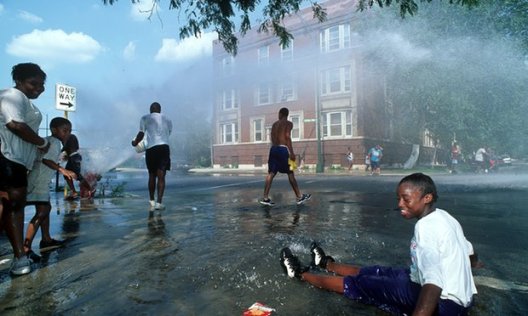
Lesson learned, apparently. Image from The Guardian.
Our last post talked about how we’ve been cheating on lead tests in much of the city, and it is the poor who suffer the most, which has startling implications for Chicago’s violent criminality. But water has always been a political tool.
As outlined in Royko’s Boss, still required reading for anyone interested in how cities work, or just in great writing, in the hot summer of 1966, firemen started turning off hydrants in poor black neighborhoods on the south and west sides, while letting children play in them in white areas. This led to rioting, and old man Daley reacted, as he did, with programs that missed the point entirely. He started bussing in giant moving pools to all the poor areas. As Royko said:
Now there was a program, and Daley liked it. Give them water. He had a whole lake right outside the door. Even before the riots ended a few days later, City Hall had embarked on a crusade to make Chicago’s blacks the wettest in the country.
This was a perfect encapsulation of the problem: quick fixes which ignore the systemic injustice, as if shutting off the fire hydrants was the first provocation, and not the last straw.
I think we’ll see the same thing here. I wouldn’t be surprised if Chicago does an orgy of quick spending to give every family a filter. It’s ignoring of the underclass until the problem becomes untenable, and then offering quick-hit solutions and hoping it’ll go away. Like lead leeching from antique pipes, though, it never actually does.

Where the water comes from. Image from Wikimedia Commons
If you’re unaccustomed to the view of Lake Michigan from Chicago, you’ll be surprised to notice several strange objects about a mile out into the lake. Depending on the weather and the light, they’ll look like large ships, before you realize that they aren’t moving, and anyway, seem to be made of stone. As your eyes focus on them, they look like houses, and the romantic among us imagine that they are old lighthouses, steering ships in through stormy western winds. Of course, there aren’t lights on them. What they are, you’ll have explained by a local, the glint of the trivia revealer in his eye, are the pumping stations, where the water that quenches a city is pulled from the vast and ancient lake and brought into the modern metropolis.
If asked why they are so far out, the local, still glinting, will explain that of course, when they were built, the river was still dumping pollutants into the lake, and just the dirty flotsam of millions made the shore and its near environs unsafe. Better to pull from, if not the open blue water where land is no longer visible and directions suddenly and terrifyingly seem to have no meaning, then close enough. This water rumbled through long pipes under water and land, through thousands of miles of pipe north and south, and into our homes.
And as an explosive Guardian report revealed, it’s been poisoned, and those in charge of testing it dodged their responsibility to let people know.
 Shooting Irrelevance