Sins of the Fathers: East Chicago’s Poisoned Water and The Weight of History

eastchicago1972_02_2000

East Chicago, 1972, around when the present began to crumble. Image from blog.hemmings.com

East Chicago is one of those strange places that most of us only glimpse while driving past it, along its southern end, on a road trip that takes us through the rundown broken-factory grime of northwestern Indiana. If we’re going toward Chicago, it’s the last in a string of scary and polluted cities before you approach the rusted majesty of the Skyway, looming at imposing and strange angles, like a bridge out of Hell. More recently, East Chicago is the home of a booming casino. You get off 90 to get there, on what is essentially a designated highway, skirting the town itself. East Chicago just exists as a string of industrial lights and smoke glowing through the darkness.

It isn’t that, of course. It is a real city, where people live. It’s still a fairly-thriving Lake Michigan port, a beneficiary of this vast body of water, so crucial to the American experiment. It’s proximity to the lake, and to the Calumet and Chicago rivers, gave East Chicago some prominence in the steel industry, and its factories provided jobs and a living, even if a dirty and difficult one. Other industries bloomed in the area, in the days where Gary was a town to behold. But that legacy crumbled, leaving poison in its wake. This poison is metaphorical, but also terribly literal: East Chicago is facing a massive crisis in its drinking water, the weight of the past seeping into the present and darkening the future. It’s a reckoning with which we all have to deal.

Continue reading

Baton Rouge is Not Obama’s Katrina


Waters will always rise. Will we? 


For almost eight years, conservatives and Republicans have been desperate to try to use the phrase “Obama’s Katrina”, knowing that the actual Katrina destroyed the tattered remains of George Bush’s credibility. It was, remember, a catastrophic failure, symbolized by Bush’s clueless flyover, where he glanced at the devastation from 30,000 feet, as well as his chuckleheaded praise for his dimwitted FEMA head. “Heckuva job, Brownie”, became emblematic of all the venality, incompetence, and cronyish destruction of his administration.

So it stands to reason that the GOP has been looking for the same thing in Obama, finding his Katrina in every tornado, every cop killing, every hurricane (one of the reasons they were so, so mad at Chris Christie following Sandy). Nothing has ever stuck, which is why they were so excited at the flooding in Baton Rouge.

After all, the President remained on vacation in Martha’s Vineyard, of all places, and didn’t visit until today. That the governor, John Bel Edwards, asked him not to do so due to distractions, is merely beside the point. Obama is aloof while a city floods and people drown. This is, finally, his Katrina.

Continue reading

Ron Johnson, Climate Change, and The Most Republican Paragraph Ever


“I don’t really understand things.”


We haven’t talked much on the blog about Ron Johnson, Senator of Wisconsin. Wisconsin being literally near me, and dear to my heart, we’ve spent a lot of time on the destructive reign of Scott Walker, the intellectual horrorshow of Paul Ryan, and even some on the quisling nebbishness of Reince Priebus. They are sort of the Big 3 in the new era of Wisconsin politics: ruthless hyper-capitalists with zero respect for the state’s progressive traditions, who think any hint of community is communism. But we’ve ignored the Senator, who defeated the great Russ Feingold in the catastrophe of 2010.

That’s because he’s…well, he’s pretty dumb. He’s one of those “I’m good at business so let me screw over the poor” kind of guys. He was perfect for Wisconsin in 2010. Honestly, the most remarkable thing about him is that he’s the head of the Homeland Security Committee, which could be shorthand for just what a stupid and unserious party the Republicans really are. Anyway, he smuckered together some words today about global warming, and you’ll never guess: it’s a hoax.

“The whole climate change debate gives, and there are all kinds of quotes from adherents of and promoters of climate change, the reason they’re doing it is it’s such a great opportunity to control, you know, pretty much, government, and control your lives,” Johnson said Monday, onthe Glenn Klein Show on the WRJN radio show. “There’s an arrogance of power there that they’re utopians, that they really think they can create heaven on earth, and where it’s failed in the past, those people like Stalin and Chavez and the Castros, the nutcases in North Korea–by the way, if you want equal results, go to North Korea, you have equal misery.”

Continue reading

Palm Oil And the Modern World

Thanks to Eric Loomis for sharing this Rainforest Action Network video about the horrors of the modern palm oil industry, which underpins so much of the processed food we eat every day.


Palm oil is one of those things that we rarely think about. It is ubiquitous-seeming, and feels healthier than high-fructose corn syrup, or any of the other corn products for which we as Americans are essentially born to be depositories. But like so much about modern capitalism, it has pernicious global effects which go unseen to the vast majority of its uses.

Centered mostly in Indonesia and Malaysia, the palm oil industry has destroyed millions of acres of jungle, which contributes to climate change, and more immediately to massive, out-of-control fires in Indonesia (which themselves heat up the world by what they blackly project into the atmosphere). It’s gotten so bad that, despite it being relatively lucrative, Indonesia is moving to ban plantations.

I say “relatively” because, basically, the amount of lucre you see depends on who you’re related to. If it is to the President of PepsiCo, then it’s a damn good deal. If you are a Bangladeshi immigrant whose passport has been seized and who has a company-store-type debt to “employment recruiters” that would make an Upton Sinclair villain seem like Eugene Debs, not so much. If you are a local worker who has to recruit your unpaid and now uneducated children to help you meet insane quotas, not so much. If you are anyone working in squalid, slave-like conditions where your health is the cost of the job and where you are disposed of when no longer useful, not so much.

Not for nothing, but Indonesia and Malaysia have long been the hidden periphery of jihad, for some reason being a good place to attract recruits who have differences of opinion with the presently-constituted modernity. It’s not all directly connected, but it isn’t on a different page altogether.

That’s the web of modern capitalism. When I buy something with conflict palm oil, I am directly contributing to the immiseration and slavery of people thousands of miles away, whose only crime was being born in the wrong country. I’m contributing to massive, ruinous deforestation and climate change. Not only that, but these massive plantations take away arable land that will be needed as desertification increases, the world heats up, and the population continues to grow. If the world seems unstable now, wait until hundreds of millions are out of food. These are the choices we make.

Luckily, the knowledge gives us power. There are ways to try to avoid it, shopping consciously. It’s very hard to give it up 100% though, which is where activism has come in. PepsiCo, which imports 750,000 tons a year, is looking to change its standards. Cargill, not exactly a liberal bastion, has put pressure on a company who has a “children make the best workers” policy. Regardless of whether or not these are sustainable, they show the public pressure works.

It works best, by the way, when it turns into political pressure. As we’ve discussed, it isn’t impossible to impose supply chain standards, including labor standards and environmental rules, on American companies (or companies that want to sell in America). If Pepsi wants to use palm oil, they can demand equitable treatment for the people who harvest it. What’s going to happen? Are the people running the plantations going to stop selling? On principle or something?

It’s a politically-winnable issue. The main issue is overcoming the eye-rolling pushback (even on the left) when people bring up “labor rights”, and the weird notion that the people buying goods can’t demand change, whether that’s you buying Lay’s or PepsiCo buying palm oil.

We also have to overcome the fatigue we all feel when we look at the enormous interlocking set of stacked labyrinths that make up modern capitalism and see the effect we have. It’s easier, and always tempting, to throw our hands up and say “that’s just the way it is” and try not to think about it. But it’s a manmade system. It can be changed.

Urbanization Visualized and Captured

urbanization

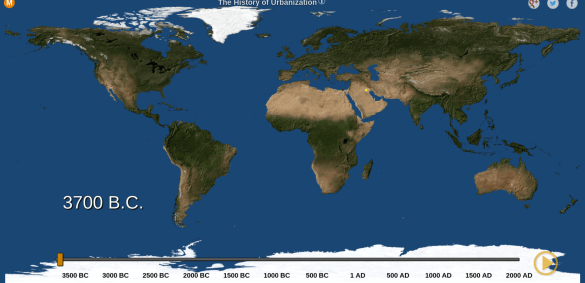
Just one city! Screengrab from http://metrocosm.com/map-history-cities.html Go there.

Right around 3700BCE, the Sumerians founded a city called Eridu. With a population of around 6000, it was the first real urban area, and undoubtedly the largest collection of humans in one spot up to that time. If you buy the Toba Bottleneck Theory (which most don’t, but there is evidence of some bottlenecking in the Pleistocene) some 50,000 years before that there were only maybe 10,000 humans total. That is an endless amount of time in the scale of our lifetimes, but it was incredibly rapid. During Toba- or at least that time, no matter what your mileage on the bottleneck- humans had very little impact on the planet. Post-ice age hunting certainly had an effect, particularly in North America. But we hadn’t yet taken over the planet. Urbanization was one of the twin engines that drove the Anthropocene, the other being widespread agriculture.

It’s also the great story of our time. From that weird beginning, in a place that must have seemed like a crushing enormity, but now would be a two-stoplight drive through, urbanization very slowly took over the world. Over the next 4000 years it was largely limited to a narrow latitudinal band, and even by the time the New World was being colonized, and north and south took on new meaning, most of the world was rural. It was only in the last 50 years that mass urbanization started taking place.

This is now beautifully visualized thanks to a landmark study on cities by Meredith Reba, Femke Reitsma, and Karen C. Seto. In it, using several data sets, they have compiled the most thorough history of urbanization that I’ve seen. They aren’t as concerned with strict definitions, but more what constitutes a large city at any given time. Cahokia, the largest city north of Mexico before colonization, makes it, whereas nearby current East St. Louis, with a larger population than Cahokia, does not. I think this is fair.

Just as exciting, at least in a visual stimulation sort of way, is the ability to map it out and watch it. I took a screenshot from Metrocosm, which is an invaluable site. In it, Max Galka shows cities popping up. It’s amazing to watch the pace, as they first center in modern-day Iraq, spread slightly east and west, and start to really roll as India and China develop their eternal cultures. Then Europe and Mesoamerica, then elsewhere, more north and more south, but still spaced out. Then the 20th-century these urban area start to spring up everywhere, and in the last few seconds of the video, it’s a violent epileptic explosion of dots, each one representing the lives of hundreds of thousands and of millions. It’s amazing. (The Guardian has a video as well, shorter and set to a jauntier tune.)

What we see with these maps, and in these datasets, is a dramatic visualization of the choices we have made as a species. I personally am very much in favor of urbanization, and think that it is a great way to reduce our impact on the planet, if done correctly. But there isn’t a way to mistake it: by transforming the land for agriculture, and then transforming the very basics of water drainage, light, sound, and other factors for urbanization, we’ve created the most species-driven environmental change since (arguably) the Great Oxygenation Event, which most scientists will tell you was a bad scene, man.  Remember that the great cities of Mesopotamia were not dry and dusty, but lush and verdant.

But not to be a pessimist entirely. The data and the videos are also thrilling. It’s a stirring wonder, that atavistic gnaw in your stomach, to imagine a citizen of Eridu, gazing in wonder at the crowds. Did they know what they had accomplished? Did they know that a mere generation or two before such a thing was unimaginable? Surely they did; they had the imagination to build. They had the imagination to plan for a future. They had the knowledge to remember the past. They were us.


Waukesha Diversion Week: What Waukesha Wants

Waukesha Diversion Week!

b99727154z-1_20160518204006_000_gp3fmgda-1-0

Image from Milwaukee Journal Sentinel


To the city of Waukesha, that unassuming Milwaukee suburb, the request seemed like a no-brainer, and coming as it did before the Great Lakes Compact was signed, seemed like a sure bet. The aquifer from which it drew its water contained naturally-occurring radium, and the growing community of 70,000 felt that they needed a cleaner and safer source.  Reasonably, they looked not-very-far-east, some 20 miles, to the shores of Lake Michigan, which contains some six quadrillion gallons of water, and provides more than a billion gallons a day for drinking. The initial Waukesha request, at less than 20 million gallons a day, seemed reasonable.

And certainly, it made sense. They were a “collar county”, straddling the Basin, with the eastern part of the county firmly within its natural borders. The Compact provides exceptions for straddling cities and counties, provided that they can meet a strict set of standards.

Wisconsin Counties within Great Lakes Basin

(Images from Waukeshadiversion.org)

Now, if you were the town fathers of Waukesha, you would feel that there is a certain didactic madness to any opposition, a sort of pecksniff tyranny not just of geology, but of pedagogy as well.

Continue reading

The Waukesha Diversion: Geology in Human Affairs

Waukesha Diversion Week. Part I: The Great Lakes And the Future Water Wars

glacier

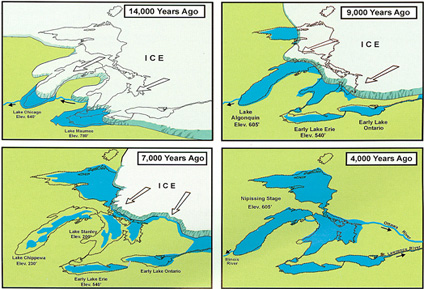
The formation of the lakes. See that 9000 years ago it was draining south. Image from glerl.noaa.gov


I type this late at night, after an evening of losing softball near the shores of Lake Michigan, which has seen us lose more than a little. It’s a warm night, on the stilled brink of a storm, and like many nights, I can hear the clacking rattle of a skateboard. There’s a kid who lives down the street, who nearly every night, walks his skateboard to the hill at the corner, and goes down.  Last year we heard him fall nearly every time, and were impressed by his ability to get back up. A cold-winded winter, in which he practiced most nights, made him better, and after he goes to the top of the hill, he shimmers down with ever more reckless speeds.

I wonder if he knows why, in this flat part of Illinois, in one of the flattest areas in the country, the street has a small hill, no more than 15 feet and low-angled, but for this area, substantial. Why his skateboarding has improved because his parents decided to live on this street, in this town. How the ancient geology of lakes affects his life, and in a real way, the interests that will shape him. If he lived two blocks down skateboarding would have basically been as interesting as cross-country skiing, which is to say: not at all.

But that’s sort of the point of this week’s series on Waukesha: the unseen role of geology, from the crisp edge of a basin to the smallest hill in Illinois. We are beholden to it, and it shapes our politics. It predates us, and it will outlast us, and our little human concerns have to find a way to propitiate geology. Becuase it doesn’t care if we do or not; it’ll keep on shaping out lives, vast and unseen, down to the water we’re allowed to drink.

Continue reading

The Waukesha Diversion: The Great Lakes and the Future Water Wars

lake_michigan_from_big_sable_point_lighthouse

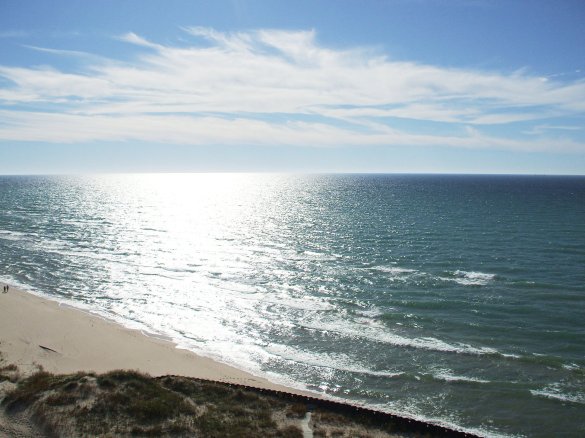
Endless and beautiful Lake Michigan

In 1998, a permit was accepted by the government of the Canadian province of Ontario, following a lightly-remarked-upon 30-day public comment session, to approve a ridiculous and pointless money-making scheme. This approval set in motion a multi-national effort to protect one of the great natural treasures of the world, one that could decide the future of water on an increasingly parched planet, and one that will shape the fate of a harmless Milwaukee suburb, whose destiny lies on its placement just east of the slight bend of a continent, a product of ancient and mute geological forces. It’s a story about our distant past, and one about our every-drawing future.

It was in 1998 that a businessman,  John Febbraro, applied for a permit to have giant tankers scoop up water from the Great Lakes– specifically the giant of the group, the vast and violent Superior– and sail them through Sault St. Marie, down through Windsor, up through Erie and Ontario, into the vast river of the St. Lawrence Seaway, and then to Asia, where a thirsty market would gobble fresh water. (This is detailed excellently in Peter Annin’s Great Lakes Water Wars, a must-read for anyone interested.)

It was an amazing plan, and a ridiculous one, born of a good idea that made absolutely no sense. Febbraro planned to scoop up 427,000 gallons a day, which comes up to around 155,885,000 million gallons a year. That seems like a lot, until, as we see, that comes to about what an average-sized suburb of Milwaukee would need in a 6-month period. That…won’t solve any Asian water problems.

But still, it proved a catalyst. There was a Great Lakes Charter signed in 1985, by the eight US states and two Canadian provinces the have land bordering the states (which yes, includes Indiana). But it turned out that the Charter wasn’t very strong, which is why a plan to take water from the Lakes and ship it around the world could be approved.

The plan provoked outrage, and incredibly enough, action. Pressure- and honestly, the economic infeasibility and ridiculousness of the plan- destroyed Febbraro’s dream. But more than that, it spurred people, Democrats and Republicans, Labor and Conservative, into recognizing that the Great Lakes weren’t permanent, and could be destroyed. Just because the plan to have boats take water to Asia was absurd- and anyone who has watched giant ships sail by, dwarfed by the enormity of this water, could tell you it was absurd- didn’t mean the writing wasn’t on the wall.

After all, if a ship could take water, why couldn’t hundreds? Why couldn’t thousands? Why couldn’t pipelines be built to replenish barren reservoirs in Western deserts? While there was never a plan to make it economically feasible to do so (and many tried, both public and private), it didn’t mean it couldn’t be done. At some point, an economy of scale could take over, and it would make sense to trickle water out of the lakes.

But apres trickle, le deluge? That was, and is, the big fear, which is why in 2008 the Great Lakes Compact was signed. This was a guarantee that no one outside of the Great Lakes Basin could use water without the permission of every state and province in the region. The problem is– one of the problems is– that with the exception of Michigan, none of these states or provinces lie wholly within the Basin. Which means politics takes over.

And that leads us to Waukesha, a city the is a suburb of the Basin-included Milwaukee, but one that is just outside. Waukesha has spent years applying for a diversion, claiming that their source of water, underground wells, is dirty and mostly poisoned, and anyway won’t last them very long, and anyway, besides, they are so close. A swift walk can get you to the Basin; a decent bike ride to Lake Michigan; if you are driving, a day at the lake is like going down the street.

Most of the obstacles to their application have fallen. Last month, the Great Lakes Compact group voted 9-0 (with Minnesota abstaining) to approve the diversion, with serious conditions. Next week in Chicago, the final governor-level meeting will take place, to decide its ultimate fate.

So, this is Great Lakes water week here at Shooting Irrelevance. It’s a story of politics and the environment. It’s a story of the future of water, and how we’ll use it, and most importantly, who owns it. After all, if the Lakes are a public good, why should greedy Chicago (who has the mother of all diversions) luxuriate while citizens in Nevada parch? It’s a story about political geology, and how these ancient forces shape our present. It’s a story of competing activism, in which every side has moral ground. Mostly though, and fully, it’s a story of the Great Lakes, this gorgeous and perfect and tempestuous system. It’s a story about their strength, and their fragility.

When you stand on the southernmost edge of the system, as I often do, at that sweeping curve that defines Chicago, they seem infinite, overwhelming, almost impossible in their magnificence. You can drive for hours and hours, up the coast of Wisconsin, and around the UP, and still have barely covered half the shoreline. They are amazing, and they are not like the ocean, which are essentially inhuman in size. The Lakes, though enormous, are human. We’ve paddled across them for millennia, traded across them, sent great ships to ply them, but also to sink. To sink in their temper, in their violence, in their sudden reminder that they are not ours to do with what we like. It’s a warning, a reminder that there are enormous ships on the bottom of these lakes, the Edmund Fitzgerald and the Carl Bradley, that were swallowed whole. But it is also a fearful warning. There is no consciousness in lakes, but if there were, they would look at the tragedy of the Aral, and ask us to stop and think. They’d remind us that, in our tempers and ill-humors, in our short-sightedness, we can ruin a great gift.

That’s what we’ll be talking about this week; ultimately, the tragedy of competing and rational human interests in the face of unconcerned nature. Hope you’ll enjoy. Here’s a rough schedule.

  • Tuesday: the political geology and geography of Waukesha and the Lakes
  • Wednesday: an analysis of the Waukesha proposal and its opposition
  • Thursday: Activism and the Great Lakes: A Model for Environmental Impact
  • Friday: What it all means; or, the future of water.

Why Labor Rights As Part Of The Global Supply Chain Can Work

image

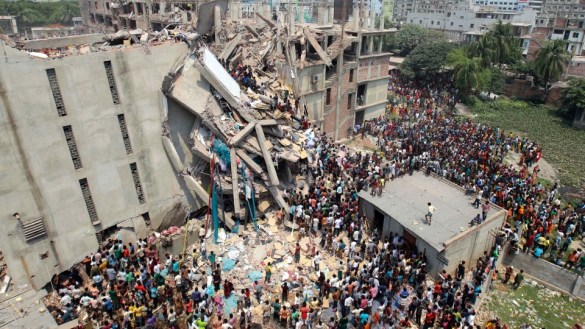
Pictured: not actually needed for the global economy to work. Image from ctv.com

One strange thing about staunch free-market advocates– who in self-image are as clear-headed about the real world as they are stout-hearted– is the mystical attachment to the lack of human agency in a human endeavor. The mystery of the market, and the “invisible hand”, is essentially the Gaia to their cute girl at the co-op. When global labor problems, and the immiseration of the Third World, is brought up, you’ll find shrugged shoulders and mumbling incantations about market forces. It’s strange to think that an economy predicated on container ships nearly a quarter-mile long and capable of carrying tens of thousands of tons, that can be unloaded by robots in massive ports, is somehow beyond the reach of human intervention.

There’s a growing movement to change that. It’s really easy to be upset when a Bangladesh factory collapses, or when you hear about union organizers for a South American sweatshop being killed, or any other of the iniquities of the global economy, but it turns out there is actually something that can be done. The invisible hand, shockingly, in attached to our arms.

Just as we have passed laws in this country that stop child labor, allow for organizing, and create working conditions that, in theory, allow you to live, we can do so for other countries. Obviously not directly, but by enforcing supply chain standards for the American and other Western businesses that use overseas factories. Over at Lawyers, Guns, and Money, Eric Loomis gives an outline of what this might look like (with a promise to delve deeper into it in the future).

1) All workers have the right to a union or workplace organization of their choice, free from harassment by employers or from corporations higher on the supply chain.

2) All workers have the right to a safe workplace.

3) All workers have the right to be free from physical, sexual, and verbal abuse.

4) All workers have the right to a livable wage based on local conditions.

5) All communities near global factories have the right to be protected from pollution

6) Western companies must take legal responsibility for the conditions in their supply chains. Western countries need to pass legislation ensuring this.

7) Western companies must agree to legally binding codes around pollution in their supply chains.

8) Corporations must take legal responsibility to eliminate all child labor, prison labor, and coerced labor in their supply chains.

9) Workers in supply chains must have legal recourse to violations of the basic principles listed above. If that cannot happen in the courts of their home nations, it must happen within the home courts of the western companies. That legal recourse should include access to corporate information and include the possibility for financial compensation for suffering.

10) These laws and regulations must travel with companies, so that they cannot escape national law in order to create a race to the bottom. Rather, the new legal regime follows the company wherever it operates.

To me, these seem like a no-brainer, and I think the political arguments against them won’t hold much water. Let’s look at a few of those.

  • The “It’s More Than They Make Now” Argument. This is a common one, especially amoing otherwise sympathetic lefties. The idea is that if you are in a sweatshop in Dhakar, you are maybe making more than you would be in a village in the countryside. This is possibly true. It also ignores the violence, lack of social safety net, and breaking of tradtional bonds that comes with it, of course. But the argument, the “race to the bottom” is that if make it less profitable for the multinational in Bangladesh, it’ll go somewhere else. That’s true if you work on a country-to-country basis, but not if you do so from the top down. If companies have to treat workers well in Mexico or Senegal or Vietnam, they won’t be able to go anywhere else. You can have the benefits of the global economy without worrying about making your entire country a hellhole for employees.
  • The “It’ll Never Get Passed” Argument. On the surface, this does seem to be a pie in the sky argument, but there’s really no reason for it to be so. I don’t see where the massive opposition will come from. After all, this isn’t going to cost Americans jobs- just the opposite. It staunches the flow by making it , if not more profitable to manufacture in America, at least not prohibitevly expensive. There are no real economic arguments against it, except the “corporate profits will be less” one, but come on. That only works when you paint them as job creators. That won’t fly. It works politically when you can ramble about job-killing regulations, but we’re talking about adding more regulations to countries that have “taken our jobs.”
  • The “Why Should We Support Their Unions When Ours Are Getting Killed Here?” Argument. This is a fairly persuasive one, at least emotionally.  After all, American labor standards have been ruined over the last generation. But that’s due in part to the globalized economy which incentivies businesses to pull out, and incentivizes states (who didn’t really need it, in many cases) to strip away more worker’s rights in order to keep or attract businesses. This creates pliant workers, who are worried that if they don’t acqueise to everything, they’ll be out of a job. But this stops the race to the bottom, and in doing so, I think, can reinvigorarate the American union movement.

I don’t think it will be easy, nor do I think it will create an international brotherhood, and nor do I think that we’ll see the glory days of the labor movement come roaring back. But it is, in many ways, a simple fix to the deep cruelty of the global economy, both here and abroad. A very comlicated and time-consuming one, and a long batle, but one that this nascent progressive coalition can fight, by rallying a large and diverse group of activists, from anti-globalization turtle-huggers (whom I love) to the bluest of the blue collar. It’s a winning issue.

Chicago And Water: A Brief Followup of Neglect

5353

Lesson learned, apparently. Image from The Guardian.

Our last post talked about how we’ve been cheating on lead tests in much of the city, and it is the poor who suffer the most, which has startling implications for Chicago’s violent criminality. But water has always been a political tool.

As outlined in Royko’s Boss, still required reading for anyone interested in how cities work, or just in great writing, in the hot summer of 1966, firemen started turning off hydrants in poor black neighborhoods on the south and west sides, while letting children play in them in white areas. This led to rioting, and old man Daley reacted, as he did, with programs that missed the point entirely. He started bussing in giant moving pools to all the poor areas. As Royko said:

Now there was a program, and Daley liked it. Give them water. He had a whole lake right outside the door. Even before the riots ended a few days later, City Hall had embarked on a crusade to make Chicago’s blacks the wettest in the country.

This was a perfect encapsulation of the problem: quick fixes which ignore the systemic injustice, as if shutting off the fire hydrants was the first provocation, and not the last straw.

I think we’ll see the same thing here. I wouldn’t be surprised if Chicago does an orgy of quick spending to give every family a filter. It’s ignoring of the underclass until the problem becomes untenable, and then offering quick-hit solutions and hoping it’ll go away. Like lead leeching from antique pipes, though, it never actually does.