Surprise! Scott Pruitt’s EPA Uses Bad Economics on the Clean Water Rule

pruittmain1

In the Aftertime, when our descendants are fighting over the last scraps of arable land, this fucking Okie hump is going to be one of history’s primary villains.

Scott Pruitt is not an honest man. He has one core belief–that extraction industries (and really any industry) should be able to do whatever they want to maximize profits. His ancillary beliefs–that there should be no regulations, that labor or environmental protections are evil, that climate change is a hoax, that we the poor and undeserving should choke on the ashes of capitalism–all flow from that.

All of his dishonesty and petty idiocy come from this. He’s an industry shill who literally copy-and-pasted comments extraction flacks wrote for him about EPA regulations he was fighting (before he was put in charge of the damn thing). He forces his department to self-censor the truth or lose their jobs (many choose the later). He replaces scientists with industry goons. He’s says it is “insensitive” to talk about climate change being a cause of more powerful and destructive because he knows it is inarguable, and so hides behind a veneer of compassion for environmental victims his whole career proves a lie.

He’s one of the primary disasters of the Trump regime, coming in close behind or ahead of Sessions, depending on where you stand on things. I’ll consider them tied. It flows from the top, of course. Just like in Pruitt’s EPA, dishonesty has begun to affect the noble institution with every one of his idiotic appointments.

We can see that inherent dishonesty in a recent review of the Clean Water Rule of 2015 (this is also known as Waters of the United States Act, or just WOTUS). The administration has been trying to overturn these regulations, which changed what water could be regulated by the federal government. The definition was expanded to include many irrigation channels and small streams.

To many, this was big government intrusion at its worst. And to be fair, I find that argument sympathetic. Irrigation channels often run on private land. The problem, of course, is that they don’t end there. Water seeps into aquifers or it runs rivulets of phosphate into lakes, creating murderous algae blooms, or it is just wasted. But, more regulations could be onerous to farmers, who already eke out a meager existence.

Who was on their side? Well, nearly everyone.

President Donald Trump made repeated campaign promises to repeal WOTUS, which is opposed by a variety of industrial sectors, including agriculture, iron and steel manufacturing, home builders, and mining groups. Industry associations representing those sectors argue it would trigger requirements to obtain costly federal permits to dredge wetlands and streams that they say fall under state and local laws already.

Now, some argue, maybe we should protect wetlands more. It’s a compelling argument these days. So who knows what to do? But no fear! That’s why the EPA commissioned a study. And they found that the economic burden would be super expensive. There’s just, well, one problem. From the Commies at Bloomberg.

The Trump administration was sloppy in how it estimated the economic impact of a proposal to repeal an Obama-era water pollution regulation, relying on data and assumptions that industry previously criticized, according to economists and regulatory analysts interviewed by Bloomberg BNA.

Chief among their complaints was that the Environmental Protection Agency and the U.S. Army Corps of Engineers used recession-era economic data and failed to account for some of the benefits of leaving the 2015 Clean Water Rule in place. Their economic analysis even drew criticism from David Sunding, a University of California-Berkeley agricultural economist who was hired by industry groups to counter theanalysis the Obama administration used to back its regulation.

“I am not normally this dismissive, but this is the worst regulatory analysis I have ever seen,” Sunding told Bloomberg BNA in telephone interview.

It’s worth repeating that Sunding had been hired by industry groups, in large part because he criticized the conclusions of the Obama administration, saying they had used faulty data to overstate the benefits. But then the Trump admin under Pruitt used the same numbers to come up with even worse results.

When the program was first proposed, it was under one set of economic conditions (coming out of the recession). That skewed the benefits, because it started from an artificially low baseline. But Pruitt’s EPA used that same baseline, and ignored any benefits. Bloomberg can explain.

The Trump administration used the 2013 estimates as a starting point, assuming that the costs of that regulation would be avoided by a repeal and the benefits of the regulation would be foregone. The proposed repeal was estimated to result in $162 million to $476 million in avoided costs, while the estimated foregone benefits range from $34 million to $73 million per year.

In the 2013 analysis, the EPA estimated the annual costs of implementing the water jurisdiction rule to range from $133.7 million to $277 million, but those costs were outweighed by annual projected benefits of between $300.7 million and $397.6 million.

The EPA’s 2017 approach drew the ire of economists because no recent permitting data was used to estimate the economic impact of the proposed repeal. Instead, the analysis used data from fiscal years 2009 and 2010, a time when U.S. economic activity was at its lowest since World War II, particularly in the manufacturing, residential, and commercial development sectors.

Basically, the Obama estimates might have been wrong, but the Trump ones were almost deliberately misleading. Or, knowing them, not almost.

I err on the side of WOTUS, clearly. But it is worth looking into. We do need to know the impact of everything we do. Scott Pruitt sort of agrees. He thinks we should know the negative impact of any regulation. He doesn’t really care to know any of the benefits, or care about the long-and-short term destruction of our environment. That sort of impact doesn’t matter.

The only impact that matters is if business is happy. For some reason they don’t, or won’t, see the ground crumbling beneath their feet. They don’t see the flames licking up the sides of the house. They feel the lash of the storm, but assume it is passing, or pretend their boat can get out of the way. Theya re depserate and greedy murderers, and Scott Pruitt is their chief enabler.

If we’re lucky enough to have history in 100 years, his name will be cursed.

A Brief Follow-Up on Houston, City Planning, And Over-Reactions


Image result for wetlands

Wetlands are pretty, but they wouldn’t have saved Houston. (They’re still good though!)


In the post below, I wrote “There might be some doubt if this particular tropical storm was a direct result of climate change, but there is no doubt that it was made worse by the simple fact that we have completely altered the way water drains itself, which is to say: it no longer does. It relies on our pavement floodplains, our sewers, our channels. And when those aren’t enough, as we know, water never slinks off.”

Charles Mahron and Daniel Herriges at Strong Towns think I am being unfair.

OK, they don’t think I’m being unfair. Neither of them have read my piece, and indeed wrote their articles before mine. I probably shouldn’t take it personally. But they both think that narrative- Houston overdeveloped, paved over wetlands, and is paying the price- is unfair. And that’s worth listening to.

They have a very good point. In their articles, they go into how Houston isn’t particularly less-regulated than other cities (though in a way it is) and how it is weird to say that “they shouldn’t keep developing”, as if development wasn’t a reaction to the desire of people to live there. (Essentially, if you took that to its logical conclusion, cities should shut people out once they reached a point, and the people shut out would most likely be poor).

But, more broadly, they point out that Harvey would have obviously overwhelmed the most porous city in the world.

As Mahron says:

he Texas A&M research I highlighted above suggests reckless wetland filling robbed Houston of 4 billion gallons of stormwater storage capacity. For context, the Washington Post is reporting now that Harvey dumped 19 trillion gallons on the Houston area. That means that, had those wetlands never been filled, they could have accommodated 0.02% of the water that fell in Harvey. I tried to plot this up in some type of graphic representation, but at no scale could I get the wetland capacity to even show up, it’s so insignificant.

That’s very true. It isn’t Houston’s “fault” that they got flooded. Harvey would have destroyed anywhere, and if my article implied that better city planning would have saved Houston, I take it back.

But the broader point is still true: our choices, all of them, helped create catastrophe, both isolated ones like Harvey and civilizational ones like climate change. And all the little disasters in Harvey, each individual explosion and each chemical leak, is the result of decisions made as to how we arrange our society and technology.

(And the point isn’t that wetlands are bad. You should still have them. Not every storm is Harvey (for now!), and a lot of flooding can be prevented.)

Both articles are very learned, well-reasoned, and worth reading, providing nuance to the story. I worry that there is a little too much “now is no time to be talking about this”. It’s the same argument about “politicizing” tragedy that lets us avoid making hard choices about how we’ve set up our lives. I don’t think either writer is saying that. Strong Towns, which I love and support, is based around the idea of asking hard questions about that very topic. But I always worry about a counter-narrative that “everything was fine and you are being hysterical” can easily take hold.

And, though both articles imply it, I think the idea that people are saying Houstonians “deserve it” is overblown. I haven’t heard any of that. And what is there shouldn’t be countered with overwhelming cries for “decency”. We can help the people of Houston and ask how we can do better at the same time. Irma might already be bearing down. The opposite of knee-jerk snark isn’t piled smarm. It’s intelligence.

The Fish Are On Anti-Depressants: The Great Lakes, Harvey, and Our Weird Global Climate Experiment

Image result for bangladesh monsoon

Storm’s coming…


A few years ago, I read this cool report out of Northwestern University about an old, hidden, forgotten cemetery near downtown Chicago, underneath some of the most expensive and tony property in the city. This boneyard was the final resting spot of thousands, maybe tens of thousands, before it was forgotten, paved over, and built upon. Skyscrapers and artisanal donut shops linger with a sneering assumption of permanence over a Potter’s Field.

It’s weird, the things our civilization leaves behind. The past, when it burbles up like poltergeists, give us this disconcerting shudder, a weird hollow dread mingled with our awe. I think that comes from twin recognitions: the first is the Ozymandias-like knowledge that we’re all going to be just dirt in the ground one day, and our buildings won’t last forever. The bodies in the ground remind us of that.

But they also remind us that we leave traces. We have an impact not just on our lives, but on the future. And as a species, we have an impact on an entire planet, in sometimes positive but mostly weird and disturbing ways. We’re changing the ecology of our home in a grand experiment to which no one really consented, but in which we’re all both participants and experimenters.

Harvey is a sign of this. Fish on anti-depressants is a far weirder, but no less profound one. In fact, it might be the most damning and on-the-nose verdict on our society I can think of. Let me explain.

Continue reading

Bear Eras Update: It Turns Out People Like National Monuments


Image result for bear ears national monument

Surprisingly, most people like the way this looks without oil derricks. 

Last week, we revisited our old friend Bear Ears National Monument, which is Patient Zero for the GOP’s attempt to destroy the Antiquities Act. They don’t like the idea that land can be set aside just for public use, and not for the gain of private extraction and logging concerns. It’s one of the driving motivations of the contemporary GOP: the idea that the government is an alien, and that if something can be sold and converted into capital, it should. It’s why the Sagebrush Rebellion is one of the primary events in modern Republican history.

But, it turns out, just as people don’t like being kicked off their health care in order to finance tax cuts for the rich, people also like the idea that we should have unspoiled land for everyone to enjoy, not just for the few to profit off of. And they let Ryan Zinke’s Department of Interior know just that.

Most regulations are subject to public comment, which lets lawmakers know where people tend to stand on things. The attempt to eliminate or reduce 27 national monuments is no different. They received an incredible 1.3 million comments. And the results? It was close!

Charlottesville, Virginia-based Key-Log Economics used an innovative combination of crowdsourcing and machine learning, to comb through and analyze every one of the 1.3 million comments that were publicly available by the end of the official comment period. They found that 99.2 percent of comments oppose the possible elimination of the national monument designations or a reduction in their size and protected status.

(That the study was conducted in Charlottesville is just a coincidence, but does provide nice harmony about who wants to unite the common good and the forces arrayed against it.)

This is unsurprising! Most people are in favor of national monuments. But that’s one of the more insidious things about the Republican Party. They simply don’t care what most people want. And they have always used the manipulation of language (government overreach, private land, etc) to convince people to support things that they don’t actually support.

Any Western GOP politician, from Chaffetz to Zinke, has the speech down pat. The government wants to take over this land! They’ve taken it over without actually setting foot in it, a bunch of Washington bureaucrats! We want to return it to the people.

“The people”, here, are of course private concerns, who would shoot your ass for trespassing on their newly fenced-off land. But it sounds seductive, and is part and parcel of their overall philosophy that the government is the enemy of the people, and not the expression of our politics. It is contempt for democracy at the most basic level.

But we can push back. Who knows if these comments will do any good. Zinke is already showing himself to be a good Trumpista by wildly spinning the results.

Comments received were overwhelmingly in favor of maintaining existing monuments and demonstrated a well-orchestrated national campaign organized by multiple organizations. Opponents of monuments primarily supported rescinding or modifying the existing monuments to protect traditional multiple use, and those most concerned were often local residents associated with industries such as grazing, timber production, mining, hunting and fishing, and motorized recreation. 

Well-orchestrated national campaigns. You can almost hear him whispering “Soros” and “fake news.” They contrast this with locals, though at least they are honest enough not to hide the mercenary motivations.

Again, this is part of the GOP and right-wing emotional strategy. A bunch of elites want one thing, and are ramming it down the throats of the hard-working locals, simple folk, really, who just want Uncle Sam off their back. Never mind that they aren’t going to be doing much huntin’ or fishin’ on Amalagamted Strip-Top Mining land. It’s freedom is what it is.

Don’t ignore either the way that the “national” campaign is sneered at, as if we as Americans shouldn’t have a say in our national heritage. It is the politics of division, as if a few people in one area have the full rights over who we are as a nation. It’s really a funny sort of patriotism. The million comments are dismissed because they came from people who care enough to comment, which is, I guess, a bad thing.

Will it work? I don’t know. I kind of feel like this is one of those things that could go either way. It is so unpopular that in a normal system they’d have to back off, but it is also under the radar enough that it can slip under the constant deafening storm of nonsense. But if the Antiquities Act goes, our national heritage is up for sale. It’s something to keep fighting.

****BONUS COMMENTING COMMENT***

You can now comment on the Water of the United States Act, which the admin wants to roll back. I think it is a bad idea. If you have an opinion, comment. It actually does mean something.


Weekend News Roundup: Gorka, Tillerson, and Harvey

Image result for day lasts more than a hundred years

There’s a Soviet-era sci-fi book by the Kyrgyz writer Chingiz Aitmatov called The Day Lasts More Than A Hundred Years. I really liked it as a book (though it has been like 18 years since I’ve read it), but love it as a title. It’s a truism every day, of course, the long pace of a day, with each individual tumbling thought taking up its own space, elongating the day beyond memory. But it is especially true in our moment of nitwit authoritarianism, when we’re so consumed with the daily thrum of horror and inanity that time itself is distorted.

All of this is a long way of saying that a whole lot happened since Friday. Let’s do a quick breakdown of the hits (we’ll have a standalone post on the Arpaio pardon).

Continue reading

A Gentle Sugesstion to Trump’s “Oil and Gas Allies” Who Are Worried About Too Much Deregulation


Image result for deepwater horizon

“But no one told us explicitly not to do this!” 


Politico offers us another example of “terrible people who are stunned by how bad Trump really is” (we can also call this “The Mitchie”).

Publicly, petroleum companies and their trade groups are cheering Trump’s efforts to undo former President Barack Obama’s environmental regulations, including restrictions on fracking-related pollution, pipeline permits and offshore drilling. But quietly, people in the industry are growing worried that deregulation could backfire on them, according to interviews with a dozen executives, lobbyists, lawyers and analysts.

Among their fears: Laxer rules could set the stage for an environmental disaster like 2010’s BP oil spill in the Gulf, which blackened the industry’s reputation and spurred a regulatory clampdown.

“Every industry wants regulations that make sense, but you don’t need to roll things back so far that it opens an opportunity for outsiders to criticize, or something bad happens,” said Brian Youngberg, an energy analyst at the investment firm Edward Jones.

A person at one oil and gas company expressed similar worries. “It’s not helpful if regulations are streamlined so as to allow something to happen — say, a methane explosion or a spill — and we’d be painted with it as an entire industry,” said the person, who requested anonymity to speak freely.

Now, far be it from me to tell titans of industry what to do, but if you are worried about public reaction to you destroying the air and water, if not actually worried about destroying the air and water, maybe you could do more than the absolute minimum required of you by a government bound and determined to make every single corner the end of Wigan Pier?

But, I guess by untying their hands, Trump is truly binding them to their fate. What are you supposed to do, you know? Be marginally less profitable? And so it goes.

With Bear Ears, We See The Fullness of the GOP (Bonus: The Worst Dude!)

00monuments-master675

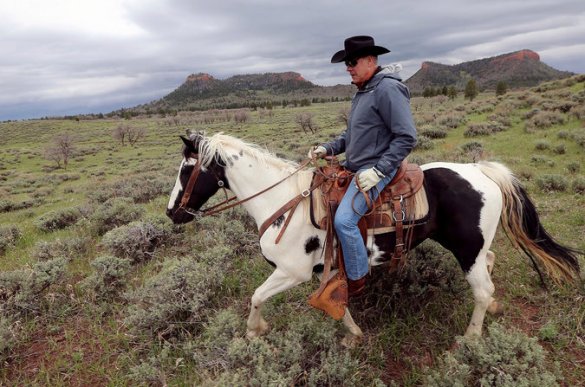
Interior Secretary Zinke: This is nice. Could use some derricks.

In December, not knowing much about him, I tentatively declared Interior nominee Ryan Zinke to be potentially “not terrible?” It wasn’t exactly high praise, but even that most mild of optimism (or a lower level of dread) was misplaced.

BEARS EARS NATIONAL MONUMENT, Utah — Parts of this sprawling region of red-rock canyons, towering mesas and ancient Native American sites in southeastern Utah could lose their strict federal protection as a national monument, under a recommendation that Interior Secretary Ryan Zinke is expected to issue on Thursday.

Shrinking the Bears Ears National Monument and reopening much of the land for possible mining and drilling would be widely seen as a direct blow to former President Barack Obama’s environmental legacy, and the first major test of a century-old conservation law.

Bear Ears is the opening for them. This was a piece of land set off almost entirely due to indigenous concerns, which in and of itself already goes against conservative philosophy. It’s not the Democrats really understand that there are multiple nations still on this continent, in different occupied territories, but conservatives want to entirely wipe that idea out, subsume it all under the guise of America.

And America, for them, is business. We’ve talked endlessly about the idea of how the modern GOP is set up in opposition to the idea of “the common good,” whether that is the shared responsibilities of public health or helping people not be trapped by the circumstances of their birth. But its apotheosis is in how it treats the sprawling and beautiful land that makes up this country, however it was gained.

They want to dig it up and convert it into wealth. Not for everyone, of course. For miners and loggers, mostly. For large companies. For those already wealthy. The argument is that the government shouldn’t control the “people’s land”, logic which is easily disproven, but very seductive on its face. Public land reverts to the states, which sells it to private companies, which tear it up.

The Trump admin has wanted to do this from Day 1, which really any GOP government would have done. He’s particularly eager to sell the country off, since he’s a cheap monster with no respect for anything but himself, but this would have happened with any Republican. It’s what they do.

Bear Ears has been at the top of their list since President Obama designated it last year. To them it was the ultimate in tyrannical over-reach, since it was just for Indians, and since there are precious, precious minerals under it. Jason Chaffetz even launched an investigation into how a staffer at Bryce Canyon could have made a mail slot for Bear Ears unless there was prior collusion (I’m not kidding).

Bear Ears was at the center of anti-Obama paranoia, fraudulent terror, anti-Native activism (of which DAPL is a huge part), and of course the assault on public land. This is the door they want to push through in order to break the Antiquities Act. Any action will be challenged in court, and challenged for years, and with hundreds of federal seats open, and the potential for more Supreme Court posts, they feel confident they’ll win.

They genuinely don’t think that the President should be able to protect land from capitalism. They don’t think anyone should. And they’re going to use Bear Ears as the first test case to erode the Act that has allowed us to celebrate the wild and impossible beauty of this still-forming continent. These are people who gaze into the vast western sunsets and say “Not bad. Could use some mines.”  Make sure you call your Senators and Reps and tell them to fight to protect the Antiquities Act.

Oh, and a bonus! Here’s the worst person.

Mike Noel, a Utah state representative, said that reducing or eliminating Bears Ears would be “a victory for our state.” Federal management of land in his state had constrained drilling, mining and grazing, he said, adding that Washington had no business setting aside so much land for the strict protection that monument status affords.

“When you turn the management over to the tree-huggers, the bird and bunny lovers and the rock lickers, you turn your heritage over,” Mr. Noel said.

Rock lickers?

Water Monday: Too Much in New Orleans, Too Little in The Plains, and a Big “Who Cares” on the Border by DHS


Image result for flash drought nebraska

But her emails, etc


When it comes to arguing about the proven and increasingly-lived reality of climate change, deniers have one big asset on their side: climate change is really complex and slow. It affects different parts of the world differently, and in ways that can be very unexpected. This is because the earth’s climate is big and complex; in fact, one could say it is all-encompassing.

But that can make it easy for deniers. They can sneer and say things like “Oh, so climate change makes it hot some places and cold in other places? That’s really convenient.” They also sneer about how “climate change” replaced “global warming”, as if scientists were caught in a lie and so changed the name; as if no one was saying that global warming would change the climate.  A simple lie is easier to digest than a complex truth.

(Unsurprisingly, Donald Trump was one of those idiots who tweeted about global warming every time it was chilly out. He was even one of those idiots who would use record-setting colds across the entire country as proof everything was fine. There’s a reason he had instant appeal to the GOP voters.)

Anyway, this is to say that if you don’t believe in climate change, this post is good fodder for your argument.

(Note: the invaluable folks at Circle of Blue linked to much of this in their daily newsletters; that’s where I got it from. Don’t want to take credit for it)

Too Much Water, Not Enough Infrastructure


This was yesterday, not 2005. Image nola.com


NEW ORLEANS — Heavy weekend rainfall in New Orleans overwhelmed the municipal pump stations, leaving parts of the community flooded, and some officials say they’re not satisfied with the city’s response.

“Are our city pumps working as they should?” Councilman Jason Williams said, according to local news reports. “If we can’t handle a bad storm, then what will we do when there’s a hurricane?”

What indeed? Now, heavy rain can’t be blamed on global warming, nor can hurricanes. But the intensity of both is modeled to increase as the oceans heat up. That’s not conspiracy or far-fetched. Even the dimmest denier admits that there is such a thing as “hurricane season”, and it isn’t when the water is coldest.

This just highlights the dangers of climate change in our most vulnerable cities, and our lack of preparation in how to mitigate its effects. We know that climate change is going to hit hardest in poorer countries ill-equipped to handle environmental and demographic shifts. But it will happen in America too. And our politics, indeed our culture, rarely gives precedence to the poorest and most vulnerable. Except poor Gulf communities, black and white (but especially black) to be decimated.

Even with good planning, water can and will overwhelm. We don’t invest in infrastructure, and we don’t take care of what we have. As a species, we’re spectacularly ill-equipped to handle enormous issues. As a wild and fragmented democracy, America might be especially ill-suited for it. That just means we have to keep fighting, though.

Flash Drought: Too Little Water

Image result for american gods ostara gif

How flash drought start (citation needed)

HELENA, Mont. (AP) — The drought plaguing eastern Montana and much of North and South Dakota came on quickly and is intensifying, leading ranchers to sell their cattle and farmers to harvest early whatever crops that have grown so far this summer.

Just three months ago, no areas of moderate drought were recorded in the Northern Plains region by the U.S. Drought Monitor at the University of Nebraska-Lincoln. But July’s soaring temperatures and lack of rain quickly parched the soil and dried up waterways, creating what climatologists call a “flash drought.”

Now, 62 percent of North Dakota, more than half of South Dakota and 40 percent of Montana are in severe, extreme or exceptional drought, according to the drought monitor’s weekly report released Thursday. There are also pockets of drought in the Southern Plain states of Nebraska, Iowa, Oklahoma and Texas.

In Montana, 12 percent of the state’s land is experiencing “exceptional drought,” meaning widespread crop and pasture losses and water-shortage emergencies, mainly in the northeastern part of the state.

“We would expect to see conditions that bad once or twice in 100 years,” said Deborah Bathke, a climatologist at the University of Nebraska-Lincoln’s National Drought Mitigation Center and a co-author of the drought monitor.

I’ve never heard the terms “flash drought”, or “exceptional drought” before, but, like “hydro-political strife”, is just another one of those damn things we’ll have to get used to. These are baking regions, and are prone to drought, and we (as a political entity working together, through the government), worked to transform them from arid to arable.

And it worked! But like the high-water mark of the Colorado, it won’t last forever. It couldn’t last forever. And climate change will accelerate that, with unknown political, economic, and agricultural impact.

Up the Wall! 


Image result for wall falling down gif

Walls are dangerous


The Secretary of Homeland Security has determined, pursuant to law, that it is necessary to waive certain laws, regulations and other legal requirements in order to ensure the expeditious construction of barriers and roads in the vicinity of the international land border of the United States near the city of San Diego in the state of California.

Yup. In one of his last acts as DHS head, General Kelly (who is a Wise and Steadying Hand, remember) waived the need to study environmental impacts of a border wall. This isn’t the whole wall, of course. But it sets an precedent.

Trump’s wall will be (among many other things) a potential environmental disaster. It’s going to be in the middle of a floodplain, which, as we’ve emphasizeddoesn’t care who is in the White House, or what a “Mexico” is.

Everyone involved in the wall, advocates like Kelly included, know that it is a political disaster. Now they don’t even want to know if it will be an environmental one. The rush to get it up is as unseemly as its end goal. But that it could be a disaster on the enviornment has to be seen, for these jackals, as a feature.

Foxconn’s Wisconsin Plant Bad for Wetlands and Workers; Another Demonstration of the Race to the Bottom


Image result for foxconn nets installed

Foxconn: Worker-friendly enough to install anti-suicide nets


So, last week it was announced that Foxconn, which builds stuff for Apple when its employees aren’t killing themselves in China, was opening a plant right in Wisconsin’s 1st District, home of Paul Ryan. This was sort of a win for Trump, who is bringing back manufacturing, etc, and presented as a very good thing for Wisconsin workers.

This is a $10 billion investment, and it could actually go higher if you listen to the President.

President Donald Trump, who has suggested the deal would not have happened without his efforts, said he was told by Foxconn Chairman Terry Gou that the investment could be larger than $10 billion.

“He told me off the record, he thinks he may go to $30 billion,” Trump said at a small business event at the White House on Tuesday of Foxconn’s investment.

“I promised I wouldn’t tell,” Trump said to laughter.

Now, based on track record, this conversation almost certainly didn’t happen. We don’t expect Donald Trump to tell the truth. But still, $10 billion is a lot, and there could be thousands of jobs, both in the plant and in the auxiliary trades.

(There is also a great little part in Reuters: “Trump praised Foxconn chairman Terry Gou at a White House event, asserting: ‘If I didn’t get elected, he definitely wouldn’t be spending $10 billion … This is a great day for America.'” That’s…not praising Gou.)

Now, to be sure, there have been some caveats. For example, a lot of that $10 billion could be spent on automation. Gou wants to have 1 million robots “working” for his factories over the next decade. It will be looking for “automation savvy workers”, which doesn’t always mean the people in Janesville who lost jobs. With retraining, it might. And if Wisconsin invests in such programs, it could create jobs for the state.

But that means money, and all this Foxconn largesse doesn’t come cheap. For example, the state is giving Foxconn $3 billion in tax breaks. And there is some more. As the Journal-Sentinal puts it:

In return for building an industrial campus that could employ as many as 10,000 people in Wisconsin, Foxconn Technology Group almost surely will expect subsidies, tax breaks, job retraining promises, infrastructure improvements and other government incentives.

And it will expect them on a scale that by traditional standards would be staggering.

“They do this everywhere they go,” said Einar Tangen, a Beijing-based Chinese economic expert, echoing the views of many Asian experts. “They extract everything they can.”

They’re not kidding, either. One of the provisions in the bill to lure Foxconn in is fewer protections for the wetlands.

Environmental groups, including Midwest Environmental Advocates and the Wisconsin League of Conservation Voters, said the state’s proposal rolls back protections for wetlands, which act as natural filters for drinking water and wildlife habitats, and protect against flooding…

The draft bill allows Foxconn to discharge dredged or fill material into some wetlands without state permits. The legislation also would allow Foxconn to connect artificial bodies of water with natural waterways without state permits.

This is not great. But it is a perfect encapsulation of the Trump/Ryan/Walker anti-worker and anti-environmental plan.

Let’s review what we have here. A decimated industrial workforce building a factory for high-tech workers who don’t, at all, have to come from the area. They can move there from anywhere (and a recent theme of the President has been people moving to Wisconsin). An anti-environmental race to the bottom where workers move from state to state depending on which lowers restrictions enough to get medium-to-low paying jobs. This is another theme of Trump, who emphasized as much in a lunatic pre-inauguration press conference.

You can do anywhere — you’ve got a lot of states at play; a lot of competition. So it’s not like, oh, gee, I’m taking the competition away. You’ve got a lot of places you can move. And I don’t care, as along as it’s within the United States, the borders of the United States.

The theme is to let the states fight it out. Who can remove the most protection for workers? Who can remove the most environmental regulations? Who can destroy unions the fastest? Who can dive to the bottom of the barrel? This is what Walker has done to Wisconsin, and it is the quintessence of the Republican jobs plan.

It’s to create some jobs, yeah, but to remove any power workers might have. To make them fight over scraps. To have states compete against each other to be “pro-business”. You want us to keep our factory here? Well then get rid of child labor laws.

It isn’t a coincidence this is being built in Wisconsin. Walker has made it the petri dish of right-wing jobs’ programs, in which the workers are reduced to disposable numbers and any idea of duty to the community is laughably archaic. He loves overturning regulations in order to attract “jobs”, because that’s how people get turned into capital. And that is his driving motivation.

It’s Trump’s, too. All his talk of the white working class was, like everything else, a lie. The plant will be good for people in the short-term, maybe. And the environmentalists will be painted as inhibiting jobs, anti-worker, etc. It’s part of the long-running war to separate the two groups, a false choice proposed by greedy management. This is the new America. Looks a lot like the old one.


The Coming Assaults on the Environment

Image result for but her emails

The Russia investigations are a grand opera, and there is a strand of thinking among the clever set that it is a Distraction from the real evil of the Trump campaign. To that, as part of the meta-clever set (and we’re just as irritating), I say: very true! But also: nonsense.

It’s nonsense because the Grand Guignol corruption, of which the Russia element is a key part, is a direct threat to our democracy.  That this is making an already deeply-ignorant and hair-trigger dumb President even more unhinged is an enormous issue. Trump’s respect for the mechanisms of our republic are already paper-thin, if that (witness the CinC telling active-duty service members to call their Congressmen in support of GOP policies); if he feels his misdeeds threaten his power, who knows what he’ll do. To say this is a distraction is to say an earthquake is a distraction from your looming heart attack. Both things are bad!

Because, yes: we do get distracted from the day-to-day awfulness of this administration, and the GOP in general. Perhaps the longest-lasting impact will be on the environment, or what is left of it.

Regulations Are For Chumps


Mulvaney: As you can see, freedom is dead. 


Last week the WaPo did a deep dive on the administration’s dismantling of the regulatory state. This has little to do with Trump, except for his self-sworn and entirely self-centered belief that businesspeople (businessmen, really) would do great if they were just left alone, because they are geniuses and don’t need any interference or help from Uncle Sucker, except when it comes to bankruptcy protection. And patent protection. And the police that protect the interests of the monied class. But still.

It’s mostly gnome-standard GOP stuff above and beyond Trump. The stated philosophy is to unleash the power of the market. The sub-philosophy is that government has no role and that any regulation is bad. The underlying idea is that there is no common good and the rich should be able to plunder.  That’s why they want to dismantle any worker and environmental protections.

We can argue about which regulations are needed and which go too far. We can argue about the role of government. But they truly believe there is no role. And they believe that because workers and the environment are the fodder of capital for other people. They go in, get churned up, and money comes out and into the pockets of the rich.

Congress Takes on Pipelines and Conduits, With Expected Results

Congress is involved too. Last week, a couple of bills passed the House and were sent on to the Senate.

One, HR 2786 seems noncontroversial (and indeed was almost unanimously passed). This makes it easier to build hydroelectric conduits. The good people at Circle of Blue, who flagged both of these bills, explain.

The bill amends the Federal Power Act to encourage the development of small hydropower projects. Currently, a hydropower project installed in a conduit — a pipeline or canal, generally — is exempt from the licensing process if it is less than five megawatts. The bill eliminates the five-megawatt cap. The bill also shortens the time frame for issuing a licensing exemption from 45 days to 30 days. There have been no national assessments of hydropower potential from adding turbines to conduits, but it is assumed to be far less than adding turbines to dams without them. Conduit projects, however, can have significant local benefits.

I admit I don’t know much about this. This might be very needed, and very good. It might be completely insignificant. But it is part and parcel of a desire to step back, to regulate less, to have less interference by experts. Maybe it will turn out great. But when we mess with water, when we alter it, it has a way of coming back to bite us. Dams break down. Cities flood. I think, as we enter an era of water instability, we shouldn’t make moves that make it easier to tamper with the flow.

The second one is less ambiguous and more immediately insidious. H.R.2883 is known as the Promoting Cross-Border Energy Infrastructure Act, so you know it is going to suck. And it is a doozy.

This bill prohibits any person from constructing, connecting, operating, or maintaining a border-crossing facility for the import or export of oil, natural gas, or electricity across an international border of the United States without obtaining a certificate of crossing.

Great! Totally approve. Seems uncontroversial so far. Who wants Canadian companies to lay pipelines willy-nilly?

The Federal Energy Regulatory Commission (FERC), with respect to oil or natural gas pipelines, or the Department of Energy (DOE), with respect to electric transmission facilities, must issue a certificate of crossing for the border-crossing facility within 120 days after final action is taken under the National Environmental Policy Act of 1969, unless it is not in the public interest.

120 days doesn’t really seem like a lot, to me. These are huge, often continent-spanning pipelines. The impact they have on natural resources is enormous and hard to judge. I don’t think I like this.

No presidential permit as required under specified executive orders shall be necessary for the construction, connection, operation, or maintenance of an oil or natural gas pipeline or electric transmission facility, including any border-crossing facility.

This is where the bill really kicks in. While this seems like it is taking away power from Trump, what it is really doing is taking these enormously impactful pipelines out of the realm of public dispute and accountability. It is depoliticizing them in the truest and worst sense. The decision, say, to let bitumen in leaky pipes flow under the Great Lakes will be shunted off to a bureaucracy.

While you could say: good! Let the experts decide without political considerations, what this is really doing is making sure that the decisions are made without scrutiny, and without the negative political ramifications that come with posioning the aquifers. And this isn’t a coincidence. They want this bill passed so that the decisions ultimately are in the hands of this guy.


Image result for rick perry gun

I know he’s like the least-objectionable person in the admin. He’s still really objectionable. 


Rick Perry believes very strongly in pipelines and in “energy independence”. He believes not very strongly in climate science or environmentalism. This bill is a way to greenlight the pumping of Canadian posion into America.

WHAT TO DO?

Call your Senators. Tell them you oppose HR 2883, because you think decisions that can impact the water we drink and the land we farm on should be decided in the open, and not by unelected bureaucrats. It’s ok that it seems hypocritical. They’re being hypocrites about it, and we’re in the right on this one. Call often.

This is a bill that can be easily overlooked thanks to the “distractions”. Which means it is one that a concerted effort can stop. If not, the whole issue of pipelines in this country will be altered, and citizens will have nearly no say in what happens to our land. Which, again, is just the way they want it.