So, if you are a Donald Trump supporter, you have to believe that Trump didn’t think it would happen, didn’t believe it would happen, but tweeted about the discussion anyway, just to give people a chance to comment on it. That he thought it was worth discussing whether “election hacking, & many negative things, will be guarded”, but then had already decided it couldn’t happen.
Now, it is pretty easy to make fun of this. Trump said something monumentally, catastrophically stupid, was promptly and bipartisanly mocked, and rescinded it while trying to save face. That is sadly par for the course for this Presidency. But let’s take a step back, because I think there is something bigger here.
One of a few things happened. One is that Trump suggested the idea, which even I don’t think happened (although, who knows?). Another is that Putin had the idea, and Trump promptly and swiftly turned it down, but then, why would he say they had a discussion about keeping the election safe? Maybe he meant to say he turned it down, but then realized he couldn’t say that he didn’t trust the Russians, because that undermines his undermining of our intelligence services, so just backpedalled to save face.
But there is another option here. And it is that Putin made the suggestion, and Trump accepted it, or at least said it was worth looking into. He would have done this through a combination of wanting to please Putin, to be on the same side as a tough white nationalist authoritarian, and from his own inability to admit to himself something might have been hinky about his monumental landslide election. That seems about right
So why did Putin do it? Because, and I think this is key, they wanted to see what they could get the President to say. Putin had to know Trump would be scorned and mocked for making this public. Even were the Kremlin not behind the hacking (they were), the perception that they were would make any offer absolutely laughable. I truly think Putin wanted to see how much he could get away with.
And he made the President look like a jackass, one both weak in the face of Russia and ready to back down when revealed to be a fool. He’s keeping the system roiled. It was a power play, pure and simple, and Russia easily triumphed. It’s wrong to say he support Trump, per se. There are certain policy similarities, such as “NATO bad”, but more than that, Putin supports western disorder. And with Trump, he has pure disorder. It’s chaos he can easily manipulate.
Myself, I am not yet so tired from all the winning. Does that start soon?
(There’s not a real reason for this song, except it is elegiac and haunting and has been in my head, and it is awesome and represents the best of us, our creativity and drive, and that it has Canadians and Brits makes it even more beautifully and beatifically American in the best sense)
There is something grotesque and unwholesome about waking up on a blinding blue 4th of July and contemplating Donald Trump. It’s a day of jubilant parauppa-dum-dum parades and picnics along the lake. We shouldn’t be thinking about this waking nightmare, this wretched intrusion into our civic life. But then, it is exactly what we should be thinking about, because of how this intrusion reflects on our yearly show of patriotism.
What do these parades mean in the age of Trump? Where do our claims to greatness stand? Is celebrating Independence Day when Donald Trump is President a rebuke to his intrusion, or is it the same head-in-sand ignorance and chest-beating triumphalism that allowed our democracy to be so degraded?
To answer that, I think, we have to really think about that horrible phrase, “the Age of Trump”. It still seems ridiculous to say and makes the fingers itch to type; after all, how can we name an age for such an obvious buffoonish clown? As someone who has hated Donald Trump for as long as I can remember (really, literally), it is particularly painful. Here’s what I wrote last year during the primaries, which I think still rings true.
He was the pinnacle of the worst of the 1980s, of the greed and opulence that marked our “return to traditional values”. In the 1990s, he was an avatar of cheating wealth, floating through a pointless time, opening and closing casinos, taking advantage of a game that was, for once and all, rigged toward the rich. In the 2000s he dominated the heightened idiocy of our reality age, all artifice and fake drama obscuring the disasters below our feet. And then of course in this decade he has been our preeminent birther, and the leader of the paranoid and hateful brigade.
In short, he’s been at the forefront of what has been the worst in American culture for four decades. He’s represented what is greedy and vulgar and dirty and stupid, what is fake and pompous and overblown and artificial. His glamour has always been the dull and lifeless sex of hostage porn, the weeping simulacrum of something beautiful. Whatever the American dream is, he’s been buying it on the cheap, packing it into something gaudy and worthless, and selling it at a profit.
He has always been this person: an insecure bully, an overhyped dope, a tabloid non-person. But that’s what has been celebrated. Artifice, vulgarity, ignorance, the virtues of blow-hardedness, the diminution of expertise, the faux-regular-guy with the golden yacht. We’ve celebrated the fake for so long that it isn’t an aberration. It might be part of our national character.
Every country has its myths and legends, and every country sees its best reflections in history’s dirty mirror. I can’t say that America is unique in this. But not being unique isn’t a virtue. America has always told a story of itself that is almost the exact inverse of the truth. It’s a cliche to say “We said all men were created equally, but still had slavery”, but really: think about it. The intensity of that hypocrisy is overwhelming, and yet, we still tell ourselves the myths of liberty.
We tell ourselves that America is now, and always has been, uniquely virtuous, and that we’ve never taken land in a war, and yet our entire country is stolen land. We warred for over a century to annihilate the existing nations. We were the exterminators. The British, French, even the Spanish after time weren’t interested in taking over all the land. Their claims were economic, making deals with the native nations to rob them. It wasn’t virtuous, of course, but it was nothing compared to the violent horrors of when America decided she wanted all the land.
(Want a good representation of our colonization process versus, say, the English? There are a billion Indians in India. The English, for all their cruelty, bigotry, and avarice, didn’t wipe them out, just as they didn’t wipe out the native tribes here. But we still somehow tell ourselves we are unique in our goodness, even while every inch of land was stolen via murder, war and broken treaty.)
We’ve employed horrific violence against workers trying to win rights. We’ve employed horrific violence against minorities trying to vote and take equal part in the civic life promised to them. We’ve employed horrific violence against the LGBTQ community for daring to be human. And those assaults–on labor, on voting rights, on equal rights–still continue, through legal means.
And yet, doesn’t that represent a kind of progress? Isn’t that sort of the point of America, this wild and fractious land, that we struggle toward a more perfect union, never getting there, but making incremental progress? Isn’t it inspiring that we’ve changed the battlefield for rights?
It is, yes. But that we’re still fighting those battles, and that the supposed rear-guard is actually winning, despite being in the minority is, I think, less an aberration but a continuation of our national character. It’s part of our belief that somehow good will always win even in the face of bad actors, and in our belief that America does good simply by doing. That we can’t do wrong, because we’re America.
That’s artifice, obviously, and it is artifice in a way that Trump exemplifies. He is a fake, and always has been. He’s a relentless self-promoter of his wholly-invented mythology, and in that way is extremely American. That he is grotesque and disgusting and entirely ignorant doesn’t make him distant from other hucksters and Gantrys, but rather an evolution.
That’s where America is right now. We’ve had 40 years of anti-intellectual “elite-bashing”, of praising “Real Americans” while destroying their jobs and poisoning their air and water, and that’s combined with a truly idiotic reality-show/tabloid/celebrity culture. None of this is entirely unique in America, but it does mix with our lack of historic honesty to create a culture in which a man like Donald Trump does more than exist, and more than thrive: it’s one in which he rises to unimaginable power, not despite, but because of these elements. He’s the right man for his time.
So yes, it is a weird 4th. We have to reconcile the fact that we aren’t a mature democracy. A mature democracy wouldn’t create opportunities for Donald Trump to rise in politics, and it certainly wouldn’t have a mechanism where he could win with fewer votes than his opponent (another legacy of slave power). A mature democracy wouldn’t allow a minority power to ruthlessly gerrymander votes out of existence based entirely on race.
This is where I want to offer hope. After all, it turns out our institutions are standing strong. The workers of the state are loyal to the country and are resisting Donald Trump’s attempts to turn them into personal servants. The courts are standing up to him. The media has seemed to at least sort of learn their lesson, and aren’t being cowered. And the people continue to resist his attempts to make bigotry and hatred the law and rule of the land.
But maybe it is already. Maybe the worst of us use these national myths not to unify, but to further their agenda of hatred (because it is impolite to cry “racism”). Maybe the worst of us use our devotion to 18th-century documents to erase actual democracy. Maybe there is something inherent in the American character, in our devotion to the myth and that makes it easy for the worst of us to win. Maybe we’re just too big and wild and impossible to be governed.
We have to reconcile with these stories. They have raw power, and can often been used for good. This has happened as recently as the election of Barack Obama, a decent man who invoked these myths as a way to inspire. They’ll be used for good today, when we smile at neighbors and paint our faces and snuggle on blankets to watch fireworks enredden and smolder the bat-wheeling night. And that will be good, and we’ll be happy.
But when a man with no decency and no dignity is fronting an agenda that works to enshrine minority power, subvert democracy, and sell off our heritage, we have to ask ourselves what these stories mean. It’s time to tell a new one, before it is too late.
Most famines, as is by now axiomatic knowledge, are man-made. These days, there is more than enough food to go around, but the problem is distribution, which is usually choked off by war or as a product of deliberate cruelty. Sometimes it is a matter of poverty, but that too is a choice we’ve made: that food should be a function of your economic status. We’ve successfully removed natural laws from the ability to generate food; it is only market laws and political decisions that allow countries like Yemen to starve.
But now, according to Chatham House thinktank, we’re taking that to the next level. The Guardian sums it up.
Increasingly vulnerable “chokepoints” are threatening the security of the global food supply, according to a new report. It identifies 14 critical locations, including the Suez canal, Black Sea ports and Brazil’s road network, almost all of which are already hit by frequent disruptions.
With climate change bringing more incidents of extreme weather, analysts at the Chatham House thinktank warn that the risk of a major disruption is growing but that little is being done to tackle the problem. Food supply interruptions in the past have caused huge spikes in prices which can spark major conflicts.
The chokepoints identified are locations through which exceptional amounts of the global food trade pass. More than half of the globe’s staple crop exports – wheat, maize, rice and soybean – have to travel along inland routes to a small number of key ports in the US, Brazil and the Black Sea. On top of this, more than half of these crops – and more than half of fertilisers – transit through at least one of the maritime chokepoints identified.
Droughts lower the water level in the Panama Canal. Most of the water comes not from the ocean, but from a lake, which is the same ones where most Panamanians get their drinking water. Drought means shipping suffers or people thirst. Or both! The Suez Canal keeps getting choked by sandstorms and is also vulnerable to terrorism. Intensifying hurricanes in the Gulf of Mexico hurt vital ports and limit the prime shipping seasons.
The issue here is that we’ve globalized food, which to me is a positive thing. In theory, our ability to easily send food from Nebraska to Somalia means that there is no reason anyone should go hungry. It is one of the benefits of globalization, and in theory, that’s something we should celebrate.
But it is a little more complicated than that. Global capitalism and local conflict combine to almost ensure that people still starve, as famine is a tool of bad actors everywhere. What’s more, the system that could generate a level of food security in the world is reliant on a few areas, and because we’ve globalized foodchains, disruption to those means instability everywhere. And one of the outcomes of this globalized planet is climate change, a byproduct of converting the environment into capital.
Which means that theoretically beneficial cross-dependencies can become vulnerabilities, either by choice or circumstance. And those vulnerabilities can spiral from local problems to global ones. We’ve talked about how drought played a huge role in the epoch-defining Syrian civil war, but The Guardian takes causality further, and farther.
The Middle East and North Africa region is particularly vulnerable, the report found, because it has the highest dependency on food imports in the world and is encircled by maritime bottlenecks. It also depends heavily on wheat imports from the Black Sea.
Weather and climate are not incidental to politics, even in our mechanized and digital age. We’re still vulnerable to them, and any vulnerabilities are made instantly global. Conflict in Yemen heightens (and is exacerbated by) the cold war between Saudi Arabia and Iran, which draws in other local actors, shifts alliances (like with Qatar), changes the calculations of Russia and Turkey (which changes the consideration of smaller players like Azerbaijan) and changes the fate of millions.
There are no small issues. There are enormous ones, and the biggest one of all is how we will deal with the changed and changing climate. Because it isn’t something that will happen in the future. We won’t wake up on New Year’s 2100 and be like “dammit, climate change happened last night. Just like those eggheads said!” It’s effects are already changing the world, and it will take a concerted, global effort by responsible and far-sighted leaders to mitigate its worst impacts.
Integrate chokepoint analysis into mainstream risk management and security planning – for example, government agencies should assess exposure and vulnerability to chokepoint risk at the national and subnational levels.
Invest in infrastructure to ensure future food security – for example by agreeing on guidelines for climate-compatible infrastructure through an international taskforce established under the G20.
Enhance confidence and predictability in global trade – for example, through a process under the World Trade Organization (WTO) to continually reduce the scope for export restrictions
Develop emergency supply-sharing arrangements and smarter strategic storage, e.g. an emerging response mechanism among major players in the global food trade, modelled in part on that of the International Energy Agency in oil markets and led by the UN Food and Agriculture Organization (FAO), the UN World Food Programme (WFP) or the Agricultural Market Information System (AMIS).
Build the evidence base around chokepoint risk – including through the collection of data on real-time food trade and infrastructural capacity to aid in assessing risks to food supply chains.
Try to imagine these happening in the next four years, and laugh bitterly at how 70,000 hippie-punching votes and an 18th-century slavery-supporting compromise made it impossible. It’s a perfect encapsulation of local decisions with global consequences. A few pissed off jokers outside of Milwaukee will make responding to this changing world impossible, which will lead to more conflicts, more deaths, and more spiraling disasters.
I always thought 2 + 2 = 5 by Radiohead was a little over-the-top, even for the Bush years,but it seems like the international anthem.
This is the yacht future king Mohammed bin Salman bought last year for over $300 million.
To say the Saudi line of succession has been sclerotic is to underestimate the ravages of sclerosis. It has barely been a succession, as far as we usually understand it, as the kingdom hasn’t moved forward a generation since Ibn Saud kicked it in 1953: it has just been a series of his sons, a bunch of dyed-bearded princelings handing the crown sideways to each other for 60 years. There’s been more dynamism in the staid permanence of Queen Elizabeth.
But that had to change. As prolific a progenitor as Ibn Saud was, eventually he was going to run out of sons. The current occupant, Salman, was one of the last born, in 1935. He’s 81 years young, and just yesterday announced one of the bigger shakeups in Saudi Arabia’s brief history.
King Salman of Saudi Arabia promoted his 31-year-old son, Mohammed bin Salman, to be next in line to the throne on Wednesday, further empowering a young, activist leader at a time when the kingdom is struggling with low oil prices, a rivalry with Iran and conflicts across the Middle East.
The decision to remove the previous crown prince, Mohammed bin Nayef, 57, comes as some members of the royal family have chafed at the rise of the younger prince, who emerged from relative obscurity when his father, 81, ascended the throne in January 2015.
So whence the trigger for this move? Well, there are competing reasons.
The first is that bin Nayef might have fallen slightly out of favor due partly to the weird diplomatic attack on Qatar. That’s probably unfair to him, since they were given a tacit (and then essentially explicit) ok to do so from Donald Trump (which is a sentence that will never seem like it makes sense: “Wait, the guy from The Apprentice?” It sounds like a dispatch from Bizzaro World, which, I suppose, it is).
On June 20, the State Department issued a statement that was perhaps the strongest criticism of Saudi Arabia and the UAE in recent memory. In response to Saudi statements about having proof of Qatar’s terror financing—an issue that historically has been a real concern for all GCC countries—State Department spokeswoman Heather Nauert said the U.S. was tired of waiting for the proof: “Now that it’s been more than two weeks since the embargo started, we are mystified that the Gulf states have not released to the public, nor to the Qataris, the details about the claims that they are making toward Qatar.”
She went on to add that the “more that time goes by, the more doubt is raised about the actions taken by Saudi Arabia and the UAE. At this point, we are left with one simple question: Were the actions really about their concerns about Qatar’s alleged support for terrorism, or were they about the long-simmering grievances between and among the GCC countries?”
That hurts. Neither country is very good at dealing with criticism, and they generally react poorly. Still, though, their heavy-handed nonsense, which only served to empower Iran and Turkey, might have been the precipitating factor, but it clearly wasn’t the only one. This is less about bin Nayef, who has long been the crown prince of American foreign policy hearts, and more about bin Salman. The Soufan Group explains:
Perhaps one element of the king’s announcements that may have caused surprise was their timing. But with the Saudi-led campaign against the Houthis in Yemen attracting wide support in the kingdom and throughout the rest of the Sunni Middle East, where it is seen, rightly or wrongly, as a long overdue and muscular retort to the growth of Iranian influence, this was a good time to promote Prince Mohammed bin Salman. As minister of defense, Mohammed bin Salman has been presented as the man in charge of the air campaign and the architect of what may be seen as a rare Arab military success. It is likely that the impact of the campaign has now peaked, with little more to be achieved against a relatively powerless neighbor without a far more tricky and uncertain ground operation; the elevation of Prince Mohammed bin Salman may therefore have caught his popularity on the flood.
Yup. That’s pretty much the long and short of it. Bin Salman was barely known before the war against Yemen, or against Iran, started. But he quickly won favor with a stirring series of military successes based entirely on indiscriminate carpet bombing. It got so bad that the US Congress intervened on arms sales to Saudi Arabia, briefly.
Now, of course, the floodgates are opened. Team Trump sees Yemen as an “area of active hostilities”, wiping away even the pretense that Yemen was a humanitarian situation more than a war zone (and, to be fair, Obama barely kept up even that pretense). They look at Yemen, and see a spot for ISIS and AQAP, but mostly they see Iran (and probably conflate the threats). And so the elevation of bin Salman, who is perhaps the strongest Sunni voice for anti-Iranian belligerence, sees his kinghood at least temporarily assured.
One can’t blame this entirely or even largely on Trump or on the United States, of course. The rivalry has been brewing for decades. Centuries, really, but not being strict determinists, we’ll look at the political battle between Saudi Arabia and Iran from a contemporary geopolitical lens. It’s the “big war” in which all the little wars are fought.
It’s a cold war which is getting hotter, and proxies are not being added as much as adopted. The war in Yemen would have happened without Saudi and Iranian interference; indeed, they more or less just chose sides, Iran more so because everyone already thought they did, and so had to save a little face. Syria, same. So every generational conflict is now being subsumed into this big war, which amps up the carnage and lowers the chance of any kind of decent revolutions for decades.
For an example of how this can spiral out of control for generations, look at how Afghanistan’s internal strife hasn’t stopped since it got further ground up in the abattoir of US/Soviet politics. And we only had like 30 years of hating each other at that point.
Yemen’ agony is unbearable. The nation “on the brink” for 10 years has fully topped over. It will never be whole. Famine and disease will wreck it. Bin Salman is not its only oppressor. These wars have been brewing and exploding through avarice, short-sightedness, and petty politics. But he is most responsible for the sheer reckless destruction and degradation of anything resembling a functioning state. And now that has been elevated. This war, both big and small, is just getting started.
(Apologies for the no posts in a week- have been working on a side project that goes off today, and will finally have time to breathe after this evening. Back to regular posting next week.)
As a quick aside on the horrific shooting in Alexandria yesterday. The shooter was clearly disturbed, and driven mad by the constant thrum of political anger that hangs over the country like a cloud of doomed, lust-mad cicadas, endlessly screeching to be heard before the reaping. And that is a very dangerous situation. The surprising thing isn’t what happened yesterday; it’s that it hasn’t happened more often.
(It has, of course, just not directed toward Congressmen. Hate crimes and race-driven murders have spiraled upward since Trump’s election, and of course, violence is part of the fabric of America. A gunman killed three in San Francisco yesterday, and it barely was a blip.)
But there are a few things about that, as we are met with calls for “unity” and “turning down the temperature” and everything.
Donald Trump is still a uniquely horrifying President, who should not be in office. His policies hurt the United States, he is bone-dumb ignorant and childishly cruel, and his whole circle is based on corruption. Mueller is looking into obstruction of justice. That hasn’t changed because a crazy person also hated him. He still must be resisted.
The GOP is still trying to destroy the environment, wreck workers rights, and take away the health care of tens of millions of Americans, which will lead to the deaths of thousands. That they were shot at by someone who is opposed to that doesn’t make their policies any less destructive.
It benefits the party in power to call for “unity” and to ask people to stop being so gosh-darn angry.
Obviously, Point #3 isn’t conspiratorial. It’s just cynically convenient. It’s convenient to say that looking into all this colluding and justice-obstructing is “raising the temperature.” It’s convenient for the GOP to say that despite this assault, they’ll continue to do “the people’s work”, regardless of the fact the people are opposed to the AHCA with almost shocking bipartisan uniformity. It’s convenient for them to say they’ll soldier on courageously, and using the shooting to deflect criticism.
And, to be sure, it is brave, in a sense. What happened yesterday was horrifying, and I’m sure personally shocking. Granted, it doesn’t seem to have changed anyone’s mind on guns. Indeed, there are many calling for fewer restrictions, so that everyone there could have returned fire. (which, I guess, isn’t politicizing tragedy?) You can see the depth of ideological madness where the response to getting a taste of the violence that keeps this country on the butcher’s block is to sound out a clarion call for increased violence.
And that’s the point. Their policies are still ruinous and destructive. They still must be resisted. That Steve Scalise caught a bullet doesn’t make his push to destroy healthcare and shatter the lives of millions any more moral or understandable. The Mo Brooks came across pretty well doesn’t mean his promotion of total corporate mastery over labor and the environment any less hideous. Scalise didn’t deserve what happened, and nor did the people around him. We all obviously hope they all recover fully, and live long happy lives.
But they still should be resisted, at every step of the way. They are trying to deny others that long, happy life. They are trying to turn humans and the earth into capital. This shouldn’t be met with violence, but with votes and with voices. Silence and unity, at this moment, will more destructive than anger.
I’m not saying that to be a successful President you have to understand what this map means. But you actually kind of do…
America has been rightfully consumed with the subdued opera of the Comey hearings, in which members of both parties accepted as a stipulation that the President was a grotesque, habitual liar, and that his best defense was he literally has no idea what he is doing, so how could he be obstructing justice? I don’t know the legal ramifications of this, but even as the GOP desperately tried to downplay Comey, which seems to imply a return to the status quo, I think there will continue to be a steady drip of revelations. Comey implying that Sessions is dirtier than we (well, the media) thought might be the first major crack. No one is going to want to be the last person to go down for this.
But think again about the essential shrugging reaction even senators from his own party have to the essential nature of Trump: sure he’s dishonest and completely incapable of being President, but is that illegal? Maybe for the former, probably not for the latter. But that’s not the issue: the issue is that it is extremely dangerous. It’s dangerous domestically, and potentially catastrophic abroad.
There could be few worse times to have a blundering, spite-filled, ego-driven ignorant man as President of the United States. The post-WWII order was crumbling, but just as importantly (if unremarked), the post-WWI order in the Middle East (and much or Eurasia) is crumbling and reforming in unexpected and difficult ways as well. This is a hinge moment for a huge part of the world, and with his disaster-junkie approach to things, Trump can’t help but make it enormously worse. And it starts, of course, with Qatar.
(This post actually covers what happened in the episode, and presupposes knowledge of the show. It has spoilers.)
“So,” Allison asked, turning to me with tear-blurred eyes as the last sweet gasp of The Leftovers faded away, “was all this just a way of telling us to be thankful for what we have?”
Before the finale, it might have seemed like an absurd question. This was a bizarre and at time operatically-bleak show about loss and grief, about how what you love can be taken away at any moment due to sickness or accident, chance or fate, one misstep or maybe some kind of supernatural event like, in the show, 2% of the world’s population disappearing all at once. Indeed, I titled my review of the opener (also in the words of Allison) “You’re Alone In Your Beliefs.”
The show was about (inasmuch as it could be reduced) somehow trying to find meaning in the face of that. Some people tried to find religion, or more likely start their own. Some entered doomed relationships where pain was the only thing that worked. Some joined cults, so threw themselves deeper into sex and nihilism. But everyone was broken by that universal truth: we’re all going to die. As Woland said in The Master and Margarita, the problem isn’t that man is mortal. It’s that he’s so often unexpectedly mortal.
How do we live with that? How do we trudge on? How do we find solace? It’s a question this remarkable TV show, one of the most astonishing I have ever seen, dared to ask but didn’t presume to answer. It didn’t care to solve its mysteries. And that turned out to be the answer the whole time.
“Think of the look on Merkel’s face, Mr. President!”
The WaPo has a great wrapup of the “thinking” that went behind Team Trump’s foregone conclusion that the US should pull out of the the Paris Agreement on climate change, that world-historic event which, apparently, led to Togo, the Ukraine, Afghanistan, and everyone else to get together to laugh at us behind our backs.
If you don’t have time to read the full article, allow me to summarize: Trump wanted to do this, people tried to talk him out of it, other people told him what he wanted to hear, so he made his “choice”. This led to an all-time classic quote about incurious and intemperate children, by the Justification Queen, Kellyanne Conway.
“He’s stayed where he’s always been, and not for a lack of trying by those who have an opposite opinion,” said Kellyanne Conway, counselor to the president. “He started with a conclusion, and the evidence brought him to the same conclusion.”
The evidence!
Now, it did seem like there was alively discussion. But, since Trump started with a false idea (“climate change is a hoax and we’re getting screwed”) and never budged from that false idea, it is pretty goddamn clear that opposite notions weren’t entertained.
But that doesn’t mean America’s Working Mom Sweetheart, Ivanka Trump, didn’t try to sway him.
Ivanka Trump, meanwhile, helped lead the effort to stay in the deal. In meetings, she argued that withdrawing could hurt the United States’ global image and weaken its moral authority abroad. She and her allies pushed the case that the president would have more leverage if he remained part of the agreement and negotiated from within.
The opposing camp, however, dismissed the substance of her appeal, brushing off her concerns as a hand-wringing question: “What will the world think of us?”
She also understood she might not be successful in swaying her father. But she helped implement a process in which Trump heard voices from all perspectives, from both inside and outside the administration.
That’s perfect. First of all, the heckling reaction of Bannon and Pruitt about “the world’s opinion”, like that fucking matters, cuck. But, while her arguments seem solid, this is clearly part of her “people don’t know just how much I did” PR strategy to doing nothing. Anytime you hear this, remember that she used whatever credibility she had to try to convince Americans, especially women, to vote for her dad. She has no excuses.
Jared Kushner is even better.
Jared Kushner, a senior White House adviser and Ivanka’s husband, agreed with the president that the Paris agreement was a bad deal. He felt that the carbon emissions standards were too high and that a U.N. fund that helps developing countries counter climate change was costing the United States too much. But he, too, felt Trump should not withdraw but simply renegotiate better terms.
He’s wrong about it being a “bad deal”, since it is voluntary, and wrong about “renegotiating” for the same reasons. He doesn’t know anything about the climate, climate science, or climate politics. But probably a lot about the Middle East! And, of course, screwing over poor people. Mostly just that. Which climate change does. So maybe he is a wunderkind.
But overall, this is nothing but a worldview of spite, summed up perfectly with this:
Pressure from leaders abroad also backfired. One senior White House official characterized disappointing European allies as “a secondary benefit” of Trump’s decision to withdraw.
Imagine that. I mean it, try to put yourself in that mindset. “Well, our main goal is sticking it to liberals at home, who care about clean air and water and land and livable cities, but if we can also make those snooty Europeans upset. Check. Mate.”
Well, it happened. In a speech heavy with Bannon-esque paranoia, conspiracy, and almost endless mendacity, Donald Trump announced that the US would no longer fulfill its obligations in a treaty designed to try to mitigate the worst impacts that climate change will have on our planet and on our species. For this, he was roundly applauded by a pack of braying idiots.
But who knows? This seems to have galvanized the rest of the world to redouble their commitment, since, unlike the Republican Party, everyone else agrees that massive flooding combined with the withering reduction of arable farmland is a bad thing. It also spurred cities, states, and businesses to basically say “eff that, we’re following the treaty anyway.”
The speech was immediately fact-checked and debunked of course, but beyond the lies, it was a pile of terrifying paranoia and a view of the world that is 100% removed from reality. Trump kept repeating that the other countries only wanted Paris in order to hamstring the United States, that the entire process was nothing more than a global attempt to destroy our economic power.
It was a speech to be yelled from bughouse square, from a dirty corner on a forgotten street, in the backroom bar of a terrible movie. Is it political cynicism, to try to rally the nationalist base? Maybe to an extent, but I think that is in some ways giving people like Bannon and Miller, and Trump and Pence, too much credit. These are deeply stupid, credulous men, whose ideas of the world are shaped by Alex Jones and a peculiarly American prosperity gospel, in which bigotry and bullying go hand-in-hand.
Read this, and try to imagine the worldview that think it.
At what point does America get demeaned? At what point do they start laughing at us as a country? We want fair treatment for its citizens, and we want fair treatment for our taxpayers. We don’t want other leaders and other countries laughing at us anymore. And they won’t be. They won’t be.
It’s a perfect summation of how insane and ridiculous Trump and the Republican Party are. They think people are laughing at us for participating in trying to reverse our catastrophic actions and leading the world. But it is true people aren’t laughing at us. They’re terrified, and they are ready to move on without us. We’re the dumb and mean cousin that might get invited to family parties, but certainly isn’t welcome.
President Trump is expected to withdraw the United States from the Paris climate agreement, three officials with knowledge of the decision said, making good on a campaign pledge but severely weakening the landmark 2015 climate change accord that committed nearly every nation to take action to curb the warming of the planet.
There’s really no way to oversell the terrible nature of this decision. Let’s just take, in what is amazingly the least terrible aspect of this, how much Trump is sticking his stubby thumb in the eyes of our allies. After returning from a disastrous and petty trip to the elected leaders of Europe (on the heels of a fawning stay with Saudi monarchists), Trump immediately continued an offensive against Germany, and the liberal order in general.
This rift between him and Merkel is self-inflicted, but entirely in nature with his character. One, Merkel is a woman who isn’t his hot daughter, so he doesn’t care much for her. Two, she stands up to his arrant bullshit, and is clearly 100 times smarter and more capable than he is. This drives him particularly crazy (see: Elizabeth Warren).
It isn’t just personal, of course. The Trump plan, inasmuch as there is one, has been to undermine the liberal order so that America would be unconstrained. This has long been the goal of the right, and it fits with Trump’s self-image. He (and they) think the US should do whatever they want, and cut deals without concern for anyone else, or how it impacts the world. And he thinks he’s the only one smart enough to do, despite a lifetime of experience that should scream otherwise.
So that’s part of the reason for this rift, and honestly, part of the reason why Trump is going to be pulling out. He hates the Paris Accords because he didn’t negotiate it (never mind that he knows as much about climate policy or science as he does anything else, which is: nothing). He hates that it constrains the US (never mind what it actually does). He hates that it is multilateral. In the latter two, at least, the far-right is there with him.
And, of course, he is a terribly small and petty man who thinks that lashing out like a spoiled baby is a sign of toughness. So he’ll gleefully pull out of the Paris Accord, saying “a very bad and very unfair and also bad, bad deal” at least 100 times. He’ll do it just because people told him it was a bad idea. He’ll do it because he wants to stick it to Merkel.
It’s jaw-dropping how politically and internationally short-sighted this is. The Paris Accords were the product of years of negotiation, bringing aboard major polluters like China and India. Remember, for years we couldn’t act on climate change because China and India wouldn’t. That excuse is gone.
This is a terrifying abdication of global responsibility. This is causing one of the biggest rifts in the post-war world order. And while “world order” might terrify the black helicopter crowd, it is an apt phrase when taken literally. After the civilizational nightmare of WWII, these institutions were painstakingly created to create peace. It didn’t happen overnight, but it became solid enough that the idea of war between the western powers became unthinkable, instead of, as it was within living memory, accepted as an inevitable part of life. That’s enormous.
I’m not saying Trump is going to lead us to war with Germany. But I am saying that the ramifications of deliberately undermining that order are unpredictable, and absolutely none of the possible outcomes are good. At best, it will muddle along with gritted teeth until we replace this bozo.
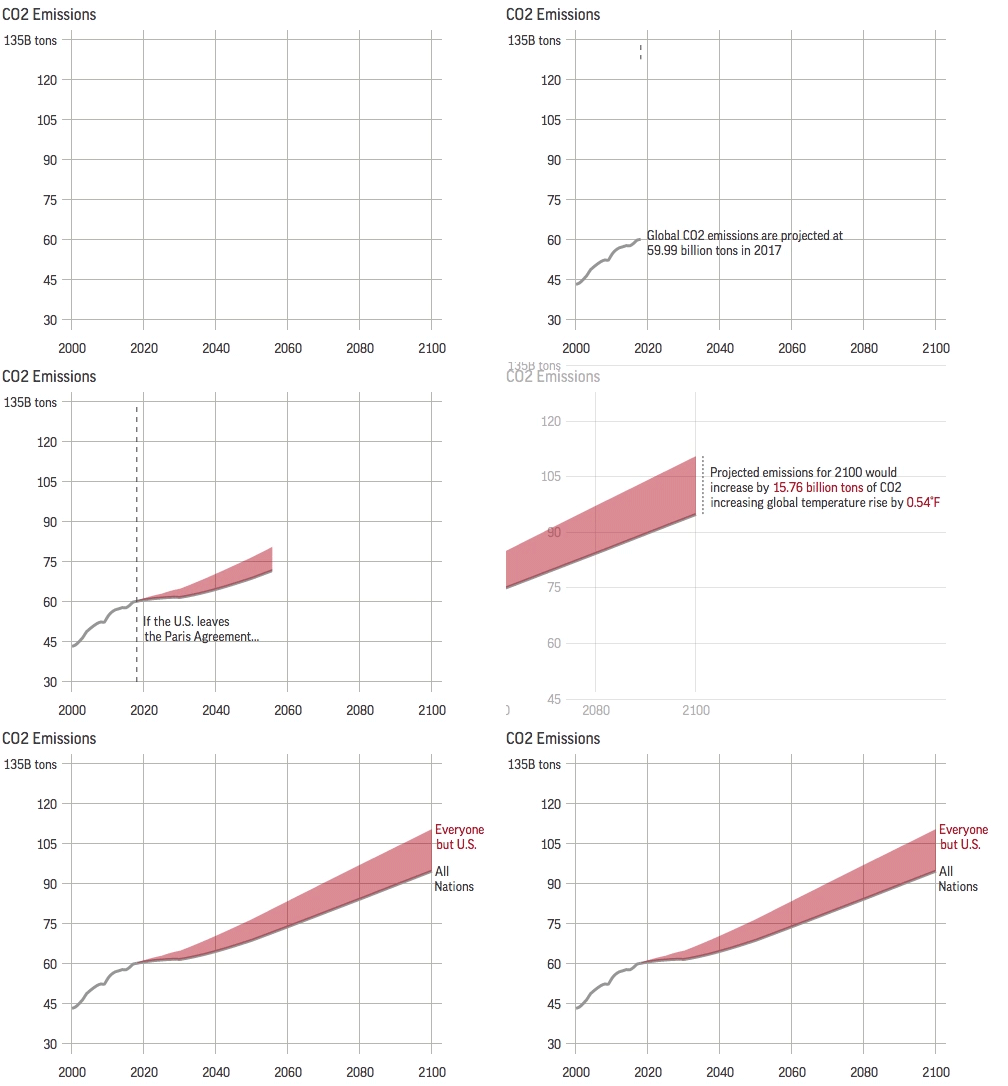
But of course, this isn’t an argument over Iraw or Bosnia. It isn’t an argument over trade. What Trump is doing will make it increasingly hard for the human race to muddle along. We’re at a very crucial point in our history. Dig this graph from AP News.
The world without U.S. efforts would have a far more difficult time avoiding a dangerous threshold: keeping the planet from warming more than 2 degrees Celsius (3.6 degrees Fahrenheit) above pre-industrial levels.
The world has already warmed by just over half that amount — with about one-fifth of the past heat-trapping carbon dioxide emissions coming from the United States, usually from the burning of coal, oil and gas.
So the efforts are really about preventing another 1.6 degrees Fahrenheit (0.9 degrees Celsius) from now.
“Developed nations — particularly the U.S. and Europe — are responsible for the lion’s share of past emissions, with China now playing a major role,” said Rutgers University climate scientist Jennifer Francis. “This means Americans have caused a large fraction of the warming.”
Even with the U.S. doing what it promised under the Paris agreement, the world is likely to pass that 2 degree mark, many scientists said.
But the fractions of additional degrees that the U.S. would contribute could mean passing the threshold faster, which could in turn mean “ecosystems being out of whack with the climate, trouble farming current crops and increasing shortages of food and water,” said the National Center for Atmospheric Research’s Kevin Trenberth
The best case scenario is more war, more instability, more starvation, and more disease. We’ll have more forced migration, refugee crises, and violence. The worst case is that the coastal cities flood, plants wither away, and human life becomes untenable on the planet in the next few hundred years. That isn’t the most likely scenario, but it is, in fact, a possibility.
This isn’t happening just because of Trump. It’s obviously a global problem, caused largely by capitalism, but with many other factors as well. And right now, the problem isn’t just Trump, but the entire Republican Party, which sees climate change as liberal snowflake nonsense, or a deep conspiracy to erode sovereignty.
It’s part of this madness that sees the earth only as land to be exploited, and sees reckless and selfish greed as a virtue. It’s the entire Republican Party. I don’t know if Jeb would have pulled out of Paris (though Cruz would have), but he would have appointed someone like Scott Pruitt to run the EPA. Maybe not as venal and corrupt, but someone who would have overturned regulations that protect us and the environment (pro tip: as animals, we’re part of the environment, which is something that we don’t really seem to understand). There is a small chance, I guess, that Trump will stay in, but he’ll do so in a way that still breaks every promise.
So that’s where we are. It would be laughable if it wasn’t so terrifying. There’s only one major political party in the world that doesn’t believe in climate science, and that is US Republicans. They don’t believe in it because they are faith-struck and fear-ridden and resentment-driven and paranoia-riven. They have no basis in the real world, and therefore don’t care what happens to the real world.
And they are a minority party in the US. And the US is only 4.4% of the world’s population. So a small, mostly-regional party in a country with a fraction of the world’s population is not only ripping apart the greatest force for peace the world has ever known, but literally setting the human race on a path toward possible wreckage, and even possible extinction.
And the face of that is Donald Trump. The sheer cruelty and stupidity of this, that Donald Trump, this vulgar dummy who in a decent world would never have been more than a cheap used car salesman, is consigning the planet to hell, is enough to send one to gibbering laughter. It’s the echoing laughter of the doomed, gone mad in a ghostship slowly drifting across a deadened sea.

/cdn.vox-cdn.com/uploads/chorus_image/image/55252903/695926812.0.jpg)


 Shooting Irrelevance