“A Hundred Tiny Hezbollahs”: In Syria, Today’s Desperation is Tomorrow’s Outline


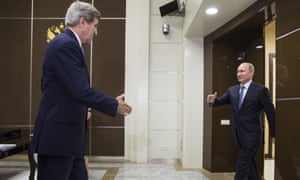
John Kerry and Vladimir Putin

Not pictured: Syrians


As talks begin again in Vienna on ending the Syrian civil war (which is so much more than that), the main issue revolves around whether Bashar al-Asad should stay or go, with the US favoring the latter and the Russians promoting the former. It seems weirdly removed and high-level, and it is, because the realities on the ground make the removal of one man a short-term fix at best, if not entirely irrelevant.

A really interesting and well-reported article in Foreign Policy by James Harkin helps illustrate why. In the article, Harkin talks of how Hezbollah has flooded the area around Damascus, propping up the Syrian army, and training local militias to fights ISIS, Nusra, and other enemies. The militias are largely Shi’ite, Ismaili, and Druze, all of whom are among the main targets for Sunni extremists. Here’s a taste of how complicated it is.

As Syrians retreat to sect, ethnicity, and tribe, Hezbollah’s services as specialists in irregular warfare are in massive demand. This isn’t only true for Syria’s tiny Shiite minority: Many other religious groups have been threatened — but also emboldened — by the crisis. Faced with the rising tide of a vicious Islamism within the insurgency, they are organizing themselves in Hezbollah-like “self-defense forces.” From the Druze in Swaida to the Syriac Christians in rural Homs to the Alawi-led “Syrian resistance” formations in the coastal provinces of Latakia and Tartous, they see themselves as engaged in a life-or-death struggle for their beliefs, and they exist in a fractious, paramilitary relationship to the Syrian state.

In any war, alliances shift and bedfellows that are made are far stranger than in politics. What ISIS has done, among other things, is to further distort who is on the “right” side. It’s easy and correct to say that the battle between ISIS and Asad is a battle between two terrible sides, but what of the other Alawites? What of the Druze who flock to an Asad quasi-ally in Hezbollah, who are also defending Christians but have all but colonized Golan? If the Ismailis side with Asad, who is a monster, against ISIS, who tried to exterminate them, should they end up on the losing side of the civil war if the US gets its way in negotiations?

The point here is that focusing on Asad, while understandable, overlooks the tectonic fractions that created these conditions in the first place. I think it is inevitable that there will be a new map, as Syria and Iraq have, for all intents and purposes, ceased to exist. In Vienna, they are as much a product of diplomatic imagination as they were at the end of WWI. Understanding the new realities on the ground is the only way to eventually find a path toward peace.

Syria, The New York Times Middle East Map, and the Length of History

On Saturday, the New York Times published a neat little article by Nick Danforth about different ways the Middle East- mostly the Levant and Iraq- could have been divided up after WWI.  There were several plans, including the original Sykes-Picot, and one from King Faisal, which at least had the benefit of being drawn up by an Arab. While there is the discomfort in thinking about conquering Westerners deciding what will be done in the region (based almost entirely on how it would serve their own interests), there are a couple times where one senses a frisson of missed opportunity and possibility, an alternative history that wouldn’t have ended with the agony in Syria and Iraq (not to mention Lebanon). A French plan for an Alawite state makes one think this could have all been avoided- the Asads would have been the king of a tiny zone, if at all, and wouldn’t have to hold on with such grim and bloody determination. Independent states around Damascus and Aleppo allow one to envision the latter city still standing, and the two countries at peace, somehow.


Alawite State hugging the Mediterranean. Isn’t it pretty to think so? Image from New York Times


Of course, any of these drawings would have carried with them their own problems, and their own internal contradictions, such as what to “do” about the Kurdish issue, Sunnis and Shi’ites in Iraq, and of course the eventual Zionist issue. Every state would have its own religious and ethnic minorities, as the lines would have to be drawn with infinite angel hairs to give everyone national determination or to make “pure” states, if such a thing were even possible, not to say desirable. And humans being humans, there would always be cause for war.  There was no real solution, perhaps.

That’s really the nut of the matter. The modern Middle East and the Balkans were both born of the same historic moment: when the rise of the nation-state coincided with the death throes of an ancient empire- the Ottomans. They aren’t exactly the same, of course. The Balkans went through a brief Austro-Hungarian phase, but that was due to the long-running collapse of the Ottomans, the Sick Man of Europe.

It’s hard to think about now, but these were places that had a political system in place for hundreds and hundreds of years (the Ottomans began to dominate in the 14th and 15th century). It was a multi-ethnic and ever-shifting empire, with central power waxing and waning, but never disappearing. When it died in the aftermath of WWI, it was suddenly due to be replaced by modern states.

We don’t really recognize that this is a long and uncertain process, but think of it like this: pretend you are reading a history book in the year 3500, or about 1500 years from now. I know there probably won’t be books at that point, but you’re going to be dead by then anyway, so just use your imagination, ok?

You’d read of the 500 years of Ottoman domination, and then the tumult of the 20th century. The Balkans were briefly dominated by the Soviets and Tito’s 3rd-wayism, and the Middle East by colonialism, followed by nationalism and tyranny, followed by religious fanaticism, until it all collapsed, slowly and then suddenly, starting in around 2003. But the thing is, that section wouldn’t be long.

We’re fewer than 100 years since the Ottoman’s collapsed, and while a lot has happened, it always seems like a lot happens when you’re living through it. But we’re still in the last rigor-mortis flicker, the dying tail of that millennial empire. The Soviets mutated the direction of the Balkans, but they were just a blip, a large factor in determining what would happen in the post-Ottoman Balkans, but still a mere factor in that longer story. Everything that has happened in the Middle East is part of that same tale. The mutations of colonialism, nationalism, and religion are just playing a role.

This isn’t historical determinism. No one’s fate was written by the Ottomans. But if we want to look to the future of the region, after the wars and after ISIS, we have to be able to look at the longer story, a region that moved from stagnant empire to the vortex of the modern nationalistic politics in the span of a few scant decades. No matter how the maps were drawn it would take decades or longer to shake out. Understanding this process, and understanding that what comes next won’t look like what came before, can help us avoid the mistakes of the past, the ones that have led to the ruin and pain of the suddenly modern Middle East.

The Right-Wing Martyr Complex, Nutshelled

Above: Glenn Beck

The brave, doomed, Lightweight Brigade  of the rightwing media charges on in the face of Facebook’s despotic decision not to promote the paranoid yippering of Newsmax as, well, news. Don’t worry. Mark Zuckerberg, showing more of an ability to stomach nonsense than I would have thought possible, is meeting with conservative thought leaders, including Glenn Beck, according to Re/Code.

Facebook has since argued, over and over, that the suppression charge isn’t true — or, at least, that it doesn’t have any evidence that it’s true — but the story continues to have legs.

See for example, Beck’s post, which says that Facebook has “the same problem that many in media and Silicon Valley face: suppression of conservative voices and ideas…How does a company who allowed voices to be heard in Iran and Egypt which sparked revolution silence voices of anyone here?”

I don’t think anyone who has been on Facebook would argue that conservative voices are “silenced”- Donald Trump’s fetchservant would probably agree- but this is absolute manna to the right wing. It allows them to try to distract from the Trump fiasco by turning their popguns on the most vulnerable targets: the media. The hated, disgusting, shameful media which refuses to ever let conservatives be heard, except literally all the time. You watch: they’ll figure out a way to tie this into the Rise of Trump, a grand scheme of how Facebook purposely silenced true conservatives and promoted Trump so that a New York liberal could pave the way for Hillary. This is just another thread in the tapestry of their minds, where they all envision themselves a mini-Churchill, fighting bravely against Saracen hordes. It all makes sense to them.

Also, don’t think Glenn Beck isn’t serious about getting something done. “Beck says he hopes that Carly Fiorina, ‘business icon and a woman with a spine of steel,’ will be joining.” I’m sure Zuckerberg can learn a lot about how to run a successful tech business from her.


After ISIS Massacre of Real Madrid Fans, Muslim Lives (Briefly) Matter


ISIS kill 14 Real Madrid fans at supporters club

Horrible story, from Vice

According to AS, a Real Madrid fan club in Iraq was targeted by Islamic terrorists during a meeting, with 16 people being killed, and 20 more injured. The attack occurred in the town of Balad, about 75 miles north of Baghdad, where at least 93 people were killed in three car bombings yesterday. Gunmen wielding AK-47s entered the cafe where about 50 club members were meeting and began firing, leaving a grisly, blood-soaked scene.

The president of the group, Ziad Subhan, told AS that the Islamic terrorists “don’t like football, they think it’s anti-Muslim. They just carry out attacks like this. This is a terrible tragedy.”

That ISIS are the kind of guys who think everything that makes life even slightly worth living is anti-Muslim is as wretched as it is, at this point, axiomatic. It’s a blinkered and blood-soaked worldview that makes the simple act of watching soccer one of almost unimaginable bravery. It makes the world as parched as the land. But the story also has this.

Real Madrid is aware of the attack and released a statement expressing condolences for the victims and their families. The team will wear black armbands during tomorrow’s match against Deportivo.

Is this the first time that Muslim victims of ISIS have received international support and sympathy on the sporting level? The sympathy gap was made obvious to everyone after the back-to-back attacks on Beirut and Paris in November, which The Atlantic more accurately called “the empathy gap.” There is of course the idea that simply by being Muslims, they have brought it on themselves, and are victims, sure, but somehow also culpable. But more than that, a feeling that those lives are disposable. Partly because they are Muslim, but also because we assume that they are going to die, just from living over there. It’s an unspoken and unexamined feeling that they don’t feel pain, or that their losses aren’t as wrenching as ours. (TNC talked about this with the lives of black men in Between the World and Me).

So it is easy to be cynical and say “ok, so their lives matter only because of sports, right?” But if it is a shared love of sports that lets people recognize a shared humanity, then all the better for sports. Let’s just hope we remember this when people who aren’t cheering for a team are slaughtered.

Political Quick Hits: Trump’s Butler, Facebook’s Journalism, and Mark J. Perrone on Paul Ryan


“I’ll remove my hand when Mr. Trump lets me!”


  1. I guarantee you right now there are people bemoaning the fact that Trump’s racist, unhinged sycophant of a butler is getting a call from the Secret Service for wishing President and Mrs. Obama to be hung for treason and saying he’d happily do it himself. Watch this turn into a rant about the 1st Amendment and Obama’s thuggish storm troopers, sent by (why not?) Eric Holder, who’s probably up to something nefarious, somewhere. The Secret Service, of course, has to do a perfunctory investigation of every threat to the President. That’s kind of their job, and it’ll probably entail a quick conversation wherein the establish that he’s simply a racist coward who spent an entire lifetime sucking up to other racist cowards, and move on. That won’t stop the complaining of course, but they have to do it. I’m sure at one point Leon Czolgosz was like “Oh, can’t a fellow even talk anymore? Don’t I have the right to express myself? When did this turn into Soviet Germany?” (Leon was pretty prescient).
  2. That said, I can’t imagine there will be too much wagon-circling around the Senecal (though “The Butler Said It” will be about 10,000 headlines). If you’re like me, you tread warily and reluctantly into comment sections on places like Newsmax or Breitbart or FOX. That, only more unhinged, are the sections of his Facebook page. When anyone says that the only racism is toward whites or that there isn’t something wild and loose and unchained in this country, point them to these. These are seriously unstable people, and they aren’t alone. For proof they aren’t, look at, say, the Republican Primary. (Warning: screenshot below from Mother Jones will probably make you sick and wail and gnash your teeth at the very thought that we live in the same country as people like this).
  3.                                    
  4. So yeah, it turns out that Facebook’s Newsfeed isn’t entirely algorithmic, and that human editors have some say. According to The Guardian, “Facebook relies heavily on just 10 news sources to determine whether a trending news story has editorial authority. “You should mark a topic as ‘National Story’ importance if it is among the 1-3 top stories of the day,” reads the trending review guidelines for the US. “We measure this by checking if it is leading at least 5 of the following 10 news websites: BBC News, CNN, Fox News, The Guardian, NBC News, The New York Times, USA Today, The Wall Street Journal, Washington Post, Yahoo News or Yahoo.” This of course has caused panic on the right, despite the presence of The Journal and Fox, because of reports that the editors would ignore stories from Breitbart or Newsmax. John Thune is screwing on his most handsomely concerned face to call for an investigation. Let’s ignore that Facebook is a private company. This is an important issue; millions get their news exclusively from Facebook, so what they decide is trending actually does matter. What Facebook does has an impact on our democracy. Which is why this is the best story ever about Facebook. I mean, come on: have you ever felt so positive about Facebook before? They actually use real news sources with fact-checkers and a sense of responsibility. Pushing stories from Newsmax, a place that Trump’s butler would think is “a little leftist”, would be wildly irresponsible. This is good citizenship by Facebook. This paints them in a much better light.  It’s not like you see Daily Kos or Shooting Irrelevance there either (although the latter would be fine). It’s a sign of modern conservativism that they see unholy bias in a publishing company not promoting the poorly-transcribed fever dreams from right-wing tidal swamps.
  5. A few days ago I ranted a bit about the Friends of the Parks in Chicago blocking the Lucas Museum, calling them “petty-tyrant pecksniffs”. However, and I’m honestly not quite sure how I missed this, I read that they are being represented in court by Thomas Geoghegan, a man whom I think is among the most honorable in the whole city, and who I admire greatly. This is a pickle, and it means that I failed as a blogger: reacting without doing enough research. I still think it is absurd, but I imagine the argument being that simply because a billionaire wants Rahm to jump doesn’t mean everyone has to say “how high”, which I respect, even if I think that ultimately the musuem is a GREAT idea. But Geoghegan vs. Rahm, man, it’s not even a question of which side you pick. Geoghegan vs. Father Pfleger? That’s much tighter. Their being on opposites sides of an issue is making my moral compass all loopy.
  6. Finally, Paul Ryan, and his vacant-eyed Hamlet vacillation on Donald Trump’s rough-palmed courtship.  I actually don’t envy Ryan his position at all, but he does deserve it. For an interpretation of the last few days, I’ll turn it over to friend of blog Mark J. Perrone, Private Eye. The title is “Thou Are Not False, But Thou Art Fickle”


“Maybe I won’t even go to the dance!”


Man, Paul Ryan is the Princess and the Fucking Pea.
 
I was watching MSNBC at the gym this morning, and his big “meeting” with Trump is today.  They’re covering it like these schmucks are dividing up postwar Europe. 
 
Reporter: “Trump arrived earlier to the building via car, a bold move.” 
 
Different Reporter: “We believe that Trump and Ryan are currently exchanging human words.” 
 
GOP Tool: “We think Paul Ryan will ultimately come to accept Trump as the nominee.  He just simply doesn’t know Trump, since his every utterance has only been covered ad nauseum for a year.”  
 
That Janesville Eddie Munster’s managed to turn this into Paul Ryan Mood Watch: “Oh Whatever Do I Feel?”  Paul Ryan 2020: LEADERSHIP!.


One of those stories that makes me feel like Clint Eastwood in “Gran Torino”

Gran Torino Movie Review

Pictured: the author, if he were cool and tough. 


Times

When it comes to emojis, women can be brides or princesses, paint their fingernails, get a haircut and go dancing in a red dress. If those sound like roles determined by the patriarchy, well, it’s not a new complaint.

But it may be changing. Google wants to add 13 emojis to represent women, and their male counterparts, in professional roles.

“Isn’t it time that emoji also reflect the reality that women play a key role in every walk of life and in every profession?” said a proposal from a team of Google employees that was submitted to the Unicode Consortium, which serves as the midwife to new emojis.

The proposed emojis include women in business and health care roles, at factories and on farms, among other things.

This isn’t a leftist complaint about modern feminism. I think representations do matter, both for personal judgement and societal expectations. Symbols are often as powerful as actions, and changing underlying and even unspoken assumptions about gender roles is important. And it isn’t a complaint about emojis. Communication evolves, and pictograms aren’t exactly a new innovation. I think there can be a discussion about if they (and other text language) actually enhance or degrade communication, but that’s neither here nor there.

It just a reflection of me, and how the world has certainly passed me by. “Emojis? We’re talking about emojis? Of all the damn things…”  Honestly, I’m ok with it. Not because there is anything inherently wrong with the new- there isn’t- but deciding that you don’t have to be up on everything is really liberating. I don’t know if there is an emoji for semi-grouchy complacency, but if there is, that’s my face.

“Until we find out what’s going on” Continues To Be Official Trump Policy


Pictured: John Kerry?

Remember when John Kerry was permanently labeled a “flip-flopper” thanks to a smart Bush team and an enabling press, who, with few exceptions, loved the label, adopted it, and breathlessly discussed it? It was fine to discuss his positions and character, of course, but any normal political act was instantly labeled another “flip-flop” by a press almost sexually enamored of a swaggering war President.

That’s normally how things work. Labels get stuck because the press is lazy and people easily accept quick caricatures in place of actual characterization. Bush was dumb (instead of arrogantly incurious), Gore was boring and a liar (instead of neither), McCain was grouchy (true!), Obama was aloof and arrogant (kind of true), etc. That’s the way it usually works.

That’s why one of the more genuinely frightening things about this election is that it has revealed, once and for all, the power of pure thuggishness in the face of any rationality. It’s why no labels have really stuck on Donald Trump. The rage he channels is enough to flatten the incredible contradictions, reversals, and sheer ignorance that underpins his campaign, like a boiling river leveling a hapless and god-beseeching floodplain town. His position on terrorism, or rather “terrorism”, makes this clear.

Continue reading

Identity Politics and The “Hunger for a Third Party”


Pictured: identity politics


The Atlantic has been writing a lot about whether their political coverage should include more about third parties, if that would be more fair and democratic. The initial reaction could be “of course not; that would be a waste of space. A 3rd-party has no chance.” The flip side is that of course they don’t have a chance, because no one writes about them. You can’t breathe without any oxygen.

Personally, I think The Atlantic, and other sources, should spend more time covering other political parties, but not because they have a chance. I think even with enough of a spotlight they wouldn’t be able to grow. Money and structure make it nearly impossible for our system to truly support a third party, and the latter reason isn’t necessarily negative. This is far from the first time in our history that people have looked to break up the duopoly, and even in times of turmoil- even when Whigs fall to the whayside- it coalesces again into two parties.

Still, though, there is the need to spend time focusing on what is happening on the outside, because it makes both parties more responsible (in theory, anyway) and allows for outsiders, like Bernie Sanders, to come in and shake things up. It might not matter electorally, but it matters in terms of policy, and it helps to showcase what people are thinking in this unruly nation.

Sometimes, that’s not very pretty.

Read more to find out what’s not very pretty! 

Continue reading

Chicago Gondolas; or, Sure: Why Not?


Pictured: Gondolas! Also Trump Tower. 


After the apocalypse of the last post, I’d still like to come out as being firmly in favor of the weird and kind of cool Chicago Gondola Plan. What I like is that it firmly reimagines Chicago as what it originally was: a river town, built from an impossible idea of dredging a narrow and shallow and sand-chocked river to ford a muddy expanse of swamp in order to make it, eventually, to the Mississippi. It was audacious and ridiculous and it worked. We’ve more or less forgotten that this was a river town, that it was built due to water, due to being at the perfect spot where the Great Lakes basin ends, and the continent shifts imperceptibly toward the Mississippi Basin. It’s that slight hinge, that tectonic blip, that has created the life of the city, and the destiny of million.

So focusing on the river, as the great people at Friends of the Chicago River* do, is an exciting development. And while I don’t quite see the connection between gondolas and Chicago, and while I don’t think they will be “iconic” in the way the Eiffel Tower is (despite the claims of the people proposing the plan), I think it is cool, and will bring even more people to the city.


Pictured: Gondolas! I think this can offer awesome views of the lakefront, the skyline, and the parks. 


What I especially like is that the plan is to go south along the river, to Chinatown and beyond. The area there has seen a bit of an uptick, as we move to clean the river and promote more tourism. Showing people that you can safely go sotuh of Madison is a good way to expand what Chicago tourism means. It won’t solve all the problems, but getting people to conceive of Chicago as more than Michigan Avenue and Wrigley Field is a great start.

(Also, while I love love love the idea of projecting opera on the back of the Civic so people can float up and watch it, I think they are overestimating the general appetite for opera.)


Pictured: perhaps an unrealistic expectation of public enthusiasm for opera. 

*Not to be confused with the ruinous petty-tyrant pecksniffs of the Friends of the Park, who blocked a museum to save parking lots. I’m so angry about this I can’t quite breathe.


New York Times Chicago Survey: A Broken and Bitter, but Better City


At one point, people were leaving the Loop


On Friday, the New York Times published a survey showing Chicago to be a fiercely divided and unmoored city, unsure of itself and seemingly faltering toward some kind of calamity. It’s not hard to see why: unearthly violence has torn apart huge swaths of the city, while other areas go unharmed. Outlandish, Syrian-like police brutality, extrajudicial black sites,  and of course murder covered up at the highest levels all add up to simmering racial resentment.

In addition to this, basic institutions seem to be crumbling. The CPS has been battling much-loathed Mayor Rahm Emmanual, in what seems to be an actual liberal revolt against an entrenched system (Chicago has always been Democratic, but only the most blinkered partisans would ever say it has been an actual liberal city in any real sense). Governor Rauner is trying to starve out any union activism by destroying the schools. Hell, we can even look over at the chaos in Brazil and reflect that a large number of people thought that was a better place for the Olympics than Chicago. It’s not a great feeling.

So then why are things better? The shoots of hope come from the actual survey.

Read more on this mind-blowing bit of counter-intuition, especially if you are a hiring manager at Slate…

Continue reading