

Pictured: possibly a slight exaggeration.
The Times provides a comprehensive reminder that when people say “global warming will have us at ‘X’ by 2100,” the problems start today.
Pictured: possibly a slight exaggeration.
The Times provides a comprehensive reminder that when people say “global warming will have us at ‘X’ by 2100,” the problems start today.

A weird and ill-thought-out tweet provided one of this miserable gut-kick of an election’s biggest unintentional laughs, save every time Jeb Bush spoke, but also highlighted its single-biggest dishonesty.

This is the Zapruder film for Angels fans
A couple of weeks ago I was watching a White Sox game (note: I don’t know why, either) and, as it will, a third strike was dropped. The catcher easily threw out the batter/runner, as they do. Maybe this one was slightly closer than usual, or maybe it was just because the game was boring and whatever I was reading wasn’t holding my attention, but I started to wonder about the dropped third strike. It’s a strange rule, giving new and unfair life to the batter. Now, as the beneficiary of one of the oddest (and honestly, dumbest) dropped third strikes in recent memory, it shouldn’t bother me, but it did. I vowed to find out why this rule existed, and what in baseball history caused it to be there.
And then promptly forgot about it, probably by the next pitch.
However! There are people who are much better than me, and coincidentally, my great and good friend Brett Kaufman took a break from aiding and abetting terrorism and sent an article from the invaluable people at the SABR Society. It’s from last year, but it pretty timeless, in the same way baseball is. Apparently, the dropped third strike has its roots in a form of German protobaseball.
The story begins in an unexpected source: a German book of children’s games published in 1796 titled Spiele zur Uebung und Erholung des Körpers und Geistes für die Jugend, ihre Erzieher und alle Freunde Unschuldiger Jugendfreuden (“Games for the exercise and recreation and body and spirit for the youth and his educator and all friends in innocent joys of youth”) by Johann Christoph Friedrich Gutsmuths.2 Gutsmuths was an early advocate of physical education. He is best known today, outside the rarified field of baseball origins, for his promotion of gymnastics. In 1793 he published the first gymnastics textbook, Gymnastik für die Jugend (“Gymnastics for Youth”). His 1796 work extended the scope to additional games. These include a chapter Ball mit Freystäten—oder das Englische Base-ball (“Ball with Free Station—or English Base-ball”).
Gutsmuths wanted people to run, as Germans do, and to exercise, even if they couldn’t hit a loftily-tossed ball (think beer league softball). Through the literal centuries, through the wild and murky past of baseball forming in cities and towns across the nation, as different rules were enforced differently, this idea came and went, and finally stuck. It’s now part of the unquestioned canon.
That’s one of the coolest things about baseball. We know exactly when James Naismith founded basketball. The history of football is pretty understood. But baseball has all these weird quirks, these little foggy twists in time. Researchers are always finding stories about a group of Norweigan tree-fellers in Wisconsin playing a recognizable game in the 1820s, or something (that’s made up, but you know). We keep learning more about it, like it’s some ancient civilization that’s continually being dug up. It’s so cool to see how it influences even what’s happening at Guaranteed Rate Stadium.

“It’s physical, sure, but not exactly beautiful, you know?”
I promise no more Trump for the rest of the week.* I’m as sick of this as you are. And without even getting into the substance of his immigration speech, I just want to point out two quick parts (from the transcript on Vox).
Number one. Are you ready? Are you ready? We will build a great wall along the southern border. And Mexico will pay for the wall. 100%. They don’t know it yet, but they’re going to pay for the wall. And they’re great people. And great leaders. But they’re going to pay for the wall.
On day one we will begin working on an impenetrable physical tall powerful beautiful southern border wall.
This is a little more substantive.
Countless Americans, who have died in recent years, would be alive today if not for the open-border policies of this administration, and the administration that causes this horrible, horrible thought process. It’s called Hillary Clinton. This includes incredibly Americans like 21-year-old Sarah Root.
I honestly don’t know if I’ve ever seen such a combination of genuine stupidity and genuine danger in a single person.
Anyway, I promise* that the rest of the week will be more fun stuff like ISIS.
*promise not binding

I run the best casinos. Believe me.
I’m not concerned– relative to my sweaty panic over the possibility that the worst person in America has a legitimate shot to become the next President– that Trump said one thing in Mexico, and then a completely different thing in his big immigration speech to an adoring crowd. The substance isn’t that interesting, and it was expected. After a solid week of people saying he had to “soften” his immigration approach, there is no way Trump wasn’t going to double down. That’s his personality: a dimwitted sociopathic 4th-grader. We know this.
No, what is much more interesting, and telling, is how he came out and said that the topic of who was going to pay for his big and beautiful wall didn’t come up when he met with Mexican President Enrique Peña Nieto. I actually believed this, because I figured both men tacitly admitted that was an insane idea, only believable by the goons in his Leni Riefenstahl stag parties.
It turns out, of course, that it apparently did come up, first thing, in the form of Peña Nieto declaring that there is no way Mexico is going to pay for his wall. So who is lying? If you have to ask, you haven’t listened to a single word Trump has ever said. He lies as a matter of course, and habit, because the sell, and the con, are the only thing that matters.
Think of his Mexican presser as him going to talk to one group of suckers who want to invest in, say, the third casino he is building on one stretch of road in Atlantic City. He just met with some experts, and is ready to deliver the news: everything is fine. “Well”, say the nervous investors, “wouldn’t all three just suck revenue from one another and lead to a collapse?” Trump would say
“Well”, say the nervous investors, “wouldn’t all three just suck revenue from one another and lead to a collapse? Did they say anything about that?” Trump would say “You know what? It didn’t come up. Everyone says it is a great idea, and it’s going to make so much money.” Trump lies because that’s how he sells things to gullible investors, including banks. He just makes up whatever he has to do to please an audience, to get them to buy his pitch. It’s different than what normal politicians
It’s different than what normal politicians do, because he has absolutely zero substance. The lie, the con, the sell, is the entirety of his approach. There’s nothing behind it. It’s why he lies with such ease and without hesitation. Behaving in this way is integral to his– and I use this word in the loosest possible sense– character.
Remember, even if he used to, Trump doesn’t build anything anymore. He doesn’t manage or run things in a real sense. He sells his name to people to use as some kind of stamp of authenticity. And that’s how he’s run his campaign. There is no actual policy, no substance. The campaign is just a way to keep the campaign going, to keep selling. It’s alie created in order to tell more lies. It’s just another reason why, while his winning would be a disaster, the fact that it is working at all has exposed a Trump-shaped rot in the American character.

I’m honestly not sure who is more demeaned by a “Trump pinata”
So, Trump’s Mexican visit was basically what you’d expect from mutual bluff-calling between a couple of dopes: awkward, pointless, and irrelevant. I’m sure there will be some pundits saying that “Trump appearing to be a statesman could convince voters!”, doing that thing we’re they are the ones convincing people of the appearance but pretending it occurs naturally. Politico already is! But still: I think it’ll be a blip on the campaign, and his attempt at coherence on immigration tonight is far more important. Because, contra the high-level discussions, it isn’t about “hardening” or “softening”; it’s about having a policy at all. He has never had one beside a few grand gestures.
That’s the only thing that should be talked about vis a vis his Mexico excursion (except maybe his bizarre and again wildly intemperate and unpresidential desire to mix it up with Vicente Fox just this morning). Because there have been only three things about which Trump has been even slightly consistent on.
So, today?
Mr. Trump said the two did not discuss the issue of forcing Mexico to pay for a border wall — one of the signature promises of his campaign.
Mr. Trump said the subject of a border wall came up, but not who would pay for such a massive construction project.
They talked about issues, except for one of his signature promises, probably because both sides realize it is completely fucking insane. That’s the only important thing: Trump can’t even talk with foreign leaders about any of his beliefs because they are completely divorced from reality and easily among the stupidest things a major political figure has ever said. This isn’t what anyone should call “Presidential”.
WaPa:
While the advantage of remotely operating a direct-fire weapon such as a machine gun or sniper rifle is obvious, remote weapons can also make small bands of insurgent groups seem stronger and better equipped. The report covers one instance in which Kurdish troops attacked an Islamic State remote-controlled sniper rifle, losing men in the process while the shooter remained protected in a bunker nearby. Instead of using men to protect the remote weapon, the Islamic State instead tied up dogs around the system.
Experts are increasingly impressed and worried with the level of technological sophistication of tele-weapons used by militant groups in Iraq and Syria, especially ISIS. Mowing down Kurdish fighters with a remote-operated gun protected by dogs seems like a perfect combination of ISIS’s patented brutality and technological sophistication.
But really, it’s only the dogs, and the relatively crude-but-successful nature of the operation that make it any different from the way violence is changing, and becoming more remote and even automized. It’s one of the main issues of our day, and I don’t think it will ever be possible to have a real discussion about it, since we rush forward, and any attempt to say we shouldn’t have a weapon is lost in a deafening drum circle of retrograde chest-thumping.
Look for example at the Modular Advanced Armed Robotic System. Even just the name makes it sound like a bad idea, but saying “this will protect the lives of Marines”– which could very well be true!– makes its deployment essentially a done deal. It needs human control now, but that’s just the first step.

This makes me uncomfortable. Image from Tech Insider
There will be a point one day soon when robots will make the kill decision, algorithmically. I’m not a person afraid of a robot takeover, but I am apprehensive of them making what are essentially moral decisions. I’m also concerned that adopting higher and higher tech makes it impossible for us to condemn it, and keep it out of the hands of even worse actors. But barring high-level political action, I don’t see this as a road off of which we’re going to veer.

Image from The New Yorker.
In her New Yorker story on the purported death of ISIS spokesman and strategist Abu Muhammed al-Adnani, Robin Wright gets an interesting quote from an ISIS expert.
Hassan Hassan, the author of the Times best-seller “ISIS: Inside the Army of Terror,” described Adnani as one of a small handful of leaders left from among the organization’s founding fathers. “This means that the transition to the second and third tiers of the group is already well under way. And this could affect the direction of the organization and how it operates,” Hassan told me. “Those leaders who grew up within this organization are more attuned to the local dynamics, so the decapitation of such leaders could, in fact, inject a new life into the group. That said, the Islamic State is already shaped and well defined by those founding fathers, strategically and ideologically, so these new leaders have little wiggle room to make a change, but this is more possible than before.”
This is the central dilemma for ISIS, and the ISIS-inspired and affiliated groups, as it moves forward and struggles with AQ for the mantle of jihad. After all, they became so powerful because of their unrelenting dedication to violence, which is incredibly attractive to people, and always has been. It offers a sort of purity, and an elevation above petty morality, etc. It’s Fight Club with a glossy religious patina and a sort of medieval escape fantasy. But that’s not always successful, which is something that Adnani should have learned. As the Soufan group points out, he had an example in his mentor.
Al-Adnani was one of the few surviving members of the original group founded by Abu Musab al-Zarqawi. Long before the declaration of a caliphate, the Islamic State’s previous iterations—such as al-Qaeda in Iraq—were among the most violent and effective terror groups in Iraq after the 2003 U.S. invasion. Al-Adnani was a trusted associate of Zarqawi, whose manipulation of media and spectacle of public savagery would be imitated by al-Adnani as the Islamic State exploded onto the global scene in 2014. Over the last 14 years, al-Adnani has been front and center as Iraq, and then Syria, became the stage of unrelenting and escalating terror. He had been imprisoned both by the U.S. in Iraq and the Assad regime in Syria. As with other infamous terrorists, the arc of al-Adnani’s terror history was long, and bent towards massive suffering and destruction. His death will not bring about the end of the Islamic State. Nonetheless, it marks a significant loss for the group and removes a leading actor from the terror stage.
Zarqawi, of course, was brought down by the revolt against his methods. It’s the difference between him and the leaders of AQAP, which made sure to not alienate the locals, and tried to make grievances dovetail. ISIS is more powerful, with more foreign fighters, and were able to subjugate the territory under their control much more rapidly than AQI. That’s made a difference, but as they start to lose ground, it obviously won’t be permanent.
This is the crossroads for ISIS, as they move toward what Hassan calls “second and third-tier leaders”. If these leaders, especially ones around the world, move toward an “think global, act local” sort of jihad, they will be largely indistinguishable from AQ affiliates. If they continue to act as the caliphate, and ignore local concerns– the biggest one being “we’re concerned that you’re burning alive anyone who looks cross-eyed”– then they’ll never gain the local support they need.
That’s why I think the ISIS model is ultimately unsustainable. If it moderates, it loses adherents, the wild-eyed passion-filled radicals who seek a glorifying fire. But if it stays like this, it will never be able to gain actual local footholds other than through domination, which won’t last. That isn’t to say this isn’t a dangerous model; there will always be people emulating it in smaller and smaller cells, trying to pick up the mantle of “the real ISIS”. That is a global danger that could hit literally any community. I think that’s what is next for ISIS: a gradual splintering, and a new phase of terrorism.

Outreach!
Trump in Mexico
I’ve always thought that one of the worst aspects of being the leader of a country that wasn’t America was having to meet with every mouth-breathing midwest governor who was once called “Presidential material” by David Broder. They’d want to burnish their foreign policy cred, so they’d travel to the Czech Republic for a meet-and-greet where they’d discuss the “bilateral cooperation and trade opportunities between Oshkosh and the good people of Czechistan”, mouth fumbling over “bilateral”, clearly the first time they’d ever pronounced it. But the foreign leader couldn’t say no, because what happens if Scott Walker wins, you know?
It has to be even worse with Donald Trump, whom every single person outside the US (except for Nigel Farage and Hungarian neo-nazis) knows will be an absolute disaster, and a repulsive one at that. What do you say when you meet him? Well, that’s what will be on the mind of Mexican President Enrique Peña Nieto today when he meets with Trump, who accepted at the last minute a long-standing invitation.
On the one hand, this could be a disaster for Trump. It’s pretty clear he has never really studied the issues of trade or immigration, his two main topics regarding Mexico, and obviously has no clue about any other topics of concern the two countries might share (indeed, he is probably ignorant to the idea that there could be topics other than “stealing our jobs” and “sending rapists”). And the country is pretty hostile to him. There is a good chance this turns out poorly.
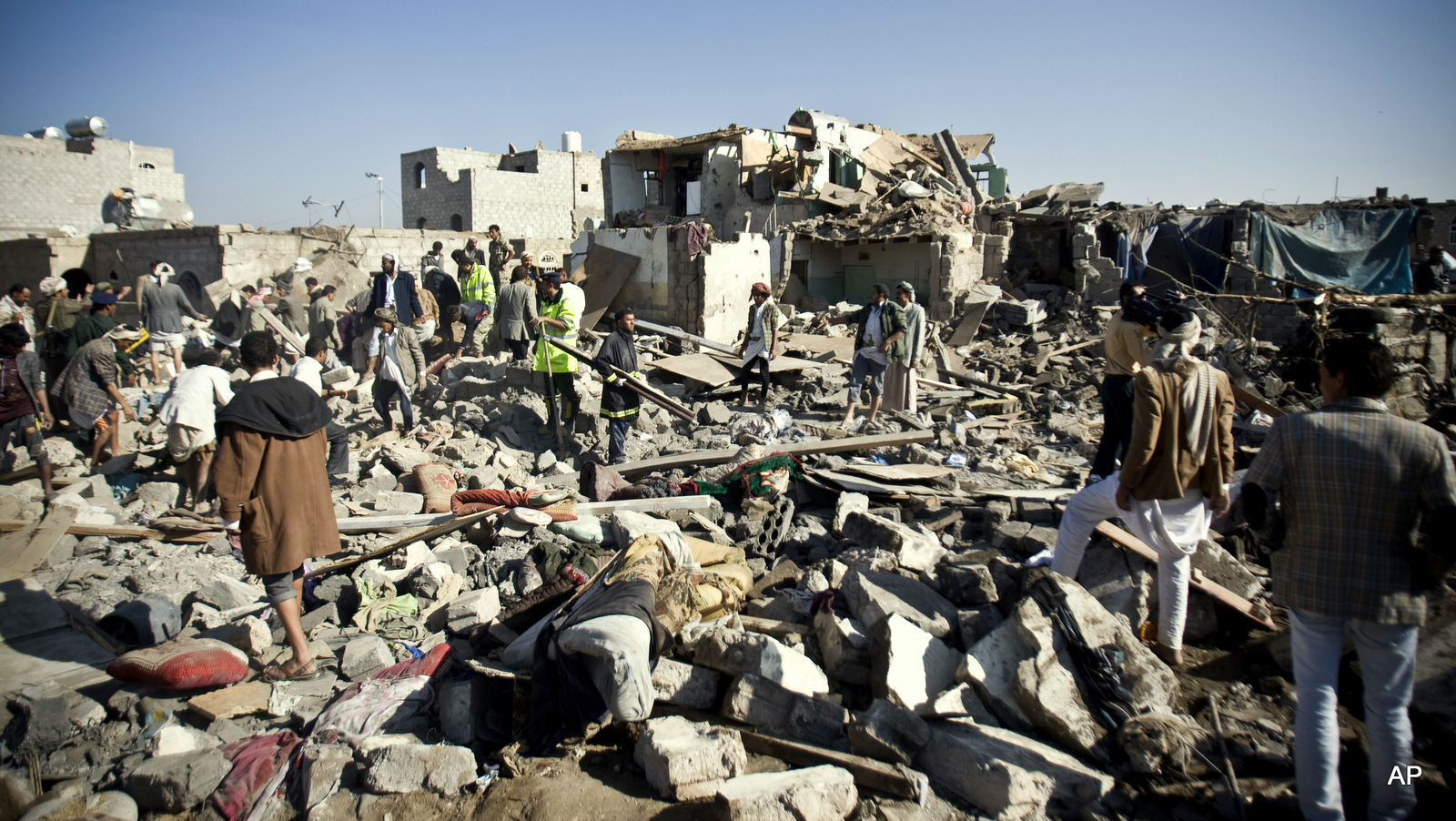
A Saudi airstrike in Yemen. Image from mintpressnews.com
Far from the ISIS-inspired headlines of Syria, Saudi Arabia has pretty calmly and easily been engaged in an endless series of war crimes in Yemen. Its policy had always been to keep Yemen weak, but not in total chaos. A kind of war madness has led them to abandon the second part of that. They are far from the only antagonists in the horrific dissolve of the nation, but they are the most powerful, and they are flexing that power in terrible ways.
And they are doing it with arms and support from the US. It is US-made planes dropping US-made bombs on hospitals and schools, with a ferocity that has led a normally-placid UN to try to stop them. From raw self-interest, this is a terrible policy for the US. From a human level, it is a nightmare.
Finally, nearly 60 congresspeople are trying to at least slow down the arms funnel, as Foreign Policy reports.
In a sign that frustration is growing in Congress over Saudi Arabia, a bipartisan group of 60 lawmakers have signed a letter seeking to delay the Obama administration’s planned sale of $1.15 billion in arms and military equipment to Riyadh.
…
The proposed sale, approved by the State Department on Aug. 9, includes up to 153 tanks, ammunition, hundreds of machine guns, and sundry other military equipment. Congress has 30 days to block the sale, but the lawmakers appear irritated that the notification of the sale came in the middle of Congress’s summer recess.
“Any decision to sell more arms to Saudi Arabia should be given adequate time for full deliberation by Congress,” wrote the lawmakers. “We are concerned, however, that the timing of this notification during the August congressional recess could be interpreted to mean that Congress has little time to consider the arms deal when it returns from recess within the 30 day window established by law.”
Part of this is territorial and bureaucratic, of course: Congress is angry about being bypassed. But they absolutely should be. The loss of Congressional prerogative in foreign policy has been a slow-rolling disaster for the US, as it allows enormously important decisions to be shaped, essentially, by the will of one branch, which in turn is shaped by the will of one person. Even when I trust the POTUS, and respect their judgment, having the lives of millions come down to one “decided” is monstrous. Leaving everyone else to deal with the ramifications of those decisions is essentially undemocratic.
So there should be more letters like this, both for the sake of our democracy, and to help the people who are being brutalized and pummeled into dust with our munitions. Slowing down the flow of arms into the Middle East, and particularly to the combatants in Yemen, is never a bad policy.
 Shooting Irrelevance