

Eeee! Image from The Guardian
Paleontologist and paleoartists– which is probably the best job in the whole wide world– have made the most accurate reconstruction of a dinosaur to date.
Eeee! Image from The Guardian
Paleontologist and paleoartists– which is probably the best job in the whole wide world– have made the most accurate reconstruction of a dinosaur to date.

Incredible new pictures of rock formations on Mars look almost banal, and that’s beautiful.
WaPa:
While the advantage of remotely operating a direct-fire weapon such as a machine gun or sniper rifle is obvious, remote weapons can also make small bands of insurgent groups seem stronger and better equipped. The report covers one instance in which Kurdish troops attacked an Islamic State remote-controlled sniper rifle, losing men in the process while the shooter remained protected in a bunker nearby. Instead of using men to protect the remote weapon, the Islamic State instead tied up dogs around the system.
Experts are increasingly impressed and worried with the level of technological sophistication of tele-weapons used by militant groups in Iraq and Syria, especially ISIS. Mowing down Kurdish fighters with a remote-operated gun protected by dogs seems like a perfect combination of ISIS’s patented brutality and technological sophistication.
But really, it’s only the dogs, and the relatively crude-but-successful nature of the operation that make it any different from the way violence is changing, and becoming more remote and even automized. It’s one of the main issues of our day, and I don’t think it will ever be possible to have a real discussion about it, since we rush forward, and any attempt to say we shouldn’t have a weapon is lost in a deafening drum circle of retrograde chest-thumping.
Look for example at the Modular Advanced Armed Robotic System. Even just the name makes it sound like a bad idea, but saying “this will protect the lives of Marines”– which could very well be true!– makes its deployment essentially a done deal. It needs human control now, but that’s just the first step.

This makes me uncomfortable. Image from Tech Insider
There will be a point one day soon when robots will make the kill decision, algorithmically. I’m not a person afraid of a robot takeover, but I am apprehensive of them making what are essentially moral decisions. I’m also concerned that adopting higher and higher tech makes it impossible for us to condemn it, and keep it out of the hands of even worse actors. But barring high-level political action, I don’t see this as a road off of which we’re going to veer.

“V” Is For Whatever I’m Told It Is For Today
Mitch McConnell might be the purest, most craven politician working today, a man with nearly zero principles other than power. Chris Christie’s speech was one of the more dishonest pieces of political theater you’ll see, but Mitch’s was pure nonsense politics. He illustrated perfectly the reasons why most people detest everything that has to do with politics.
For Mitch, that’s not a bug: the whole point is to make sure that people despise the government, and don’t want to get involved, and see it as a waste of time. That way he can do the only thing that really animates him: accumulating power so that he can siphon it off to the wealthy.
If that sounds like an exaggeration, don’t forget the tapes of his meeting with the Kochs and other billionaire donors, wherein he basically promised them the store. That made when he said last night that “More than anything though my job has taught me the value of trust. How to distinguish between people who are in this to serve others, and people who are in it for themselves.” the most honest line of the night. Mitch is in this to serve others: just not, you know, anyone who doesn’t use an ivory pen to write a 7-figure ivory check.
(All quotes come from Time transcript)
The rest of the speech was unbearably cynical, and in increasingly twisted and frustrating ways. To wit:
Two years ago voters delivered a clear verdict on the Obama years by sending a freshman class of rock-star Republicans to the Senate, and delivering us a majority that I promise to make you proud of. We never hesitate to confront the President, but we also do the hard work of tackling urgent problems head on. And, we delivered on that promise.
Oh cool: tackling huge issues like inequality, the environment? Well, that’s silly. And unfair. You weren’t elected for that. So: jobs, national security, borders?
We put Obamacare repeal on the President’s desk, he vetoed it. Donald Trump would sign it.
Oh- well, that’s not really urgent, is it?
We passed a bill to finally build a Keystone Pipeline, Obama vetoed it. Donald Trump would sign it.
That’s…not at all urgent either, even if you think “energy independence” is the most important thing in the world, and that the only way to get it is more oil. Keystone wouldn’t have helped at all. And if you thought it was about jobs, why not pass a jobs bill?
We passed a bill to defund Planned Parenthood, Obama vetoed it. Donald Trump would sign it.
That’s like the least urgent problem in America. You would have to define “access to health care for poor women” as an urgent problem for that to qualify. You people…
And finally: here’s the most urgent problem they were elected to solve!
And, on that sad day when we lost Justice Scalia, I made another pledge that Obama would not fill his seat. That honor will go to Donald Trump next year.
“I swore I’d nullify an election and refuse to do my job. Leadership.”
Ah, but that wasn’t even the worst part. Here’s the part that leaves you in a sputtering rage, impossibly angry at the sheer inhuman smarm and transparently dishonest posturing that makes politics unbearable.
So, my friends, keep the Senate in Republican hands and we’ll continue this work and the remarkable public servants that I’m proud to lead in the Senate will not let you down. But, put Hillary Clinton in the White House and I promise you this, she will double down on the cynical approach that Senate Democrats seem to revel in these days.
Here’s what I mean. As we sit here tonight, a terrifying mosquito born illness threatens expectant mothers and their babies along our southern coast. And, just last week, just last week, Clinton Democrats in the Senate blocked a bill aimed at eradicating that virus before it can spread.
See…the GOP fought against any Zika funding for months, before realizing a tactic which was to tie Zika funding to Planned Parenthood (and a host of other barely-related weakening of environmental laws). The bill would limit funding for Planned Parenthood, even though Zika was largely a sexually-transmitted disease, and PP was best-equipped to help people. They did this knowing that Democrats wouldn’t support it, because it was one of those bills that did way more harm than good. This is not a matter of debate. They never had any interest in funding Zika defense until someone came up with a way to make it seem like Democrats didn’t care about it. There was no reason to bring up Planned Parenthood, which experts agree was in the best position to help in the fight against the weird and terrifying disease, except that A) saying Planned Parenthood riles up the base, and B) it can make Dems look bad.
To an extent, that’s normal politics: poison pills and whatnot. It is monstrous, but not caring about human lives is par for the GOP course. That’s not fine, but it’s the baseline of where we are at. What is amazing, and what makes Mitch who he is, is to rail about the “cynical approach” of the “Clinton Democrats”.
What can you do? What can you do except sputter at the brazenness, the stone-faced dishonesty? You can point out that he knows his position was such bullshit he couldn’t even fully explain it. You can argue, and say how him saying the Dems are cynical while describing his cynical ploy is the most cynical thing of all, but then you are just haggling about who is worse, and that’s how they win. Because then everyone is sniveling and cynical and craven. That’s exactly what the GOP wants: people to despise the government, treat it as an enemy, and ignore it except when they are angry at it because “Washington is broken”. That’s how they win elections. That’s how they “continue the work” of making sure that government does nothing except monitor ovaries and bomb foriegners. That’s the whole goddamn platform.
And don’t forget, he was booed because he’s seen as not confrontational enough. That’s the party now.
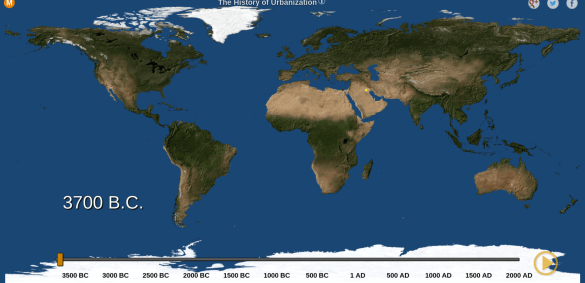
Just one city! Screengrab from http://metrocosm.com/map-history-cities.html Go there.
Right around 3700BCE, the Sumerians founded a city called Eridu. With a population of around 6000, it was the first real urban area, and undoubtedly the largest collection of humans in one spot up to that time. If you buy the Toba Bottleneck Theory (which most don’t, but there is evidence of some bottlenecking in the Pleistocene) some 50,000 years before that there were only maybe 10,000 humans total. That is an endless amount of time in the scale of our lifetimes, but it was incredibly rapid. During Toba- or at least that time, no matter what your mileage on the bottleneck- humans had very little impact on the planet. Post-ice age hunting certainly had an effect, particularly in North America. But we hadn’t yet taken over the planet. Urbanization was one of the twin engines that drove the Anthropocene, the other being widespread agriculture.
It’s also the great story of our time. From that weird beginning, in a place that must have seemed like a crushing enormity, but now would be a two-stoplight drive through, urbanization very slowly took over the world. Over the next 4000 years it was largely limited to a narrow latitudinal band, and even by the time the New World was being colonized, and north and south took on new meaning, most of the world was rural. It was only in the last 50 years that mass urbanization started taking place.
This is now beautifully visualized thanks to a landmark study on cities by Meredith Reba, Femke Reitsma, and Karen C. Seto. In it, using several data sets, they have compiled the most thorough history of urbanization that I’ve seen. They aren’t as concerned with strict definitions, but more what constitutes a large city at any given time. Cahokia, the largest city north of Mexico before colonization, makes it, whereas nearby current East St. Louis, with a larger population than Cahokia, does not. I think this is fair.
Just as exciting, at least in a visual stimulation sort of way, is the ability to map it out and watch it. I took a screenshot from Metrocosm, which is an invaluable site. In it, Max Galka shows cities popping up. It’s amazing to watch the pace, as they first center in modern-day Iraq, spread slightly east and west, and start to really roll as India and China develop their eternal cultures. Then Europe and Mesoamerica, then elsewhere, more north and more south, but still spaced out. Then the 20th-century these urban area start to spring up everywhere, and in the last few seconds of the video, it’s a violent epileptic explosion of dots, each one representing the lives of hundreds of thousands and of millions. It’s amazing. (The Guardian has a video as well, shorter and set to a jauntier tune.)
What we see with these maps, and in these datasets, is a dramatic visualization of the choices we have made as a species. I personally am very much in favor of urbanization, and think that it is a great way to reduce our impact on the planet, if done correctly. But there isn’t a way to mistake it: by transforming the land for agriculture, and then transforming the very basics of water drainage, light, sound, and other factors for urbanization, we’ve created the most species-driven environmental change since (arguably) the Great Oxygenation Event, which most scientists will tell you was a bad scene, man. Remember that the great cities of Mesopotamia were not dry and dusty, but lush and verdant.
But not to be a pessimist entirely. The data and the videos are also thrilling. It’s a stirring wonder, that atavistic gnaw in your stomach, to imagine a citizen of Eridu, gazing in wonder at the crowds. Did they know what they had accomplished? Did they know that a mere generation or two before such a thing was unimaginable? Surely they did; they had the imagination to build. They had the imagination to plan for a future. They had the knowledge to remember the past. They were us.
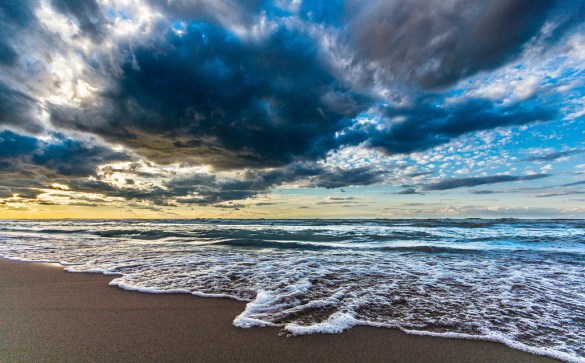
A Great Lakes sunrise for Waukesha. Image from North Country Public Radio
Previous Waukesha posts:
Governors from the eight Great Lakes states agreed Tuesday to allow a Wisconsin city to start pumping millions of gallons a day from Lake Michigan, marking the largest diversion of water from the lakes since Chicago reversed the flow of the Chicago River in 1900.
The unanimous decision favoring Waukesha, a Milwaukee suburb of 70,000 about 17 miles west of the lake, is the first test of a 2008 legal compact intended to prevent thirsty communities or countries outside the Great Lakes region from dipping into the world’s largest source of fresh surface water.
There are two ways to look at this: one is that it is a disaster, a slippery slope, a sluice suddenly opened that’ll eventually compromise the Great Lakes. The other way to look at it is that it showed the Compact, essentially works. The Compact does have allowances, and Waukesha has possibly the strongest possible case: straddling the Basin, poisonous waters, a plan to divert 100% of the water back into the Lakes, etc. And yet they still spent years and years and millions of dollars trying to get the exemption, and their plan was shrunk and compromised. If a city with the best-case scenario for application can barely get it, what chance does Arizona have?
And yet, the flip side of this is that you always start with the easy one. Now don’t get me wrong; I don’t think there is some conspiracy here. But I do worry greatly about water, and the desire to privatize it, and anything that makes it easier to do so can be troublesome. Do you really trust Rick Snyder with your water?
For the most part, protecting the Great Lakes has had a surprising amount of bipartisan support for conservation. Being angry at environmentalists usually stops when it is your resources on the line, and the Lakes are one of America’s great treasures. It’s why staunch conservatives like Tommy Thompson were eagerly behind it. I worry about the new breed, though, who see it as a mission to put everything public in private hands. That Minnesota governor Mark Dayton approved, given the conditions, makes me feel better, but Walker, Rauner, Snyder, et all (including Cuomo) is worrisome. Approving the diversion might be right, and might be essentially apolitcial (it is supposed to be), but given the attempt to parcel off water to the highest bidder, caution is required. I do think Republicans of good faith want to protect the Lakes. I don’t trust those who believe the free market can do it on its own.
Given the need for vigilance, it is disheartening to see that neither the Times nor the Post saw fit to cover this. I know we’re just the Midwest, but this is actually a huge story.
Speaking of, I am working on a much longer non-blog piece about the diversion. If you are a publisher, or know any, and would be interested, drop me a line. Thanks!
Foreign Policy has an interesting article this week about how the US, short of ice-breakers, is falling behind the “Arctic Game” by not having enough giant-icebreakers, like the nuclear-powered ones Russia has or Finland’s LNG-driven vessels. These are gigantic ships, costing over a billion dollars, and taking almost a decade to build. It’s a story of bureaucracy and priorities, as the Obama administration has slowly pushed for more funding, with limited bipartisan support. It seems America is catching up to its duties, as one of the “Arctic nations.”
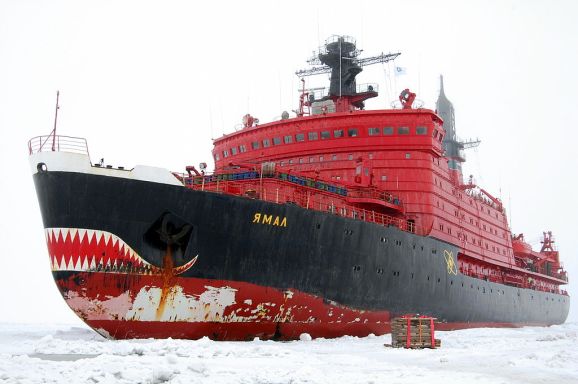
A Russian nuclear-powered ice-breaker, seen here devouring the planet. Image from Wikimedia Commons
It’s sort of a strange thing to think about; that residents of Florida or Arizona can consider themselves part of an Arctic nation, but thanks to the ability of great powers to buy and sell land like one does trinkets, America is one. And more than that, as a great power, we’re honor-bound to explore the Arctic, making it safe for oil and gas producers, as well as our navy, not to mention tourist ships. After all, “(T)his summer, for the first time, a cruise ship will sail from Anchorage, Alaska, to New York City, through the Northwest Passage.”
Think about that, and the whole insane scope of the last 500 years comes into focus. The rise of great, globe-stamping powers, the population clash and transfer between Europe and the Americas, the rise of industry and the way it changed the environment, initially imperceptible on a human level, but then suddenly very quickly.
The whole “discovery” of the Americas was an attempt to find a sea passage to the Asian markets. John Cabot probably was the first person (or at least the first famous person; his four-ship crew might argue on “firsties) to die looking for the Northwest Passage. In doing so, though, he claimed much of the northern part of the Canada for England, which eventually set off the fierce wars between England and France, that also pulled in Spain and the Dutch. These wars, particularly the Seven Years War, sparked by inter-tribal rivalry between the Annishabeeg and Iroquois, helped create the crucible in which the United States was formed, and was later able to buy Alaska from Russia, as if the concept of owning land that people lived in was an inarguable right. These wars helped, as wars always do, spur the industrial advances that changed a planet.
And so, here we are, not too long in the scope of things since John Cabot- who was actually Giovanni Cabato, but in his famous voyage he sailed for the King of England, so we can’t be having any excess vowels, by god- possibly died looking for the Northwest Passage. All it took was pumping poison into the air and sea. All it will take to exploit this discovery is billions of dollars and enormous ships, powered by nuclear energy, so that we can dig up more oil and gas. Cabot was just a little early, was all. We’ve finally achieved the dream.
The Oklahoma Legislature on Thursday passed a bill that would effectively ban abortions by subjecting doctors who perform them to felony charges and revoking their medical licenses — the first legislation of its kind.

Pictured: Nathan Dahm, who clearly sees bigger things for himself.
The measure passed by the Oklahoma legislature will be struck down by any court- it’s as blatantly unconstitutional as it is punitive. Senator Nathan Dahm, the sponsor, said he knew it would be challenged, but that he hoped it would lead to overturning Roe v. Wade. It won’t, or course- if Mary Fallin (who is openly angling for a Trump/Fallin ticket and has November on the mind) signs it, it’ll get slapped down by the first judge whose desk it slithers across.
I don’t know if Dahm is stupid enough to believe his bill will make the Supreme Court, or just cruel, but it doesn’t matter. This bill isn’t about the law. It’s nothing more than intimidation, making it chokingly oppressive to provide women’s health services in Oklahoma. It’s about putting fear in the heart of anyone who wants to perform a vital (and as we seem to need to be reminded, legal) service. It’s goons smashing windows and breaking kneecaps, and it is designed to encourage violence by legal labelling any abortion doctors as felons. You don’t want felons in your neighborhood, do you Clem? Of course not. Let’s go get ’em.
That defending the bill will cost money doesn’t make this less a mafioso tactic. The mob rarely did anything that didn’t turn a profit, but they knew that while war would cost business, it was sometimes needed. And that’s what this is: the biggest bomb yet dropped in the war against women’s health. Cost doesn’t matter. Can you really put a price tag on fear?

Pictured: Mars
OK, so this isn’t as much “breaking” as “happened 3.4 billion years ago”, but it is still pretty amazing.
Dr. Rodriguez said that some 3.4 billion years ago a meteor crashed into the ocean triggering a mega-tsunami that plowed into the coast with waves as tall as 400 feet. The meteor left behind a crater about 19 miles across. When the water retreated into the ocean it dropped 30-foot tall rocks that obscured the original shoreline and also left behind channels that provided clues to the ocean’s elevation.
It’s always important to remember that we live in a solar system so vast and in a universe so unimaginable that it can wipe us out- our science and our Shakespeare, our dumb wars and our fierce loves- without even noticing. It would just be a matter of a couple of tiny rocks smacking into each other.
That’s not nihilism. That the sun will one day explode makes every day that it doesn’t- every day that we’re near enough to that gigantic nuclear cataclysm to live but not near enough to melt- a day to celebrate. Just, you know, keep funding Near Earth Objects research. It’s sort of important.

 Shooting Irrelevance