Trump’s Foreign Policy: More Dumb Than Bad, But Also Bad


Map of Balkans

Pictured: The Baltic States, to Trump. 


Everyone who cares about foreign policy was stunned by David Sanger and Maggie Haberman’s NYTimes piece yesterday, in her interview with Donald Trump about foreign policy. The biggest revelation was that he wouldn’t automatically extend support to NATO allies if they were attacked, in particular the Baltics. And the only country that would attack them is Russia, unless Sweeden gets ornery.  This caused a lot of gasps, from right and left, because it undercuts the basis of security after WWII, not to mention being in line with Trump’s (and Manafort’s) love of Putin.

For example, asked about Russia’s threatening activities that have unnerved the small Baltic States that are among the more recent entrants into NATO, Mr. Trump said that if Russia attacked them, he would decide whether to come to their aid only after reviewing whether those nations “have fulfilled their obligations to us.”

He added, “If they fulfill their obligations to us, the answer is yes.”

The Trump camp, led by Manafort, is disputing this and saying that she’s lying, but honestly, who do you believe? Even if the reporters didn’t have Haberman and Sanger’s reputation, is it possible to believe anything the Trump camp says?

While I was writing this, Haberman and David Sanger released the transcript:

“You can’t forget the bills,” Trump said. “They have an obligation to make payments. Many NATO nations are not making payments, are not making what they’re supposed to make. That’s a big thing. You can’t say forget that.”

“My point here is, Can the members of NATO, including the new members in the Baltics, count on the United States to come to their military aid if they were attacked by Russia? And count on us fulfilling our obligations—” Sanger asked.

“Have they fulfilled their obligations to us? If they fulfill their obligations to us, the answer is yes,” Trump said.

“And if not?” the Times’ Maggie Haberman asked.

“Well, I’m not saying if not,” Trump replied.

To me, this is even more damning, and more to the point. There’s actually a strong case to be made out NATO, and our role in interventions, and how much we pay. And Trump knows that, sort of. But only a little, and only on the surface. Only enough to say things like “you can’t forget the bills”. He can claim he didn’t say not, because “I’m not saying if not”, but that’s bullshit. It’ a dodge, but not one to try to soften the blow. It’s a dodge because he has no idea what he’s talking about

There’s a vague principle of “I’ll screw you over if you try to screw me over”, but it’s not the thinking of a man who has ever thought about foreign policy in any broad way, in any way that wasn’t part of his narrow worldview. He literally has no idea what he’s talking about. That’s the scary part. He knows absolutely nothing about the world, except for his “instincts”, which are invariably dumb and ill-considered.

Take this:

Mr. Trump said he was convinced that he could persuade Mr. Erdogan to put more effort into fighting the Islamic State. But the Obama administration has run up, daily, against the reality that the Kurds — among the most effective forces the United States is supporting against the Islamic State — are being attacked by Turkey, which fears they will create a breakaway nation.

Asked how he would solve that problem, Mr. Trump paused, then said: “Meetings.”

Or:

He talked of funding a major military buildup, starting with a modernization of America’s nuclear arsenal. “We have a lot of obsolete weapons,” he said. “We have nuclear that we don’t even know if it works.”

“We have nuclear” are the words of a man who was told something in passing and assumed he is an expert. It’s like Paul Ryan’s “well, there are fighting seasons in Afghanistan” line, except more shallow.

I mean, he isn’t disqualified because his policies are bad. Twitter was alive with his NATO nonsense as being “disqualifying”, as if someone would say “this line has finally been crossed.” That’s not the case. The statements are “disqualifying” because they reveal, again, how manifestly unqualified he is. The man knows literally nothing about foreign policy save for what he reads on the back of cereal boxes. You could fit his knowledge in a matchbox and still never have a want for matches. It’s a terrifying prospect.

But, at least, he cleared up that his “America First” slogan isn’t like Lindbergh’s.

“To me, ‘America First’ is a brand-new, modern term,” he said. “I never related it to the past.”

He paused a moment when asked what it meant to him.

“We are going to take care of this country first,” he said, “before we worry about everyone else in the world.”

Oh.
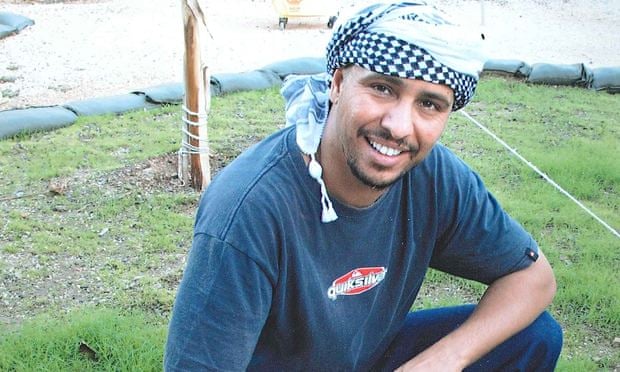
Out of the Maw: Slahi Cleared For Release

America is a carceral state. There’s no disputing the statistics; we house nearly a quarter of the world’s prisoner, have the largest prison population in the world, and the second-highest rate per capita (behind Seychelles, which has a total prison population of 735). It’s one of the hallmarks of American history: we have a fierce desire to lock people up and throw away the key, and it has often been bipartisan, and always steeped heavily in race. Black lives have been fodder for free labor in prisons across the country, and more recently, as a way to pad the profits of private enterprises. It’s how we’ve dealt with the end of slavery and the expansion of civil rights; we’ve undercut those gains through prison.

And that desire for incarceration, that deference toward rough justice, is reflected by the fact that exonerating the wrongfully convicted, through programs like the Medill Justice Project, are seen as squishy and self-interested and grandstanding, instead of the backbone of true justice. We’d rather 50 innocent were convicted than a guilty person going free. It’s part of our national character.

After 9/11, that character became global. Our system of mass imprisonment swallowed the world, reaching into every country for anyone who might have done wrong. The people who were sucked up were tortured in black sites, tortured by their own governments, and tortured by the United States. They disappeared into obscure bases, and were locked up in Guantanamo Bay, cut off from the world.

It was part and parcel of our normal way of handling justice: wrap up anyone who might be guilty, or who might look like they are guilty (often because a disputatious neighbor dropped a dime), and never look back. To be sure, many people who were captured were dangerous terrorists. But not all. And that was the problem. It tooks years for many of them to be released, and after Obama took office, the whole idea of releasing them began to be seen as some sort of liberal weak-on-terror-weak-on-crime synthesis, and the wheels of justice slowed down again. Nativism, and our native tendencies, created an atmosphere where the dominant feeling was “if they aren’t guilty then why are they in jail?”

But some good news, finally, if you can describe “end of terrible” as being good. Mohamedou Ould Slahi, whose memoirs described in great detail the suffering and torture he went through, was yesterday cleared for release after a 13-year nightmare. His release has long been a cause celebre, as he was a symbol of everything that went wrong, but it was also a real cause for the dedicated and heroic lawyers of the ACLU.

You should read his book, Guantanamo Diary, (and the legal fight to have it released and see the light of day was equaly heroic), but in brief: he fought for al-Qaeda against the Afghan Communists, which we were cool with, went to Germany where he “crossed paths” with one of the 9/11 planners, and then went home to Mauritania. No evidence he was active, none that he was a plotter. But after 9/11, everyone who might be a baddie, or who was loosely connected to one, was swept up by countries who wanted to be on the good side of the US. Slahi was arrested in 2001, sent to Jordan for torture, and would up in Gitmo after a stop at Bagram, a bloody map of the worst excesses of the “war on terror”. As Hina Shamsi of the ACLU writes, talking about what happened in Guantanamo:

Slahi was one of two so-called “Special Projects” whose brutal treatment then-Secretary of Defense Donald Rumsfeld personally approved. The abuse included beatings, extreme isolation, sleep deprivation, sexual molestation, frigid rooms, shackling in stress positions, and threats against both Slahi and his mother. In Slahi’s habeas challenge, the federal judge determined Slahi’s detention was unlawful and ordered him released in 2010. The U.S. government successfully appealed that decision, and the habeas case is still pending.

He’s no less guilty of anything today than he was 15 years ago. But today he finally gets to see the light of day, or at least the hope for it.

There are still 76 people in Guantanamo, 31 of whom have been cleared pending security conditions in their home countries. This isn’t for their safety; but to guarantee they can be monitored. Think about that: we’re telling these people we have no reason to hold you any longer, but we’re going to until we can be sure that your life is nearly as circumscribed as it is now.

The problem is that they aren’t seen as people. They are by the ones closest to them, even those in charge of the system, who actually have to interact with them. But there is no public pressure; if anything, it is appealing to say “keep em locked up!” That means there is no political will. Not shutting down Guantanamo became a rallying cry of the right as soon as Obama was sworn in, even though many had believed in it before, since it was common sense. But the Obama era mutated that, and now the prisoners are back to who they were: faceless terrorists, guilty by dint of being not-American.

This isn’t surprising. We have no problem locking away innocent Americans, because, they’re probably thugs anyway, right? That’s why this delayed justice for Slahi, who lost so much of his life, is bittersweet. The injustice hasn’t stopped. It’s part of who we are, whether it is in Lousiana or the Cook County Jail or around the world. We lock people up, and then assume the shadows of the bars are a tatoo reading guilty.

Jabhat al-Nusra and Post-ISIS “Syria”


Meet the new boss- not quite the same as the old boss. 


Syria and The Success of Smarter Militants

Interesting WaPo article by David Ignatius about Jabhat al-Nusra, the Qaeda affiliate in Syria. They’ve bascially bided their time during the rise of ISIS, gaining reputations as good fighters and building alliance with relatively more-moderate groups, and they seem poised to emerge successful out of the wreckage when the more apocalyptic jihadist group enters its post-Caliphate stage (which could be loosely described as “A caliphate of the mind”).

Jabhat al-Nusra has played a clever waiting game over the past four years, embedding itself with more moderate opposition factions and championing Sunni resistance to Syrian President Bashar al-Assad. The group has mostly avoided foreign terrorist operations and has largely escaped targeting by U.S. forces. Meanwhile, it has developed close links with rebel organizations such as Ahrar al-Sham that are backed by Turkey, Qatar and Saudi Arabia.

But the global jihadist ambitions of Osama bin Laden remain part of Jabhat al-Nusra’s DNA. U.S. officials report increasing evidence that the group is plotting external operations against Europe and the United States. Its operatives are said to have tried recently to infiltrate Syrian refugee communities in Europe.

A stark warning of the danger ahead comes from the Institute for the Study of War, which closely follows events in Syria. In a forthcoming forecast, the institute argues that by January 2017, “Jabhat al-Nusra will have created an Islamic emirate in northwestern Syria in all but name” and will merge with the supposedly more moderate Ahrar al-Sham.

And that’s the smart way to do it. It’s one of the reasons why AQAP in Yemen has been so successful for so long, even so far resisting an ISIS takeover (more on that coming soon). There are certain organizations which are “lessons learned” oriented, who can take the success and mistakes of the past and integrate them into the local situation from which they are emerging. They don’t try to jam a rigid system into a fluid situation. You can have short-term success doing that, but it is far more difficult to maintain, as ISIS is finding out.

(That said, of course, ISIS isn’t halfway out the door. I am as guilty as this as anyone: because the outline of the end, or at least the end of this phase, can be roughly seen, it shouldn’t be assumed that it will play out the way we imagine, and shouldn’t be so quick to act like we are already in the next phase. Analysts and bloggers are, I think, more guilty of that than actual military people, so I’m not too worried.)

This is part of the mutation of the jihadist threat, and why it needs to be treated as a generational problem, one that requires supple and strategic thinking, on all levels, and not be treated as a eopochal failure when it isn’t met with “unconditional victory” during, say, a Presidential term.

It’s almost inevitable that, if not al-Nusra, another AQ or ISIS-like group emerges in whatever comes out of Syria, whatever post-state shape it is in. That isn’t a clarion call to give up, but more that we have to be realistic about what can be accomplished, and to me, that means not trying to force Syria back together again.

I think the Kerry plan, which Ignatious describes as a “three-cushion shot”, is a good outline. “Kerry’s plan would include joint U.S.-Russian operations against the group, as well as the Islamic State. Kerry also hopes to reduce Assad’s attacks on moderate rebel forces so that they (rather than Jabhat al-Nusra) can gain ground in a post-Islamic State Syria.” That’s probably the best outcome that can be hoped for: increased moderation, though not perfection, in post-Syria areas. The more we try to maintain a 20th-century fiction, the more other fictions, like that of the glorious caliphate or the purity of fanaticism, will tell the story.

A Brief List Of What I Didn’t Hear On National Security Night

  1. North Korea
  2. European Union
  3. Brexit
  4. Nuclear weapons
  5. China (save for Jeff Sessions mentioning their “burgeoning economy”, which is a weird way to put it)
  6. South China Sea
  7. South America
  8. Africa
  9. Syria (outside of ISIS)
  10. Russia (unless I missed it)
  11. Turkey
  12. Incirlik Air Force base
  13. Cyberterrorism
  14. Saudi Arabia
  15. Piracy
  16. Ukraine
  17. Transnational crime
  18. Nuclear Preparedness
  19. Pakistan
  20. India

All of these are issues on which you could plausibly hammer Barack Obama and Hillary Clinton, if you wanted, to various degrees of fairness. But unless I missed it, nothing about this came up. Again, not a serious candidate, not a serious party, which makes it an intensely serious threat.

(I promise I’ll do the same for the DNC, just to be scrupulously fair)

What the RNC Gets Wrong About ISIS and al-Qaeda

33968

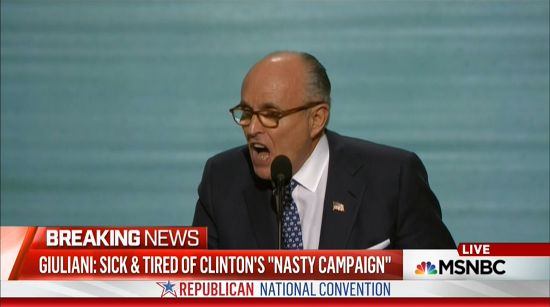
Being tired of the nasty campaign run by “crooked Hillary Clinton who should be in prison” is actually one of the less-misleading things Giuliani said.

So, “Make America Safe Day” is over, and I don’t know about you, but I feel much safer already! I know that all we have to do is elect Trump, and we’ll be fine. Or, as Mike McCaul, the inexplicable Chairman of the House Committee on Homeland Security said, “It’s time to take back our country and make America safe again!”

That’s a good jumping-off point for not just the emotional reaction, of which there was plenty, but the substantive one as well. Because that was sort of the heart of the night: argument through assertion. That’s common in politics, but it was common in a very dangerous way last night, which perfectly encapsulates the right’s unflinching commitment to not understanding the threat of jihad while spittling that they are the only ones who get it.

Because let’s start with the biggest lie of the night, the one that was the driving theme: Hillary Clinton can’t keep as safe (whatever that actually means), and Donald Trump can. That’s pretty normal, and I think you can argue pro or con on the first half of that, as long as you don’t use “Benghazi” as a data point, because come on.

What you can’t really argue, or, more to the point, that no one actually did argue, is that Trump can keep us safe. It was all just assumed that because Trump talks big, and says he’s going to go get them, he will. McCaul even said he’ll make the ground tremble under the terrorists’ feet. It’s actually amazing that all these people who ostensibly care about national security can bring themselves to pretend that Trump has any genius, expertise, competence, o even basic knowledge of these issues.

But that’s really the problem. He doesn’t need to have any knowledge, because their understanding of ISIS is reduced to talking point about “political correctness” and not calling the enemy by it’s name. Rudy Guliani, who gave the most effective speech of the night, was the clearest on this (all Rudy quotes come from What The Folly).

(On The Fort Hood shooting): The only person who couldn’t figure out this was an Islamist terrorist extremist attack was Barack Obama, who called it workplace violence. This is why our enemies see us as weak and vulnerable!

Donald Trump has said the first step in defeating our enemies is to identify them properly and see the connections between them so we can find them and catch them.

To defeat Islamic extremists, we must put them on the defense.

If they are at war against us, as they have declared, we must commit ourselves to unconditional victory against them!

(Wild applause, baying at the moon, a general sense of punchiness)

Rudy used this to segue into the Iran deal, misreading it entirely (as Kaplan points out), and pretending that the money going there is funding ISIS and AQ. Which he didn’t say explicitly, and may or may not believe, but these were his phantom “connections.”

And that’s really the heart of the right’s idea on terrorism: a monolithic enemy that can be defeated merely through the brawny use of strength and the exact right words*. They believe that there is such a thing as “unconditional victory”, which is a strange and grandiose and entirely misleading turn of phrase, since it implies that there is a scenario where conditions would be accepted or not, and that there would even be someone to whom you could deliver the conditions.

The jihadist threat is not one that can be bombed out of existence, nor one that can actually be defeated in a conventional sense. The problem that the right wing has is that they want to fight a war against an enemy that doesn’t exist. They can defeat “ISIS”, in its current incarnation, but have no answer for 1) what comes next in the wreckage of Syria and Iraq, 2) what happens to affiliates around the globe, and 3) what to do with the next mutation. They can’t see this because they are unable to understand that there are root causes of jihadattraction that go beyond good and evil. As Scott Atran said in the NYRB this weekend,

Are we again dangerously underestimating ISIS’s will to fight, and its ability to endure and expand? Although military defeat in Iraq, Syria, and Libya could help make it more difficult for the group to recruit, we will not be able to defeat ISIS itself until we find a way to reconnect the neighborhoods, online communities, and other particularly susceptible social and political settings where attacks like what occurred in Nice continue to find inspiration and support.

“Reconnecting the neighborhoods” isn’t something I heard last night. I don’t think Barack Obama has all the answers, clearly. I don’t think Hillary does, either. But I think they both actually recognize the complex nature of the threat, and are seeing the world as it is. The party of realism is completely unmoored, and want to take our entire national security apparatus along with them.


* Everyone points out their weird and childish fixation with saying “Islamic terrorism”. It’s hard to say if they actually think that will defeat ISIS; it’s entirely possible that anti-PC cognitive dissonance has taken over, and they actually believe it’s a big deal, and that Obama is actively hurting the US by not saying it. What’s weirder is the “define the enemy” thing. It’s very post-modern: you’ll become what words are used to define to. It’s the mutability of the self in the face of the observer. Gombrowicz would totally dig their platform.

1968 and 2016: Convention Violence and Anger in America

wer2002-07a

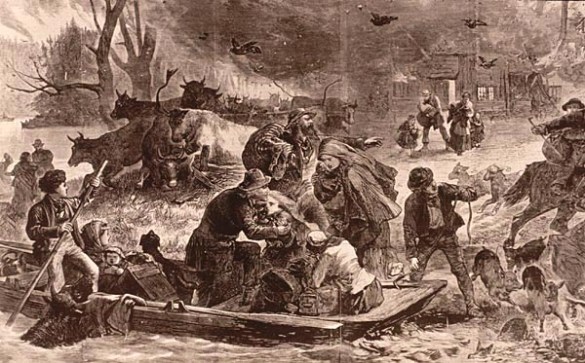
Peshtigo, 1871.

Politico

For the GOP insiders most concerned about violence in Cleveland, many cited protest groups tied to liberal causes, like the Black Lives Matter movement. Nearly a half-dozen Republicans mentioned the Hungarian-born billionaire George Soros, who is a prolific donor to liberal causes. But few thought violence would ensue from an effort to fight Trump’s nomination on the convention floor. “It’s simply too big of a target for the malcontents and violent left to miss,” said an Iowa Republican. “George Soros’ money will pay for thousands of disaffected screaming thugs. Think Seattle [1999], Chicago 1968. Riots and looting. They are the tools of the liberal left.” “I say this with no joy whatsoever,” a Republican in the host state of Ohio added, “but the far-left agitators in Cleveland will make the 1968 Democratic Convention in Chicago look like a fourth-grade slap fight.

Now, I don’t expect an “Iowa Republican” who thinks that George Soros is bussing anarchists to Cleveland to understand this, or for that matter an Ohio Republican, but it is worth noting that the violence in the 1968 convention did not come from the far-left. It came from the cops. There was provocation, sure, but it was the police that were rioting. As the Walker Report indicated, the refusal to allow permits, the wish to cordon American citizens away from where the powerful were meeting, led directly to the bloodshed.

I would hope that when covering the protests this week, the media remember that. There will almost certainly be Seattle-type violence (and that is the actual far left), but chances are high a lot of the violence will be coming directly from those sanctioned by the state to levy it, and who should take the responsibility seriously.

Or hell, it might come from all the armed lunatics gathering in an open carry state, many of whom feel that these far-left weirdoes and blacks are threatening America and conspiring to ruin Donald Trump’s chances. Would you be surprised if these patriots opened fire? If they saw, incredibly, an anarchist of a Black Panther with a gun, and had to protect themselves? Does any of this seem implausible? A firefight between on-edge police, right-wing militia types, angry protestors, and lone gunmen types like in Dallas and Baton Rouge?  This is Peshtigo in the hot summer of 1871. The sawdust is baking in the heat, and the firestorms are being born.

Cleveland is on Lake Erie, but the closet analogy is up the Great Lakes system, up Michigan, near Green Bay. This is Peshtigo in the hot summer of 1871. We’re on the edge on conflagration. Little fires burst every day. The skies are increasingly choked with soot. The sawdust is baking in the heat, and the devouring and murderous firestorms are being born.

Michael Hayden Tells His Side

Penguin Press

In the August/September issue of Reason, Brett Max Kaufman of the ACLU (and of the most alternately triumphant and nervous fanbase in sports) reviews Playing to the Edge, Michael Hayden’s apologia for the post-9/11 security state, and why he would do everything he was able to do to protect us.

But it is not a good sign when your memoir’s central metaphor breaks down in the foreword. Hayden’s conceit is that those who run intelligence have a duty to “us[e] all the tools and all the authorities available, much like how a good athlete takes advantage of the entire playing field right up to the sideline markers and endlines”—the edge. As he’s said elsewhere (he’s been on this kick for nearly a decade), “Playing back from the line protected me but didn’t protect America. I made it clear I would always play in fair territory, but that there would be chalk dust on my cleats.”

The first problem is that if you get chalk on your cleats, it means you’re out of bounds. (Or at least you are in football, Hayden’s obvious inspiration.) That this has apparently gone unremarked to Hayden over the years—even by Dan Rooney, the owner of Hayden’s hometown Pittsburgh Steelers and Hayden’s high school football coach, with whom he watches too many Super Bowls in this book to count—is notable in itself. That it goes entirely unexamined in the book’s numerous invocations of the image is, alas, characteristic.

Worse still is that “taking advantage of the entire playing field” is a pretty odd way to describe the main thing that good athletes do. Of course, spraying one down the right-field line or throwing it deep and wide can sometimes help the team. But they are hardly required to win the game. Hayden never bothers to explain why pushing it to the edge is a main point of his duty as a public servant. Like so much in the book, it is simply assumed that people of good faith will agree.

That’s sort of the whole ballgame: we know what’s best, and you don’t. There is a “trust” factor in intelligence that assumes a one-way relationship. While no state wants entirely transparent intelligence, it is assumed that America should have the same level of secrecy, and the same dom-sub relationship with our intelligence forces, as the most fly-bitten police state in the world. It’s an argument that sounds persuasive on the surface, but can and should be taken easily apart.

Brett, who is one of the best at crafting an argument that is both forceful and legally exacting (sort of a hyperlogical polemicist, employing the best of both world), is the right man to tear it apart.

After Weeks of Violence, What Is Legitimate Protest In The Age of Trump?


Oh beautiful, for spacious skies…


Sunday struggled awake to the news of another mass, targeted killing of police by a lone gunman, trained by the military and motivated by racial, anti-police anger. This time it was in Baton Rouge, one of those American cities that is a simmering racial flashpoint, as we’ve all learned in these last few hot, tense weeks.  It already feels like we’re living in a documentary about that terrible year, 2016, where everything sped up, where the divisions between white and black, between those who believed in the police and those who believed the police were just a tool of oppression, boiled over. Where economic anger, racial hatred, xenophobia, and several strands of populism

It already feels like we’re living in a documentary about that terrible year, 2016, where everything sped up, where the divisions between white and black, between those who believed in the police and those who believed the police were just a tool of oppression, boiled over. Where economic anger, racial hatred, xenophobia, and several strands of populism distorted our politics. Reading the news has the uneasy feeling of watching that documentary, that every day is part of the central montage of an uneasy summer. We’re watching the flash points scroll by in real time, all leading up to that violent week in Cleveland, where the least-qualified and most dangerous candidate in American history grabbed his nomination, against a backdrop of horrible violence.

Obviously, as Sunday gave way to Monday, that hasn’t happened yet. But everyone believes it is going to. The Cleveland police certainly do, as Reason reports. 

To prepare for that, Cleveland has reportedly purchased over three miles of “Blockader” steel barricades, plus over 3,000 feet worth of six foot-high barricades, over 2,000 sets of riot gear, and 10,000 sets of plastic handcuffs.

Almost half of downtown Cleveland, roughly 1.7 square miles, will be under major restrictions as the designated “event zone.” Within that area, according to the New York Times, everything from glass bottles and tennis balls to “large bags and backpacks, mace, loudspeakers, tents, coolers and canned goods” will be prohibited. The Washington Postnotes that it has provided a “standard kit” to its staff attending the RNC, including “helmets, gas masks and flak jackets,” but gas masks are among the items banned from the event zone.

That is, simply put, a police state. And maybe it is needed. There is no doubt that this year is a far angrier one than 2012, or even 2008, when the world was collapsing. We say every four years “this is the worst”, but things are qualitatively different this year. For one thing, you no longer have Barack Obama. For another, you have Donald Trump, and that leads to the question: what is legitimate protests in the face of a quasi-fascist, white nationalist campaign?

For many people, the only good form of protest is peaceful, maybe marching in the designated areas, maybe giving a speech to fellow freaks at some kind of jazz club, but preferably at home. Anything else — anything that smacks of violence, or even without humble acqueisence to the men in the riot gear, pushing back with their truncheons — is beyond the pale of reasonable discourse. This year, after the killings, the desire by the media and all the establishment for absolute calm will be even more severe. We’re too divided and too on edge, and the natural deference toward law and order will be a full-throated scream.

Even anti-Trump Democrats and liberals are hoping for nothing distracting in the streets, nothing to take away from the spectacle of watching Donald Trump become the candidate, hoping that the mere sight of that will jar people into awareness that this is really happening. And I’m in that camp as well. I’m hoping that the focus will be on the surreal nightmare that is the Trump candidacy, and not on juvenile anarchists thinking that smashing up a Starbucks is a counterstrike against Trump, or really against Trumpism (neither, by the way, is the naked woman protest, as the libertine Trump won’t exactly be scandalized. Still, highlighting female autonomy to the GOP is always a good idea).

But then, what is? This is a completely different candidacy than we’ve ever had, one that is explicitly trying to divide the nation into “us vs. them”, with “them” being everyone who isn’t white, Christian, and already a Trump voter. I don’t feel like we have a duty to treat this as politics as normal, to respect the process, and to assume that this convention is, well, conventional. I feel that the media, and the protestors, should do everything they can to highlight the grotesque nature of what is happening, and just how dangerous it is.

To me, I think that means following the letter of the rules, but not the spirit. Don’t bring in any restricted items, and don’t throw down the barricades, but protest everywhere. Make it so that people can’t go anywhere without seeing protestors, being strong and forceful, though not violent. Make every street corner an area for speeches. Make all of Cleveland one big bughouse square. Drown out the lunacy inside Quicken. Hold a mirror to the wild madness inside.

Because, to be clear, the violence that is spreading in America is reflected in the gaping, stupid mouth of Donald Trump. Elections matter, and he’s legitimized the howl. He’s the candidate of the authoritarian right. He’s the candidate of having armed goons and rabbled supporters brutalize anyone who dares question him. He’s the candidate of the truncheon and the flak jacket, of the newly-deputized posse, of the flurry of arms and legs pummeling the prone and terrified outsiders. He’s cranking the wheel on the projector, speeding up this documentary, to where all the images blur together. The people marching in the center of the frame move toward a lockstep while around them the film burns att he edges. It is his carnival, and the only response seems to be just as mad.

There are smart responses to Trumpism, and intelligent, helpful ways to protest this week. There are ways that can make everything worse, and heighten this unbearable tension. There are ways that can empower the candidate of “law and order” (his law, and his order). But when it comes down to it, there are no illegitmate ways to protest this candidacy. Its very existence is already a protest against reason and decency. It’s a savage axe-blow to the heart of the American experiment, and any reaction pouring from that supperating wound is justified.

Well, Newt, You Gave It Your Best Shot!


Lwox1ixjwzrbhpbbevn5

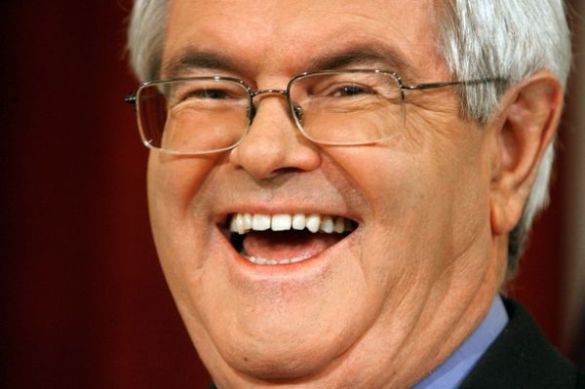
Pictured: the face of a man who isn’t going to get to be the leader (possibly) of the civilizing forces. (Screengrab from TPM)


This is a man who isn’t getting the VP nod.

“A great deal of the coverage of what I said on Fox last night has been distorted,” Gingrich said. “The news media went into a hysteria overnight trying to over-exaggerate what I was saying. This is not about targeting a religion.”

“This is about looking for certain characteristics that painfully, we have learned time after time, involve killing people,” he elaborated.

But he seemed to take a different tack while discussing how to deal with a pattern of terrorist activity from American citizens, saying that it would be “impossible” to deport them.

“With an American citizen, deportation is impossible,” he said. “It’s not appropriate under the Constitution and there, historically we’ve always said, if you fought against the United States, that the correct answer were basically jail as opposed to deportation. I think we have to talk through what should be the right way of handling people who are here, but are not citizens.

And this was the man who still thought he had a chance.

“Western civilization is in a war. We should frankly test every person here who is of a Muslim background and if they believe in sharia they should be deported,” Gingrich told Fox News’ Sean Hannity.

Or, in the words of Hollywood Mark Perrone, “Once again the liberal media’s unabridged replay of the video of everything I said on a national broadcast just last night is dividing this nation.”

It’s a testament to Newt’s incredible mendacity and absolute lack of principle’s that he’s willing to disagree with his 12-hours-ago-self once he realized that being hatefully anti-American and totally fascistic wasn’t enough to get him a job he wanted. But he sure gave it the ol’ college try, if the college is the University of East Berlin. The man needs a team of Sherpas just to reach the moral basement.

How Not To Keep A Free Society: Newt Gingrich Edition

0eeba-newtgingrichgiantlaugh

“I’m a really deep thinker, frankly.”

In the last post, we talked about how the kind of mutating terrorist attacks like we saw in Nice will happen in a free society. Newt Gingrich, whose VP dreams have yet to be crushed, eschews all talk of free society.

“Western civilization is in a war. We should frankly test every person here who is of a Muslim background and if they believe in sharia they should be deported,” Gingrich told Fox News’ Sean Hannity.

“Sharia is incompatible with western civilization. Modern Muslims who have given up sharia, glad to have them as citizens. Perfectly happy to have them next door,” he added.

There’s no real need to point out everything that is wrong with this, right? Forget how hideously unconstitutional and un-American it is to have everyone of a single faith line up for loyalty testing. That’s standard Newt: he knows it is what Trump wants to hear, so he’ll say it. (Bonus Newtism: he always says “frankly” when he’s about to say something really dumb, because he feels it gives it intellectual heft. Once you notice that, you’ll see it is always true.)   Let’s also forget for the moment that believing in Sharia is not, in and of itself, against the law. There are a lot of people who don’t believe in the Constit

Let’s also forget for the moment that believing in Sharia is not, in and of itself, against the law. There are a lot of people who don’t believe in the Constitutional order, and as long as they aren’t acting on it, that’s ok. Let’s also ignore the insanity of someone saying that a belief is “incompatible with western civilization” when he’s literally proposing mass expulsion based on a religious-based ideological litmus test, which seems pretty goddam incompatible with Western civilization, to me.

No, what’s really stupid– what makes Newt so world-historic dumb at times — is that he proposes this as the realistic and tough-guy way of dealing with a threat. Tthe attacks at Nice were the “fault of Western elites who lack the guts to do what is right, to do what is necessary,” he told Hannity, and between the two, the perfumed machismo must have been through the roof.  This is, frankly, incredible. How exactly does he imagine this is going to go down? Does he actually think that people dedicated to the destruction of America and the death of all its citizens are also incapable of lying? That after waiting in line for hours, after the Muslim Registration Act, which won’t do much to change their attitude toward the US, they won’t be able to plot a complicated web of deceit, i.e., saying “no” when asked if they are a terrorist?

The most charitable interpretation of this is that Newt actually believes this will work, and that it will allow good Muslims to stay in the US and have everyone be happy. It’s barking madness, of course, and deeply antithetical to the kind of free society that is at the end the final bulwark against radicalism. But if he believed this would work, or was a good idea, at least you could argue from there.

But he probably doesn’t, at least not in any way that doesn’t require the cognitive dissonance that is the heart of the modern right wing. He decided this sounded good, and would appeal to Trump, who appeals to millions and millions of voters. They want the tough guy who will trample our values, because it feels good. In less than a week the GOP is going to nominate someone who brags about his willingness to employ torture. They are appealing because their idea of America is one of soil and blood and steel, and not the actual values that make this country great. They have the same boot-stomping atavistic lure of LePen and Orban and the Brexiters.

ISIS and al-Qaeda want a civilizational clash. They are experts at provoking one. It’s their great good fortune that they have enemies who want to give it to them. What Newt said wasn’t in a vacuum. It’s the direction in which the whole world is lurching.