AQAP vs. ISIS in Yemen: The Battle For the Soul of Jihad

Note: I’ll be out of town between the 4th and the 15th, in a wilderness repast, with little to absolutely zero connection to the internet or my phone. Posts during this time, written in advance, will be bigger-picture, or more idiosyncratic, rather than directly pegged to the news. If events happen that supersede or negate anything I say, think of these as a more innocent time capsule. Try not to let the country burn down while I’m gone, ok? 

8500c362-15a9-4e0b-929f-35a72c4dfd41_16x9_788x442

ISIS appears in Yemen in 2015. Image from al-Arabiya English.

A little more than 10 years ago, in early February of 2006, there was a massive jailbreak in from a Yemeni prison, in which 23 Islamic militant tunneled out of their cells and into the women’s bathroom of a nearby mosque, from which they disappeared into the San’a morning (for a detailed look at this, buy Greg Johnsen’s The Last Refuge).  Among the 23 were old militants, like Jamal al-Badawi, one of the masterminds of the USS Cole bombing. He was the big name. Others, like the al-Raymi brothers, weren’t as known.

That was soon to change. What we didn’t realize immediately was that the jailbreak wouldn’t be seen as part of the old battle against al-Qaeda in Yemen, but a new phase with a new group. Over the next few years, and through various names, the younger generation of jihadists took over the organization, before unveiling, the day of the Obama inauguration in 2009, al-Qaeda in the Arabian Peninsula. They had shown themselves to be a patient, smart, and to-the-vest group, and that paid off by becoming the dominant al-Qaeda branch in the heartland of Islam.

For years, people in the know were warning about how dangerous they were, because they were patient and smart, because they kept it close to the vest. They saw the carnage of al-Zarqawi in Iraq and realized you couldn’t build a coalition like that. Their whole goal was to build coalitions, attract foreign fighters through audacious but targeted strikes agaisnt the far enemy, defeat the near enemy (Salih, secular southerners), and eventually have enough land where they could expand unmolested.

That was then. Now they are the old guard, fighting off the ravening, cannibalistic tide of ISIS, which has brought their particular brand of violence to a land destroyed by war, ravaged by poverty, and stalked by hunger. What is happening between the groups is a battle for the very idea of the future of Islamic militancy. It is the horrible past versus the unimaginable future.

Continue reading

Talking Turkey: Donald Trump, the Military, and The Coming Constitutional Crisis

Note: I’ll be out of town between the 4th and the 15th, in a wilderness repast, with little to absolutely zero connection to the internet or my phone. Posts during this time, written in advance, will be bigger-picture, or more idiosyncratic, rather than directly pegged to the news. If events happen that supersede or negate anything I say, think of these as a more innocent time capsule. Try not to let the country burn down while I’m gone. 

hp8bdga

Pictured: Trump Tower

One of the phrases that you hear most often when people talk about the possibility of Donald Trump, that calamitous baby, that reject from a frat house treasurer race, is “constitutional crisis.” The idea behind the threat is that our system, with its checks and balances, and respect for the rule of law, can’t handle such a dingbat authoritarian, someone guided entirely by his fascistic whims. This has been argued in many ways,  by the ACLU, by the New York Times, and many others.

The argument about him provoking this crisis isn’t just about his repellent personality, of course, but about the ways in which that personality manifest itself. His “plans”, which are really just the knee-jerk impulses of a dimwit child, include expanding libel laws to crush opposition press, rounding up illegal immigrants, building enormous walls, and reestablishing our immigration policy to discriminate explicitly on the basis of faith.

All of these go against the basic idea of the rule of law, but the argument isn’t always legal. Certainly, lawyers like in the Times and the ACLU make perfectly convincing arguments that his ideas are so blatantly illegal that they will set up the Executive Branch in a state of open warfare with the Judicial Branch, with the Legislative in between, either facilitating his madness or trying tentatively to stop it. It will force us to see how powerful we’ve made the Executive, if a President can truly ride roughshod over anyone in his way. It will be a literal test of the power of the Constitution, to see if it the institutions are strong enough to resist the phony populist strongman.

Continue reading

Throwback Thursday: The CIA and The Killing of Dag Hammarskjold


If this man was killed by the CIA it’s a really big deal, or at least it should be. 


Here’s today’s must-read: Foreign Policy‘s Colum Lynch on the UN reopening an investigation into the Congolese plane crash that killed heroic UN Secretary-General Dag Hammarskjold in 1961. If you want to understand what the early 60s were actually like for actually oppressed people, the opening paragraph has a lot of pretty important keywords.

U.N. Secretary-General Ban Ki­-moon will propose reopening an inquiry into allegations that Dag Hammarskjold, one of the most revered secretaries-general in the organization’s history, was assassinated by an apartheid-era South African paramilitary organization that was backed by the CIA, British intelligence, and a Belgian mining company, according to several officials familiar with the case.

Christ. That’s a rogue’s gallery right there. Basically, in a nutshell, Hammarskjold was working for Congolese independence and security, and try to broker a treaty between the government of the new Congo and the separatists in uranium-rich Katanga, who were backed by the Belgians and other western powers to make sure that the Soviets stayed away (and let’s be honest: to make sure that other riches continued to flow into the right pockets). Hammarskjold believed that the Congo should be one independent nation, and not carved up by colonialists.

Continue reading

Friday Jihad Reading

665003303001_5057982825001_5057959426001-vs

A rebranding and personnel announcement by the CEO of a newly independent franchise. Image from al-Jazeera

1). Jabhat al-Nusra made an important move yesterday when they officially decoupled themselves from al-Qaeda, establishing an independent group. Charles Lister of Foreign Policy says that this shouldn’t make anyone think they are somehow more moderate or less dangerous.

Nobody should be confused by this maneuver: Jabhat al-Nusra, which is also known as the Nusra Front, remains as potentially dangerous, and as radical, as ever. In severing its ties to al Qaeda, the organization is more clearly than ever demonstrating its long-game approach to Syria, in which it seeks to embed within revolutionary dynamics and encourage Islamist unity to outsmart its enemies, both near and far. In this sense, the Nusra Front (and now Jabhat Fateh al-Sham) differ markedly from the Islamic State, which has consistently acted alone and in outright competition with other Islamist armed factions. Instead of unity, the Islamic State explicitly seeks division.

Ultimately, while this may be a change in name and formal affiliation, Jolani’s group will remain largely the same. Therefore, this is by no means a loss to al Qaeda. In fact, it is merely the latest reflection of a new and far more potentially effective method of jihad focused on collective, gradualist, and flexible action. Its goal is to achieve recurring tactical gains that one day will amount to a substantial strategic victory: the establishment of an Islamic emirate with sufficient popular acceptance or support.

This is what we talked about when discussing them last week: that they are smart enough to work in small local gains as a way to expand. It’s why they can outlast ISIS (which isn’t going away anytime soon). It’s also a really good sign of what is happening: we’re not at the beginning of the end, or the midpoint, of the Islamic extremist phenomenon. It’s probably much closer to the beginning. It is shaking itself out, and adjusting to new political realities (many of which are themselves an adjustment to the phenomenon). It will continue to mutate and evolve and operate in a variety of competing and complementary ways for decades.

2). This is a long, detailed, and amazing demographic report about what we know on ISIS foreign fighters, by Nate Rosenblatt at the International Security project of New America. Called All Jihad Is Local, it goes into what makes someone leave to fight for a group like ISIS. It’s a combination of their message and, of course, of local conditions that drive the fighter to leave. There is a lot to absorb in this report, which came out last week, and I’ll be doing a deeper dive into it next week, with its lessons and what it means for the next wave. In the meantime, Bethan Mckernan at The Independent pulled out some charts and info from it to look at.

All in all, what we’re seeing is a time of transition and regrouping. And, blogtimes aside, it is a long process without a clear path. An unexpected military setback by Asad could butterfly-wing the dynamic of jihad in 10 countries. But I think we’re really seeing the clear delineation between two different models: current-period Qaeda and ISIS. There are a lot of in-group differences of course, and there is also a lot of crossover, but for now, that seems to be the helpful model, and something we’ll come back to here. The way these models compete (because it would be reductive to say the “groups” are competing, because both models have incredible amounts of locally-driven varietals), and the way they influence each other, will shape our world for a long time to come.

Anyway, happy Friday.


Tomorrow’s Jihad: How Foreign Fighters Can Reshape The World


Where you going next?


In the late 50s and early 60s, there was a TV show called Have Gun, Will Travel. I’ll be honest: I don’t know if I ever have seen a single episode. Maybe on Channel 50 when I was a kid, on a TV that still had a dial, but there are no clear memories. Still, the name always stuck out. In my imagination, it captured a desolate and sad American west, where if you were a violent man, or at least someone willing to do violence, you could travel the vast landscape and keep order. Or at least someone’s version of order. Whether lawman or outlaw, and the two sides could shift back and forth, if you had a gun, you were always needed somewhere.

That might seem a flippant way to talk about the next stage of jihadism, but that is the spirit. Because the next stage is going to be the vast spread of foreign fighters, stateless men who have been trained in war, that will come when ISIS crumbles or partially crumbles in Iraq and Syria. Yesterday, in a speech overshadowed by Trump and the convention, FBI director James Comey laid it out: we’re going to see “a terrorist diaspora out of Syria like we’ve never seen before.” But what does that mean? Who are they?

While for years, the massive impact of suicide attacks, whether in Beirut or Tel Aviv or New York, dominated the news. That was our idea of jihad. And to be sure, it was terrifying, terrorism in the true sense. But with some exceptions, it was also always the short game. Suicide bombers were, by definition, expendable, regardless of their courage or conviction. The real force of jihad was the battle-tested soldiers who might not have been afraid to die, but who were more useful alive. These were men who were comfortable with violence, and with gun, traveled.

Continue reading

Quick Hits On Trump’s Press Conference: Non-Russian Edition


Might be the next President


Until the convention, Donald Trump’s insane and near-treasonous bafflegab of a presser yesterday dominated the news, especially his call for Russia to interfere with our election. That’s been pretty thoroughly covered elsewhere, so I want to make a few additional comments. I know writing about something some 20 hours after the fact is way too late, but I don’t think this news cycle should be over. There was so much in that press conference that defied imagination. It deserves to be talked about again and again, because, remember: this man could be President.

No way to get to it all now, but I want to highlight not specific policy things, because there are none except “Russia’s fine, ok?”. Instead I want to point out just how impossibly shallow this man is. The statements on Russia might have, as many said, “disqualify” him from the Presidency in a moral sense. But the rest of the words show that isn’t qualified, in the professional sense, to teach 3rd-grade social studies. He refuses to learn even the basics about the world, and can’t get through more than a tweet-length of a sentence without

He refuses to learn even the basics about the world, and can’t get through more than a tweet-length of a sentence without doubling-back, repeating himself, resorting to the verbal tricks of agreeing with himself, or (most often) self-aggrandizing. Insane anti-democratic fascistic tendencies aside, he’s really the most baffling incomprehensible public figure we’ve ever seen. Sarah Palin knew more about the world.

Continue reading

Julian Assange Casts His Vote

88092635_013873333-1

His vote will ultimately be worth more than yours.

When you’re thinking free and open society, you’re thinking Donald Trump, right?

Six weeks before the anti-secrecy organization WikiLeaks published an archive of hacked Democratic National Committee emails ahead of the Democratic convention, the organization’s founder, Julian Assange, foreshadowed the release — and made it clear that he hoped to harm Hillary Clinton’s chances of winning the presidency.

(The Times immortally invaluable Charlie Savage put this all together)

So, one could have initially, if one ignored the Russian angle cast this as an attempt to throw a corrupt and evil “democracy”, the world’s great evil and enemy of freedom, into a state of real higgedly-piggedly. But that’s clearly not the case.

Mr. Assange replied that what Mr. Trump would do as president was “completely unpredictable.” By contrast, he thought it was predictable that Mrs. Clinton would wield power in two ways he found problematic.

First, citing his “personal perspective,” Mr. Assange accused Mrs. Clinton of having been among those pushing to indict him after WikiLeaks disseminated a quarter of a million diplomatic cables during her tenure as secretary of state.

“We do see her as a bit of a problem for freedom of the press more generally,” Mr. Assange said.

I’m going to ignore the middle part, where he is mad at Mrs. Clinton for moving to indict him after, you know, breaking the law. I get why he sees her as an enemy, but did that really come as a surprise? Regardless of what you think of the justice or efficacy of the Wikileaks diplomatic dump (and I think they are a different type than Snowden’s heroism), it stands to reason that the US government would be miffed. I get why Assange sees her as an enemy, but really, shouldn’t take it so personally.

It’s the first and third bits that are either idiotically naive or completely sinister, depending on where you stand on Assange. Seeing Clinton as “a bit of a problem for freedom of the press” is fair: the Obama Administration has a terrible track record on press freedom, and Hillary has never been known for her openness, exactly. I think being peeved at the cable dumping, in which legitimate diplomatic communication was exposed and lives were put in danger, doesn’t in and of itself mark her as an enemy. But I get it.

However, the contrast is, and was known at the time Assange made these statements (about six weeks ago) Donald Trump. Donald Trump. Donald Trump. He’s made it…very clear where he stance on the media, the role of antagonistic journalism, and the role of the press in a free society, which is: fuck the press. If they aren’t subservient to him, they are useless. He’s shown it in his willingness to excommunicate anyone who is “unfair” (by which we mean fair) to him.  He’s shown it on his ravaging Twitter feed, where he demonstrates that trying to keep the media in line is a bigger goal than talking about policy or anything else. This tweet— “I was at and met Juan Williams in passing. He asked if he could have pictures taken with me. I said fine. He then trashes on air!”– is a perfect example of his childish authoritarianism.

Not all his authoritarianism is childish and petulant (though really, aren’t those the emotions at the heart of tyranny?). He has made it very clear that he intends to, or at least wants to, “open up libel laws” so that he can sue unfriendly press out of existence. He’s been trying to do that for decades. One could argue the pursuit of this power is one of the driving goals of his Presidency. So even he won’t be able to open up libel laws, as that wouldn’t come close to holding up in court, he’s clearly a man who wants to quash press freedom, either de facto or de jure, in order to burnish his own heroic image. Not exactly an ally of an open society.

So when Assange says Trump is “completely unpredictable”, he’s lying, or else he’s not paying any attention, which doesn’t strike me as plausible. Trump has made it very clear he’s a huge fan of waterboarding, and of even more torture. He’s been clear about that his entire run. That Assange chooses to ignore that, and, worse, accommodate it, raises a few questions about motivations.

The charitable interpretation here is that Trump is an agent of chaos, will rattle America, will end the neoliberal agreement that is underpinning much of the world’s immorality. He’s ignorant about who Trump actually is, and underestimates the racism and nativism that undergirds the campaign, focusing on globalization and isolationism.

That’s actually dovetailed with the uncharitable interpretation, which is that Assange sees the US/EU as the real enemies, and any of their enemies– including the ruthless and literal-press-murdering Putin regime– as his friends. That’s pretty sinister, but when someone sets himself against one party, in this case the war-mongering, trade-hawking, and press-stifling US (and all these are legitimate charges!), he tends to cling to any port in the storm.

You are free to question if he is pro-freedom, merely anti-West and pro-Russia, pro-authoritarianism if it’s the right person, or anywhere in between. I don’t think there is a cut-and-dry answer, though I lean toward him being a bit of an authoritarian creep with libertarian clothes. All I know for sure is that with friends like these, freedom doesn’t need the many enemies it already has.
Grasping Toward a Cohesive 21st-Century Trump and Russia Story


The man playing the real high-stakes game


I’ve spent a long time arguing on the blog that Trump’s campaign is not a grift, but a con— that is, it has defined goals (the Presidency), but is getting there by pretending to be a campaign. I think the slapdash family affair that was the RNC showed that to be pretty true, but what I didn’t realize is that he is also a mark. He’s being played by Vladimir Putin, who is playing a much bigger game.

Franklin Foer, Josh Marshall, and Max Boot (among others) have done a great job of laying out in detail the ties between Trump Tower and the Kremlin, a sentence I can’t believe I even wrote.  The problem is that it is hard to really tell what certain motivations are, and which horse is leading which cart. Let’s lay out some facts/suppositions. (Info from these links, and from other sources like The Times and Foreign Policy)

  1. The Trump campaign is deeply in bed with Putin’s Russia. Paul Manafort worked for Putin’s Ukranian proxy, Paul Flynn is a close friend of Putin and has advocated for Russia’s regional rights, his top FP advisor, Carter Page, has ties to Gazprom, and has given speeches in Russia advocating for the US to back off.
  2. Trump himself relies on Russian banks and Russian money to do business, since a lot of American banks won’t touch him anymore, on account of him being a disastrously bad businessman and a terrible bet.
  3. It is pretty clear by now that Russia has had direct involvement in the American election to try to sow more chaos in the DNC. They have more emails, and more hacks, and everyone is waiting with a nauseous fear to see what Russia, with its useful stooge Wikileaks, will do next. That a couple of neckbeards booed Elizabeth Warren is the big story rather than Russian interference on behalf of a candidate says quite a bit.
  4. The Trump campaign let social conservatives run wild over the party platform, including lunatic things like gay conversion therapy (which I guarantee you Trump doesn’t care about), but interfered to water down language about supporting Ukranian opposition to the Russian invasion/annexation of Crimea.
  5. In addition to Crimea, his most coherent FP statement is that, more or less, every country should fend for itself. He couches it in the language of business– we’ll help them if they pay us– but if there is anything in the ballpark of a coherent foreign policy it is that no one is in this together. Needless to say, that means that larger countries will dominate the smaller ones.

#5, by the way, happens to be Russia’s main foreign policy: dominating their “sphere of influence” (think a colder Monroe Doctrine for the 21st-century). For Putin, anyplace that was a Soviet state, or was at least under the Soviet thumb, should be gravitationally attracted toward Russia. Russia should be able to dictate their fates, who they buy oil and gas from, what their foreign policy will be, and more. That’s why they are so livid at the Baltics joining NATO, or the Ukraine or Georgia looking west. Our putting out thumbs on the scale is seen as tantamount to war. That’s their FP: control the near abroad.

To be fair, it is hypocritical to say that they have “no right” to do so, since America certainly tries to, and tries to control the far abroad as well. But in terms of competing sectors of influence, it isn’t unfair to say that we encourage countries to fall into the US/EU/NATO sector. If Russia thinks power politics are the main game, they have to know that losing is an option.

Ah, but what if it doesn’t have to be an option? What if America had a President like this:

  • Who was essentially incurious about the world?
  • Who, insofar as he was interested, leaned toward strongmen and bullies?
  • Whose native instincts were to pull back and not help anyone else except in the absolute narrowest definition of self-interest?
  • Whose native instincts were inherently racist, and so hated any projects (the EU, immigration) that might foster integration?
  • Who had a lifelong admiration for people who felt the same way?
  • Who was incredibly susceptible to flattery by the powerful?
  • Who felt that business and political power should be inherently intertwined?
  • Who could be swayed by the riches of Russia?

That’s um…well, not to put my thumbs on the scales, but I think we have something here. Hint: it isn’t Hillary Clinton.

I don’t think Putin is funding Trump’s campaign, nor do I think the two are strategizing. Trump isn’t the Manchurian candidate. However, he is the perfect candidate for Russia’s vision of the world: a world of spheres, of dividing the near enemy in Europe, of making as many countries as possible reliant on Russian resources. It’s a world of walls and of anti-immigrant posters rattling by torchlight. It’s a world where international organizations are nonentities, so for any protection, countries have to do the bidding of the near and strong.

This is a world were thuggish psuedodemocrats (like Putin and Orban and Trump) form teams where they get rich through the rawest of power politics. This is what Trump believes, and he’s surrounded himself with people who feel the same way. I doubt this is by design. It is probably partly by temperament, but more by suggestions from people like Paul Manafort, who knows how the game is played.

This reveals a far more dangerous side of Trump. Everything he does is a threat to the Constitutional order, but it took me a while to realize that he himself was being played by far darker forces. Trump has the idea that whatever he does is genius. People like Manafort, who have actual goals, will ride this fearmongering and racism and hatred and blithering incoherence as far as it will go, telling him he’s brilliant, and steering him in a pro-Putin direction. They know they have the perfect idiot who believes his own clippings (indeed, that’s all he reads).

This isn’t to say that he isn’t an American fascist. He is. His melding of the personal and the political into a garish abattoir, a reality freak show, is the perfect expression of the 21st-century, and exactly how fascism would form in the here and now. His ideas of the world are a 21st-century reaction to the ills of modernity, of the dislocation, mixed with a lifetime of racism and self-aggrandizement. He’s extremely dangerous on his own. But that doesn’t mean he isn’t also being played, being manipulated by people with a larger game, who recognize that he can be a useful clown. Trump, with his snarling ridiculousness, is the perfect American counterpart for the growing anti-Europe axis: the fool who thinks he is the king.


RIP DWS. DNC? GFY.


“How many times have I failed at this job?” 


Well, it took catastrophic stupidity to finally end the DNC tenure of Debbie Wasserman-Schultz, but since that’s what it clearly took to appoint her, and to keep her in after 2014, I suppose that’s fitting.  A few quick thoughts.

  • The main take from the emails– that the DNC was pulling for and maneuvering in favor of Hillary– is not surprising. Not surprising in the sense that we already knew this, but also not surprising in tone. Political people think like political people and talk like them. There wasn’t going to be any neutrality. Remember this when you see people talking about the rigged Democratic leadership who were wondering when the Republican leadership was going to step up to stop Trump. It’s always ok when Republicans do it.
  • That said, this is terrible. It’s another example of DWS’s disastrous “leadership”, in which we managed to lose the Senate, virtually every possible statehouse, and fall backward in the House. It’s like she saw Rahm ignoring the successful lessons of Howard Dean, and saying “I think we should do more of this.” The organization followed. Were in not for the once-in-the-lifetime skills of Barack Obama, and the energy of the resurgent left giving new life to the party, it would be total disarray.
  • I’m not worried about this electorally. Bernie will still be speaking tonight, calling for unity. There will be protests, and a lot of #neverhillary people yelping on TV, but these people weren’t going to vote for her anyway. This is cover, not a reason.
  • That they are right– the system was set up against Bernie– should, in theory, give them even more resolve to push the party to the left. Look at what they accomplished with (admittedly incompetent) enemies. And now DWS is gone! This is a great chance to keep pushing one of the only two viable parties more toward their goals. I know that’s what I am hoping for: an actually progressive in the DNC chairperson role. Why not bring back Howard Dean under whom we were, remember, wildly successful. In the short, medium, and long run, this idiocy could be hepful. (It’s Donna Brazille, at least through the election, which is fine.)
  • A lot depends on the speech tonight, and how well the convention goes. The press would love to have a “both parties in turmoil” story, based on the equivalence of jumped-up fundraisers and college interns at the DNC acting like their venal boss and the rise of American fascism. It’s going to take a hell of a convention to turn that tide. If so, and the story is “a week that started in disarray ended with great unity”, that’ll be a rising tide. I think having Bernie and Michelle and Elizabeth Warren and Joe Biden and Barack Obama speak makes it a decent bet.
  • Really, the big story is the Russian connection. It looks more and more likely that they were officially behind the hack, in whatever way the Russian intelligence services work. Trump and Putin are clearly sympatico, though I don’t think Putin sees it as a gathering of equals. Trump does a lot of business in Russia, and needs Russian money, since American banks don’t trust him. His top advisors are intimately intertwined with Russia, and its goals of using energy to dominate their regional rivals. They are vested in the dissoltuion or Europe, the weakening of NATO, and an isolationist agenda. And hey, those are all Trump stances! This could get really interesting…

The Hazara Suicide Bombing And The Hint of Normal Life

97a525d7c0df45eea3f59d7a281daa7b_18

Image from al-Jazeera

The week after the horrors in Nice was another brutal one, a visceral slog through the depths of today’s insanity, focused mainly on Germany.  An axe attack in Germany. A suicide bombing by a Syrian refugee in Germany. Another German tragedy, an American-style mass shooting, was (seemingly) not directed or inspired by ISIS or al-Qaeda, or any militancy at all, save for the militancy of a disturbed criminal mind (which: same with Nice, and Munich, and Orlando. Same mindset; barely-different justifications).

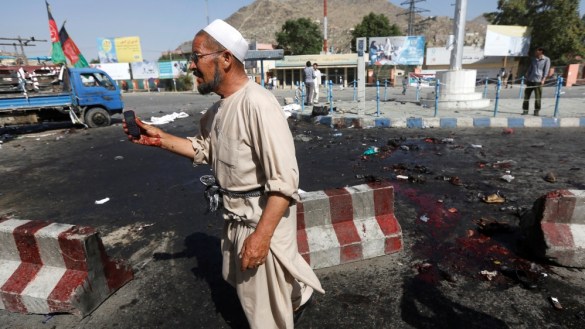
There was also a massive suicide bombing in Afghanistan, in which 80 people were killed and another 230 were wounded. It’s a strange number, 80. On the day of the Nice attack, as the number kept spiraling upward, 80 seemed unimaginable. It feels different in Afghanistan, though. It feels almost normal. We’re inured to violence there, in a way that dehumanizes the victims of ISIS. Even when lip-service is paid, even (especially) when politicians say that “ISIS kills more Muslims than anyone else”, there’s a feeling that those lives don’t matter. They certainly don’t grab the headlines.

That’s partly a man-bites-dog thing, of course: Afghanistan has been in a state of near-constant war for nearly 40 years, and we’re fatigued. Same with Iraq and Syria and Lebanon and Yemen and anywhere else where people are seemingly constantly being killed. It seems like part of normal life, just the regular course of things. We have trouble extending empathy to imagine them feeling the same kind of pain we can envision in France or Germany.

The thing is though, one of the grossest tragedies of the Afghanistan suicide bombing is who the targets were, and why they were there. The targets were the Hazara, Persian-speaking Shi’ites, a minority based mainly in Afghanistan who are the frequent target of the Taliban, of ISIS, of al-Qaeda, of the Pashtun, and others. They are frequently kicked around, and struggle for protection. Iran is the one constant friend.

So, then, why were they all in a group, able to be targeted?

Guardian

The protesters were marching against government plans for a major power project to bypass Bamiyan, a predominantly Hazara province in the central highlands. Following similar protests in May, Afghanistan’s president, Ashraf Ghani, established a commission to look into the issue but government attempts to find a compromise failed. On 19 June, a contract was signed to build a smaller electricity line through Bamiyan, which did not placate Hazara activists.

Al-Jazeera

The 500-kilovolt TUTAP power line, which would connect the Central Asian nations of Turkmenistan, Uzbekistan and Tajikistan with electricity-hungry Afghanistan and Pakistan, was originally set to pass through the central province.

But the government re-routed it through the mountainous Salang pass north of Kabul, saying the shorter route would speed up the project and save millions of dollars.

Electricity. Power. Zoning. The desire to be economically and literally connected. The decision to bypass them might have been to save money, or it might have been to further put the screws on the Hazara, or it may have been both. The former might have been an excuse for the latter, or maybe just a coverup for it. The reasons are part of Afghan history and politics, and I don’t feel comfortable speaking to them.

But the protest? That’s normal life. That’s a group of people who are tired of their situation, who feel oppressed, and who want something that is normal. Take away the historical oppression, and imagine it as anything else: a potentially lucrative and life-bettering development was going to happen (imagine it if you want a railroad or a dam or a base to build the newest military joint-strike hybrid disaster) and then it was taken way. The hydroelectric plant was supposed to go near this town but the TVA shifted it away. There are a million parallels around the world. Anyone would be mad, and anyone would protest.

That’s exactly the point: this is normal life, or at the very least, the desire for it, taken away in a energy-filled pulse, that pulverizes organs and rends limbs and makes the face of life unrecognizable. These are (and were) human beings, who despite living in a land of war, many of whom have known war and terror their whole lives, who are willing to stand outside and protest electrical lines. They petition for surveyors and government project planners to look over their notes again and maybe try something new. They are standing up in the city council meeting of a mid-sized Illinois town and asking for the baseball diamond on 4th to be maintained.

There’s no simple answer for terrorism, and the extension of empathy (which can’t just be willed, not even for someone who tries) won’t end it. The recognition that Muslim lives are real won’t stop ISIS, especially when they are the ones taking Muslim lives like a joyless Queen of Hearts. But the dehumanization of Muslim lives, whether that is in the headlines or in the speeches of politicians who treat refugees like a murderous and faceless horde, serves the recruitment purposes of our enemies. It can help a non-political, non-active, and not-even-particularly-religious immigrant decide that they are going to move from petty crimes and personal abuse to a mass killing, in the vague name of some group they barely know. It’s a cycle that will take a generation to break out of. But that doesn’t mean we don’t have a duty to start.