
He’s all about repealing Obamacare, not much for helping poor and posioned minorities in the state of which he’s still the governor.
He’s all about repealing Obamacare, not much for helping poor and posioned minorities in the state of which he’s still the governor.

The Fonz is rolling in his grave
There is no other explanation for Scott Walker’s actions other than his hatred of Wisconsin

That’s a big boat! All images in post from MLive, courtesy of the Great Lakes Maritime Institute
We interrupt this daily cavalcade of horrors to think back to a time when you could cruise the Great Lakes in luxury, before they set the boats on fire for scrap metal.

More in-depth investigative reporting from The Guardian uncovers papers thought destroyed that tie Walker to a nexus of anti-Democratic, but possibly tragically legal, corporate greed.

East Chicago, 1972, around when the present began to crumble. Image from blog.hemmings.com
East Chicago is one of those strange places that most of us only glimpse while driving past it, along its southern end, on a road trip that takes us through the rundown broken-factory grime of northwestern Indiana. If we’re going toward Chicago, it’s the last in a string of scary and polluted cities before you approach the rusted majesty of the Skyway, looming at imposing and strange angles, like a bridge out of Hell. More recently, East Chicago is the home of a booming casino. You get off 90 to get there, on what is essentially a designated highway, skirting the town itself. East Chicago just exists as a string of industrial lights and smoke glowing through the darkness.
It isn’t that, of course. It is a real city, where people live. It’s still a fairly-thriving Lake Michigan port, a beneficiary of this vast body of water, so crucial to the American experiment. It’s proximity to the lake, and to the Calumet and Chicago rivers, gave East Chicago some prominence in the steel industry, and its factories provided jobs and a living, even if a dirty and difficult one. Other industries bloomed in the area, in the days where Gary was a town to behold. But that legacy crumbled, leaving poison in its wake. This poison is metaphorical, but also terribly literal: East Chicago is facing a massive crisis in its drinking water, the weight of the past seeping into the present and darkening the future. It’s a reckoning with which we all have to deal.

Starboard side of Lady Washington. Image from Roger Pawlowski
A team of amateur- but still really damn good- underwater archeologists have discovered the incredibly-intact remains of an 1803 shipwreck in Lake Ontario, one of the earliest shipwrecks in the vast lake system. From their website:
Oswego, NY – A rare 18th century built sloop, Washington (also known as Lady Washington), has been discovered in Lake Ontario off the shores of Oswego, New York by a team of shipwreck explorers. Jim Kennard, Roger Pawlowski, and Roland Stevens located the sloop in late June utilizing high resolution side scan sonar equipment.
The sloop was enroute from Kingston, Ontario to Niagara, Ontario, Canada with a full cargo when it foundered during a gale on Lake Ontario in 1803. The Washington is believed to be the oldest confirmed commercial sailing ship to exist in the Great Lakes. It was the first sloop built on Lake Erie and the first to sail in both Lakes Erie and Ontario. Sloops only existed for a limited period of time on the Great Lakes as they were replaced by schooners which had two or more masts and were much more efficient to operate.
It’s a thrilling find on a historical level. It’s also incredible to think about the enormous differences a scant 200 years can make. For settlers, in 1803, Erie and Ontario were on the edge of the West, that teeter-point between a barely-born nation that had just pushed itself away from the coast into the fearful forests and the wild lands outside. (The story was a little different for the natives, of course.) The fur trade, while declining, was still incredibly important, and a continuous link to the early days of colonization and exploitation, a direct line between the toddling American nation and the days of trappers and Jesuits.
And the Lakes were wild and fearsome beasts, capable of rising up and swallowing a ship whole, never to be seen again. It’s only in the last few decades, really, that we’ve gotten to the point where a Great Lakes shipwreck would be due to massive error, rather than the cruel and unforgiving coldness and brutality of the whipping winds and exploding waves.
But you can still see it when you walk past any of them, on a summer storm or during a winter gale. You can see the contained fury stir up into a frenzy, and from a safe and warm window you can imagine being out there, in a creaking wooden ship, eeking out a living bringing the dissected remnants of nature back to the cities in exchange for the meagerest goods of survival, and know the fear that must have gripped them when this implacable and wild land struck back. When Ontario, the smallest of the Lakes, but still terrifyingly larger than three of the original 13 states, roared up, and swallowed you whole, your bones never to wash up, lost forever, lost in the country, lost in the water, lost in a new America. You can still feel that vastness, sometimes, a chill up your spine, as you wonder what we’ve gained, and think of all that was lost doing so.
Note: I’ll be out of town between the 4th and the 15th, in a wilderness repast, with little to absolutely zero connection to the internet or my phone. Posts during this time, written in advance, will be bigger-picture, or more idiosyncratic, rather than directly pegged to the news. If events happen that supersede or negate anything I say, think of these as a more innocent time capsule. Try not to let the country burn down while I’m gone.

A few years ago I was doing a periodic dive into Chicago history, as will frequently happen, and was perusing the relevant section at the local library. Over the preceding few years, I had gotten more and more interested in Chicago as a city built on a lake and river, which we all know, but tend to take for granted. While Chicago is a major port city, for most residents, that takes places completely out of sight. The river and the jawdropping lakefront are for recreation and beauty; they are no longer the economic engine.
So an old book called “The Chicago” caught my eye. It was plain blue, no jacket, but you could tell it was going to have that musty and delicious old book smell, with pages that hadn’t taken a breath in years, if not decades. It was by an author named Harry Hansen, and not knowing too much about it, I put it on the pile. How bad could it be?
It turned out to be a thing of wonder. Hansen was an old-time Chicago journalist, originally from Iowa, who loved the city but looked at it skeptically. The book blended history and the present- or, rather, Hansen’s present, as it came out in 1942, but was clearly written before the outbreak of war. He took us up and down the still dirty and gritty river, which still had grimy industrial buildings and warehouses and factories on most of its grim banks.
But he also took the reader through time. He had the history of exploration, the Kinzies and Du Sable, and the earlier French explorers who found the portage. It was amazing to read, as he’d talk about a place at, say the 31st and Western, on the south branch, and talk about what was there when he had come to the city some 40 years beforehand, when the smoke from the fire could still be detected in memory and the city had yet to celebrate its first century. And, reading it some 80 years later, both waves of history have been lapped, but both are still present in any given spot.
This journey, it turned out, was part of the Rivers of America series, a huge, sprawling, ambitious piece of Americana that spanned nearly 40 years and three publishers. The idea was to tell the history of America through its rivers, those first highways, along which all cities were built. It is a 50-book series, with the first being The Kennebec in 1937, and the final one The American in 1974. It’s also instructive to think of how much America itself changed over the years. The series takes you from Panama to Alaska, and from Maine to California. It is, fully, American. (Towns End Books and Wikipedia have complete lists)
And who doesn’t?

The Chicago River is very pleasant now. That…that wasn’t always the case.
It’s often remarked that Chicago doesn’t make anything anymore. The city, in addition to being the “hog butcher to the world” and lumber hub between east and west, was throughout its history a major industrial city, drawing workers from around the world to its factories and warehouse, creation dotting the riverfront and radiating into the neighborhoods. Now we’re more known for finance and startups and the normal “transforming city” type businesses. And that’s fine. It’s imperfect, and even cruel, as the city’s new wealth is incredibly uneven. But to say that Chicago is not better off than it was in the 1970s and 1980s, after old man Daley did everything he could to keep Chicago from adjusting to new realities, would be a lie.
That said, there does feel like something has been lost. Into that void comes the Made In Chicago Museum, a new site exploring the things that Chicago used to make. Full disclosure: the site’s creator and collector, Andrew Clayman, is a very good friend of mine, who introduced me to my wife, and who is the best damn shortstop a softball pitcher could hope to have behind him. But I’m promoting this because it is awesome. My friends do a lot of stupid shit that I never write about. It’s a celebration of industry, both high and low, from the most useful to the most ephemeral and whimsical.
Even that stuff, though, stands out because it is long-lasting. Clayman doesn’t just collect and take pictures of old ice skates, clocks, scales, tins, and other gee-gaws and doo-dads. He celebrates a history of manufacturing. On each page there is a history of the company tht made these items, and as much as possible, the people that worked there.
Let’s take this Ice Skater Sharpener, made by FW Planert and Sons in 1910.
Patented in 1910, this metal clamping device was used to keep an ice skate secure while its blade was sharpened. The manufacturer, F.W. Planert & Sons, was one of the “The Big 3” in the Chicago-dominated ice skate industry of the early 20th century. The other two, family rivals Nestor Johnson and Alfred Johnson, were also headquartered on the Northwest side.
Did you know that Chicago used to dominate the ice-skating industry? Or that there was rivalrous Big 3? I certainly didn’t! Throughout the piece, Clayman talks about Planert, his business, and the people that worked there. He’s dug up archival pictures from newspapers, because, throughout the life of a city, nearly everything has been covered.
One of the cooler parts is that for every manufacturing plant, he tells what is there now (in the case of Planert, it is the trendy Cotton Duck, a restaurant in the extremely hip and foodie-oriented Ukranian Village neighborhood.
It’s sort of elegiac. I’m old enough to remember when Ukranian Village felt sort of rough. It wasn’t, but comparable to the neighborhoods we usually hung out in, it had some hard edges that gave you a glimpsed hint of the city before the great transformations of the 90s and 2000s, of the hard city of Algren and Terkel. Even now, the huge gilded churches remind you that the neighborhood has a history, that it isn’t just a name, that it is where an ethnic group found comfort and solace and work in a new and confusing country.
That works has faded, and the neighborhood is entirely disconnected from the idea of being “Ukranian” in any real sense. Most residents probably barely connect it with the Ukraine, the place. It’s just a name. And that’s fine: cities change. The toil that consumed lives fades into blurry pictures and hardly-understood designations. Factories that defined whole existences become transient restaurants waiting for the next food trend to shut them down.
Into that comes Clayman’s project, which reminds us that these neighborhoods, these streets, these cities, and yes, these anachronistic and old-looking products were all created by people, who devoted some or all of their one short and difficult live to make them. It isn’t romantic; these were hard lives. But they were real lives. There is a weight on every page, a lived weight, which in its own way is a cry against the weightless nature of our new disconnected economy.
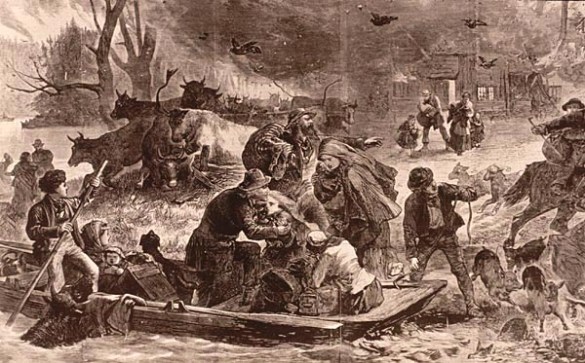
Peshtigo, 1871.
For the GOP insiders most concerned about violence in Cleveland, many cited protest groups tied to liberal causes, like the Black Lives Matter movement. Nearly a half-dozen Republicans mentioned the Hungarian-born billionaire George Soros, who is a prolific donor to liberal causes. But few thought violence would ensue from an effort to fight Trump’s nomination on the convention floor. “It’s simply too big of a target for the malcontents and violent left to miss,” said an Iowa Republican. “George Soros’ money will pay for thousands of disaffected screaming thugs. Think Seattle [1999], Chicago 1968. Riots and looting. They are the tools of the liberal left.” “I say this with no joy whatsoever,” a Republican in the host state of Ohio added, “but the far-left agitators in Cleveland will make the 1968 Democratic Convention in Chicago look like a fourth-grade slap fight.
Now, I don’t expect an “Iowa Republican” who thinks that George Soros is bussing anarchists to Cleveland to understand this, or for that matter an Ohio Republican, but it is worth noting that the violence in the 1968 convention did not come from the far-left. It came from the cops. There was provocation, sure, but it was the police that were rioting. As the Walker Report indicated, the refusal to allow permits, the wish to cordon American citizens away from where the powerful were meeting, led directly to the bloodshed.
I would hope that when covering the protests this week, the media remember that. There will almost certainly be Seattle-type violence (and that is the actual far left), but chances are high a lot of the violence will be coming directly from those sanctioned by the state to levy it, and who should take the responsibility seriously.
Or hell, it might come from all the armed lunatics gathering in an open carry state, many of whom feel that these far-left weirdoes and blacks are threatening America and conspiring to ruin Donald Trump’s chances. Would you be surprised if these patriots opened fire? If they saw, incredibly, an anarchist of a Black Panther with a gun, and had to protect themselves? Does any of this seem implausible? A firefight between on-edge police, right-wing militia types, angry protestors, and lone gunmen types like in Dallas and Baton Rouge? This is Peshtigo in the hot summer of 1871. The sawdust is baking in the heat, and the firestorms are being born.
Cleveland is on Lake Erie, but the closet analogy is up the Great Lakes system, up Michigan, near Green Bay. This is Peshtigo in the hot summer of 1871. We’re on the edge on conflagration. Little fires burst every day. The skies are increasingly choked with soot. The sawdust is baking in the heat, and the devouring and murderous firestorms are being born.

I’ve been lovingly making fun of this sign for years- really, you have all three?- but I don’t know if I ever noticed the “open for business”. Is that new.
Here at Shooting Irrelevance, we’ve spent some time talking about what Scott Walker is doing to Wisconsin, because being a Chicago kid, we’ve spent a lot of time in Wisconsin. I love the state: love the people, love the food, love the drinking culture. I realized once it is the unpretentious south. You can’t see them writing a Huckabee-style book called God and Hot Ham Rolls. It’s a beautiful place where nature plays a deep role.
Underneath all that, or perhaps because of the cold winters and the need for community, is a fierce tradition of progressive populism. Wisconsin is our great labor state, or at least it was. That’s one of the tragedies of Scott Walker. He came in with the idea to ruin Wisconsin, to ruin the idea of Wisconsin. To literally change the Wisconsin Idea.
As we said once:
If you want to know everything base and venal about Scott Walker and the Wisconsin Republicans, remember that the literally wanted to edit the Wisconsin Idea to remove anything about the human spirit, and put in language about the state’s workforce needs.
The mission of the system is to develop human resources to meet the state’sworkforce needs, to discover and disseminate knowledge,
to extendknowledge and its application beyond the boundaries of its campusesand toserveand stimulate society by developingdevelop in students heightened intellectual, cultural, and humane sensitivities, scientific, professional and technological expertise, and a sense of purpose.Inherent in this broad mission are methods ofinstruction, research, extended training and public service designed to educatepeople and improve the human condition. Basic to every purpose of the system is the search for truth.(lines are Walkers’ proposed edits)
It’s this baseness, this venality, this reduction of the unaligned poor to gristle in a mill that is the heart of the modern conservative movement. Trump’s white nationalism is a part of it, of course, but when he is (hopefully soon) swept from the stage this will remain. It’s the main economic message. Most humans exist to make others rich. Money is the only power. It’s true materialism.
Walker confirmed this yesterday, when talking about school funding, and how the rich school should be able to hoard all the good teachers.
Walker said school districts can set pay based on performance and hire based on merit.
“It’s about putting the best and the brightest in the classroom,” Walker said. “If someone is an exceptional talent and wants to go into education, they can be rewarded for that.”
When asked whether he thought such incentive-driven salary programs would be a hindrance to allowing school districts to keep quality teachers, Walker compared teaching to being a player in the NFL.
“If the Green Bay Packers pay people to perform and if they perform well on their team, (the Packers) pay them to do that,” Walker said. “They don’t pay them for how many years they’ve been on the football team. They pay them whether or not they help (the Packers) win football games.”
And, you know, some schools are the Pack or the Pats, and some are the Rams. That’s just the way the market works. You have winners and Lions.
Walker was a joke during the Presidential campaign, but he didn’t disappear. He went back to his true love: ruining Wisconsin. Walkerism isn’t going away. White nationalism and “othering” will alwas be a driving force in the GOP, as presently constituted, but its fires might not always burn so bright. When that fire is embers this mentality, the desire to turn everything into commodity, including and especially people, will remain.
(Note: everytime I type “ruining Wisconsin”, and I’ve noticed this in gmail as well, it is underlined and says “did you mean to say ‘running'”. Nope.)
 Shooting Irrelevance