Jabhat al-Nusra and Post-ISIS “Syria”


Meet the new boss- not quite the same as the old boss. 


Syria and The Success of Smarter Militants

Interesting WaPo article by David Ignatius about Jabhat al-Nusra, the Qaeda affiliate in Syria. They’ve bascially bided their time during the rise of ISIS, gaining reputations as good fighters and building alliance with relatively more-moderate groups, and they seem poised to emerge successful out of the wreckage when the more apocalyptic jihadist group enters its post-Caliphate stage (which could be loosely described as “A caliphate of the mind”).

Jabhat al-Nusra has played a clever waiting game over the past four years, embedding itself with more moderate opposition factions and championing Sunni resistance to Syrian President Bashar al-Assad. The group has mostly avoided foreign terrorist operations and has largely escaped targeting by U.S. forces. Meanwhile, it has developed close links with rebel organizations such as Ahrar al-Sham that are backed by Turkey, Qatar and Saudi Arabia.

But the global jihadist ambitions of Osama bin Laden remain part of Jabhat al-Nusra’s DNA. U.S. officials report increasing evidence that the group is plotting external operations against Europe and the United States. Its operatives are said to have tried recently to infiltrate Syrian refugee communities in Europe.

A stark warning of the danger ahead comes from the Institute for the Study of War, which closely follows events in Syria. In a forthcoming forecast, the institute argues that by January 2017, “Jabhat al-Nusra will have created an Islamic emirate in northwestern Syria in all but name” and will merge with the supposedly more moderate Ahrar al-Sham.

And that’s the smart way to do it. It’s one of the reasons why AQAP in Yemen has been so successful for so long, even so far resisting an ISIS takeover (more on that coming soon). There are certain organizations which are “lessons learned” oriented, who can take the success and mistakes of the past and integrate them into the local situation from which they are emerging. They don’t try to jam a rigid system into a fluid situation. You can have short-term success doing that, but it is far more difficult to maintain, as ISIS is finding out.

(That said, of course, ISIS isn’t halfway out the door. I am as guilty as this as anyone: because the outline of the end, or at least the end of this phase, can be roughly seen, it shouldn’t be assumed that it will play out the way we imagine, and shouldn’t be so quick to act like we are already in the next phase. Analysts and bloggers are, I think, more guilty of that than actual military people, so I’m not too worried.)

This is part of the mutation of the jihadist threat, and why it needs to be treated as a generational problem, one that requires supple and strategic thinking, on all levels, and not be treated as a eopochal failure when it isn’t met with “unconditional victory” during, say, a Presidential term.

It’s almost inevitable that, if not al-Nusra, another AQ or ISIS-like group emerges in whatever comes out of Syria, whatever post-state shape it is in. That isn’t a clarion call to give up, but more that we have to be realistic about what can be accomplished, and to me, that means not trying to force Syria back together again.

I think the Kerry plan, which Ignatious describes as a “three-cushion shot”, is a good outline. “Kerry’s plan would include joint U.S.-Russian operations against the group, as well as the Islamic State. Kerry also hopes to reduce Assad’s attacks on moderate rebel forces so that they (rather than Jabhat al-Nusra) can gain ground in a post-Islamic State Syria.” That’s probably the best outcome that can be hoped for: increased moderation, though not perfection, in post-Syria areas. The more we try to maintain a 20th-century fiction, the more other fictions, like that of the glorious caliphate or the purity of fanaticism, will tell the story.
A Brief List Of What I Didn’t Hear On National Security Night

  1. North Korea
  2. European Union
  3. Brexit
  4. Nuclear weapons
  5. China (save for Jeff Sessions mentioning their “burgeoning economy”, which is a weird way to put it)
  6. South China Sea
  7. South America
  8. Africa
  9. Syria (outside of ISIS)
  10. Russia (unless I missed it)
  11. Turkey
  12. Incirlik Air Force base
  13. Cyberterrorism
  14. Saudi Arabia
  15. Piracy
  16. Ukraine
  17. Transnational crime
  18. Nuclear Preparedness
  19. Pakistan
  20. India

All of these are issues on which you could plausibly hammer Barack Obama and Hillary Clinton, if you wanted, to various degrees of fairness. But unless I missed it, nothing about this came up. Again, not a serious candidate, not a serious party, which makes it an intensely serious threat.

(I promise I’ll do the same for the DNC, just to be scrupulously fair)

What the RNC Gets Wrong About ISIS and al-Qaeda

33968

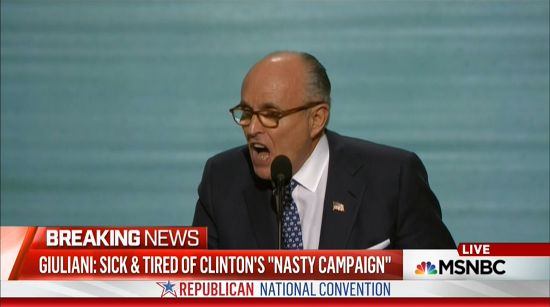
Being tired of the nasty campaign run by “crooked Hillary Clinton who should be in prison” is actually one of the less-misleading things Giuliani said.

So, “Make America Safe Day” is over, and I don’t know about you, but I feel much safer already! I know that all we have to do is elect Trump, and we’ll be fine. Or, as Mike McCaul, the inexplicable Chairman of the House Committee on Homeland Security said, “It’s time to take back our country and make America safe again!”

That’s a good jumping-off point for not just the emotional reaction, of which there was plenty, but the substantive one as well. Because that was sort of the heart of the night: argument through assertion. That’s common in politics, but it was common in a very dangerous way last night, which perfectly encapsulates the right’s unflinching commitment to not understanding the threat of jihad while spittling that they are the only ones who get it.

Because let’s start with the biggest lie of the night, the one that was the driving theme: Hillary Clinton can’t keep as safe (whatever that actually means), and Donald Trump can. That’s pretty normal, and I think you can argue pro or con on the first half of that, as long as you don’t use “Benghazi” as a data point, because come on.

What you can’t really argue, or, more to the point, that no one actually did argue, is that Trump can keep us safe. It was all just assumed that because Trump talks big, and says he’s going to go get them, he will. McCaul even said he’ll make the ground tremble under the terrorists’ feet. It’s actually amazing that all these people who ostensibly care about national security can bring themselves to pretend that Trump has any genius, expertise, competence, o even basic knowledge of these issues.

But that’s really the problem. He doesn’t need to have any knowledge, because their understanding of ISIS is reduced to talking point about “political correctness” and not calling the enemy by it’s name. Rudy Guliani, who gave the most effective speech of the night, was the clearest on this (all Rudy quotes come from What The Folly).

(On The Fort Hood shooting): The only person who couldn’t figure out this was an Islamist terrorist extremist attack was Barack Obama, who called it workplace violence. This is why our enemies see us as weak and vulnerable!

Donald Trump has said the first step in defeating our enemies is to identify them properly and see the connections between them so we can find them and catch them.

To defeat Islamic extremists, we must put them on the defense.

If they are at war against us, as they have declared, we must commit ourselves to unconditional victory against them!

(Wild applause, baying at the moon, a general sense of punchiness)

Rudy used this to segue into the Iran deal, misreading it entirely (as Kaplan points out), and pretending that the money going there is funding ISIS and AQ. Which he didn’t say explicitly, and may or may not believe, but these were his phantom “connections.”

And that’s really the heart of the right’s idea on terrorism: a monolithic enemy that can be defeated merely through the brawny use of strength and the exact right words*. They believe that there is such a thing as “unconditional victory”, which is a strange and grandiose and entirely misleading turn of phrase, since it implies that there is a scenario where conditions would be accepted or not, and that there would even be someone to whom you could deliver the conditions.

The jihadist threat is not one that can be bombed out of existence, nor one that can actually be defeated in a conventional sense. The problem that the right wing has is that they want to fight a war against an enemy that doesn’t exist. They can defeat “ISIS”, in its current incarnation, but have no answer for 1) what comes next in the wreckage of Syria and Iraq, 2) what happens to affiliates around the globe, and 3) what to do with the next mutation. They can’t see this because they are unable to understand that there are root causes of jihadattraction that go beyond good and evil. As Scott Atran said in the NYRB this weekend,

Are we again dangerously underestimating ISIS’s will to fight, and its ability to endure and expand? Although military defeat in Iraq, Syria, and Libya could help make it more difficult for the group to recruit, we will not be able to defeat ISIS itself until we find a way to reconnect the neighborhoods, online communities, and other particularly susceptible social and political settings where attacks like what occurred in Nice continue to find inspiration and support.

“Reconnecting the neighborhoods” isn’t something I heard last night. I don’t think Barack Obama has all the answers, clearly. I don’t think Hillary does, either. But I think they both actually recognize the complex nature of the threat, and are seeing the world as it is. The party of realism is completely unmoored, and want to take our entire national security apparatus along with them.


* Everyone points out their weird and childish fixation with saying “Islamic terrorism”. It’s hard to say if they actually think that will defeat ISIS; it’s entirely possible that anti-PC cognitive dissonance has taken over, and they actually believe it’s a big deal, and that Obama is actively hurting the US by not saying it. What’s weirder is the “define the enemy” thing. It’s very post-modern: you’ll become what words are used to define to. It’s the mutability of the self in the face of the observer. Gombrowicz would totally dig their platform.

How Not To Keep A Free Society: Newt Gingrich Edition

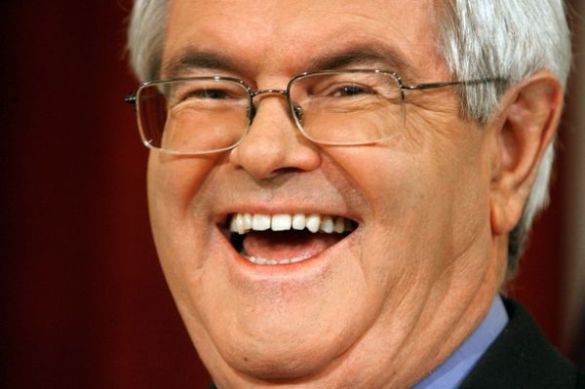
0eeba-newtgingrichgiantlaugh

“I’m a really deep thinker, frankly.”

In the last post, we talked about how the kind of mutating terrorist attacks like we saw in Nice will happen in a free society. Newt Gingrich, whose VP dreams have yet to be crushed, eschews all talk of free society.

“Western civilization is in a war. We should frankly test every person here who is of a Muslim background and if they believe in sharia they should be deported,” Gingrich told Fox News’ Sean Hannity.

“Sharia is incompatible with western civilization. Modern Muslims who have given up sharia, glad to have them as citizens. Perfectly happy to have them next door,” he added.

There’s no real need to point out everything that is wrong with this, right? Forget how hideously unconstitutional and un-American it is to have everyone of a single faith line up for loyalty testing. That’s standard Newt: he knows it is what Trump wants to hear, so he’ll say it. (Bonus Newtism: he always says “frankly” when he’s about to say something really dumb, because he feels it gives it intellectual heft. Once you notice that, you’ll see it is always true.)   Let’s also forget for the moment that believing in Sharia is not, in and of itself, against the law. There are a lot of people who don’t believe in the Constit

Let’s also forget for the moment that believing in Sharia is not, in and of itself, against the law. There are a lot of people who don’t believe in the Constitutional order, and as long as they aren’t acting on it, that’s ok. Let’s also ignore the insanity of someone saying that a belief is “incompatible with western civilization” when he’s literally proposing mass expulsion based on a religious-based ideological litmus test, which seems pretty goddam incompatible with Western civilization, to me.

No, what’s really stupid– what makes Newt so world-historic dumb at times — is that he proposes this as the realistic and tough-guy way of dealing with a threat. Tthe attacks at Nice were the “fault of Western elites who lack the guts to do what is right, to do what is necessary,” he told Hannity, and between the two, the perfumed machismo must have been through the roof.  This is, frankly, incredible. How exactly does he imagine this is going to go down? Does he actually think that people dedicated to the destruction of America and the death of all its citizens are also incapable of lying? That after waiting in line for hours, after the Muslim Registration Act, which won’t do much to change their attitude toward the US, they won’t be able to plot a complicated web of deceit, i.e., saying “no” when asked if they are a terrorist?

The most charitable interpretation of this is that Newt actually believes this will work, and that it will allow good Muslims to stay in the US and have everyone be happy. It’s barking madness, of course, and deeply antithetical to the kind of free society that is at the end the final bulwark against radicalism. But if he believed this would work, or was a good idea, at least you could argue from there.

But he probably doesn’t, at least not in any way that doesn’t require the cognitive dissonance that is the heart of the modern right wing. He decided this sounded good, and would appeal to Trump, who appeals to millions and millions of voters. They want the tough guy who will trample our values, because it feels good. In less than a week the GOP is going to nominate someone who brags about his willingness to employ torture. They are appealing because their idea of America is one of soil and blood and steel, and not the actual values that make this country great. They have the same boot-stomping atavistic lure of LePen and Orban and the Brexiters.

ISIS and al-Qaeda want a civilizational clash. They are experts at provoking one. It’s their great good fortune that they have enemies who want to give it to them. What Newt said wasn’t in a vacuum. It’s the direction in which the whole world is lurching.

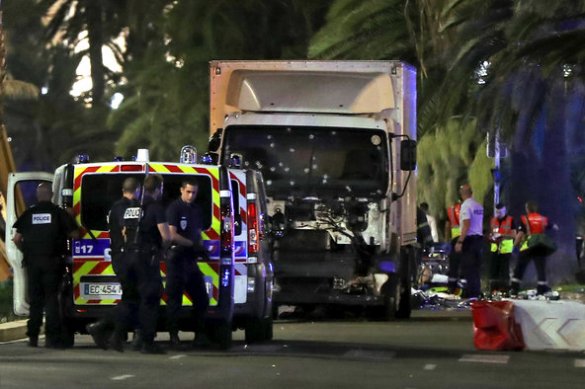
Nice, The New Terrorism, And The Limits of Freedom

15france-blog-top-tmagarticle-v2

Image from NYTimes

As of this writing, no jihadist organization has taken credit for the horrific attacks in France last night, when a petty criminal with no known ties to any group plowed a truck through a mile of death during a celebration of freedom. It doesn’t mark a new chapter in terrorism, but it does make everyone aware that we are firmly in that chapter, that the pages have turned around us, and we’re stuck in a new plot.

My initial instinct is that this will be the plot of a small, independent cell, possibly with some training behind them, but more than likely not. If it wasn’t coordinated with any central ISIS/Qaeda group (as seems to be the case), it also wasn’t entirely unsophisticated, despite the bluntness of the attack. The right street was picked for maximum efficacy, and the presence of weapons in the truck showed the ability to acquire the tools of war.

All that said, it wasn’t very sophisticated, and indeed was taken right out of the pages of Inspire, as well as a few smaller-scale attacks. This is the new kind of terrorism: as what ISIS actually is changes over the next few months, there will be more of these attacks, both coordinated by the remnants of the caliphate or their affiliates, or from independent groups/actors who might pledge allegiance to ISIS but in an essentially meaningless way, tactically.

That it is meaningless doesn’t really matter, though, especially to the dead. These small cells usually wind up shooting themselves in the ass, but they can sometimes be successful, especially if they keep things very simple. One of the main dangers, as I see it, is that as ISIS starts to create a vacuum, there will be more room for a) affiliated terrorist organizations to try to take the leadership mantle with coordinated, large-scale attacks; and b) unaffiliated-but-inspired groups to try to step up with attacks like these, which can be large-scale by dint of simplicity and luck.

The former can potentially be slowed down (if not stopped) by intelligence, and also luck. The latter might not be as spectacularly successful, but they can be extremely dangerous, and potentially do more to unravel the fabric of free society than larger groups. It makes everyone with a grudge, some sociopathic tendencies, and the “right” sort of inspiration (jihad, rather than The Matrix or whatever), a potential terrorist.

The problem is that a free society won’t really be able to stop these attacks until the fervor of jihad runs its course, which it will, at some point, though possibly not in the lifetime of anyone reading this. As the Middle East convulses, and as Europe tries to handle the expansion of superstates, the reaction of nationalists, and the influx of the stateless, emotions and politics on personal and international levels will be subject to huge changes and dangerous trends. We’re at the beginning of it now. The end is nowhere in sight.

The key is not to give up on the idea of a free society. Bastille Day was the right day to pick for this, for maximum symbolism. It is a celebration of freedom. Of course, the French Revolution became a horrible Goya flipbook of bloodlust and revenge, and ended in Empire, but through fits and starts, it became France. It has its problems with assimilation, but has strong democratic values.

As a free society, that’s the sort of timeline we have to look at when dealing with the mutating scourge of jihad. One day, it will be history. The question is if we’ll be reading that history in a free society, or if we’ll be looking at it through the gray-barred schoolhouse of a modern police state.

What’s Next For ISIS?


Going my way?


As we talked about last week, ISIS is clearly entering a new phase as they lose territory in the Caliphate. I said that they might transform into a “carnage-based idea”, but of course that is pretty vague, and not really informative. I had meant to bring up this piece in War on the Rocks by Clint Watts, who goes into great detail about the three different types of ISIS affiliates: Statelets (as in Yemen, Libya), Insurgency (like Boko Haram) and Terrorist Organization (Saudi Arabia).

Watts discusses foreign fighters, trained in the caliphate, who will be unable to return to their actual homes after ISIS collapses in Syria and Iraq. They are the ones to watch to see the strength of the movement. “The most indicative data will come from the roughly 15% of Islamic State foreign fighter survivors I estimate will be unable or unwilling to return home. These “floating” fighters lacking roots to a homeland affiliate will be inclined to choose the most promising global affiliates for safe havens.”

I think this is very true. Over the last 25+ years, we’ve seen increasingly-sophisticated foreign fighters find the group that best represents both their ideology, and, more important, the desire for successful jihad. It’s why AQAP was so powerful; it was the most far-reaching and far-sighted AQ affiliate out there. But now we see even AQAP struggling to reach an even newer and less-patient generation, losing fighters to ISIS. As they increasingly clash, though, I’d put my money on AQAP.

And that’s the big question, for me. ISIS was extremely bold in declaring a caliphate, knowing that the aura of success (and their actual battlefield success) would draw in more foreign fighters, and more money. As they begin to lose on that battlefield, will ISIS central still have much control? Will the ISIS brand, to use an awful term, still mean much? That is, when shifting toward affiliate-based statelets and insurgencies, will they still be ISIS in any recongnizeable way, or just groups with a shared heritage but different, more localized goals?

That to me is key. In the same article, Watts mentions how Central Asian fighters might “choose to resettle with an Asian group known for attracting foreign fighters, such as the Khorasan wilayat or possibly more likely the Islamic Movement of Uzbekistan (IMU).” The IMU has been around for a long time. It’s been both a generator and absorber of jihadists. It has long-term and essentially-localized goals. I think that a lot of groups, no matter their worldly ambitions, eventually get settled into what is happening around them. What made ISIS different, even more so than their lust for carnage and media sophistication, is that it pretended otherwise. But even with the spate of attacks, even with the “inspired” killers in cities around the world, they spent far more time fighting  the near enemy.

So then, as they change, as lose that idea of the caliphate, will ISIS really mean anything? Or will they be just a blip? An important one, one that changed the game, for sure. But in the end, will it just be a splintered movement, a period of consolidation followed by fracturing, before the next consolidation? I tend to think so. I think their “affiliates” will be even less affiliated than AQ. That might make whatever they are, in however many forms they are, even more dangerous, though, as everyone will have to up their game to get recruits.

Would be interested to know how I am misreading this, of course.

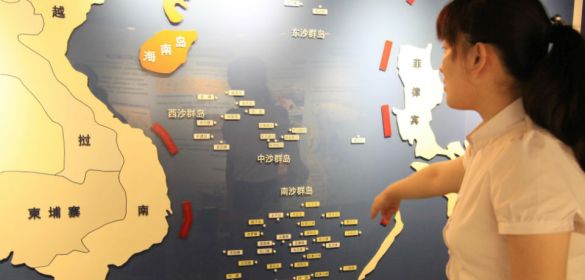
The South China Sea And the World Order: The Chinese Response Will Tell Us A Lot About the 21st Century

9dl

I don’t need to explain any of this, do I? Image from Foreign Policy

Here at Shooting Irrelevance, we’re mostly concerned with the growing contours of a post-state world, if not a de jure one, then at least a de facto, as the system is pulled apart by dislocation and globalization. That said, we’re not there yet, and in many ways are still a long way from it. There are a few countries who can still impose their will on the world, for better and for worse, and to varying degrees of efficiency. The US is the main one; Russia, for all its cracks, is another (though I think the impositions are largely just to paper over those fissures).  And then there is China, who is seeking to reshape Asia and global trade to its benefit.

China received an expected blow today from the International Court of Arbitration in the Hague, which ruled that it did not have the right to shipping lanes in the South China Sea. Based on dubious ownership claims of atolls and sun-bleached lifeless rocks around the Philippines, China has claimed historic right to them for their navy and fishing vessels, blocking Philippine ships and obstructing trade. The decision, which is binding (both countries are signatories to its statute) said that China didn’t really have a historic claim to the Philippines, and should back off.

This is important. In addition to saying that little rocks give them sovereignty and historic claim, China had been building little islands and claiming that they had the right to own territory within a 200-mile radius, as the Law of the Sea dictates. Obviously, that was a clever way to gobble up territory and to control some of the world’s most important shipping lanes. They have done the same in the East China Sea, as part of a very long-standing plan to control the waters around them. In building massive ports throughout the Indian Ocean and the Pacific, China is looking to create a trade-based maritime empire backed by a growing navy.

So now we have an international tribunal saying that China needs to slow down, at least in one crucial area. Needless to say, the official Chinese response is that this is unfair, the court is wrong, they are biased, etc. The question is what their official response will be. It’s neighbors, especially Japan, are worried. The Guardian captures a slightly contradictory response.

The Communist party mouthpiece newspaper the People’s Daily said in an editorial that the tribunal had ignored “basic truths” and “tramped” on international laws and norms. “The Chinese government and the Chinese people firmly oppose [the ruling] and will neither acknowledge it nor accept it,” it added.

Speaking to reporters Wang Yi, China’s foreign minister, said: “Chinese people will not accept the result and all people around the world who uphold justice will not accept the result.”

“Now the farce is over it is time to get back to the right track,” Wang added, hinting that Beijing would now be willing to enter into negotiations with the Philippines “over the South China Sea issue”.

This strikes me as sort of important. The Court didn’t rule that the Chinese had no right to fish there; just that they had no historic claim of domination. So it appears to be a hinge moment for China’s 21st-century idea of power: do they use their vast economic might to enter into what could be very fruitful negotiations with a country clearly within their sphere of influence? Or do they ignore the ruling, and carry on, confident that the US will not interfere too much, being unwilling to risk war with one of its most important trading partners.

There is a lot to parse out here, and I am not really the man to do it. China, in terms of trade, needs us to a mutually-dependent degree. Their Navy, while growing more powerful, would still be completely outgunned in a war with the US. It’s a situation no one wants. What I’m interested in is how China decides to act in the 21st-century, a century which they seem to believe, understandably, is theirs, and it is not a coincidence that the Phillippines are a flashpoint. If I were China, the statement by John McCain and Dan Sulllivan this morning would be particularly enraging. They are excited and particularly chest-thumpy.

“With today’s award, China faces a choice. China can choose to be guided by international law, institutions, and norms. Or it can choose to reject them and pursue the path of intimidation and coercion. Too often in recent years, China has chosen the latter. The world will be watching to see the choice China makes.

“The United States must continue to be clear and consistent in its policy to oppose unilateral actions by any claimant seeking to change the status quo in the South China Sea through the use of coercion, intimidation, unilateral declarations or military force; prevent any other country from exercising its rights to the resources of the exclusive economic zone; engage in any reclamation activities in the South China Sea; or militarize any reclaimed features.

“In light of the findings of this ruling, we expect that the United States military will continue to fly, sail, and operate wherever international law allows, as we have done in the Western Pacific for more than a century.

This is rich, of course. How dare China attempt a pseudo-colonization of the Phillippines in disaccord with international law. It’s been ours fair and square for over 100 years, when we took it over and brutalized it after beating the Spanish in a phony war! What right do they have?

Honestly, John McCain talking about how China has to be guided by “international law, institutions, and norms” is rich enough, but especially when talking about the Chinese not using unilateral action in the South China Sea. After all, US colonization of the Phillippines is essentially what made us a global empire, and set the stage for our “winning” of the 20th-century. This supercilious tongue-clucking when someone is trying to do the same thing at the dawn of the 21st must be maddening.

And that’s why I think this is an important moment. Does China continue to seethe under the anti-colonialist lectures of the US, listening to us say that the Phillippines have the only right to control their sea lanes, which are actually controlled by us? Do they use more negotiations to try to make the balance more equitable? Or do they now risk a confrontation, hoping a distracted and divided America might back off?

I don’t have an answer, but I do feel like the time when China is forced to put up with US hypocrisy in the region is coming to an end. I don’t say that this is a good thing; the world won’t be better off with Chinese dominance. I also think outright war is, thankfully, a very very small possibility. It’s just clear to see that the 20th century is clearly and finally coming to a close. What happens next will help to determine how the 21st one goes.


Reacted to the Gun: Yemen and the US; National Security and the Illusion of Exceptionalism


Pictured: Lunatics

Pictured: Patriots


Back when I was writing more or less exclusively about Yemen, the same conversation would always come up: “I’ve heard that there are so many guns in Yemen, and like, people just carry them around.” And that’s true! Yemen is a country completely awash in guns, and it was not uncommon to see people carrying rifles in the streets of San’a. Old rifles, generally, and rarely loaded, but yes. It’s something you got used to. The point of the question was generally not curiosity, but a way to explain how violent and dangerous and maybe even primitive a land it was, one ruled by savage bloodlust.

You clearly see where this is going. The person who asked was nearly always American, and my followup would be “yeah, by a lot of estimations Yemen has the second most guns per capita in the world!”, the first, of course, being America. But that’s where there was always a disconnect. Regardless of how the person I was talking to felt about gun control, there was never an idea that it was a similar thing. They had too many guns and that’s why it was so violent. We just have a lot of guns, is all.

Global Gun Policy Comparisons

A few notes on this graph from CFR. The last Small Arms Survey was in 2007. Some more recent estimates have US guns per capita at an incredible 112.6 guns per person, though the actual amount of gun owners has decreased. Just more people with an absurd amount of guns. Yemen has a wide variance, with some estimates putting it at 2nd (54.8 guns per capita) and others considerably lower.

I feel that people may be realizing just how insane this is getting, which the last terrible week may have shown. When Philando Castille was shot by a police officer, he was (reportedly) carrying a weapon he was legally allowed to. The officer, by way of exoneration, said through his lawyer that he was reacting to the “gun, not to race.” You can quibble about the role race played in how that gun was reacted to (spoiler: probably a lot!), but the key is the gun.

“Reacting to the presence of that gun” could be our national motto. We saw it again in Dallas, where protestors, enacting their legal right to armed carry, added to the confusion of an active shooter situation. This makes the incredibly difficult job of a police officer even tougher. How are you supposed to determine, in the moment, whether a person is a “good guy with a gun”?

For that matter, how are we? A couple of years ago, a man in Georgia went to a park with a Little League game, waving around a gun and bragging about how it was legal, and there was nothing anyone could do.

“Anyone who was just walking by – you had parents and children coming in for the game – and he’s just standing here, walking around [saying] ‘You want to see my gun? Look, I got a gun and there’s nothing you can do about it.’ He knew he was frightening people. He knew exactly what he was doing,” said parent Karen Rabb.

Rabb said that the man’s intimidating behavior panicked parents causing them to hustle children who were there to play baseball to safety after the man refused to leave.

After deputies arrived, they questioned the man who produced a permit for the handgun. According to authorities, since the man made no verbal threats or gestures, they couldn’t arrest him or ask him to leave.

(Again, if the man was black, he’d be dead, but move on). This is insane. Unless and until he started shooting, there was nothing anyone could do except hope this man wasn’t a murderer. That’s where we all live now. We are all on the front lines. We’re all at the mercy of chance, hoping we don’t get shot. We’re all just reacting to the presence of a gun.

But what does it all mean?  We’ve talked a lot about how our devotion to guns is a reflection of a violent national character — we’re a country whose national symbol of freedom, for many, isn’t the founding documents or the broken chains of even the Statue of Liberty, but a tool designed by man to kill other men. More than that, I think, the mere presence of so many guns has a distorting and fearful impact on who we are. It’s hard to go out to dinner without thinking, in the back of your head, that this is a great spot for a mass shooter, whether they are pledging allegiance to the Caliphate or just the voices in their head. I think it makes us more savage.

It makes us less safe, and makes us feel less safe. There are people who carry, and feel a little more secure, but really: if you actually felt secure you wouldn’t need to. And yes, in an era of global terrorism, nowhere is safe, but getting shot is far more likely to happen here, for no reason, not even a sick and twisted justification. Just because someone falls asleep angry every day and wakes up exhausted and has access to guns.

This refusal to look at the impact being flooded with guns has on our national character is the dangerous side of American exceptionalism. It’s easy to look at Yemen and assign a national characteristic based on loosely-understood ideas about gun culture. I think taking any one thing and making it as synecdoche is foolhardy, but there is something there. It is there a little in Yemen (tribal culture is inherently more a negotiating one than a violent one, but revenge always has to be in the toolbelt). And it is here in the US.

We aren’t immune from history. It shows in our borders (having migration issues a mere 100+ years after mass annexation is not unusual!), and it shows in the way we react to the physical presence of guns. But we refuse to have an actual national examination. It’s easy to say “Yemen has guns and so it is violent”; but we have a lot of trouble doing it here, a country that is way more gun-heavy and death-ridden. It’s the same mentality that says torture is OK if the US does it, because our inherent goodness alchemizes war crimes into justice. It’s this inability to look nward, this blithe shattering of every national mirror, that I think more than anything is responsible for our decline.

A Brief Semi-Defense of Tony Blair’s Chilcot Defense

Eh, about that, old boy…

(I suppose the title should actually read “Defence”, but not this close to the 4th, right?)

After yesterday’s Chilcot Report, the world has more or less been united in scorn of Tony Blair, the once-dashing head of New Labor, who decided to yoke his genuine concern for human rights to a Bush administration that alternated between messianic and cynical. Blair’s reputation had already been mostly destroyed; now there is little chance of him being remembered for anything but a bloody (with meanings relevant to both sides of the Atlantic) disaster.

But there was one part of his defense that struck me as being relevant, and that was “you think things would have been any better had Saddam stayed?”

He added: “I can regret the mistakes and I can regret many things about it – but I genuinely believe not just that we acted out of good motives and I did what I did out of good faith, but I sincerely believe that we would be in a worse position if we hadn’t acted that way. I may be completely wrong about that.”

He argued that had Saddam Hussein been left in power, “he would have gone back to his [weapons of mass destruction] programmes again”.

And if he had been in power during the Arab Spring in 2011, “I believe he would have tried to keep power” in the way that Syria’s President, Bashar al-Assad, had done.

We’re all pretty much agreed that Trump’s semi-praise of Saddam is ludicrous, and we all agree because Saddam was one of the worst human rights violators of the 20th-century, which is pretty damned impressive. So to reckon with that is to ask if another 13 years of Saddam would have been a net benefit, in terms of human suffering.

It is obviously unanswerable, mostly because we liberated Iraq from the soul-crushing horror of controlled tyranny into the soul-crushing horror of anarchy, ethnic cleansing, and religious totalitarianism. Both options are pretty bad, and I can’t say which is worse. I can’t remember where now, but I remember an Iraqi writer saying that under Saddam, there was one giant dark circle you had to avoid. If you fell in you were dead. But now, there are millions of deadly circles and you don’t know where they are.

Still, if the Arab Spring had happened without the invasion, which seems likely in some form, would Saddam have just stepped aside? Or if he wasn’t alive, would one of his maniac sons be Asad but even more violent? Of course, if he had died, would the internal contradictions of Iraq have burbled up anyways, leading to a civil war like the one we have been seeing since 2003? It’s not hard to imagine the party breaking apart even without Bremer’s unimaginable idiocy, just under the weight of palace and fratricidal rivalries.

Counterfactual history is a mug’s game, of course. But I think Blair had a point in his defense of the war, even when it became a clear calamity: this might have happened anyway, and indeed, it probably would have. Iraq couldn’t have maintained itself after the tyranny of Saddam, and then you might have seen the hardening of ethnic lines, the splintering of Syria, regional chaos, the rise of an ISIS-like group anyway, etc. Indeed, you could argue that having troops there made the war more contained.

That’s an argument, anyway. We’ll never know of course, but the one thing that is clear is that it is hard to imagine how anything can be worse than what we have now, which undercuts any rationale for the invasion. The only thing we can say for sure is that American and British (and other) troops wouldn’t have been killed or maimed or had their brains broken, and that the hatred we engendered by doing the killing wouldn’t be so strong. Iraqis may have been killed horribly otherwise, but maybe not. The invasion was so destabilizing that maybe the nearly-inevitable impact of the final dissolution of the Ottoman Empire may have been relatively peaceful.

That’s the final argument for any of the war’s last defenders. It isn’t that Obama lost the war or anything like that. It’s that it takes an willful act of disturbingly macabre imagination to imagine a worse possible world.

The Chilcot Report: The Complicity of a Wasted Decade


I will be with you, whatever. Christ. 


What’s a bigger shock to a national system: an actual surprise, or the tug on the chin, forcing you to look at something unpleasant and buried? For Great Britain, was the Brexit vote (and the loss to Iceland!) the biggest blow to national image, or is it today’s Chilcot Report on Tony Blair, the Ministry of Defense, the political/media class, and the Iraq War? At over two million words- the summary alone is 145 pages- it looks to be an exhaustive look at the complicity of Tony Blair in the rush to an era-defining disaster. (Here are the high points.)

(The low point for Tony BLair is probably this: “In his forensic account of the way Blair and his ministers built the case for military action, Chilcot finds the then Labour prime minister – who had promised US president George W Bush, ‘I will be with you, whatever’ – disregarded warnings about the potential consequences of military action and relied too heavily on his own beliefs, rather than the more nuanced judgments of the intelligence services.” No matter in which tone you read that singular “whatever” it is reputation-definingly pathetic. The Guardian has a great look at how a smart man yoked himself to a swaggering bouffon he thought was both moral and controllable)

But then, the obvious answer to the above question is: of course Brexit (and Iceland!). I mean, everyone knew that the intelligence was phony, the options to avoid war unexhausted, the righteousness of its defenders equal parts unbearable and completely blinkered, and the execution of the war and its aftermath criminally cruel and indictably incompetent. Through its wreckage we have the unspiraling of Syria, the rise of ISIS, the generational refugee crisis, and more. But we know all this.”

That said, there is something vastly important in getting everything down on the record, in complete and unflinching detail. I think this is always important, but especially for the Iraq War. We have to remember what happened last decade. The run-up to the war was filled with chest-thumping fury and smoldering conviction. Those who spoke out against it were banished (remember the Dixie Chicks?). As the war went sideways, it was increasingly buried, ignored, and treated as some distant colonial enterprise on a more malarial time. We collectively (though not entirely, thanks to some brave journalists and activists) shrugged it off, and watched TV.

There was a brief bout of patriotic bellowing during the surge, but even that was perfunctory. It was getting the band back together for one last rusty gig, as the various national security ghouls invaded TVs again to talk about Republican leadership in the face of Democratic cowardice.

But something funny happened during all of that; or rather, not funny, but historically tragic. We somehow shifted from everyone thinking the invasion was great to everyone thinking that it was a bad idea without ever really thinking about it. The conclusion became a done deal, and one we officially don’t talk about. As a nation, we refused to learn its lesson, which is why we focus insanely on Benghazi rather than the intervention in Libya, and more insanely, why Obama can be pilloried for “doing nothing” in the labyrinthine abattoir of Syria. ISIS is painted as Obama’s fault for “losing” in Iraq, and the actual war isn’t talked about.

As a nation, we’ve pretty much forgotten about 2002-2009. That’s partly because its been Republican strategy, with media complicity, to ignore everything pre-Obama (remember how they mocked him for sometimes talking about George Bush, as if there could be any way that the recent past affected the present?). But it is also a national longing to ignore a stupid and bloody and disastrous decade, one that was filled with the dead and wounded, with economic collapse, and a sense of guilt that we spent it watching reality TV. We haven’t had a national reckoning with what went wrong. We jumped into the Obama era as a way to assuage national guilt, and then have been focused on the fury that followed.

Great Britain seems now to have had that reckoning, and we’ll see what the fallout is. Even if people “know” this, there is a difference between knowing something and being forced to face it. It’s the drunk who wakes up in the morning with the lingering guilt he wants to ignore, before finding out that, yup, he knocked up his wife’s sister. You have to face your crimes. I’d like to think we can learn from the Chilcot Report, but think it might be too late. We went from the Obama Era to the Era of Obama Racial Backlash, personified by a symbol of that horrible decade, the reality-show racist. We’ve learned nothing.

I just read Karen Greenberg’s excellent Rogue Justice, which I’ll be reviewing for publication. When that comes out, we’ll have a lot more discussion on how we drifted into the security state we have now. It’s all tied together. In the meanwhile, you should read her book. It’s a great look at the decisions that were made which helped us, as citizens, fall into the indecisions that cemented them.