
Trump Attacks the Antiquities Act; Public Land At Risk


They seriously had the nerve to announce this in front of Teddy Roosevelt, who created the Antiquities Act. 


While the grim and still-strong lingerings of slavery and Jim Crow animate much of the modern conservative movement, it also drew enormous energy from the Sagebrush Rebellions of the 70s, when western ranchers and farmers started “standing up” to an overbearing federal government who didn’t want them to destroy the land. It was this, dovetailing with Buckley’s ideas of conservative politics, that allowed Ronald Reagan to win by saying “government is the problem”; something that Richard Nixon wouldn’t even think, much less say out loud.  It’s not very well-known now, but its spirit is still around.

You see the spirit of Sagebrush in most Republican policies, which is that the there is no common good. It’s what makes the idea that corporations should be able to do whatever they want to whomever they want seem somehow principled, and even patriotic. But you also see it literally, in the actions of the Bundys, direct descendants of the movement.  And you see it in the actions of the Trump administration, run by a man who never saw anything he didn’t want to sell.

We talked about how the administration was planning to sell off public lands to be developed or mined or logged or stripped clean (the cruel quintessence of the GOP), but now they are paving the way to make it actually happen. Adam Markham at the Union of Concerned Scientists has the details.

The Antiquities Act of 1906 gives the president of the United States the power to designate lands and waters for permanent protection. Almost every president since Teddy Roosevelt has used the Act to place extraordinary archaeological, historic and natural sites under protection and out of reach of commercial exploitation.

Many sites originally designated as national monuments were later upgraded by Congress to become national parks, including Bryce Canyon, Saguaro and Death Valley. In many cases in the past, the Antiquities Act allowed presidents to protect vital natural and cultural resources when congressional leaders, often compromised by their ties to special interests representing coal, oil, timber and mining industries, were reluctant or unwilling to act.

A new Executive Order signed by President Trump on April 26th, 2017 puts this important regulatory tool for conservation and historic preservation at risk. The clear intention of the Executive Order is to lay the groundwork for shrinking national monuments or rescinding their designation entirely, in order to open currently protected public lands for untrammeled growth in coal, oil and minerals extraction.

Ryan Zinke, who this blog once made the mistake of calling “maybe not terrible“, is all in on this. Markham slaps him down.

Secretary Zinke himself was quoted ridiculing “people in D.C. who have never been to an area, never grazed the land, fished the river, driven the trails, or looked locals in the eye, who are making the decisions and they have zero accountability to the impacted communities.”

But, in fact, national monument designations almost always derive from a local grassroots demand for greater protections, and usually only come after lengthy periods of community engagement and consultations.

Because here’s the thing. In Zinke’s list, “graz(ing) the land” is the only thing that people will still be able to do. Maybe fish the rivers, if you buy commercial fishing rights. People can walk or drive the trails and visit the areas because they are protected. What do you think–if a mining company buys rights to land in Bear Ears they’re going to just let you waltz in?

Or course not. If you let rich ranchers like the Bundys take over more land, it is, by definition, no longer the people’s land. Go ahead. Walk onto Bundy property. They aren’t going to greet you with a Woodie Guthrie song.

Public designations are how we protect these lands for everyone. It’s how we protect our heritage. It’s a way of saying that not everything can or should be parceled off, exploited, turned into capital, and sold to benefit the very few. Because of that, it is anethema to the modern Republican Party. That this move is an immediate screw you to natives is just a bonus). Bear Ears didn’t

(Bear Ears didn’t create an idiotic Chaffetz controversy for no reason: it’s because Obama designating it a park became a cause celebre to the heirs of Sagebrush.)

I guarantee you that Trump has never heard of Sagebrush, and I doubt he has any strong ideological reasons for selling off the land, unless he gets a taste. But he hates things that Obama did, and his animating principle has always been “I got mine, so screw you.” In that, as in so many things, he is the perfect Republican. He is ready to sell, and our national sense of unity and a common good is paying the price.
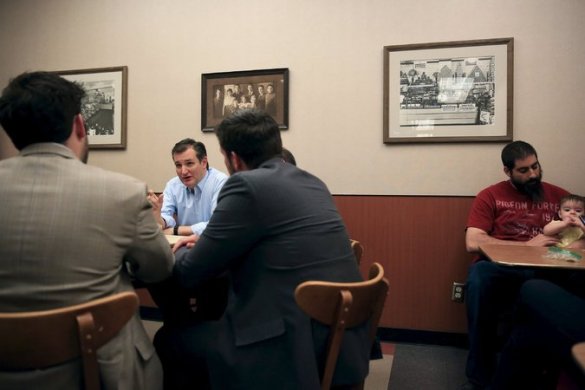
Ted Cruz’s “El Chapo Act” Is Peak Ted Cruz

22cruz-master675

“Let me tell you about my acrostics”

Here at Shooting Irrelevance, we’ve long held that Ted Cruz is more clever than smart, and more of a short-term tactician than a strategist. He moves in short bursts to get his name in the spotlight, but usually ends up shooting himself in the foot. That might be slightly unfair, as he’s managed to come this far while being spectacularly and almost supernaturally unlikeable, but I think it is still pretty true.

Another long-held belief is that all of his smart things are actually dumb (which is really another aspect of his being more clever than smart), and that cleverness doesn’t always hold up. That said, this is pretty ingenious, at least on the surface. From Real Clear Politics

Sen. Ted Cruz joins ‘Fox & Friends’ to discuss his fun plan to pay for the Mexican border wall with money seized from Mexican drug lord ‘El Chapo.’ Apparently, up to $14 billion have been seized from his gang.

The Ensuring Lawful Collection of Hidden Assets to Provide Order (E.L.C.H.A.P.O.) Act would use fund confiscated from drug dealers and traffickers to pay for border security.

“So Mexico would end up paying for the wall,” host Steve Doocy commented. “That’s pure genius on your part!”

“El Chapo led the Sinaloa drug cartel,” Cruz explained. “There is a sense of justice. A sense of, this is what is right, that the people who are violating the border like crazy, we should use their ill-gotten gains to finally build the wall, and to finally ensure we have the assets to secure the border.”

A couple of thoughts on this.

  1. If El Chapo was rich from selling drugs to America, it is because we, as a nation, were voraciously hoovering down his drugs while shoveling him money in exchange for drugs. If we weren’t getting them from El Chapo, it would be someone else.
  2. Arguably (or really inarguably), El Chapo’s biggest victims were Mexicans. The scope of suffering inflicted by the drug gangs is enormous and terrifying. Tens of thousands killed, corruption and murder made institutional. That’s not even counting the disappeared women of Juarez. Even if that wasn’t directly connected to the drug trade, it is part of a society ripped apart by violence.
  3. And again, this was done by Mexicans, to Mexicans, but it was done because America loves drugs. The suffering of Mexico is in so, so many ways an outcome of being neighbors with a rich drug-addicted country.
  4. So maybe we’re not the real victims, and maybe that $14 billion doesn’t belong to us.
  5. And even if it does, it certainly shouldn’t be used to build a wall that is steeped in racism and will do nothing to stop the drug trade (because where there is a market, which America is, drugs will find a way) and will continue to make life harder for el Chapo’s real victims.
  6. So it’s perfect. Like with wall-caused floodings, it is a perfect representation of our imperialistic indifference toward Mexico and our refusal to see them as real people. “Our bottomless appetite for drugs ravaged your country? Well, we’ll take the gains and use them to wall you off. Maybe that’ll teach you a lesson, Mexico.”
  7. That said, it is pretty smart, on one level. Idiots like Doocey love it (and a quick trip around Twitter showed me that people inclined to like the wall were going nuts over it). It is on the surface very satisfying, and even seemingly airtight. People for whom the only objection to the wall was its cost could be persuaded.  Especially if you accept that El Chapo’s money somehow belongs to us.
  8. But, as the arguments above said, I don’t think it does, and more to the point, having a smart way to pay for a dumb idea is still dumb. The objection to the wall wasn’t primarily cost, it was that the wall was an astronomical cost for a terrible and stupid objective. Ted Cruz’s smart plan is still in favor of something incredibly terrible.
  9. Also, it’s just stupid. You know his staffers were high-fiving when they made that acrostic. But it isn’t “Ensuring Lawful Collection”; that’s already ensured. And “Provide Order” is just creepy. And since when do we name bills after bad guys? I don’t think the end of Prohibition was marked by the “Concerning Alcohol: Perhaps nOw aNd thEn Act”
  10. In short, Ted Cruz is more clever than smart.

Honestly, I’m not totally sure Ted Cruz’s game here. I can’t imagine him waiting til 2024 to run for President. There’s no doubt he was rooting for Hillary (only Jason Chaffetz was screwed over more by her loss*), but he was going to run either way. I assumed he was running in 2020 against Hillary or against the fake conservative Donald Trump who hijacked the party.

He’s been a very vocal defender of Trump, supporting and even outflanking his racist cruelty, but I assume he is doing that so he has bona-fides to run against him. “I supported the President but now he betrayed us.” The problem is that no one will believe that, since he famously didn’t endorse Trump at the convention, and because his naked ambition and backstabbery has always been palpable. Again, more clever than smart.

But hot damn, do I look forward to that race!

*Ok, Hillary as well. And literally everyone who isn’t a rich white man. But beside them.

Floodplain Treaty Shows Ridiculousness of Trump’s Mexican Border Wall (and borders in general)


Image result for mexican border fence floodplain

As you can clearly see, the wall doesn’t spring forth from the seeded earth. 


There are few things more inherently unnatural than a border. We know this on a human level: they are weird and arbitrary lines drawn on a map. We understand this culturally, especially when we look at the Middle East or Africa, at colonial maps that were drawn without concern for how it would impact the people living there, and we are dealing with their legacies. Borders are the result of wars and appropriations and treaties and traditions, and not inherent things unto themselves. They only have meaning because we decide they should.

But step back, and they are even more unnatural. They idea of borders is absurdly recent in human history, which makes it impossibly new on the planet. Borders, geologically, don’t mean anything. Even if a border is drawn to correspond with part of nature, like along a river, well…rivers shift. (Sometimes very quickly!) The land isn’t really interested in political distinctions that only appear on some pencil-neck’s globe.

We’re reminded of this by an NPR story on how the idiotic and immoral border wall proposal by Trump might be stopped by an obscure 50-yr treaty.

Texas-based NPR reporter John Burnett says Antonio Rascón, chief Mexican engineer on the International Boundary and Water Commission, came to NPR with the story.

The commission is both in Juarez, Mexico and El Paso, Texas, and is normally a quiet job about diplomacy and allocation of water, Burnett says. But Rascón told Burnett he was gravely concerned about what a concrete wall would do to the river, especially in the Rio Grande Valley.

“Mexico has been growing more and more alarmed as they see plans for Trump’s wall progress,” Burnett says. “In the west desert on the Arizona-Mexico border we have proven examples that border security fencing has clogged with debris and has caused very serious flooding in places. … These walls, when they get clogged with debris, act like a dam.”

A 1970 treaty signed by both countries says neither side can put an obstruction in the floodplain, unless both countries sign off.

Now, it goes on to explain, we have been putting obstructions there (the fence), much to Mexico’s dismay and protest, but they haven’t really protested much. But if an enormous wall that will be partially underground goes up? A wall that will block the natural flow of water and almost certainly cause flooding on the Mexican side?

It’s almost too perfect. We’ve been using water as a weapon against Mexico for 150 years, whether it has been diverting most of the Colorado and sending them the polluted and salinated trickles, or just dumping pollution in southbound rivers. (And while there has been progress made, that’s in jeopardy now.)  What bigger “Screw you” could there be than to enact a racist, cruel, and dehumanizing border wall that has the added impact of causing flooding? It’s the height of bigoted indifference.

It also shows just how arbitrary and stupid the border actually is. I’m not advocating for “open borders” or anything,  but they are deeply unnatural. The floodplain will exist regardless of what lines we draw or how we pave it over. Water will flow where it flows, and people will imitate that water, crossing and erasing these lines. A wall is nothing more than a vanity-piece for a racist bloated manchild. To even entertain it is to show how fake these divisions on which he’s based his Presidency really are.

Yemen’s Agony: Starvation, War, Drought, and a Posioned Future


Yemen has only really been in the American public conscience since December of 2009, when Umar Farouk Abdulmutallab tried to explode a bomb hidden in his underpants aboard a plane over Detroit. It didn’t go well, for him at least. But that was the first time the media en masse started to pay attention to Yemen. Before, if it was known at all, it was talked about vaguely, as a state where there were probably terrorists, but who really knew?

Well, after that, everyone knew. It wasn’t vague. For Americans, and much of the West, Yemen = terrorism. For me, as someone who spent a good decade of my life writing (or trying to write) professionally about Yemen, terrorism was always the hook. Most of us writing or talking about it tried to show the bigger picture, to paint Yemen as an actual country with real people and a history, but the story was almost always, ultimately, terrorism.

And that’s been a contributing to Yemen’s agony.  I’m trying to remember the last (or first) time I’ve heard a US politician talk about Yemen in positive terms, other than paying tribute to former President Saleh for being an “ally” in the GWOT, but even that was entirely about terrorism. It is identified, if at all, with being one of those explosive places on the map, the kind of joint where nearly everyone wants to kill you. Yemen is met with a shrug, at the most positive.

That’s partly why, I think, the horrible reality of its present has failed to make even the slightest dent in the public mind. What is happening in Yemen is shocking and sick-making and morally revolting; the numbers are truly apocalyptic. 17 million people are facing famine this year. Social services are wiped out. Traditional safety nets have been destroyed by war. Distribution networks are non-existent. Every 10 minutes, a child under the age of five dies of preventable causes.  The mind reels at the brutality of life and cowers from the lengthening shadow of a death-hunted land.

These are the kinds of horrors that usually awaken the generous conscious of the American people, and I genuinely mean that. For all our public meanness, when the country is roused, its private citizens turn their good fortunes outward. But with Yemen, there is nothing.

I think that’s partly, of course, because we have our own problems here. A quick glance down this blog shows where my priorities are; I have less an excuse to ignore Yemen than literally almost anyone in the United States. Even Yemen posts have largely been US and Trump-centric. But a lot of it is because Yemen is easily brushed off as a country where there are no real people, just terrorists. And if not terrorists, certainly some other kind of bad dude.

That’s why the war crimes of our great ally Saudi Arabia have been ignored (by successive administrations, to be clear). It’s why we don’t at all blink an eye when Yemen is reduced to “areas of active hostilities“, an expansion of war.  It’s why it isn’t a scandal when the incoming POTUS knows absolutely nothing about the region (though to be fair, he doesn’t know anything about anything). And it is why a strategy designed to provoke civilizational collapse is basically seen as aces all around, when it isn’t being actively ignored.

And that’s what this is: a civilization that is collapsing, pummeled from without and starving from within. It’s running out of water as well as food, a terrible harbinger for our collective climate-imperiled future. The lack of resources fuel more war; war increases the resource shortage. Millions will die in withering agony.

This could be the worst famine in modern times, surpassing even the miseries of Ethiopia, Somalia, Biafra, Ireland, approaching the terror famines of the Ukraine. And to be clear, this is little different than the last example (or any of these examples). You don’t have the towering figure of Stalin or Mengistu orchestrating the misery, but you have the shadow of indifference and even active complicity across the world.

The UN estimates it needs $2 billion dollars to fight the famine, and $1 billion has been pledged. That’s pledged, not collected, and it is still short. Meanwhile, we’re slashing foreign aid (the public meanness which stands contemptuous rebuke to the short bursts of private decency; no politician has ever won by promising to increase aid to foreigners). The US alone could easily make up the shortfall; Trump wanted a billion for a down payment on his idiot wall. But there was no way to turn cruelty into decency.

This isn’t about the next generation of terrorists, or the stretegic importance of turning enemies into allies. That is important, and it is blind and willful idiocy to let Yemen collapse. It isn’t even about how we are dealing with a terrible onrushing future in which this will happen more and more, as resources dwindle and water evaporates and conflict increases. That’s also important; this is just the beginning of the show.

But it is also simply mean and terrifying. These are real lives, which will be extinguished with a stomach’s empty and piteous howl. These are human beings, lives ripped apart by Yemen’s place in the world’s collective conscience, as a testing ground for ideas and ideologies. It’s another judgment on our species. It isn’t a good one.


Some Unrequested Advice to Mr. President Trump, In Re: The First 100 Days

Far be it from me to give advice to our President, especially when I actually agree with him. The “First 100 Days!” measurement is such a breathtakingly stupid and destructive media-driven standard that it makes me dizzy. It’s arbitrary and emphasizes the image of “wins” over the long hard work of government.

But it seems to me that when you are “the ultimate deal maker”, and all you promise are “wins”, and have frequently talked about how many wins you’ll get in the first 100 days, maybe you shouldn’t slag it? And maybe you shouldn’t brag about how much you’ve accomplished when it has been essentially nothing?

And maybe the one accomplishment you can point to is filling a Supreme Court seat that was stolen for you and was, by dint of majority, guaranteed to be filled, so much so that a not-particuarly-bright chimpanzee throwing rocks at the Federalist Society could have done the same, maybe don’t brag about how much you’ve done?

And maybe when everything you’ve done has failed, don’t say that you have new plans that are very, very good, and you’re going to have health care and a budget next week, when no one seems to have a bill for either, and Congress isn’t even in session, because people will begin to realize that you just say things to fool them, kicking the can down the road, but now you’re the only one on the road, and you can’t duck away and hide from your own ineptitude, and the tidal wave of unrelenting and greedy bullshit that has taken you so far in life has crashed, has taken you to the top, but it doesn’t work anymore.

And maybe when realizing that take a moment to reflect, probably for the first time in your life, at what you’ve done. Not what you’ve done to other people, of course, because that’s asking the moon to shine only for me, but to yourself. Everyone knows you are a liar now. Everyone knows your little games. Everyone can see that you promise things you have no intention, and no capacity, to deliver. They see you doing the same thing you’ve always done, like building a third casino, and then going bankrupt, and blaming the economic climate, like you weren’t the idiot who built during that climate in the first place (and that other casinos were doing fine, anyway). Maybe realize that it’s too late for you to save your reputation. Everyone knows you are empty, and a joke. You’ve spent your whole life running both away from and inexorably toward your fraudulent nature, and now it is there for the whole world to see.

Anyway, I don’t have any advice for how to deal with that. It just makes me happy to think of you suffering a bit for the trashy horror you’ve brought upon us to satiate your empty vanity.

When You Elect Trash…

I hope Paul Ryan sees this picture burned on the insides of his eyelids every time he closes his eyes for the rest of his life. I hope this image–three horrible trashy clowns (or two; Kid Rock sucks, but is mostly fine, I guess)–is the very last thing Orrin Hatch sees before he dies, so he won’t be able to convince himself he served his country well. I hope that every Republican who pretends that they care more about the nation than their own partisan nonsense has to have this framed in place of every family photo.

Seriously, what a collection of undignified human garbage (except Kid Rock, who, again, sucks, but seems like Cicero compared to Sarah Palin and Ted Nugent). This is what Trump is doing to the White House, above and beyond his terrible policies and reckless idiocy. This is what happens when we elect a reality show ding-dong who is shunned by anyone with a hint of class or taste or grace. You get these dipshit numbnuts hee-hawing around the White House and mocking someone with more intelligence and decency in one finger than they have put together (and I include the POTUS in that equation).

And what did Nugent, who called Obama a “subhuman mongrel” and told Hillary Clinton to suck on his shotgun have to say?

“We were there for four hours, man!” Mr. Nugent, a 68-year-old Detroit native, said in a telephone interview on Thursday, using a four-letter expletive to signal his amazement at Mr. Trump’s willingness to spend so much time with his three casually dressed visitors.

Why are you amazed? Trump lives for the flattery of minor celebrities. It’s way more fun than being President. We elected an idiot; he’s at his happiest when surrounded by idiots.

During dinner, which ended with flaming baked alaska in honor of Ms. Palin — who stepped away from her job as governor of that state in 2009, after serving as Senator John McCain’s running mate the year before — the president and his guests engaged in a wide-ranging conversation that Mr. Nugent said included the following topics: “health, fitness, food, rock ’n’ roll, Chuck Berry and Bo Diddley, secure borders, the history of the United States, guns, bullets, bows and arrows, North Korea, Russia” and a half-dozen other issues.

Yeah, I’m sure it was the Algonquin Roundtable. The history of the United States? It was good until 2008 and now it is great again. Remember when we used to win? Liberals lost Vietnam! Who needs more bow and arrows? (To be fair, I’m sure that the guests could talk about guns and bullets and knives and bows and arrow-guns and knife-bullets with the eloquence of Seneca).

And fuck you for talking about Chuck Berry and Bo Diddley, unless it was to apologize for crimes against the music they invented. “Cat Scratch Fever” sucks.

“President Trump’s invitation for dinner included bringing a couple of friends,” Ms. Palin wrote on her web page, which displayed behind-the-scenes snapshots with a grinning Mr. Trump.

“Asked why I invited Kid Rock and Ted Nugent, I joked, ‘Because Jesus was booked,’” she wrote.

I bet this idiot actually believe that this is as close as you can come on the earthly plane. If someone asked her 10 years ago who her dream dinner guests throughout all of history would be, she probably said Nugent, Kid Rock, and Trump. This was her goddamn dream come true.

And finally, the picture.

The encounter included a tour of the executive residence, a grip-and-grin session with Mr. Trump in the Oval Office and an impromptu snapshot — featuring a sneering Ms. Palin — in front of Mrs. Clinton’s official portrait as the three guests and their families left through the East Wing.

Mr. Nugent said one member of the group — he wouldn’t say who — asked the three to extend their middle fingers beneath the portrait. “I politely declined,” he said. “Let the juxtaposition speak for itself.”

“The Leftovers” Season 3: You’re Alone in Your Beliefs

(Note: This isn’t a “review” per se of Episode 1 of The Leftovers, nor is it a summary of what came before. We might do a mini-breakdown every week, but there are people far better at that, and at tying that into the big themes, than I am. This is just random thoughts. There are minor spoilers here, but nothing you wouldn’t know just from getting the general vibe. If you’ve never seen the show, the central driving plot point is not spoiler.)

Season 3 of HBO’s The Leftovers, perhaps the most astonishing and awesome (in the literal sense) show I’ve ever seen, opens with colonial characters we’ve never seen in an unmentioned place, though it seems clear it is Australia (it is colder in August than January; the people look Australian; we know the show is going there eventually). But while you can look for Easter eggs, it doesn’t really matter: what matters is that these strange characters are wrapped up in the same mysteries our main characters are. Roughly: why do some things happen and others don’t?

The wordless cold open shows a family of three, a youngish married couple and their young son, enthusiastically following a preacher who divines through what we, on our couches, snicker at as snake-oil tomfoolery, what day a rapture-like event will occur. The family spends the night excitedly standing on the roof, waiting. They are still there the next morning, which sort of sucks, since they gave away their goat and other possessions. Ah, but the preacher gets another date! And the same thing happens.

The mother still believes, with a desperate yearning, when she gets the next date. The father has taken the son away. She climbs to roof on a cold night, a storm comes in, she looks at the lightning with hope and terror and despair…and climbs down the next night, sodden, broken. Laughed at and scorned. Of course nothing happened. Phonies have spent thousands of years convincing suckers that the end was here. And it never was.

But in the universe of The Leftovers, the End did come, of sorts, and that’s the driving tension. If you’ve never seen it (and again, this isn’t a spoiler), one day 2% of the world’s population suddenly vanishes. They might be eating breakfast or at school or driving a car or on TV. Just bam- gone. The show has resolved to never “solve” the mystery, because that’s beside the point. It is more interested in asking what would happen next?

What happens is much how you would expect. 2% is a perfect number, because the world could go on pretty normally, on the surface. But everything is different. Some religions take this as vindication; others have no idea what it means. Dozens, hundreds, probably thousands of new religions and cults spring up, showing finally that there is no difference between the two. Beauracracy tries to make sense of it, but there is a lingering and miasmatic dread everywhere. Every human interaction is changed. How do you become close when the person might disappear? How do you create bonds in the face of such awful mystery?

Those of you paying attention to life might ask: ok, but don’t we all wonder that? After all, we’re all going to die. We all have that looming and terrible mystery at the back of every interaction. Every meeting carries within it the seeds of tragedy. The law of conservation of matter hints that every cloud carries the memories of someone’s weeping goodbyes.

And that is part of the show, to me (I never want to say “that’s what it’s about”, because it is reductive and makes it a lesson). The show at many times seems like an enveloping manifestation of grief, filtered through terror, humor, and an outlandish sense of possibilities. It’s a far stranger and outright weird show than I am making it seem.

But it isn’t just grief. It isn’t “just” that we’re all going to die one day. If there is a central message of the show to me, it became clear in the first episode of this season, which took an incredible show to dizzying heights. As Allison and I discussed it, we came to realize that it was saying, in a way (or rather reminding us), that we’re all alone in our beliefs. Every single one human being has a different faith, because we all have a different way of looking at the world, even if it is just slightly.

Everyone in The Leftovers went through the same thing, ostensibly, to one degree or the other (some to horrifying ones. Carrie Coon’s Nora turned her back on her husband and two kids to grab something and then they were gone). Everyone is looking for answers or trying hard not to think about it. Everyone has an idea or an answer, but even the people in the same churches or the same cults filter what happened through the veils of their own experience. Everyone is broken in their own way, and removed from each other. No one can really know how the other person is handling this world.

Kevin, the primary character, was tormented by a ghost no one else could see. But aren’t we all?

And that’s sort of the point. None of us experience the world in the same way. We can’t. We’re ultimately all alone. You could be staring at the same sunset with the love of your life, the person with whom you share every experience, inseparable, and you can both be describing your inner monologue, but you can never really know what they are thinking, or how they are thinking, or the way the aching orange blabbers through their brain and tingles the nostalgic memory centers buried somehow in their toes. And you can never really know how they feel about dying.

And that’s ok. There are nearly 7.5 billion people experiencing the terrors and mysteries of the world all alone, but we find each other, and come together. The Leftovers shows the aftermath of these mysteries, but it is just an exaggerated look at what we go through just from being alive. It portrays this loneliness and fright as unmistakeable, instead of sublimated. It rips away the veil. But it leaves open the possibility that people still come together, and that there is still light and happiness and joy even in the face of unspeakable loss, which, really, all loss is.

And to me, love in the face of this is the whole point of life. It’s not how we get by. It’s why we get by. It’s the miracle for which we don’t have to wait.

Anyway, watch it. There’s never been anything like this on TV. It’s singularly great, brilliantly acted, beautifully directed, impossibly rich, often funny, difficult, wrenching, and bizarre.

Wednesday Good Reads: SETI, El Faro, and Labor


FREE BOOKS! | Forever Free | Georgia Pathway to Language  Literacy

“Go to the one about organized labor, Madison


A few good reads from the last few days. What’s stopping you? You have nothing to lose, and everything (or, well, three things) to gain.

Searching the Skies for Alien Laser Beams, Marina Koren, The Atlantic

Some scientists believe that the best way to find alien life is to look for pulses of laser beams shot out across the dark eons. While SETI doesn’t always get priority for telescope use (understandably), researchers have found a workaround: poring through data collected by other observations and looking for anomalies. Of course, this presupposes that aliens have seen our planet, want to send some form of contact, and have also decided that laser pulses are the best way, but that makes some sense. It’s easier than sending, like an expedition, and it isn’t really committal (“Oh, jeez, sorry, we were sending that to Rigel 7.”), but there’s something very romantic about it. It’s like being at camp and blinking your flashlight across the lake, wondering if there were campers over there, wondering if you were somehow making a connection through the darkness.

(Granted, I doubt the aliens are hoping, as we campers did, just to make contact with girls, but the general principle holds.)

Democrats and Labor: Frenemies Forever, Erik Loomis, Boston Review

I don’t think there is anyone concerned with labor and with unions (the only thing that can bring back any form of rough economic equality) that isn’t frustrated with the Democrats. Even a very pro-labor government like Obama’s saw labor decline. But as Loomis argues, deciding the abandon the Democrats is ridiculous. A labor-driven third party can’t work, and the Republicans are fully committed to destroying what’s left of unions.

Loomis diagnosis how, oddly, the grassroots/progressive liberal wing helped to strip unions of their power, which accelerated the Democrats no longer needing them as much for votes, and relying on small donors/huge corporate cash, which pushed them toward unfettered free trade, which helped destroy the unions. It’s a complicated story where good guy/bad guy is pretty blurry, but there are ways to get back. The alliances that shattered unions can be used to build them back up.

Other unions have embraced grassroots activism to elect liberal and friendly Democrats. The latter is unions’ best answer if combined with committing as many resources as possible to organizing. Because, paradoxically, unions have little choice but to continue tying their fate to the Democratic Party. Indeed it is even more important now than five decades ago. Even though Democrats have helped create their demise, unions’ only chance against a full-on war with the Republican Party is a moderately favorable relationship with the Democrats acting as a kind of political bulwark.

The whole thing is worth the read.

‘I’m a Goner’: El Faro’s Last Hours as Ship Sails Into StormJason Dearen, AP

The El Faro was nearly 800 feet long and could carry 31,000 tons. It wasn’t one of the neo-Panamax megaliners that are transforming global shipping, but it was a beast. It also had bad boilers which could hurt its engine, and old-fashioned lifeboats that were essentially useless in a big storm. On Oct 1st, 2015, it

On Oct 1st, 2015, it rushed headlong into a big storm. Hurrican Jaoquin, near the Bahamas, a Category 3 with winds up to 130 mph. Battered by waves, unable to turn, the ship broke up and sank, taking its crew of 33 with it to the bottom.

In the AP, Jason Dearen crafts a story out of transcripts recorded on the bridge, and they tell a harrowing story of calm professionalism over growing terror. The list of things that went wrong is terrifying and maddening. The ship listed a bit, which meant the parts that brough oil to the engines didn’t quite reach the reserves, which made the pumps not work, which brought on more water. It couldn’t steer into the waves, and so was pummeled by them, hundreds of feet high. They couldn’t even call for help, since the company that owned the boat (the one that signed off on the boilers and the lifeboats) had an answering service set up after hours. There was no way to contact them directly (though it might not have mattered in the face of a hurricane, that’s still pretty cold).

They do their jobs and try to figure it out. But eventually, there is no way out. The ship is sinking. Some panic, some try to just find the next way to survive. None do. It’s a terrible story, written with a modest and removed reserve, which heightens the true natural terror. And that boat, that human immensity, carrying with it the dreams and memories of dozens, disappears, swallowed unremarkably by a roiling sea.


Yukon River Rerouting Shows Sudden Impact of Climate Change; Is Bonkers Crazy


This river is younger than, say, “Lemonade”


There are few things that can change the course of a river suddenly. The New Madrid earthquakes in 1811-1812 briefly reversed the course of the Mississippi by suddenly shoving millions of tons of water in northward, but that was temporary. Normally, (unless like in Chicago you do it intentionally) rivers change directions or reroute their course very slowly, through generations of erosion as it pokes and prods and tries to find the easiest way to flow, a grinding process that eventually levels everything in its path, though never on the mere scale of a human lifetime.

Thanks to climate change, that might not always be the case. Times?

In the blink of a geological eye, climate change has helped reverse the flow of water melting from a glacier in Canada’s Yukon, a hijacking that scientists call “river piracy.”

This engaging term refers to one river capturing and diverting the flow of another. It occurred last spring at the Kaskawulsh Glacier, one of Canada’s largest, with a suddenness that startled scientists.

A process that would ordinarily take thousands of years — or more — happened in just a few months in 2016.

Much of the meltwater from the glacier normally flows to the north into the Bering Sea via the Slims and Yukon Rivers. A rapidly retreating and thinning glacier — accelerated by global warming — caused the water to redirect to the south, and into the Pacific Ocean.

Last year’s unusually warm spring produced melting waters that cut a canyon through the ice, diverting more water into the Alsek River, which flows to the south and on into Pacific, robbing the headwaters to the north.

Think about that. If you lived there (or, I guess, if you are a tremendous liar), you could say “I remember the days when these waters flowed north, onward to the Bering Sea”, and you’d be talking about last summer.

Now, to be fair, this was a perfect confluence of conditions: the way the land was shaped there didn’t have to be too much melt and erosion for the higher ground to make its way to the lower; the channels cut my newly melted water didn’t have far to go. We’re not going to wake up one day and see that the Ohio is charging back toward Pittsburgh. But it is still a stark and terrifying reminder that climate change isn’t something happening in the distant future. It is happening now, and it is really unpredictable.

In essence, we’ve decided as a species to enter a vast generational experiment where we see what happens when we accelerate natural processes and introduce unnatural ones. The earth heats and cools, glaciers advance and melt, rivers change their courses. These things happen on unimaginable time spans. They don’t happen over the course of a century, or the life of a summer. But, thanks to our desire to turn nature into capital, that’s what’s happening.

We don’t know how it will turn out. Things will happen that we can barely even guess. But it seems short-sighted to say it won’t be enormous.

I’ll leave this with an example of what retreating glaciers mean. We all know that the glaciers carved out the Great Lakes and completely wiped out the landscape that came before them. And we know it was cold as hell. But I don’t think it is generally understood how much their immensity impacted geology, and not just topography.

They pressed down on the earth’s surface, slowly impacting it under their enormity. And as they retreated, the surface slowly started to rebound. This is a process that, tens of thousands of years later, is still happening. The impact of this can be felt right around here, in Chicago. When the glaciers first retreated, and the lakes took their present form, the ground was low enough that Michigan (and Lake Chicago before it) flowed southwards, toward the Mississippi Basin. But as the land rebounded, and glaciers cut more channels, eventually the whole Lakes basin made its way to the ocean.

Until, of course, the city of Chicago, disgusted with and sickened by the filth of its residents, reversed the course of the Chicago, turning southern Lake Michigan into an extension of the Mississippi Basin. That happened in a geologic instant. The reversal of the Yukon rivers was even quicker. It was instant.

Our impact on the planet might mimic the planet’s own cycles, as somewhat more sophisticated climate deniers claim, but that’s wildly misleading. It’s a gruesome imitation, at high-speed, a janky cassette player that suddenly turns your music into a screeching cacophony, with little regard for the consequences. It’s like jumping off the Empire State Building and saying you’re imitating the gentle swaying of a leaf on the wind. Same general direction maybe, and with the same end point, but brother, you’re fucked.

Need a Reason To Support Jon Ossoff? He’s Pro-CDC, Which I Guess is Controversial


Image result for georgia 6th district

Turning this blue would be pretty cool…


Today’s special election in Georgia’s 6th is being widely touted as a “bellwether”, which is one of those fun words that political journalists like to say, and is rarely used in any other context. I’m guessing most pundits aren’t versed on its etymology, as it refers originally to a castrated male sheep with a bell around its neck that the rest of the flock follows.

I’m not criticizing pundits for not knowing the word’s history; it’s been used as a metaphor for about 700 years, which is really pretty cool. But it still fits in this scenario: these are the sort of elections that everyone decides mean something, and because of that, they actually do. If no one paid much attention to GA-6, as normally happens, it wouldn’t be seen as anything except a dreary local election focused entirely on local concerns. But because we are paying attention, the stakes are raised, and it matters. The main candidates have decided to run on more explicitly national themeseEveryone is moving in the same direction, following the bell.

If no one paid much attention to GA-6, as normally happens, it wouldn’t be seen as anything except a dreary local election focused entirely on local concerns. But because we are paying attention, the stakes are raised, and it matters. The main candidates have decided to run on more explicitly national themes, which of course means pro-or-anti-Trump. Lines are drawn, and in our tribalized times you have to choose. Everyone is moving in the same direction, following the bell.

I can’t claim to be any expert on GA-6, but smart money is that young Democrat Jon Ossoff won’t get quite enough to avoid a runoff, which is too bad. An outright win today would, by dint of consensus, send a clear signal that Trump isn’t popular, and that his voters are turning away. Whether or not this is true, I don’t know. It could just be that his voters are his alone, and aren’t interested in the midterms.

I do know that it is important to support Jon Ossoff (and it isn’t too late to make phone calls!), if for no other reason than it will drive Trump crazy. But any indication of wobble could make nervous Republicans slightly more reluctant to attach their fates and their sacred honor to the President, which is a good thing.

But it is also just good to get more liberals, or at least, more people who aren’t conservative Republicans who might, against all odds, let Ryanism happen. Proof of this? Something that caught my eye when I was getting the volunteer link.

CHAMBLEE, GA –  Joined by former CDC director Dr. Jeffrey Koplan at a press conference this morning, Congressional candidate Jon Ossoff called on the other 17 candidates in the Sixth District race to unify in opposition to a provision of the American Health Care Act (AHCA) that would gut the health security infrastructure necessary to detect and fight infectious disease outbreaks like Ebola and Zika.

The provision would slash funding for the Centers for Disease Control and Prevention (CDC), devastating efforts to protect Georgians and the nation from deadly pandemics. The massive cuts would eliminate the Prevention and Public Health fund, which is critical to preventing outbreaks of dangerous diseases like Ebola and Zika.

For more info, read this Vox explainer linked in the blurb about Republican opposition to funding public health research, including work on heart disease, vaccines, and efforts to reduce deadly infections people catch at hospitals. This includes cuts to the CDC of nearly 10%.

Anyone who is worried about a pandemic, which would be anyone possessed of more consciousness and public spirit than a castrated sheep, should be on the side of this. If you want to know why Jon Ossoff should win–if you want to know why the madness of the current GOP needs to be fought–you don’t have to go much further than slashing funding for the CDC. Seriously, these people…