It’s Different Now: What Buzzfeed Gets About 2016

Ullrich has strong feelings about the way Hitler came to power in January 1933, enthroned by a ‘sinister plot’ of stupid elite politicians just at the moment when the Nazis were at last losing strength. It didn’t have to happen. He constantly reminds his readers that Hitler didn’t reach the chancellorship by his own efforts, but was put there by supercilious idiots who assumed they could manage this vulgarian. ‘We engaged him for our ends,’ said the despicable Franz von Papen. A year later, in the Night of the Long Knives, von Papen was grovelling to save his own neck.

Neal Ascherson, London Review of BooksJune 2nd 2016

“What protects us in this country against big mistakes being made is the structure, the Constitution, the institutions,” McConnell told CBS News last month. “No matter how unusual a personality may be who gets elected to office, there are constraints in this country. You don’t get to do anything you want to.”

via Talking Points Memo

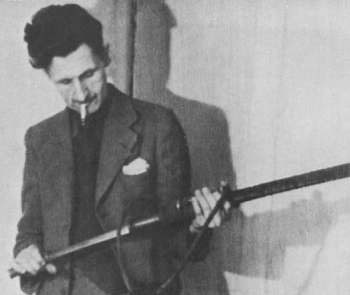
Neal Ascherson, the Scottish travel writer, wrote The Black Sea, which is my favorite kind of history book. It shows the long scope, how areas change slowly (and then very quickly) through migration, demographics, and the slow glacial push of cultural shifts becoming norms, and of violent revolutions mutating slowly into evolutions. It’s the long view of history, the kind that understands there aren’t black lines dividing epochs and periods, much in the same way that Masters of Empire explores how native culture didn’t hit a quick reboot when the Europeans arrived, and that understands (as we’ve argued) that the misery of Syria is part of the long night of Ottoman dissolution.

We tend, in this country at least, to see history as buried, and something that doesn’t impact us. It’s sort of the national myth, and it relies heavily on cognitive dissonance, since it is clear that our major issues still spring from the legacy of slavery and the historical memory and political divide of the Civil War. But we admire amnesia, and always look forward. This was accelerated by the 24-hr news cycle, and made manifest in the 24-second news cycle. When discussing yesterday’s tweets marks bloggers such as this one as hopelessly behind the times, understanding how we got to this point is an exercise in futility.

This isn’t just a little rant either; a lack of historical knowledge of American political trends has helped lead to the rise of the first openly white nationalist campaign we’ve seen in modern times. The elite media, and most of the non-elite, failed to understand how 40 years of Reaganite nonsense, 60 years of conservative takeover, and 150 years of post-Civil War resentment could factor into today’s election, and help facilitate the rise of Donald Trump. We live in the immediate present, which is where a man as completely removed from the truth as Trump thrives, and why he has, until the last week, managed to get away with whatever he wanted. It’s in this eternal present that it was believed that a man like Donald Trump couldn’t win simply because he was a man like Donald Trump. This is an ahistoric tautology, in the literal sense, because it ignores the factors that enabled his victory. It was obvious in August that he was appealing to the most violent lizard part of a broken party, one torn apart by geographic and demographic pressures. But he was still treated like a joke.

Now, as he shatters all norms, threatening to “look into” judges and to jail his likely opponent should he win (a statement that should be breathtaking, but barely makes noise), we wonder how we got here, and how we should react. It’s why it is interesting that Buzzfeed, who has generally symbolized the memory-free nonsense of the internet, has broken ties with the RNC over Trump’s nomination. (It should be noted that over the last 5 years BuzzFeed has created some excellent journalism, but its reputation is still that of the constant present, a man seeing the sunrise every morning and wondering what he could possibly be seeing.)

BuzzFeed, which accepts ads from GOP and Democratic candidates, had a $1.3 million ad deal with the RNC, but cancelled it, because Trump is beyond the pale. In a statement, BuzzFeed CEO Jonah Peretti said:

The tone and substance of his campaign are unique in the history of modern US politics. Trump advocates banning Muslims from traveling to the United States, he’s threatened to limit the free press, and made offensive statements toward women, immigrants, descendants of immigrants, and foreign nationals.

(cont)

We don’t need to and do not expect to agree with the positions or values of all our advertisers. And as you know, there is a wall between our business and editorial operations. This decision to cancel this ad buy will have no influence on our continuing coverage of the campaign.

We certainly don’t like to turn away revenue that funds all the important work we do across the company. However, in some cases we must make business exceptions: we don’t run cigarette ads because they are hazardous to our health, and we won’t accept Trump ads for the exact same reason.

This is a big deal. This is exactly how the media should be covering Trump. We’ve never had anything like this in our modern history, and he shouldn’t be treated as just another nominee, albeit a flamboyant one. We’re at a hinge in our country’s history. It could go either way.

I began this piece with a few quotes, one from a book review about how Hitler’s rise to power was facilitated by old-guard politicians who assumed they could let him ride popular anger into office but then control him for their ends, and one by Mitch McConnell, who represents Republicans who think the same thing about Trump. The thrust of the TPM article is that the old guard’s main pledge is that sure, Trump might be an authoritarian monster, but once he’s in office we’ll be able to control him.

This isn’t to say that Trump is Hitler. This isn’t Germany in 1933. It’s the United States in 2016, a country that isn’t sure of itself, feels like its best days are behind, and is sliding along a weird trail of economic dislocation and historical amnesia. That’s bad enough, and it can get much worse. That we have even gotten to this point shows how much worse it can get. Not understanding how we got here, and ignoring everything except tomorrow’s news, creates the possibility to slip past the point of no return.
Shooting in Chicago: The Times reports on a violent city facing the brink of summer


01chiccrweb2-jumbo

Image from NYTimes

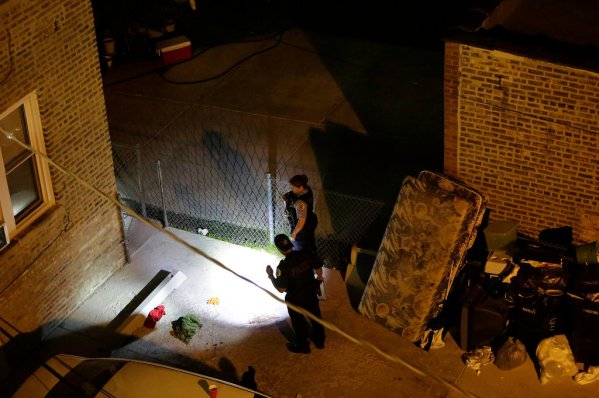
On Sunday, anyone who subscribes to the New York Times (or fine, reads it online, in which it is a huge multi-media piece) saw a huge, front-page special report on the violence in Chicago over Memorial Day weekend, in which more than 50 shootings left six people dead as the long and hot summer juddered into a violent beginning. This has already been an apocalyptic year in Chicago, for reasons we’ll explore as the summer moves on.

The story is a series of excellently-reported rapid-fire vignettes, weaving in and out of the shootings, which are of course concentrated almost entirely on the south and west sides (though three of the fatalities, oddly, are up north, one near O’Hare). This is where I admire the Times piece, as it only briefly mentions that most of Chicago is very peaceful, and many of us are not touched even obliquely by violence. It instead portrays the city as a nightmare of murder, of random gunfire, of targeted killings and counter-killings, as a place of escalating violence where nihilism runs the streets and decent citizens live in expectation of being next. It’s easy for those not affected by it to shrug it off, saying that there are two Chicagos. The Times piece forces us to confront as a problem for the city, not just a problem somewhere in the city. It removes all remove.

To me, one of the most striking parts is the reaction people have to being shot. “Babe, they shot me” or “I’ve been shot!” I know- what else are you going to say? But I imagine for many of us our reaction would be bewildered terror, an inability to comprehend what is going on. One minute we are watching TV in our homes or standing on the porch or driving down Lake Shore, and the next, gutshot and bleeding. I doubt I’d understand what happened when a stray bullet caught me. That everyone in the story is instantly aware is a sure signifier of the huge gulf in our lives, the shame of Chicago, and of a country that has bred this vicious nihilism.

Trump’s “My African-American”: The Problem Isn’t The Possessive; It’s The Singular

waldo81

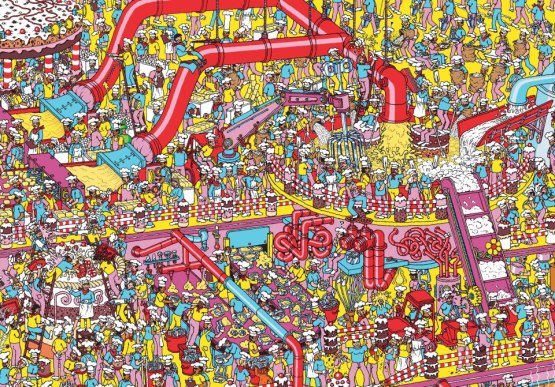
Pictured somewhere: Trump’s black support. Can you find him???? Image from whereswaldoemotionally.blogspot.com

So, the weekend was dominated, as it should be, by Donald Trump’s not-bizarre insistence that the judge in his fraud case is biased against him because he’s not just Mexican, but really super Mexican. To say this line of thinking should be disqualifying is self-evident, but the real disqualifications are, once again, just how dumb and ill-informed Trump sounds dumb and ill-informed Trump sounds (and is!) when talking about anything other than his business acumen.

These comments caused some fainting in green rooms across the country, as the media tries to reconcile their belief that any bad thing a politician says is a gaffe with the reality that Trump is running a white nationalist campaign based on ignorance and petty grievances. To their credit, they actually seem to be coming around to it. Perhaps the best line of the weekend was offered up by Newt Gingrich, who has always managed to find the perfect combination of obsequiousness when he wants power with self-serving self-righteousness. He called Trump’s comments inexcusable, which allows him to maintain independence, but then said that Trump’s comments were the “biggest mistake of the campaign” so far, as if this was a stumble, and not the point of the whole project. But Gingrich gets to seem like a wise Washington hand, as he angles for the Vice Presidency.

Still, that wasn’t the only racial flap. Trump began the weekend by pointing out a black person in the crowd and saying “my African-American.” The man, who wasn’t a Trump supporter, also wasn’t offended, which is fine. He shouldn’t have been. The outcry was over the use of the possessive, which strikes me as silly. Every politician refers to their supporters like that. The real problem is that, when trying to say you have a racially-inclusive campaign, you probably shouldn’t be able to highlight the single minority in your audience. Having a diverse following isn’t Where’s Waldo.

To me, though, the real highlight was when Trump retweeted a picture of black supporters, which turned out to be fake, just a photo pulled off the internet somewhere.   That’s normal, except, dig this: the account he retweeted.

@Don_Vito_08: Thank You Mr. Trump for Standing up for Our Country! JOIN ME ON THE 🚂http://twitter.com/Don_Vito_08/status/739075864793653248/photo/1pic.twitter.com/zgopGvSEen 

Skin Too Thin To Fail: What’ll Sink Trump

gettyimages-524732160_wide-1951934875efc83bfeb5db5285f91a29052bffbb-s1100-c15

Mr. Perfect!

I mentioned earlier today that Trump responded to Hillary Clinton saying he had thin skin by immediately huffing that he had the opposite of thin skin, which is of course what someone who is totally secure and unflappable would do. In an interview with Jake Tapper today, notable mostly for continuing his assumption that any Mexican can’t be an unbiased judge because of the wall, he doubled down on that claim.

“Well, I don’t have thin skin,” Trump protested. “I have very strong and thick skin. If you do a report and it’s not necessarily positive but, you’re right, I never complain. I do complain when it’s a lie or when it’s wrong.”

(Which of course, it always is)

Trump then went on to explain how his thick skin and “good temperament” made him have “one of the best-selling books of all-time” and a successful television show.

This is what, I think, will sink him with all but those who feel a tribal connection to him, either through whiteness or general Republicanness (not unrelated!). But anyone who is sort of on the fence about him, emotion-wise. It’s the idea that no matter what anyone says, he has to come back with the most absurd statement, because he can’t possibly have a moment of self-doubt. That’s not a political tactic, although it works politically. It’s who he is.

You saw it with the Trump Steaks nonsense. After Mitt Romney made fun of him for having a steak line that failed, Trump brought out steaks to prove they still existed, on election night! A night he won real legitmate primaries. As Chait pointed out: “His campaign displayed store-bought steaks for the media, not even bothering to fully remove the labels of the store at which they purchased them.”

That’s the thing: anyone with an ounce of security would have said, “You know what- I’m a businessman. In business, you take chances. You win some, and you lose some. I win a lot more, but no one’s perfect. I’m still a billionaire.” He could have then lit a pile of $100 bills on fire on threw the flaming pile at a lackey who would have thanked him for it. That’s how you be an asshole, but one slightly tethered to the real world.

There are a lot of people who love Trump because he says racist things, and that own’t change. But for those who don’t, they’ll see a small, vainglorious toad, who overreacts in bizarre ways to the slightest hints that he is fallible. It’s deeply unattractive, and there is a serious limit to its appeal.

Recommended Summer Read: Masters of Empire, by Michael McDonnell

51rjmg1ovvl-_sx332_bo1204203200_

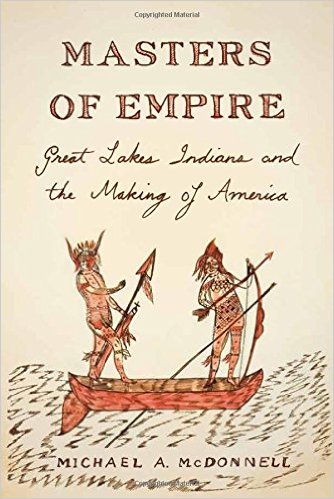
Masters of Empire: Great Lakes Indians and the Making of America, but Michael A. McDonnell

(Buy here)

It must be strange, one would think, to be a background player in your own destruction. But that’s how we understand the great historical clash between Europeans and natives in the Americas- with the exception of some battles, like Pontiac’s Rebellion (and what a loaded word “rebellion” is, implying that he was rising up against some sort of rightful order), or the Nez Perce War, the history is one of dominance versus submission. And to be sure, the Europeans dominated, and eventually destroyed the natives, whether they were in the form of the Spanish, the French, the English, or the Americans.

But that’s far from the whole story. In Masters of Empire, Michael McDonnell, an Australian scholar who has written several books on American history, takes the story from another point of view, one that is far more accurate. This isn’t a “from the Indians’ point of view” story, which is important, but rather he demonstrates how local concerns,  rivalries, and politics weren’t so much shaped by the arrival of Europeans, but how they shaped the formation of empires.

This is a very useful corrective. Using primary, at-the-time sources, McDonnell tells the story of how most of European policy was built around placating the original inhabitants in order to further trade (here it’s important to note that while there was cruelty, enslavement, misplaced moral righteousness, and callous indifference, a policy of extermination didn’t come around in America until it became, well, America). This is a different story than we’re familiar with.

McDonnell skillfully demonstrates how much Great Lakes tribes, especially the Anishinaabeg, who centered around Michilimackinac, played the English and French against each other, making demands, declaring war, rallying troops to fight for or against one side or the other, and generally making themselves indispensable. They were a partner that had to be placated, not a rival to be fought, or worse, a submissive people to be destroyed.

In one of the book’s key elucidations, he demonstrates how the French taking sides in the Anishinaabeg rivalry with the Iroquois, and the English taking the other, was the beginning of the Seven Years War, the first battle of which he positions as the Raid on Pickawillany in Ohio, which was part of an inter-tribal war. The Seven Years War reshaped empire, and the world, and helped create the conditions that led to America. We called the front of that war here the “French and Indian War”, but McDonnell has none of that, rightfully relabeling the conflicts as The First and Second Anglo-Indian Wars.

(Throughout the book, McDonnell uses “Indian” instead of “Native American”, which might make some readers uncomfortable, but I think is more correct. I loathe “Native American”, because it implies a paternalistic adoption after forced extirpation. It basically says “Don’t think of it as America destroying your ancient way of life. You were really Americans all along, and just didn’t know it! You’re welcome!” Indian, obviously, has its problems, but at least it gives some agency.)

This isn’t revisionist history, either. This is how the wars and the policies were seen at the time, by the people living them. The whole history of Europeans on the continent was about managing their relations with the natives, who were skilled politicians, and knew how to get what they wanted in the face of overwhelming military superiority and disease-borne apocalypses.

It’s a great read, and shows how the tribal structure worked, and how lines of kinship influence politics and culture. It’s a powerful look at the Great Lakes during the dawn of the Europeans, and one can imagine the locals, with their intimate knowledge of these great and fearful bodies of water, and the rivers that feed them, shepherding frightened and lost Europeans around. You can get a sense of what the region was like before lines were drawn to signify borders, where activity was centered around the water and hunting grounds.

Indeed, the map shows a pre-state (in the national, not just the “great state of Mississippi!” sense) Great Lakes region, stretching on one end to the St. Lawrence and the Atlantic and the other up through Lake Winnipeg and on to the Hudson Bay. This is how the world was, then, before lines of demarcations chopped it up. It was a world before our obsession with borders shifted the axis, and before we decided that some people were Natives, instead of just, well, natives. It’s a world that had a narrative forced upon it, changing its history ex post facto. McDonnell’s book is a great corrective for that. It shows that these were people, who frequently bent London and Paris to their wills. Their actions shaped the world we live in now, as much as we destroyed theirs.

Trump’s Security Briefings: The First Real Sign Of the Sweaty Terror

dr-strangelove-still-580

“On my first day in office…” -Donald Trump

Until now, the fears of a hypothetical Trump presidency- and even just typing that makes me a little woozy– were just that: hypothetical. We’ve all been able to imagine just how scary it would be, given his combination of rampant insecurity, raw egotism, paranoia, and general inability to keep two coherent thoughts in his head at any one time. But now, as the possibility becomes decidedly more real (although demographically unlikely), the actual outlines of just how fearful his win would be begin to take shape.

Hillary Clinton’s excellent attack on him  yesterday, in which she mockingly demonstrated his unfitness to serve (and demonstrating that she knows how to needle him), was just the beginning.  He further elaborated upon his attacks on the judge in his civil case, claiming that merely being of Mexican descent was a conflict of interest with Trump, a truly frightening line of thinking. And today, the Times has a piece by legal experts worried about his contempt for the First Amendment, separation of powers, and more.

But again, those are all still in the realm of “wouldn’t it be bad if he became President?” As he gets closer to the nomination, though, various norms start to take hold, and we see just how grotesque his victory really is. Reuters had the far more interesting story, about how security officials are worried about giving Trump the daily briefings that are traditionally accorded a nominee.

Eight senior security officials told Reuters they had concerns over briefing Trump, whose brash, unpredictable campaign style has been a feature of his rise as an insurgent candidate. Despite their worries, the officials said the “Top Secret” briefing to each candidate would not deviate from the usual format to avoid any appearance of bias.

Now, to be fair, one says that the briefings are more of an overview, and won’t tell him much that he won’t get from reading the paper. And it’s not like he has the intellectual wherewithal to actually explain anything. The briefings can be politically advantageous, because they give a patina of respectability to his rantings (“I’m getting security briefings because they know I’m the smartest. And let me tell you, people, ISIS is bad, ok. And the people doing the briefings are saying, ‘Mr. Trump, you have to save us, crooked Hillary can’t do, you’re the only one who can stop this’, ok?”).

However, it isn’t the politics of it. It’s the fact that people are beginning to really realize how different this is from anything we’ve ever seen, how large a mutation. We have someone who is not just intellectually unfit, or even morally, but tempramentally and emotionally. We have someone who is truly dangerous, and the people tasked with keeping this country safe are genuinely terrified. This needs to be made a much bigger deal. We’re seeing what the actual election of Donald Trump as President means- a complete breakdown of every national apparatus. The media needs to hammer this, to make sure he loses in such a way that completely discredits the terrifying politics of personal resentment.

(Of course, in the story, Rueters also quotes a sneering RNC official who makes an flagrantly dishonest snark about the email scandal, I guess for “balance”. This allows places like The Hill to have headlines reading “US Intelligence Officials Concerned About Briefing Trump, Clinton”. Goddammit, Reuters, and The Hill. This isn’t balance. Both sides aren’t doing it. This only normalizes the most abnormal and scary campaign we’ve ever had.)


Quote of the Day

Presented without comment…

In an interview with The New York Times during Mrs. Clinton’s speech, Mr. Trump said that Mrs. Clinton’s performance was “terrible” and “pathetic.” He added: “I’m not thin-skinned at all. I’m the opposite of thin-skinned.”

Breaking! Republican Endorses Republican

I’ll say this for Paul Ryan, his little community-theater Hamlet act turned out to be pretty smart. He waited until Donald Trump was having one of his worst weeks, as the “complete scam artist” story seemed to be taking hold, then unleashed the least-surprisng endorsement of all time, which will lead to breathless headlines about how Trump is “unifying the party.”

It was a sharp two-man game of 3-card monte, with Ryan shuffling at the table and Trump luring in the marks, designed to sucker the dimmest coneys in the media. Ryan got to pretend he was smart and thoughtful, and Trump got to pretend there were a few different sides of the Republican Party for him to win over. It looks like dominoes are falling, but this was all preordained.

Chicago And Water: A Brief Followup of Neglect

5353

Lesson learned, apparently. Image from The Guardian.

Our last post talked about how we’ve been cheating on lead tests in much of the city, and it is the poor who suffer the most, which has startling implications for Chicago’s violent criminality. But water has always been a political tool.

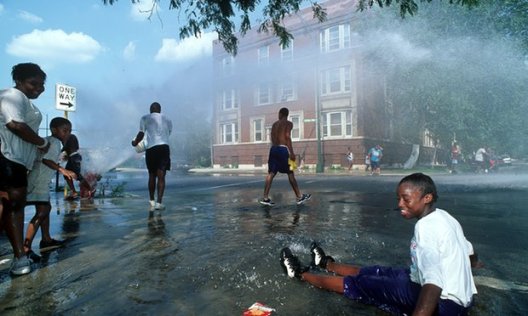
As outlined in Royko’s Boss, still required reading for anyone interested in how cities work, or just in great writing, in the hot summer of 1966, firemen started turning off hydrants in poor black neighborhoods on the south and west sides, while letting children play in them in white areas. This led to rioting, and old man Daley reacted, as he did, with programs that missed the point entirely. He started bussing in giant moving pools to all the poor areas. As Royko said:

Now there was a program, and Daley liked it. Give them water. He had a whole lake right outside the door. Even before the riots ended a few days later, City Hall had embarked on a crusade to make Chicago’s blacks the wettest in the country.

This was a perfect encapsulation of the problem: quick fixes which ignore the systemic injustice, as if shutting off the fire hydrants was the first provocation, and not the last straw.

I think we’ll see the same thing here. I wouldn’t be surprised if Chicago does an orgy of quick spending to give every family a filter. It’s ignoring of the underclass until the problem becomes untenable, and then offering quick-hit solutions and hoping it’ll go away. Like lead leeching from antique pipes, though, it never actually does.

Lead in the Water: Local Cheats, National Disaster

wilson_avenue_crib_060820

Where the water comes from. Image from Wikimedia Commons

If you’re unaccustomed to the view of Lake Michigan from Chicago, you’ll be surprised to notice several strange objects about a mile out into the lake. Depending on the weather and the light, they’ll look like large ships, before you realize that they aren’t moving, and anyway, seem to be made of stone. As your eyes focus on them, they look like houses, and the romantic among us imagine that they are old lighthouses, steering ships in through stormy western winds. Of course, there aren’t lights on them. What they are, you’ll have explained by a local, the glint of the trivia revealer in his eye, are the pumping stations, where the water that quenches a city is pulled from the vast and ancient lake and brought into the modern metropolis.

If asked why they are so far out, the local, still glinting, will explain that of course, when they were built, the river was still dumping pollutants into the lake, and just the dirty flotsam of millions made the shore and its near environs unsafe. Better to pull from, if not the open blue water where land is no longer visible and directions suddenly and terrifyingly seem to have no meaning, then close enough. This water rumbled through long pipes under water and land, through thousands of miles of pipe north and south, and into our homes.

And as an explosive Guardian report revealed, it’s been poisoned, and those in charge of testing it dodged their responsibility to let people know.

Continue reading