
A neighborhood set to be destroyed to make the 290 in Chicago. Image from WBEZ
We’re talking about the building of highways is one of the hidden racial histories in the US, and much more.
A neighborhood set to be destroyed to make the 290 in Chicago. Image from WBEZ
We’re talking about the building of highways is one of the hidden racial histories in the US, and much more.

I’m not saying that to be a successful President you have to understand what this map means. But you actually kind of do… (Image from Vox.com)
In which the ludicrous complexity of a region in historic transformation is nearly impossible to understand.
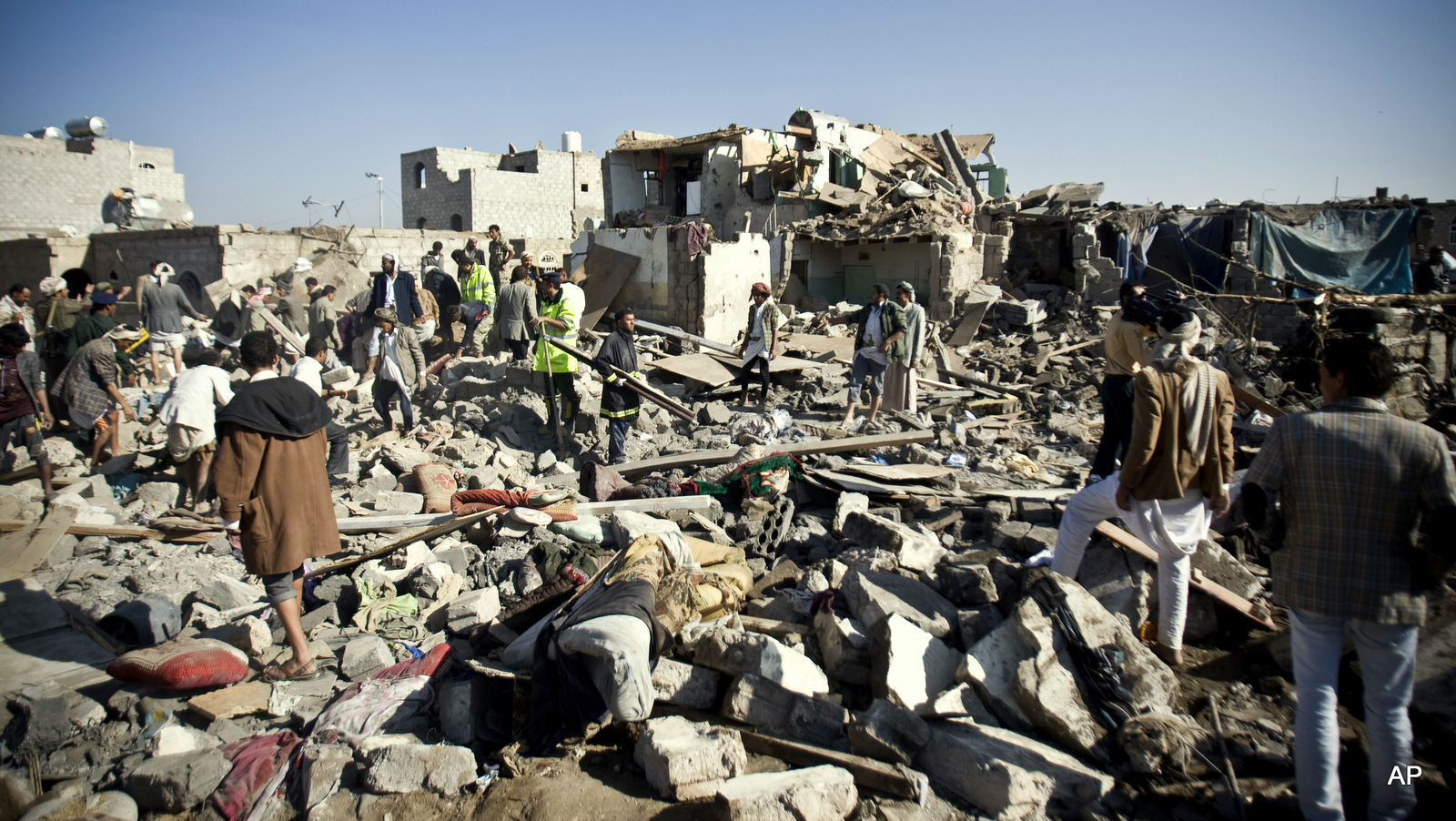
A Saudi airstrike in Yemen. Image from mintpressnews.com
Far from the ISIS-inspired headlines of Syria, Saudi Arabia has pretty calmly and easily been engaged in an endless series of war crimes in Yemen. Its policy had always been to keep Yemen weak, but not in total chaos. A kind of war madness has led them to abandon the second part of that. They are far from the only antagonists in the horrific dissolve of the nation, but they are the most powerful, and they are flexing that power in terrible ways.
And they are doing it with arms and support from the US. It is US-made planes dropping US-made bombs on hospitals and schools, with a ferocity that has led a normally-placid UN to try to stop them. From raw self-interest, this is a terrible policy for the US. From a human level, it is a nightmare.
Finally, nearly 60 congresspeople are trying to at least slow down the arms funnel, as Foreign Policy reports.
In a sign that frustration is growing in Congress over Saudi Arabia, a bipartisan group of 60 lawmakers have signed a letter seeking to delay the Obama administration’s planned sale of $1.15 billion in arms and military equipment to Riyadh.
…
The proposed sale, approved by the State Department on Aug. 9, includes up to 153 tanks, ammunition, hundreds of machine guns, and sundry other military equipment. Congress has 30 days to block the sale, but the lawmakers appear irritated that the notification of the sale came in the middle of Congress’s summer recess.
“Any decision to sell more arms to Saudi Arabia should be given adequate time for full deliberation by Congress,” wrote the lawmakers. “We are concerned, however, that the timing of this notification during the August congressional recess could be interpreted to mean that Congress has little time to consider the arms deal when it returns from recess within the 30 day window established by law.”
Part of this is territorial and bureaucratic, of course: Congress is angry about being bypassed. But they absolutely should be. The loss of Congressional prerogative in foreign policy has been a slow-rolling disaster for the US, as it allows enormously important decisions to be shaped, essentially, by the will of one branch, which in turn is shaped by the will of one person. Even when I trust the POTUS, and respect their judgment, having the lives of millions come down to one “decided” is monstrous. Leaving everyone else to deal with the ramifications of those decisions is essentially undemocratic.
So there should be more letters like this, both for the sake of our democracy, and to help the people who are being brutalized and pummeled into dust with our munitions. Slowing down the flow of arms into the Middle East, and particularly to the combatants in Yemen, is never a bad policy.

I like what this Putin guy is doing. He’s got the right ideas!
A big argument, popular among the right, but also among serious foreign policy thinkers, is how effective Russia’s effective new foreign policy is. After all, they seem to be doing very well in Syria, bending the civil war to their will, and have all of Europe on high alert after annexing Crimea. Military exercises near the border are making people tense about the possibility of further assaults on Ukranian sovereignty. An alliance with Iran makes for a powerful new axis.
While it is clear there is serious danger in a belligerent and over-confident Russia, I argued last week that this was more a sign of weakness, a desperate attempt to project strength, because in international relations, if you’re perceived as strong, in a way you actually are strong. I argued, as have many others, that “(i)t’s a series of moves, not a coherent strategy to make the country stronger in the long term. It’ll catch up.” Here’s a few data points to back that up.
But the most telling sign comes from Yemen, where former President Ali Abdullah Saleh, who hasn’t quite left the scene, and it still maneuvering, has said that he’d welcome Russian help in “fighting terrorism.”
A newly-formed governing council in Yemen could work with Russia to “fight terrorism” by allowing Moscow use of the war-torn country’s military bases, Yemen’s former president said on Sunday.
Ali Abdullah Saleh, a former counter-terrorism ally of the U.S. who was toppled by mass protests in 2011, told state-owned channel Russia 24 that Yemen was ready to grant Moscow access to air and naval bases.
“In the fight against terrorism we reach out and offer all facilities. Our airports, our ports… We are ready to provide this to the Russian Federation,” Saleh said in an interview in Sanaa.
The ex-strongman may lack the clout to implement such an offer. But officials from the party he heads now run a political council that controls much of the country along with the Houthi movement allied to Iran.
This is actually pretty perfect. It’s a scary thought– that would put Russia directly against the Saudis, and in turn, the US– but it is a perfect wedding of like-minds. Saleh is the king of short-term strategy, playing sides to buy time, making a series of desperate moves to stave off the nearest enemy, kicking the can down the road and hoping to make things better then. By necessity, and by temperament, he’s always been a “live today no matter what, and deal with the ramifications of today’s actions some other time.” He’s a genius at it, and is genuinely talented at survival, but not at solving any problems except the ones immediately in front of him. He never seemed to grasp that doing so creates even bigger monsters.
So his seeming approval of Russian strategy and desire for their help kind of confirms that they are playing the same game.

Never quite as strategic as people think.
So, Russia is now using Iranian air bases to launch pro-Asad strikes in Syria, creating a triangle within which I can’t imagine Turkey is particularly pleased to be. This seems to be a solidification of an ad hoc alliance that has been growing tighter, even as Russia agreed to be part of the Obama-led sanctions which crumpled Iranian nuclear resistance. Russia is now firmly part of the Iran/Syria axis, which could be extended to include the Houthis in Yemen and of course Hezbollah in Iraq. This is like every nightmare enemy of the last 50 years, even if they are opposed to our other nightmare enemies of al-Qaeda and ISIS.
There is a lot to discuss about the Middle East, and the ramifications in that, but I think there is an important question to ask. The Soufan Group’s IntelBrief hints at it: “While there is clear military value in the use of an Iranian airbase to launch strikes in Syria, the real gain for Russia is further solidifying its increasing role in the region.”
This is cause, in some circles, for palpitations and hyperventilations. Russia is playing maybe the leading role in the region now, certainly in Syria, and is forcing the action in favor of Asad. So are they winning? And what does winning mean?
I think this is lunacy, honestly. This is madness for Russia. What is going to happen if they “win”? What does that even look like? Asad in power, and what, all the rebel groups agreeing to lay down arms? A stable and secure Syria where both ISIS and Jabhat Fateh al-Sham are gone? Is that even possible?
There can be no long-term good for Russia to get deeper and deeper into Syria, and into its endless war, and into the collapse of the modern Middle East. This transformation is just starting. Russia, which wanted to show strength to cover up fundamental weaknesses, has had success, but it is of the short-term variety. It is expanding its war involvement against any and all of the enemies of its new allies, which are literally everyone else in the region, in some combination or another. This is not going to play well within its own Muslim population. The borders of Russia are not settled and secure either. It could have dozens of its own little Syrias.
The idea that Russia is somehow winning in the Middle East is absurd. It’s flying right into turbulence, possibly of the historic, country-reshaping kind. The “great power” conflict between the US and Russia in the Middle East should be between who can do the most good without tying themselves in too much. You can argue that Obama has steered too close to the latter benchmark while largely avoiding the first one. I think it is silly to say that is weakness, or that it has cost us esteem, especially when there is just loss of esteem within the very same region from which he is trying to extricate us from. (It’s like being kicked out of a bar toward whose exit you’re strolling.) Russia isn’t playing that game at all: neither doing good, nor staying out of getting involved. It’s a series of moves, not a coherent strategy to make the country stronger in the long term. It’ll catch up. Russia, a country whose internal contradictions have never been resolved, is tying itself up in a century-long process of dissolution, one that could easily spread to that most impossible of nations.
Note: I’ll be out of town between the 4th and the 15th, in a wilderness repast, with little to absolutely zero connection to the internet or my phone. Posts during this time, written in advance, will be bigger-picture, or more idiosyncratic, rather than directly pegged to the news. If events happen that supersede or negate anything I say, think of these as a more innocent time capsule. Try not to let the country burn down while I’m gone.

(All posts about Yemen have been, almost be definition, depressing. And they’ve been depressing because this means something. These are real people, in a real country, which was and is filled with beauty. I’m going to reprint an essay I wrote about the Old City of San’a, way back in 2004. It was for a book I helped The Yemen Observer publish, to commemorate San’a. I honestly don’t know if I have the permission to run this, but will anyway, because I think it matters. I want people to know that this was real and living city, wrecked by idiot ideologies. I apologize for the youthful Orientalism– I wince every time I see “nameless” in the 2nd paragraph– but I’m going to leave it intact. Please don’t think this is an attempt to define San’a; that isn’t in me, and I’m not arrogant and misguided enough to believe that it was. I urge you to read Abdel Aziz al-Maqaleh. It is just my impressions at the time, and they are now a terrible reflection of the broken and shattered present. The talk of permanence has brought bitter tears. If you read this, please know it was written with love, love for people and a place. And think of them as you read it. I want to thank Greg Johnsen for providing the image that opens the piece).
The brown and white cupolas of the AL-Mahdi Abbas Mosque loom above the dry banks of a stone river. Inside is a tomb; outside is a magician. The tomb is of the man whose mosque bears his name. A ruled of Yemen who twice had to put down revolts led by the sorcerers of his day, he lies uneasy as another one has come back to haunt his restless nights. The magician is a teamaker, a timeless resident of Sana’a, who operates at night in a dirty and noisy little hole carved into the side of the silent mosque.
It is here, at the nameless stand operated by a nameless stranger that you can get the best cup of tea in town. The magician doesn’t pour milk into the black tea– he makes it all at the same time, a long procedure that is worth the wait, the noise, and the screaming silence of its creator. The sweetness of his alchemy is matched only by the grandeur of the view from the uncomfortable metal chairs that are set up haphazardly outside. You sit and sip and gaze out over the paved levy that used to carry water and raiders into Sana’a. On the other side the Old City sits in its nighttime silence. Frontlit from the street, it seems unreal, a movie prop, a gingerbread backdrop that would topple on you if a strong wind came roaring off Jebel Nuqum.
Note: I’ll be out of town between the 4th and the 15th, in a wilderness repast, with little to absolutely zero connection to the internet or my phone. Posts during this time, written in advance, will be bigger-picture, or more idiosyncratic, rather than directly pegged to the news. If events happen that supersede or negate anything I say, think of these as a more innocent time capsule. Try not to let the country burn down while I’m gone, ok?

ISIS appears in Yemen in 2015. Image from al-Arabiya English.
A little more than 10 years ago, in early February of 2006, there was a massive jailbreak in from a Yemeni prison, in which 23 Islamic militant tunneled out of their cells and into the women’s bathroom of a nearby mosque, from which they disappeared into the San’a morning (for a detailed look at this, buy Greg Johnsen’s The Last Refuge). Among the 23 were old militants, like Jamal al-Badawi, one of the masterminds of the USS Cole bombing. He was the big name. Others, like the al-Raymi brothers, weren’t as known.
That was soon to change. What we didn’t realize immediately was that the jailbreak wouldn’t be seen as part of the old battle against al-Qaeda in Yemen, but a new phase with a new group. Over the next few years, and through various names, the younger generation of jihadists took over the organization, before unveiling, the day of the Obama inauguration in 2009, al-Qaeda in the Arabian Peninsula. They had shown themselves to be a patient, smart, and to-the-vest group, and that paid off by becoming the dominant al-Qaeda branch in the heartland of Islam.
For years, people in the know were warning about how dangerous they were, because they were patient and smart, because they kept it close to the vest. They saw the carnage of al-Zarqawi in Iraq and realized you couldn’t build a coalition like that. Their whole goal was to build coalitions, attract foreign fighters through audacious but targeted strikes agaisnt the far enemy, defeat the near enemy (Salih, secular southerners), and eventually have enough land where they could expand unmolested.
That was then. Now they are the old guard, fighting off the ravening, cannibalistic tide of ISIS, which has brought their particular brand of violence to a land destroyed by war, ravaged by poverty, and stalked by hunger. What is happening between the groups is a battle for the very idea of the future of Islamic militancy. It is the horrible past versus the unimaginable future.

Where you going next?
In the late 50s and early 60s, there was a TV show called Have Gun, Will Travel. I’ll be honest: I don’t know if I ever have seen a single episode. Maybe on Channel 50 when I was a kid, on a TV that still had a dial, but there are no clear memories. Still, the name always stuck out. In my imagination, it captured a desolate and sad American west, where if you were a violent man, or at least someone willing to do violence, you could travel the vast landscape and keep order. Or at least someone’s version of order. Whether lawman or outlaw, and the two sides could shift back and forth, if you had a gun, you were always needed somewhere.
That might seem a flippant way to talk about the next stage of jihadism, but that is the spirit. Because the next stage is going to be the vast spread of foreign fighters, stateless men who have been trained in war, that will come when ISIS crumbles or partially crumbles in Iraq and Syria. Yesterday, in a speech overshadowed by Trump and the convention, FBI director James Comey laid it out: we’re going to see “a terrorist diaspora out of Syria like we’ve never seen before.” But what does that mean? Who are they?
While for years, the massive impact of suicide attacks, whether in Beirut or Tel Aviv or New York, dominated the news. That was our idea of jihad. And to be sure, it was terrifying, terrorism in the true sense. But with some exceptions, it was also always the short game. Suicide bombers were, by definition, expendable, regardless of their courage or conviction. The real force of jihad was the battle-tested soldiers who might not have been afraid to die, but who were more useful alive. These were men who were comfortable with violence, and with gun, traveled.
Going my way?
As we talked about last week, ISIS is clearly entering a new phase as they lose territory in the Caliphate. I said that they might transform into a “carnage-based idea”, but of course that is pretty vague, and not really informative. I had meant to bring up this piece in War on the Rocks by Clint Watts, who goes into great detail about the three different types of ISIS affiliates: Statelets (as in Yemen, Libya), Insurgency (like Boko Haram) and Terrorist Organization (Saudi Arabia).
Watts discusses foreign fighters, trained in the caliphate, who will be unable to return to their actual homes after ISIS collapses in Syria and Iraq. They are the ones to watch to see the strength of the movement. “The most indicative data will come from the roughly 15% of Islamic State foreign fighter survivors I estimate will be unable or unwilling to return home. These “floating” fighters lacking roots to a homeland affiliate will be inclined to choose the most promising global affiliates for safe havens.”
I think this is very true. Over the last 25+ years, we’ve seen increasingly-sophisticated foreign fighters find the group that best represents both their ideology, and, more important, the desire for successful jihad. It’s why AQAP was so powerful; it was the most far-reaching and far-sighted AQ affiliate out there. But now we see even AQAP struggling to reach an even newer and less-patient generation, losing fighters to ISIS. As they increasingly clash, though, I’d put my money on AQAP.
And that’s the big question, for me. ISIS was extremely bold in declaring a caliphate, knowing that the aura of success (and their actual battlefield success) would draw in more foreign fighters, and more money. As they begin to lose on that battlefield, will ISIS central still have much control? Will the ISIS brand, to use an awful term, still mean much? That is, when shifting toward affiliate-based statelets and insurgencies, will they still be ISIS in any recongnizeable way, or just groups with a shared heritage but different, more localized goals?
That to me is key. In the same article, Watts mentions how Central Asian fighters might “choose to resettle with an Asian group known for attracting foreign fighters, such as the Khorasan wilayat or possibly more likely the Islamic Movement of Uzbekistan (IMU).” The IMU has been around for a long time. It’s been both a generator and absorber of jihadists. It has long-term and essentially-localized goals. I think that a lot of groups, no matter their worldly ambitions, eventually get settled into what is happening around them. What made ISIS different, even more so than their lust for carnage and media sophistication, is that it pretended otherwise. But even with the spate of attacks, even with the “inspired” killers in cities around the world, they spent far more time fighting the near enemy.
So then, as they change, as lose that idea of the caliphate, will ISIS really mean anything? Or will they be just a blip? An important one, one that changed the game, for sure. But in the end, will it just be a splintered movement, a period of consolidation followed by fracturing, before the next consolidation? I tend to think so. I think their “affiliates” will be even less affiliated than AQ. That might make whatever they are, in however many forms they are, even more dangerous, though, as everyone will have to up their game to get recruits.
Would be interested to know how I am misreading this, of course.

Pictured: Lunatics

Pictured: Patriots
Back when I was writing more or less exclusively about Yemen, the same conversation would always come up: “I’ve heard that there are so many guns in Yemen, and like, people just carry them around.” And that’s true! Yemen is a country completely awash in guns, and it was not uncommon to see people carrying rifles in the streets of San’a. Old rifles, generally, and rarely loaded, but yes. It’s something you got used to. The point of the question was generally not curiosity, but a way to explain how violent and dangerous and maybe even primitive a land it was, one ruled by savage bloodlust.
You clearly see where this is going. The person who asked was nearly always American, and my followup would be “yeah, by a lot of estimations Yemen has the second most guns per capita in the world!”, the first, of course, being America. But that’s where there was always a disconnect. Regardless of how the person I was talking to felt about gun control, there was never an idea that it was a similar thing. They had too many guns and that’s why it was so violent. We just have a lot of guns, is all.

A few notes on this graph from CFR. The last Small Arms Survey was in 2007. Some more recent estimates have US guns per capita at an incredible 112.6 guns per person, though the actual amount of gun owners has decreased. Just more people with an absurd amount of guns. Yemen has a wide variance, with some estimates putting it at 2nd (54.8 guns per capita) and others considerably lower.
I feel that people may be realizing just how insane this is getting, which the last terrible week may have shown. When Philando Castille was shot by a police officer, he was (reportedly) carrying a weapon he was legally allowed to. The officer, by way of exoneration, said through his lawyer that he was reacting to the “gun, not to race.” You can quibble about the role race played in how that gun was reacted to (spoiler: probably a lot!), but the key is the gun.
“Reacting to the presence of that gun” could be our national motto. We saw it again in Dallas, where protestors, enacting their legal right to armed carry, added to the confusion of an active shooter situation. This makes the incredibly difficult job of a police officer even tougher. How are you supposed to determine, in the moment, whether a person is a “good guy with a gun”?
For that matter, how are we? A couple of years ago, a man in Georgia went to a park with a Little League game, waving around a gun and bragging about how it was legal, and there was nothing anyone could do.
“Anyone who was just walking by – you had parents and children coming in for the game – and he’s just standing here, walking around [saying] ‘You want to see my gun? Look, I got a gun and there’s nothing you can do about it.’ He knew he was frightening people. He knew exactly what he was doing,” said parent Karen Rabb.
Rabb said that the man’s intimidating behavior panicked parents causing them to hustle children who were there to play baseball to safety after the man refused to leave.
After deputies arrived, they questioned the man who produced a permit for the handgun. According to authorities, since the man made no verbal threats or gestures, they couldn’t arrest him or ask him to leave.
(Again, if the man was black, he’d be dead, but move on). This is insane. Unless and until he started shooting, there was nothing anyone could do except hope this man wasn’t a murderer. That’s where we all live now. We are all on the front lines. We’re all at the mercy of chance, hoping we don’t get shot. We’re all just reacting to the presence of a gun.
But what does it all mean? We’ve talked a lot about how our devotion to guns is a reflection of a violent national character — we’re a country whose national symbol of freedom, for many, isn’t the founding documents or the broken chains of even the Statue of Liberty, but a tool designed by man to kill other men. More than that, I think, the mere presence of so many guns has a distorting and fearful impact on who we are. It’s hard to go out to dinner without thinking, in the back of your head, that this is a great spot for a mass shooter, whether they are pledging allegiance to the Caliphate or just the voices in their head. I think it makes us more savage.
It makes us less safe, and makes us feel less safe. There are people who carry, and feel a little more secure, but really: if you actually felt secure you wouldn’t need to. And yes, in an era of global terrorism, nowhere is safe, but getting shot is far more likely to happen here, for no reason, not even a sick and twisted justification. Just because someone falls asleep angry every day and wakes up exhausted and has access to guns.
This refusal to look at the impact being flooded with guns has on our national character is the dangerous side of American exceptionalism. It’s easy to look at Yemen and assign a national characteristic based on loosely-understood ideas about gun culture. I think taking any one thing and making it as synecdoche is foolhardy, but there is something there. It is there a little in Yemen (tribal culture is inherently more a negotiating one than a violent one, but revenge always has to be in the toolbelt). And it is here in the US.
We aren’t immune from history. It shows in our borders (having migration issues a mere 100+ years after mass annexation is not unusual!), and it shows in the way we react to the physical presence of guns. But we refuse to have an actual national examination. It’s easy to say “Yemen has guns and so it is violent”; but we have a lot of trouble doing it here, a country that is way more gun-heavy and death-ridden. It’s the same mentality that says torture is OK if the US does it, because our inherent goodness alchemizes war crimes into justice. It’s this inability to look nward, this blithe shattering of every national mirror, that I think more than anything is responsible for our decline.
 Shooting Irrelevance