What the RNC Gets Wrong About ISIS and al-Qaeda

33968

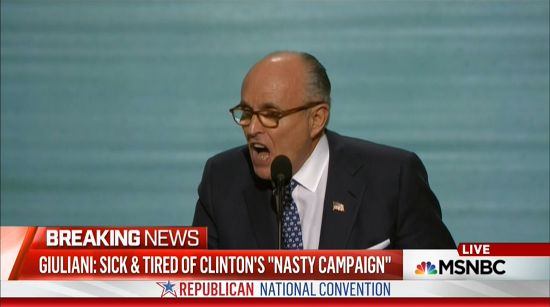
Being tired of the nasty campaign run by “crooked Hillary Clinton who should be in prison” is actually one of the less-misleading things Giuliani said.

So, “Make America Safe Day” is over, and I don’t know about you, but I feel much safer already! I know that all we have to do is elect Trump, and we’ll be fine. Or, as Mike McCaul, the inexplicable Chairman of the House Committee on Homeland Security said, “It’s time to take back our country and make America safe again!”

That’s a good jumping-off point for not just the emotional reaction, of which there was plenty, but the substantive one as well. Because that was sort of the heart of the night: argument through assertion. That’s common in politics, but it was common in a very dangerous way last night, which perfectly encapsulates the right’s unflinching commitment to not understanding the threat of jihad while spittling that they are the only ones who get it.

Because let’s start with the biggest lie of the night, the one that was the driving theme: Hillary Clinton can’t keep as safe (whatever that actually means), and Donald Trump can. That’s pretty normal, and I think you can argue pro or con on the first half of that, as long as you don’t use “Benghazi” as a data point, because come on.

What you can’t really argue, or, more to the point, that no one actually did argue, is that Trump can keep us safe. It was all just assumed that because Trump talks big, and says he’s going to go get them, he will. McCaul even said he’ll make the ground tremble under the terrorists’ feet. It’s actually amazing that all these people who ostensibly care about national security can bring themselves to pretend that Trump has any genius, expertise, competence, o even basic knowledge of these issues.

But that’s really the problem. He doesn’t need to have any knowledge, because their understanding of ISIS is reduced to talking point about “political correctness” and not calling the enemy by it’s name. Rudy Guliani, who gave the most effective speech of the night, was the clearest on this (all Rudy quotes come from What The Folly).

(On The Fort Hood shooting): The only person who couldn’t figure out this was an Islamist terrorist extremist attack was Barack Obama, who called it workplace violence. This is why our enemies see us as weak and vulnerable!

Donald Trump has said the first step in defeating our enemies is to identify them properly and see the connections between them so we can find them and catch them.

To defeat Islamic extremists, we must put them on the defense.

If they are at war against us, as they have declared, we must commit ourselves to unconditional victory against them!

(Wild applause, baying at the moon, a general sense of punchiness)

Rudy used this to segue into the Iran deal, misreading it entirely (as Kaplan points out), and pretending that the money going there is funding ISIS and AQ. Which he didn’t say explicitly, and may or may not believe, but these were his phantom “connections.”

And that’s really the heart of the right’s idea on terrorism: a monolithic enemy that can be defeated merely through the brawny use of strength and the exact right words*. They believe that there is such a thing as “unconditional victory”, which is a strange and grandiose and entirely misleading turn of phrase, since it implies that there is a scenario where conditions would be accepted or not, and that there would even be someone to whom you could deliver the conditions.

The jihadist threat is not one that can be bombed out of existence, nor one that can actually be defeated in a conventional sense. The problem that the right wing has is that they want to fight a war against an enemy that doesn’t exist. They can defeat “ISIS”, in its current incarnation, but have no answer for 1) what comes next in the wreckage of Syria and Iraq, 2) what happens to affiliates around the globe, and 3) what to do with the next mutation. They can’t see this because they are unable to understand that there are root causes of jihadattraction that go beyond good and evil. As Scott Atran said in the NYRB this weekend,

Are we again dangerously underestimating ISIS’s will to fight, and its ability to endure and expand? Although military defeat in Iraq, Syria, and Libya could help make it more difficult for the group to recruit, we will not be able to defeat ISIS itself until we find a way to reconnect the neighborhoods, online communities, and other particularly susceptible social and political settings where attacks like what occurred in Nice continue to find inspiration and support.

“Reconnecting the neighborhoods” isn’t something I heard last night. I don’t think Barack Obama has all the answers, clearly. I don’t think Hillary does, either. But I think they both actually recognize the complex nature of the threat, and are seeing the world as it is. The party of realism is completely unmoored, and want to take our entire national security apparatus along with them.


* Everyone points out their weird and childish fixation with saying “Islamic terrorism”. It’s hard to say if they actually think that will defeat ISIS; it’s entirely possible that anti-PC cognitive dissonance has taken over, and they actually believe it’s a big deal, and that Obama is actively hurting the US by not saying it. What’s weirder is the “define the enemy” thing. It’s very post-modern: you’ll become what words are used to define to. It’s the mutability of the self in the face of the observer. Gombrowicz would totally dig their platform.
How Not To Keep A Free Society: Newt Gingrich Edition

0eeba-newtgingrichgiantlaugh

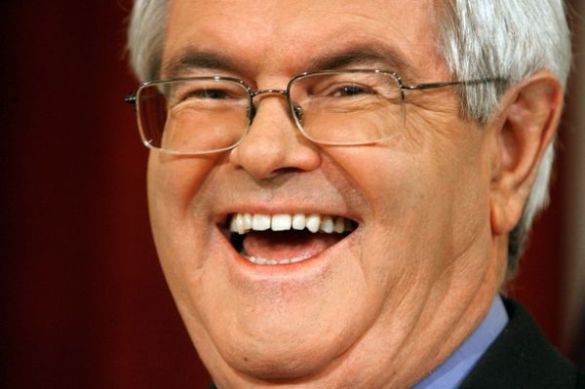
“I’m a really deep thinker, frankly.”

In the last post, we talked about how the kind of mutating terrorist attacks like we saw in Nice will happen in a free society. Newt Gingrich, whose VP dreams have yet to be crushed, eschews all talk of free society.

“Western civilization is in a war. We should frankly test every person here who is of a Muslim background and if they believe in sharia they should be deported,” Gingrich told Fox News’ Sean Hannity.

“Sharia is incompatible with western civilization. Modern Muslims who have given up sharia, glad to have them as citizens. Perfectly happy to have them next door,” he added.

There’s no real need to point out everything that is wrong with this, right? Forget how hideously unconstitutional and un-American it is to have everyone of a single faith line up for loyalty testing. That’s standard Newt: he knows it is what Trump wants to hear, so he’ll say it. (Bonus Newtism: he always says “frankly” when he’s about to say something really dumb, because he feels it gives it intellectual heft. Once you notice that, you’ll see it is always true.)   Let’s also forget for the moment that believing in Sharia is not, in and of itself, against the law. There are a lot of people who don’t believe in the Constit

Let’s also forget for the moment that believing in Sharia is not, in and of itself, against the law. There are a lot of people who don’t believe in the Constitutional order, and as long as they aren’t acting on it, that’s ok. Let’s also ignore the insanity of someone saying that a belief is “incompatible with western civilization” when he’s literally proposing mass expulsion based on a religious-based ideological litmus test, which seems pretty goddam incompatible with Western civilization, to me.

No, what’s really stupid– what makes Newt so world-historic dumb at times — is that he proposes this as the realistic and tough-guy way of dealing with a threat. Tthe attacks at Nice were the “fault of Western elites who lack the guts to do what is right, to do what is necessary,” he told Hannity, and between the two, the perfumed machismo must have been through the roof.  This is, frankly, incredible. How exactly does he imagine this is going to go down? Does he actually think that people dedicated to the destruction of America and the death of all its citizens are also incapable of lying? That after waiting in line for hours, after the Muslim Registration Act, which won’t do much to change their attitude toward the US, they won’t be able to plot a complicated web of deceit, i.e., saying “no” when asked if they are a terrorist?

The most charitable interpretation of this is that Newt actually believes this will work, and that it will allow good Muslims to stay in the US and have everyone be happy. It’s barking madness, of course, and deeply antithetical to the kind of free society that is at the end the final bulwark against radicalism. But if he believed this would work, or was a good idea, at least you could argue from there.

But he probably doesn’t, at least not in any way that doesn’t require the cognitive dissonance that is the heart of the modern right wing. He decided this sounded good, and would appeal to Trump, who appeals to millions and millions of voters. They want the tough guy who will trample our values, because it feels good. In less than a week the GOP is going to nominate someone who brags about his willingness to employ torture. They are appealing because their idea of America is one of soil and blood and steel, and not the actual values that make this country great. They have the same boot-stomping atavistic lure of LePen and Orban and the Brexiters.

ISIS and al-Qaeda want a civilizational clash. They are experts at provoking one. It’s their great good fortune that they have enemies who want to give it to them. What Newt said wasn’t in a vacuum. It’s the direction in which the whole world is lurching.

Nice, The New Terrorism, And The Limits of Freedom

15france-blog-top-tmagarticle-v2

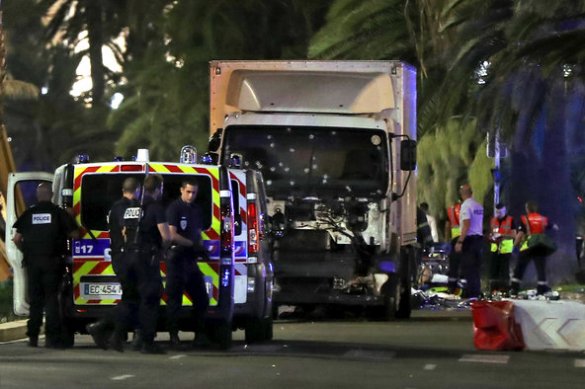
Image from NYTimes

As of this writing, no jihadist organization has taken credit for the horrific attacks in France last night, when a petty criminal with no known ties to any group plowed a truck through a mile of death during a celebration of freedom. It doesn’t mark a new chapter in terrorism, but it does make everyone aware that we are firmly in that chapter, that the pages have turned around us, and we’re stuck in a new plot.

My initial instinct is that this will be the plot of a small, independent cell, possibly with some training behind them, but more than likely not. If it wasn’t coordinated with any central ISIS/Qaeda group (as seems to be the case), it also wasn’t entirely unsophisticated, despite the bluntness of the attack. The right street was picked for maximum efficacy, and the presence of weapons in the truck showed the ability to acquire the tools of war.

All that said, it wasn’t very sophisticated, and indeed was taken right out of the pages of Inspire, as well as a few smaller-scale attacks. This is the new kind of terrorism: as what ISIS actually is changes over the next few months, there will be more of these attacks, both coordinated by the remnants of the caliphate or their affiliates, or from independent groups/actors who might pledge allegiance to ISIS but in an essentially meaningless way, tactically.

That it is meaningless doesn’t really matter, though, especially to the dead. These small cells usually wind up shooting themselves in the ass, but they can sometimes be successful, especially if they keep things very simple. One of the main dangers, as I see it, is that as ISIS starts to create a vacuum, there will be more room for a) affiliated terrorist organizations to try to take the leadership mantle with coordinated, large-scale attacks; and b) unaffiliated-but-inspired groups to try to step up with attacks like these, which can be large-scale by dint of simplicity and luck.

The former can potentially be slowed down (if not stopped) by intelligence, and also luck. The latter might not be as spectacularly successful, but they can be extremely dangerous, and potentially do more to unravel the fabric of free society than larger groups. It makes everyone with a grudge, some sociopathic tendencies, and the “right” sort of inspiration (jihad, rather than The Matrix or whatever), a potential terrorist.

The problem is that a free society won’t really be able to stop these attacks until the fervor of jihad runs its course, which it will, at some point, though possibly not in the lifetime of anyone reading this. As the Middle East convulses, and as Europe tries to handle the expansion of superstates, the reaction of nationalists, and the influx of the stateless, emotions and politics on personal and international levels will be subject to huge changes and dangerous trends. We’re at the beginning of it now. The end is nowhere in sight.

The key is not to give up on the idea of a free society. Bastille Day was the right day to pick for this, for maximum symbolism. It is a celebration of freedom. Of course, the French Revolution became a horrible Goya flipbook of bloodlust and revenge, and ended in Empire, but through fits and starts, it became France. It has its problems with assimilation, but has strong democratic values.

As a free society, that’s the sort of timeline we have to look at when dealing with the mutating scourge of jihad. One day, it will be history. The question is if we’ll be reading that history in a free society, or if we’ll be looking at it through the gray-barred schoolhouse of a modern police state.

What’s Next For ISIS?


Going my way?


As we talked about last week, ISIS is clearly entering a new phase as they lose territory in the Caliphate. I said that they might transform into a “carnage-based idea”, but of course that is pretty vague, and not really informative. I had meant to bring up this piece in War on the Rocks by Clint Watts, who goes into great detail about the three different types of ISIS affiliates: Statelets (as in Yemen, Libya), Insurgency (like Boko Haram) and Terrorist Organization (Saudi Arabia).

Watts discusses foreign fighters, trained in the caliphate, who will be unable to return to their actual homes after ISIS collapses in Syria and Iraq. They are the ones to watch to see the strength of the movement. “The most indicative data will come from the roughly 15% of Islamic State foreign fighter survivors I estimate will be unable or unwilling to return home. These “floating” fighters lacking roots to a homeland affiliate will be inclined to choose the most promising global affiliates for safe havens.”

I think this is very true. Over the last 25+ years, we’ve seen increasingly-sophisticated foreign fighters find the group that best represents both their ideology, and, more important, the desire for successful jihad. It’s why AQAP was so powerful; it was the most far-reaching and far-sighted AQ affiliate out there. But now we see even AQAP struggling to reach an even newer and less-patient generation, losing fighters to ISIS. As they increasingly clash, though, I’d put my money on AQAP.

And that’s the big question, for me. ISIS was extremely bold in declaring a caliphate, knowing that the aura of success (and their actual battlefield success) would draw in more foreign fighters, and more money. As they begin to lose on that battlefield, will ISIS central still have much control? Will the ISIS brand, to use an awful term, still mean much? That is, when shifting toward affiliate-based statelets and insurgencies, will they still be ISIS in any recongnizeable way, or just groups with a shared heritage but different, more localized goals?

That to me is key. In the same article, Watts mentions how Central Asian fighters might “choose to resettle with an Asian group known for attracting foreign fighters, such as the Khorasan wilayat or possibly more likely the Islamic Movement of Uzbekistan (IMU).” The IMU has been around for a long time. It’s been both a generator and absorber of jihadists. It has long-term and essentially-localized goals. I think that a lot of groups, no matter their worldly ambitions, eventually get settled into what is happening around them. What made ISIS different, even more so than their lust for carnage and media sophistication, is that it pretended otherwise. But even with the spate of attacks, even with the “inspired” killers in cities around the world, they spent far more time fighting  the near enemy.

So then, as they change, as lose that idea of the caliphate, will ISIS really mean anything? Or will they be just a blip? An important one, one that changed the game, for sure. But in the end, will it just be a splintered movement, a period of consolidation followed by fracturing, before the next consolidation? I tend to think so. I think their “affiliates” will be even less affiliated than AQ. That might make whatever they are, in however many forms they are, even more dangerous, though, as everyone will have to up their game to get recruits.

Would be interested to know how I am misreading this, of course.

Better the Infidel Than The Apostate: Medina Bombings and the ISIS Endgame

1cda2d4558af4f23acb0ec1e06156ac6_18

Saudi Press Agency/EPA

It’s been a particularly bloody week in ISIS’s history of violence. Since Tuesday, we’ve seen an attack on Ataturk Airport in Istanbul, a slaughter in Bangladesh that was carried out by radicalized elites, an apocalyptic bombing in Baghdad that was mostly overlooked, and the suicide bombings in Saudi Arabia, including near the Prophet’s Tomb in Medina, Islam’s second-holiest city. As of this writing, ISIS has yet to claim responsibility for the Medina bombings, which means it may not have been an attack planned by ISIS, but rather one “just” inspired by it. However, the wave of bombings throughout Saudi Arabia is indicative of some coordination.

This has led, understandably, to a lot of talk about the next phase of ISIS. Speaking to the CFR last week, John Brennan  “warned that the trajectories for the ISIS religious state, or caliphate, and global violence point in opposite directions. ‘As the pressure mounts on ISIL,” he said, “we judge that it will intensify its global terror campaign to maintain its dominance of the global terrorism agenda.'” The headline to the Times piece linked above captures most of the analysis: “As ISIS Loses Land, It Gains Ground In Overseas Terror.”

I think this is largely true. There’s no doubt that they are doubling down on large-scale overseas attacks, and are mutating to the point where it is hard to say what ISIS even is: is it caliphate-based and centrally-coordinated like pre-9/11 al-Qaeda, or is it franchised out, like Qaeda starting in the middle of last decade? Or, perhaps more frightening, is it just a particularly carnage-based idea?

I think it is the latter, which is why I think we’re seeing the endgame of what ISIS has been. Note that endgame doesn’t mean the world is particularly close to defeating ISIS, mostly because I don’t think “defeating” is even possible. It’s a generational battle to have the ideology be discredited and to have them stop serving as an inspiration for those who feel that life should be offering more.

Because that is what they do: they offer a sense of greatness in a world that seems to have lost its moorings. This doesn’t mean that they only appeal to the poor and dispossessed; if the last 100 years have taught us anything, it is that the truly scary people are the ones who are comfortable and feel guilty about it, or feel that they shouldn’t be comfortable, but be truly great. Think of the middling student who reads Ayn Rand and begins to believe that his relative failure is due to a conspiracy of the weak. That’s the mindset.

That’s why these attacks, during Ramadan, are so important to ISIS, but also represent their eventual breaking apart. Going after Medina, and attacking largely Muslims (the Bangladesh attack partially notwithstanding) is key to their success. That’s how they attract the truly dispossessed, because they further cut up the world, slicing belief into an ever-narrower portion. It’s exciting to say that, yes, the Turks are Muslims, but bad ones. I mean, Ataturk should pay, symbolically, for being secular. It’s thrilling to say that bombing Baghdad is the blood price that has to be paid for a more just world. It’s radical and dangerous to attack the holy cities. That’s the kind of sick passion that inspires people into being radicalized: the idea that they are the most committed. It makes up for a lifetime of drifting, even if (especially if) that lifetime is only 19 or 20 years. A wasted year or two seems longer to the young, and a certain kind of mindset wants to rectify that through absolute purity.

(It’s important to remember that in many ways the modern radical Islamic movement wasn’t kicked off by the Iranian revolution, which was more concurrent, or even by the Soviet invasion of Afghanistan, but by the seizure of the Grand Mosque in Mecca, also in 1979. It’s weirdly a footnote now, but this audacious attack on the corrupt monarchy was inspirational to the future leaders of al-Qaeda.)

Why this represents their eventual breaking apart, though, is the same reason any revolutionary group ends up either coalescing into an actual political entity (Hezbollah) or burning itself out (Zarqawi’s al-Qaeda). The need to up the ante constantly, to keep swimming, means that you’ll alienate more people than you attract. The entire Muslim world seems to be speaking out against the Medina attacks.  The well from which they draw their legitimacy- the well of violence- is the one that will eventually poison them, and they’ll discredit themselves.

It’s a long and uphill battle, and whether through direct coordination or through inspiration, it’s one in which we’re all on the undrafted frontline. As they break apart, and as the slowly lose militarily (and don’t expect progress here to be a straight line), they’ll increase these attacks in an attempt to maintain primacy. It’s no comfort to the dead that this will also be their downfall.

McCain: Obama “Directly Responsible” For Orlando: Dispatches From The Land of Cognitive Dissonance

As we briefly discussed in the Quick Hits, John McCain knew who was to blame for a violent, sexually-confused psychopath buying an assault weapon and pledging vague and meaningless allegiance to a terrorist group.

(via @benjysarlin)

Now, McCain went on to say that he hold’s the President’s policies responsible, not Obama himself. Ben Mathis-Lilley of Slate says that “In summary, John McCain is not going to be the Republican Party’s voice of reason on this one,” but in a way he sort of is. After all, unlike a lot of his colleagues, he isn’t whispering that Obama wanted this to happen (or, like the presumptive nominee, he isn’t shouting it). Unlike Ted Cruz, he isn’t saying that the FBI would have kept up their investigations on Mateen due to a series of incomprehensible and contradictory boasts and the fact that he went to Mecca, indefinitely, if only Obama said “radical Islamic terrorism” every once in a while.

The Cruz line is interesting, because, as Simon Maloy points out, the FBI is doing exactly what Ted Cruz says they should do: investigate anyone who might have any connection whatsoever to terrorism, even if it is specious at best. (Even though he, in theory, is against “Big Government”, and the tyranny of insurance regulations, these sorts of prolonged and rights-denying investigations are ok.) But for Cruz, the FBI would have somehow found something, found a non-existent connection, and arrested and stopped Mateen for a crime he hadn’t committed, for allegiances, even tenuous ones, he had yet to pledge, if only the magic words were uttered. It’s less the obvious anti-democratic and terrifying nonsense here, although that’s important, as it is the level of mental contortions that make even John McCain’s fabulisms look logical.

Obviously, Obama demolished this line of thinking, as he has before, but that doesn’t matter. The words “Radical Islam” have achieved totemic power on the right. Their incantation of it isn’t so much to stop ISIS, but to create a witch’s brew of allegations against Obama. It doesn’t matter that it doesn’t make any sense. In a political climate where certain phrases, like Keystone XL and (of course) Benghzai, take on a meaning far beyond their actual physical weight or strategic merit, the President’s refusal to say a phrase becomes all-encompassing. It becomes an article of faith.

This sort of faith-based fippery of the professional amnesiac is what is driving nearly all of  Republican thinking, especially on foreign policy. They don’t even engage with Obama’s arguments for why he doesn’t say the phrase. There is even a case. Not on their terms, but it is possible to say “Oh, come on- explaining why you won’t say it is basically saying it. At this point, it doesn’t matter if you do or don’t. It’s not like ISIS is waiting for you to say ‘Radical Islam’ before they get really cocky.” But nope. There is no actual debate. They just get angrier and angrier at it, because it is a worldview, not a thought.

This brings us to McCain. He’s running for office, as we said, so he has no interest in being even a semi-decent person, but it’s more interesting that he blames Obama, directly, for ISIS. On one level, that’s politics, of course- he’s not going to blame himself! But it’s also a matter of deeply internalized cognitive dissonance. The right has wholly swallowed up the idea that we were about to win in Iraq, because it was relatively peaceful, until we pulled out, and then ISIS formed. On a very surface level, that makes some sense. It did happen like that, chronologically.

But think about it more. That basically means that our “victory” was such that as soon as we left it all fell apart. Our great triumph was a “peace” held together only by limitless troops staying there from now until infinity. But that doesn’t matter. The myth has, contra Lord of the Rings, faded into history, and become reality. The present started in January of 2009.

The whole right-wing foreign policy mentality consists of this kind of magical thinking. When McCain says that Obama is responsible for Orlando, or when moderate New Jersey governor Chris Christie says that we have to hit them where they live, when they live here, they aren’t fringing out. They are in the dead-center of their mainstream, and, given the reality they have constructed, are acting perfectly reasonable.


Bernie Staying In; Hillary’s Savvy, Billionaire Fight, and More Political Quick Hits

giphy1


  • There is a trace amount of frustration, and even panic, in Bernie Sanders not taking the time yesterday to drop out and endorse Hillary. But that’s fine. He did the right thing. In not dropping out, he can continue to grow his left coalition, and keep pressure on for the Fight for $15, other labor issues, and everything else related to inequality. He pledged to make sure Trump doesn’t win, which precludes a lengthy run. And by telling his supporters that he knows “we must continue our grassroots efforts to create the America that we know we can become.” This is smart- building on the local and state levels, continuing with that energy, working to make a more progressive platform, and eventually reconciling differences with Clinton that turn into an endorsement. You can see the “We had serious differences, but over the last few months we have made our voice heard, and I can state that I unequivocally vote for Hillary Clinton, etc”.  This makes it seem- correctly!- like Bernie and his supporters will have a big influence. There will be a very small “sellout!” crowd, but those will mostly be people who were attracted to politics as a form of self-expression, a way to show that they were the real rebels, and whom identity as leftier-than-thou was more important than then actual election.
  • Speaking of that, unless something comes out that Bernie backstabbed Hillary, kudos to her for recognizing the passion of the Sanders campaign, and making sure that they can be eased off the hook. If Bernie’s speech was the result of an agreement at their meeting, she played this very well. It’s hard for a politician who has won to not spike the football a bit, but not only is she being gracious, she’s letting Bernie go out on roughly his own terms. This is really smart politics, and speaks very highly of her character.
  • Billionaire fight! Billionaire fight! Writing in The Financial Times, (behind paywall, Re/Code recap here) big-time VC Michael Moritz tears Trump apart for his phony business schemes, his fake narrative, and how he “seems little more than a hustler who takes from the rich (lenders he has short-changed, partners he has sued) and also takes from the poor (hapless students of Trump University, tenants whom he has allegedly bullied).” He praises the same immigrants who Trump has denigrated for being the real winners, people who came with nothing and made something of themselves, like Andy Grove or Jerry Yang. He also picks a side in the Trump/Bezos spat, in which Trump has revoked the WaPo’s access and threatened to use the power of the IRS and other government agencies to go after Bezos. It’s a tribute to Trump’s utter loathsomeness that you instinctively side with Bezos, instead of the normal reaction, which is “fuck Jeff Bezos”.
  • Speaking of jerks, hey guys, John McCain is running for office this year! It means that any reasonableness he might have is completely launched out the window and he once again reveals himself to be the grasping, desperate, unprincipled and self-righteous huckster he is. He can’t side tooooo close to Trump on most issues, because Hispanics do exist in Arizona, but he certainly doesn’t want to get tooooo far away either, because white racists make up his base, so what to do? Oh yeah- ISIS is Obama’s fault for not keeping and indefinite amount of American troops in Iraq indefinitely. This makes him directly responsible for Orlando, which was a devious ISIS plot. That’s the way to show steady leadership, John!  You can deconstruct a lot of right-wing lunacy, and the weird moonscape of their mentality, just from this. Maybe it deserves its own post.

Well, We Have to Bomb Somebody!


Coming soon…


I think just being around Donald Trump makes everyone dumber. Not that I thought Chris Christie was ever an astute foreign policy thinker, but yeesh

“It’s unacceptable to allow this kind of stuff in our country and for us not to fight back, and we need to fight back, and that’s all these people understand,” Christie told the radio show. When the hosts smartly pressed the New Jersey governor on exactly where that fight should take place, he responded: ““You gotta get over there and start making them pay where they live. It’s an ugly and difficult thing but if we don’t get over there, they’re coming here, and they showed it again this weekend.”

Count the cliches!

  1. “that’s all these people understand.” This is always a good one, because it makes you sound really tough and realistic. Look, I don’t like violence, but it’s the only language we have in common. No translation needed. You should generally crack your neck after you say this.
  2. “start over there”. This is fantastic. It deals with the “if we stop them there, they won’t come here” reasoning which was one of the big reasons for why we are  supposed to fight ISIS in Iraq, even though the invasion created the conditions for regional collapse. But it’s even better because Christie has no idea what “over there” he’s referring to. As Will Bunch said, he “wants the U.S. military to drop bombs on Port St. Lucie, Florida,” since that’s where Mateen lived.
  3. “making them pay where they live”. He got this directly from a movie. I’m not sure which one. Maybe a cheap knockoff of The Sopranos, one in which the hero is a tough-talking, and tougher-acting, governor, played by Steve Schirripa. I’m not saying Christie wrote this movie (working title: The Boss of Jungleland), but I’m certainly not saying he didn’t.
  4. “ugly and difficult thing”. Translation: this’ll be great, but I have to use the somber face.
  5. “if we don’t get over there, they’re coming here, and they showed it again this weekend.” Mostly a repeat of number 3, because Christie literally has less than three sentences worth of foreign policy knowledge, but with a neat little bow that highlights the cruel absurdity of everything he is saying. They showed again that they’re coming here, like 30 years ago, and creating sexually-confused psychopaths who wrap their hatred up with the thinnest veneer of religion.

The thing is, this incoherent nonsense is essentially no different than what you hear from Lindsay Graham, who, anti-Trump charm tour notwithstanding, still believes we have to invade literally everywhere or we’re all gonna die. There isn’t a major GOP foreign policy “thinker” who doesn’t advocate this in some form or the other. We have to go there so they can’t come here. Action simply for the sake of action. The Max Power way. Christie isn’t saying just because he’s a dumb guy on foreign policy. He’s saying this because it is perfectly in line with his party’s mainstream ideas.

I don’t know guys. Newt “Bring back HUAC!” Gingrich has some strong credentials, but if Christie keeps sounding like such a dumbass he might get that Veep nod.

Mateen’s Terrorist Ties and the Gun Argument

There’s a good chance that you’ve heard (or made) a comment about how the Orlando shooter, Omar Mateen, had been investigated for ties to terrorism, but was still able to buy a gun. I know I did, when I heard it: a gnashing of teeth at how easy it is to get an semi-automatic rifle, how insane it is that we have decided, as a country, that these kind of killings are the price of freedom, and just something with which we have to deal, and anger at Republicans for talking about being tough on terror but refusing to close the loophole which allows people on terrorism watchlists to buy guns. That he was investigated is true, of course. Here’s from the Times: 

The F.B.I. investigated Mr. Mateen in 2013 when he made comments to co-workers suggesting he had terrorist ties, and again the next year, for possible connections to Moner Mohammad Abusalha, an American who became a suicide bomber in Syria, said Ronald Hopper, an assistant agent in charge of the bureau’s Tampa Division. But each time, the F.B.I. found no solid evidence that Mr. Mateen had any real connection to terrorism or had broken any laws.

But see: these aren’t real ties. A bragging 26-year old, looking to sound tough or maybe even joking, or whatever combination of swagger, anger, and insecurity a 26-yr-old will have (I barely remember). The other is that he might have possibly known someone who joined ISIS.

Even if he did know Abusalha, that isn’t enough to put him on a list. These are the kind of blanket connections that can ruin lives. You’re a Muslim, and you went to school with a Muslim who may be a bad guy, so you’re on the list. We’ll make it harder to fly, harder to rent a house, harder to do most everything. That it isn’t harder to buy guns is inhuman hypocrisy, of course, but that doesn’t mean these terrorism watch lists aren’t over-broad and inherently anti-liberal.

Mateen of course is a monster, a twisted wreck of hate and a poisoned culture- both the culture of ISIS and the rampant homophobia that still exists in the US. That he had the right to buy a gun that can easily kill dozens is a crime. That those rights exist easily for anyone is sickening. But the idea that any rights can be curtailed because of blanket suspicion and the merest whiff of connections is also a crime. Mateen isn’t innocent. But many innocent people are on these lists, and we shouldn’t just complain that they can get guns. We should be outraged by their overbroad existence.

Why People Kill: Scott Atran’s “Devoted Actor” Model and Its Critics

atran

Scott Atran image from jjay.cuny.edu

In his first show back after the attacks of September 11th, David Letterman gave a searing and moving monologue, in which he asked a question, simply and bluntly, that had been on many of our minds. (transcript from Crooked Timber).

As I understand it (and my understanding of this is vague at best), another smaller group of people stole some airplanes and crashed them into buildings. And we’re told that they were zealots, fueled by religious fervor… religious fervor. And if you live to be a thousand years old, will that make any sense to you? Will that make any Goddamned sense?

For most of us, the answer was, simply, no. Even for many of us who had studied Islam and terrorism, and had some reasons, and were able to dimly weave analysis in a vain attempt to comfort ourselves or others, the fundamental question of “why”, was unanswerable, because it tied into the “how”. How, exactly, could a person sprint toward self-abnegation? What was going through their mind as they made that long, sickening turn into the buildings?

That wasn’t the first example of suicide bombing, obviously- it was a tactic that we knew from WWII, and was prevalent in other parts of the Middle East, and especially (though barely remarked upon) in Sri Lanka, by the Tamil Tigers. Suicide attacks are different than the willingness to die you see in many soldiers. They are even different from “suicide missions”, like in The Dirty Dozen (which I know is fiction), or other seemingly hopeless situations. Because the goal in those is still, in a way, survival. It’s not the only goal, but nor is its opposite. When looking at it as a semi-global phenomenon, from Sri Lanka to Japan in the 40s (although that was a late-war tactic, and not used that much) to the modern Middle East, we see that it is widespread, but that only makes it more mystifying, not less.

One of the people trying to explain this is Scott Atran, whose remarkable book, Talking to the Enemy, does exactly that: interviews with radicals and burgeoning jihadists, in the Maghreb and the slums of Europe, to find out why they want to fight and kill, and why they are willing to die.

Recently, Atran, along with Hammad Sheik and Angel Gomez, released a paper for Current Anthropology that hones in on the theory of why, which they call the “Devoted Actor Model“.  Here is from the abstract:

This report presents two studies in very different contexts that provide convergent empirical evidence for the “devoted actor” hypothesis: people will become willing to protect nonnegotiable sacred values through costly sacrifice and extreme actions when such values are associated with groups whose individual members fuse into a unique collective identity.

I think this makes sense. Basically, what they are saying is that group pressures and loyalties can tighten under extreme circumstances, especially when the idea of identity is at stake. Atran’s work has largely revolved around this idea of group bonding, and group identity, and how the willingness to subsume your identity into a higher cause. This is prevalent among people who feel like they want to be part of something bigger because what they have is small, based not so much on poverty, but on humiliation (in the slums of Europe or the occupied and broken territories of the Middle East) and a sense of historical wrongness, heightened by group-based reinforcement. This focus on group identity has allowed others to misinterpret his works, I think. A recent excellent article on Atran by Tom Bartlett in the Chronicle of Higher Education talks about some of the critics of his theories, who seem a little prone to hysterics.

With prominence comes criticism, and Atran has suffered his share. Sam Harris fired the most personal broadside after listening to a lecture by Atran. Harris, a neuroscientist known for his advocacy of atheism, deemed Atran “preening and delusional” and wrote that his views were evidence of either “mental illness or a terminal case of intellectual dishonesty.” Per Harris, Atran believes that Islamic extremists who blow themselves up do so “not because of their deeply held beliefs about jihad and martyrdom but because of their experience of male bonding in soccer clubs and barbershops.”

Equally dismissive is Jerry Coyne, a professor of biology at the University of Chicago, famous these days as a thunderous ridiculer of religion. In a blog post titled “Once again, Scott Atran exculpates religion as a cause of terrorism,” he quotes the following remarks by Atran: “[W]hat inspires the most uncompromisingly lethal actors in the world today is not so much the Qur’an or religious teachings. It’s a thrilling cause that promises glory and esteem.” Coyne then addresses Atran directly, caps-lock on to drive the point home: “WHAT WOULD IT TAKETO MAKE YOU ASCRIBE ANY OF THEIR ACTIONS TO ISLAM?”

In many ways, these criticisms are the perfect mirror to our degraded political culture, in which the President is pilloried for not saying “Islamic terrorism” even as he bombs half the known world. It’s very easy to say “it’s because of Islam!”, but while that is true in the proximate sense- and is a clear sickness in much of the Islamic world- that still doesn’t actually explain why. It just sounds like truth-telling, a chest-thumping bullying through any pusillanimous nonsense, when in reality it doesn’t get us any closer to the truth of why people kill. There are a billion Muslims in the world. There aren’t a billion suicide bombers. And it doesn’t explain why Tamils were willing to do the same.

That’s what makes Atran’s work so valuable. He certainly doesn’t actually shy away from the reality of Islam, but he asks what it is that makes these people do this right now. There’s nothing inherent in Islam that commands suicide vests (as the Chronicle article shows, Kurds abhor the idea). Nor is there anything inherent in an occupied people that make them go to such moral extremes. So why in this time and place is there an epidemic of people willing to kill themselves for Islam? What social pressures lead someone into this? What about the modern Middle East, and Europe– not to mention Western China, Central Asia, and other places? (I know that the last two are not indistinct, but still.)

I think work like this is extremely valuable, if we really want to understand the reason why we’re in these wars, personified most gruesomely and atavistically by ISIS. If you want, you can say the somewhat relevant, but still fairly facile statement which is that people are willing to kill themselves because Islam, or whatever is passing for it in certain quarters, is telling them to. That’s true. The real important question then is why do some people listen? Understanding that is the whole ballgame.