War for 16 Years, Redux


Image result for syria bombing us

I hope it isn’t churlish to point out that these are terrifying weapons of death, and the people who see them screaming across the sky are no different than you or I. 


I know below I reposted something from last year’s bombing. I’m going to do the same thing with another post from last year’s bombing which, again, could have been written today. The media reaction was, in the main, sickeningly the same. We’re so susceptible to war footings and being cheerleaders for violence. The media loves images like above. We’ll probably be at war forever.

REMINDER: WE’VE BEEN AT WAR FOR 15 YEARS. THIS IS JUST A DIFFERENT ONE


This is what I was getting at in today’s first post, when worrying that CBS was trying to reassure its viewers that the only reason Colbert was making fun of the President is that he didn’t know we had struck Syria.

One can see the telltale signs of a media gearing up to make war normal. Flashes of missiles launching through the darkened foreign night, the President huddling with advisors, reading a stern statement with a serious face, maps and graphics across innumerable cable screens, “experts” who just heard of Idlib this week talking about the strategic importance of sending a message.

I ultimately don’t think much will come of this. Trump is too chaotic and unfocused, and too deeply unpopular. I don’t think there will be much flag-wrapping across the country. I don’t think he’s going to grow significantly more popular because of this, except in a very few knee-jerk quarters. In a week, we may forget this even happened (though it did, with real consequences, but I am just talking domestically for this post).

But it is broadly disturbing how quickly the media gets on its own war footing, which not only has the effect of making Trump seem like a normal President, but shows something dark about our character, and about the last 15 years.

We’ve been at war since 2001 in one country or another, and usually several on some level. But most of those go unnoticed. They don’t get the banner treatment or the blaring chyrons. This is different, because it is against a President, which means it is against a real country, which means it is a real war (regardless of how limited). That’s exciting! That’s newsworthy. The rest? Background noise.

It’s really a dual danger. The first danger is that we get so excited to be at a real war, because that is what stirs the American character. It does so in other countries as well, though America seems particularly susceptible, at the same level as, say Russia. The idiot media is a reflection of that. It doesn’t just prime the pump. But the other danger is that war is so entrenched in our story, and so inextricable from the present moment, that it takes something extraordinary to even stir out attention. It’s ingrained now, in ways we haven’t begun to understand. We’ve always been at war, and always will be.


Syria, Redux


When news that the US was bombing a different part of Syria last night, there was talk of this being a dramatic escalation, which made me wonder if I was crazy? Because didn’t we just do this last year? Asad uses chemical weapons, the US sends a few missiles, we make sure the Russians are out of harm’s way, and everyone agrees to pretend something was accomplished.

This is probably even less worthwhile than before (and here I’m stipulating that this isn’t just “a distraction” from the swirling criminality of his administration). That the Pentagon today basically said this was going to be the extent of the operations, save for a vague promise from Nikki Haley that we’re “locked and loaded” to go again, if need be, was a clear tell.

There is no real goal here, and no real plan. The military had to react to a Trump tweet, and took the least actionable action. We carefully avoided triggering war with the Russians (which is good!) but will not involve ourselves in any other way, and will do nothing to stop Asad’s more routine atrocities, nor do anything to end the civil war.

Basically, Russia and Iran know that Trump is hollow. Please don’t get me wrong: I am not in favor of escalation in Syria, and certainly not in favor of war with Russia or Iran. But it is quintessentially Trumpian that a “mission” meant to “show resolve” really shows the exact opposite. It shows that Russia and Iran are free to have Syria so long as ISIS is sort of contained, and that Asad has a free hand, so long as that hand isn’t holding chlorine.

I think it is good to show that what happened last night is no different than what happened a year ago, save for different people dying (which, to the American press and politicians and, really, the public, doesn’t matter a fig). It’s all theater, and will go back to the same carnage, until Trump shoots some more missiles again, and becomes President.

So after the jump, here’s last year’s article on bombing Syria, from 53 weeks ago. Except for the part about Don Rickles dying, it could have been written today.

Continue reading

Nearly Spring Quick Hits and Good Reads

This is not what it looks like outside. But a fella can pretend, right?

It’s Friday, and after a day of false spring here in Chicago, we seem destined for another spell of cold drear. But dammit, I enjoyed yesterday, and I’ll enjoy today, even if the sun is fleeting. What does today care for tomorrow’s Smarch?

Nothing, brother, that’s what. These are strange and terrible times, where every day brings some numbing horrors. But that makes taking the brief burst of spring when you can, and sine-waving your arms in the warming wind.

So dammit, let’s do some quick hits, and gird ourselves for the battles to come.

Patricia Lockwood on the troubles of writing now

Writing about politics in deeply political times is pretty easy. Writing about other things isn’t, because politics seeps into every nook of our brain. And it isn’t just politics: it’s the leering dumbface of our lowing idiot, and the carnival of horrors his cheap victory opened in town square.

It is omnipresent, amplified of course by our ever-present media, the supercomputers in our pockets, which even in the best of times (2015) was impossibly distracting. All of this makes it difficult to practice the serious slow thinking that serious writing deserves.

In an essay/lecture in TinHouse the poet Patricia Lockwood tackles this problem, capturing precisely the weird recursive anger that any thinking person has these days. She is asking, titularly, how do we write now? How can anyone really write in this moment?

It’s funny, angry, depressing, uplifting, and never saccharine. In the end, the advice is just to read things that slow you down, which I think we can all do. Here’s a good sample.

Read diaries, which make the day permanent. Read anything that slows you down to the pace of real life, like Zora Neale Hurston’s preservations of dialect that walk in dresses down dirt roads. Read one of those Annie Dillard books where she watches an ant fuck for like fourteen straight hours and at the end of it somehow believes in God even more than she did already.

Continue reading

Farewell to Paul Ryan, Who Is Actually The Worst

What an asshole

One of the great joys in life is old friends, especially when you realize that, for the most part, you see the world in the same way. So it is a measure of no small joy to me that, despite the understandable hatred my good friend and Ace Blog Reader Diamond Mark Perrone both have for Trump, we agree that we hate Paul Ryan way, way more.

I don’t think there is much question. I know it is weird and contradictory, because I hate Donald Trump more than I’ve ever hated anyone in my life. Like, a lot more. But while Trump is all dark malevolence, cruelty and ignorance, and while his emptiness, vanity, and snarling hatreds consume us all and pull the world into his hideous vortex, well, Paul Ryan is just more dweebishly evil.

I mean, look at his wistful and dewy farewell statement, as he confirmed he won’t be running for re-election this year.

Entitlement reform is the one thing, the one other great thing I spent most of my career working on. I’m extremely proud of the fact that the House passed the biggest entitlement reform bill in the history of the House of Representatives. Do I regret that the Senate did not pass this? Yes. But I feel, from all the budgets that I’ve passed, normalizing entitlement reform, and the House passing entitlement reform, I’m very proud of that fact. But of course, more work needs to be done. And it really is entitlements. That’s where the work needs to be done. And I’m going to keep fighting for that.

Look at this aw-shucks asshole. “I’m proud I was able to give so, so much more money to the wealthy, but doggone it, I didn’t quite destroy the life of the poor, so I’ll keep fighting for that.”  That’s he’ll fight from the private sector, which may keep him away from his wistful Janesville manse, is going largely unnoticed.

Continue reading

Orban’s Hungary Is The Blueprint For Russian-Oriented Wingers Around the World


Image result for viktor orban

Mr. Democracy 2018


WaPo:

Hungarian Prime Minister Viktor Orban easily won a third consecutive term Sunday and his Fidesz party was poised to regain its super majority in parliament, according to preliminary results from the country’s election.

So, when is the last time that Hungary was an important country in global politics? Was it in 1989 when the leadership, essentially indifferent to communism but very hep to corruption, opened its borders to East German refugees in 1989, helping accelerate the fall of the Wall and the end of the Cold War?

Or maybe it was all the way back in the late stages of WWI, when the Dual Monarchy was falling apart, and Hungary was trying (futilely) to protect its ancient land, essentially splitting with Austria?

In both of these cases, it is more of an example of passivity than of action. So why now is a relatively obscure and minor player in global affairs important? It’s because Hungary has set the blueprint for how Putin runs his corners of the world. To wit:

Opposition parties feared that another super-majority would allow the autocratic leader to more easily push through constitutional changes, continue his crackdown on civic groups that he claims work against Hungarian interests and further strengthen his grasp on the highly centralized state power structure.

Orban has campaigned heavily on his unyielding anti-migration policies. He claims that the opposition is collaborating with the United Nations, the European Union and wealthy philanthropist George Soros to turn Hungary into an “immigrant country,” threatening its security and Christian identity.

That…sounds sort of familiar, no? And it isn’t the case that Orbán saw the success of Donald Trump, and decided to emulate it. He’s been at this for years. Viktor Orbán, who hates the EU, hates Muslim refugees, and hates a free and open press, is the essential template for Trumpism, Brexitism, and all the iterations of right-wing pseudo-populist corruption schemes happening around the world.

It goes without saying that the Foreign Minister of a country ostensibly concerned with democracy and press freedom shouldn’t be breaking his fingers in a rush to praise racist autocracy, but it is clear that the Tories are now an essential adjunct of UKIP, which is itself an essential adjunct of the National Front, Fidesz, the GOP, and, in the end, the All-Russia People’s Front.

This isn’t conspiracy-mongering either. It’s obviously clear that Putin supports candidates that support his vision of a decentralized world, and from a clear power-oriented point of view, that makes sense. It is also obvious that the pro-Russian anti-multilateral team would rely heavily on nationalism, because that is the opposite of the post-WWII internationalism the world has relied on for so long.

And it stands to reason, then, that relying on nationalism necessecarily means demonizing others, whether those are legal immigrants or desperate refugees, the latter of which are incredibly easy to dehumanize.

What’s interesting is that it is increasingly clear that the enemy of multilateralism must be democracy, because in every instance, democracy is being limited in ways both large and small. This doesn’t mean brutal repression, as demonstrated in an essential article on Orbanism by Jan-Werner Müller, but it does mean the closing of democratic spaces.

At home, Fidesz has been extremely careful to avoid anything that could look like serious human rights violations. When tens of thousands demonstrated in the spring of 2017 against the threatened closure of the Central European University (founded and endowed by Soros), the police were restrained. Free speech is not suppressed in Hungary, at least not openly; bloggers are free to criticize the government, and all kinds of debates can be staged in Budapest coffeehouses. The government seems to use other means to control speech. In 2015, Hungary’s largest left-leaning newspaper was bought by a dubious Austrian investor and, a year later, abruptly closed down, supposedly for financial reasons.

As my colleague Kim Lane Scheppele has emphasized, the very instruments that the West once considered crucial for a transition from socialism to liberal democracy—law and the market—have been used to establish a soft autocracy: after all, the creation of a new Hungarian constitution and Orbán’s capture of the judiciary were done in a procedurally correct manner, as one would expect from a party of clever lawyers. And the closing of the liberal newspaper was, ostensibly, caused by the market, not politics.

Again, this sounds very familiar. There isn’t widespread repression (which is different than the daily pounding thrum of police violence and ICE brutality, though those are threads). I am free to write this blog every day without fear of a knock from the police (or, indeed, of anyone even reading it). We march and we protest and we make fun of Trump every night on the TV and Twitter.

But that’s not what modern autocracy really is. It’s gerrymandering the vote. It is stacking the courts. It is demonizing and ruining the free press. That, clearly, has been the GOP plan, and resistance to it, along with Trump’s sluggish incapacity for follow-through, doesn’t diminish their attempts.

The big question is: why? Why bother silencing the press if it doesn’t matter? What is it about anti-alliance politics that lends itself to a hatred of real democracy and sunshine? Weirdly, or probably not weirdly, it all comes down to corruption.

It turns out that from Moscow to Budapest to Washington, these right-wing parties are little more than enormous grifting schemes, pandering to populism while bleeding dry the people and turning the state into a machine for private fortune. Müller, again.

Without a functioning media, a government’s missteps, corruption, and embarrassments will not show up at all on screen or paper. Consider, for example, the mayor of Orbán’s hometown and one of his friends from primary school, Lőrinc Mészáros, who was an unemployed pipefitter a decade ago. He is now the fifth-richest man in the country, and his business has grown faster than Mark Zuckerberg’s. With disarming frankness, Mészáros once explained that “the good Lord, good luck and the person of Viktor Orbán have certainly all played a role” in his success. Orbán’s own family is listed in a Forbes report as being worth €23 million.

One reason for Orbán’s opening to the East—and his enthusiasm for strongmen from Azerbaijan to China—is that standards of transparency in business transactions are decidedly lower there than in the West.

I mean…the money-grubbing non-ethics of Trump and his family of dipshit grifters. The Bourbonite instincts of the Mnuchins. The ridiculous peacock buffonery of Ryan Zinkie. The grandiose absurdity of Scott Pruitt. The sobering thing is that America is not an exception, but a continuation.

That’s not to say there are no politics or ideology. People like Paul Ryan really believe that the wealthy should be able to do whatever they want and the government should exist to help them do so. Pruitt believes the same, so long as they pollute while they are robbing the coffers. Zinkie really believes that public land should be parcelled off to private interests. They all really believe the state exists to make the rich even richer.

Trump? Well, he only believes in himself, but luckily in practice that means the same what everyone else believes.

The modern GOP is perfectly aligned with every far-right movement in the world, because their beliefs are the same. There is nothing exeptional or really interesting about them. There are particularly American flavors to it, of course, but the outlines are all the same. The only difference between Trump and Orbán is that the latter earned his station in life.

And what really ties everyone together is that they pretend George Soros is the most powerful dude in the world and they pretend he controls everything, from Hungarian electins (which he never wins) to protests in Ferguson (which always overthrow the white power structure).

I guess if you are on the other side of this, you have to ask yourself which is more likely: that a loose coalition of ideologically-aligned leaders who would prefer to be away from multi-lateral institutions with their rules and regulations will support each other and influence each other, or that George Soros controls the world. Because the former wants you to believe the latter really does. What seems more plausible to you?
Borders Create Refugees: The Caravan in Mexico, the Global Displaced Person Crisis, and The Violence of Language

The word “refugee” is one of those teetering and uncertain words in the language, sitting on the precipice of our politics, capable of falling to one side or the other. For some the word evokes pity and sadness and a desire to open your heart. That side sees human misery and attempts, in a staggered and incomplete way, to imagine what it would be like to be driven from one’s home, set adrift by violence in a violent world, and to plunge into the uncertainty of every day.

Then there is the other side, who sees refugees as some kind of inhuman horde, swarming across borders, straining the limitis of deceny. The word has nasally connotations, a certain smell to it, a whiff of something low and ragged, bloody and violent and fecal. Like a rat with babies clinging to her matted-fur sides.

The world is seeing a refugee crisis unlike any it has seen since at least WWII, and possibly in human history. According to the UNHCR, at the beginning of 2017 (the last year for total numbers), there are over 65 million displaced people in the world. Many of them of internally-displaced people, like the miserable Rohingya, but many more are spread out in countries not their own.

The Syrian refugee crisis is probably the most remarkable and devastating and impactful one in the world, as it is not only reshaping the Middle East, but the reverberating effects are changing European politics, yanking it to the right, and have had a measurable impact on US politics, despite the paltry number of Syrians we allow in our borders.

That’s the secondary impact of the refugee crisis: it allows the very worst, those who see refugees as inhuman, to gain power by stoking fears. It’s remaking the world. It has further empowered Viktor Orban in Hungary, even though very few Syrians or Iraqis have matriculated to Hungary, which should be enough to prove a level of intelligence. It’s boosted far-right parties in France and Italy and Germany, and of course was a key factor in Brexit. Right-wing politicians were able to exploit fears and xenophobia by rushing to borders and declaring them an inviolable line of defense against the mongrelizing hordes.

And, well…we weren’t exactly immune to it in America.

Continue reading

Thursday Water News: Nestle Wins; Mackinac Gets Cool(ant), and Some Good News From Cape Town

giphy

Water has good and important uses and we should protect it!

Let’s do some quick water news.

I suppose maybe the best news for water these days is that Scott Pruitt might be on his way out for being ludicrously, shamelessly corrupt. Granted, that might endear him to Trump, but there is also maybe a line that you can’t cross, even in this administration. (although apparently Trump still wants him to replace Sessions, which is pretty perfect.)

It’s fitting, I guess, that this is how he might go. His whole career has been to facilitate the wishes of industry and to destroy regulations, and doesn’t care what level of corruption it takes to get that, and the more power he’s gotten, the more willing he is to be corrupt (even as he hilariously can’t pay his $50 a day rent).

Still, I mean, it kind of sucks that he goes down for penny-ante corruption and “abuse of taxpayer dollars” and “acting like a total boob” rather than, you know, being one of the great enemies of the environment the world has ever seen, and therefore being responsible for hurting and killing people now and for generations to come. But that’s all legal.

Anyway, we’ll have more to say on this evil man when his goose is cooked, or when he’s promoted, or as he continues to be awful. But let’s get some water news. Let’s…start with the bad news and end with the good. We’ll end with the good! We’ll all be happy.

Nestle Gets Huge Win; Republicans Stop Pretending To Care About People

woman-drinking-nestle-purelife-in-park

Go to hell, scab! 

(h/t loyal reader and Michigan Great Lakes buff Krista for pointing this story out over tacos)

80,945 to 75.

That was the tally of public comments about Nestle taking more water out of Michigan’s lakes and groundwater reservoirs. We’ve talked before about how Nestle pays essentially nothing for water, even while towns like Flint and many others lack clean water, but even that sweetheart deal wasn’t enough.

Nestle was pumping 250 gallons a minute from its wells in Western Michigan, but wanted to ramp that up to 400. The Michigan Department of Environmental Quality  (staffed by Rick Snyder) asked for public comments. They got a record number.

If you were wondering, that 75 was the amount for. But Nestle still got approval, to the surprise of no one paying attention, and the dismay of everyone.

Now, public comments clearly aren’t binding. They aren’t even a referendum. But it’s pretty impossibly clear that nearly everyone is against this. But it doesn’t matter at all. It doesn’t matter that this will cost Michiganders by taking their water, not paying for it, and selling it at a profit. It’s robbing a resource to pump into plastic bottles, bragging about its purity, while hundreds of thousands around the state drink and shower in lead.

What matters is that a corporation wants water, and doesn’t want to pay for it. That’s the GOP, where any notion of the common good is decidedly uncommon.

I guess the bright side is that “‘The state says Nestlé has to complete a monitoring plan and submit it to the DEQ for approval,’ MR reports of the 58-page final memo from the Michigan agency.”  I mean if, you know, there weren’t bills going through that would eliminate DEQ approval for large users. What a happy break for Nestle!

Coolant Leak in Mackinac Highlights Insane Dangers of Enbridge 5

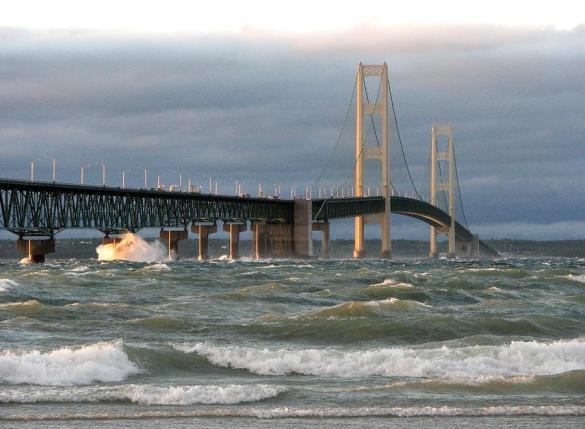
stormy-straits-of-mackinac-keith-stokes

Yeah, let’s put pipes here, why not?

Submerged cables that carried electricity between Michigan’s two peninsulas were shut down after leaking about 550 gallons (2080 liters) of coolant fluid into the waterway that connects Lake Huron and Lake Michigan, officials said Tuesday.

The fluid is a mineral-based synthetic oil used for insulation that can be harmful if released into the environment, said Jackie Olson, spokeswoman for American Transmission Co., which operates the cables. It was too early to know what ecological damage might have been done in the Straits of Mackinac, said Joe Haas, district supervisor for the Michigan Department of Environmental Quality.

So this is not great. The amount of coolant itself is probably not a huge deal, although any wildlife that comes into contact with it is going to get pretty sick, and die. But we’re assured the risk to humans is pretty minimal, so…yay?

Regardless of whether or not this was a disaster, and its certainly not good, we’re reminded that the Straits are incredibly ecologically important, and also wild and tumultuous, and what man puts down there is buffeted by the awesome and endless power of the Great Lakes, crashing into each other as they flow toward the sea.

That’s why there really shouldn’t be pipelines down there. Enbridge, they of DAPL, assure us that their oil pipelines, now being considered to bring ruinous tar sand under the waters, won’t leak. But they will. Enbridge 5, under the Straits, has already leaked, and Enbridge has already lied about it. It’s had nearly double the amount of leaks than previously reported. Don’t forget they’ve already had record fines against them for leaks in Michigan.

(It’s also the case that Enbridge had as one of its chief lobbyists the jamoke who rented Pruitt his $50 a night condo, right when the EPA was approving the extension of the Alberta Clipper, a pipeline to bring in material from Canadian oil sands. This has a lot to do with water, and the insane corruption of Pruitt, but we’ll deal with that in a bigger piece on all this. I’m so enraged thinking about I’d need another 10,000 words.)

So yes: it’s dangerous and insane to run pipelines under the Straits. They’ll leak. They’ll be damaged. They already have. We know that. We’ve talked about it incessantly. Every day is a gamble, and it is one that needs to stop.

Good News For Cape Town

Over the last few months, Cape Town has been hurtling toward a disaster. They were running out of water, which top scientists described as: bad. But the people and the government worked together to cut down waste and usage, and lo and behold:

High-income Cape Town families have cut their average water use by 80%, according to Martine Visser, director of the Environmental Policy Research Unit at the University of Cape Town, while low-income families cut back by 40%. After city residents were restricted to just over 13 gallons per person a day, any household that blew the limit had a water restriction device attached to its pipes by authorities.

Becuase of this aggressive stance, Day Zero keeps getting pushed back, maybe until next year. It’s still not good. It’s still very bad! But it shows that it is possible to cut back on water, and that people who can’t waste water won’t.

It shows that when a government actually is aggressive about making sure water isn’t wasted, then water isn’t wasted. John Fleck, as per habit, talks more about the lessons learned from Cape Town.

The message is that, if the need is there, in these modern rich world settings we are able to dial back our water use a lot. The apocalypse is not nigh.

Honestly, after everything else, saying that the apocalypse isn’t right here is as good a note to any on which to go to bed. Small miracles, right? That’s the stuff sweet dreams are made of.

Martin Luther King Was Killed Because He Was A Radical

Today, at 6:01 PM, we hit the 50th anniversary of the moment Martin Luther King, Jr was shot on a balcony in Memphis. He was pronounced dead less than two hours later, at the age of 39, which seems impossibly young to have become such towering moral giant, and far too young to be a martyr.  It was the day after giving what is one of the most retrospectively painful and difficult speeches in the history of our nation.

Today has been a day of memory and mourning, looking back at a man who changed his country as much as anyone ever has.  It’s been two kind of celebrations: one of the (almost-literally) whitewashed King, who people pretend was colorblind, and who has been adopted by conservatives. There have been grotesque hosannas to him from scum like Paul Ryan and Bruce Rauner, who hope to capture some of his mythologized glory. It’s all part of the campaign, seen time and time again, to pretend that King was some kind of conservative.

But the other side of that has been, refreshingly and bracingly, a revolt against that. It’s been a strict reminder that the March on Washington was actually called the March for Jobs and Freedom, as economic opportunity was always at the heart of King’s message. It’s been a searing reminder that he was in Memphis to support black workers who were being oppressed. To support unions against the bosses, and the underclass against the rich.

It’s been a reminder that King was truly a radical. It wasn’t just that he was against Vietnam, although he was hated for that. It was that he was (in large part) against Vietnam because he saw it as a way to push more poor blacks into the firing line.

Nor is his radicalism just because he began to turn against the cruel grinding mechanisms of capitalism, although he was hated for that. It was that he was (in large part) against capitalism because he it saw it as a system to transform black bodies and black lives in money for rich whites.

No, he was radical because he saw America for what it really was: a vast system in which black people were still property. He saw it as a system in which they didn’t matter except as a way to make money for people, whether it was the connected owners sanitation companies and the politicians they bribed, factory bosses who could pay blacks a lower rate, prison wardens getting slave labor, cops demanding overwhelming bribes, or the vast layers of American wealth that had been built on the backs of slaves and carried throughout Jim Crow, segregation, and redlining.

King was a radical because he used his overwhelming moral force to hold up a mirror to this country and shame it. He showed us that our story was a lie, that the placidity and decency we pretended underpinned every action were propped up by violence against blacks, and that it had been that way since the country was discovered.

He held up his mirror and showed a bent-backed miserly tyrant of a nation, a whip-holding hunchback who thought itself Adonis. And he had demands.

It’s a lie when people say that King was colorblind. When he said his famous line about judging by the content of character instead of the color of skin, he wasn’t talking to everyone. He didn’t say “let’s never see race, ok?” He was saying that black people were only seen as black people, and they had vast injustices leveled against them because of the white power class- which everyone was a part of, even moderates who felt themselves friends of the Negro- and he wanted that to stop.

He was a radical because he demanded America live up to its promise. As many have said, he didn’t demand “peace” in a “let bygones be bygones” way. He demanded justice.

My favorite essay of the day was by Michael Harriot in The Root. In it, in which he points out again how hated King was by white America at the time of his death, he makes a great point:

We regurgitate the narrative that King and Malcolm X were on opposite sides of the fight. We don’t seem to remember that both men were targets of the FBI’s Counterintelligence Program, or COINTELPRO.

We have conveniently forgotten that both men were considered “Negro radicals.” We like the phrase “Black Power” because history has reduced the term “nonviolent resistance” to “nonviolence.”

They have erased the most important ingredient of King’s civil rights struggle:

He resisted like a motherfucker.

It’s true: King was every bit as radical as Malcolm X. He saw into the heart of America, and rejected it. Malcolm X and others wanted to fight the system. King wanted to uproot it by shining the brightest possible light on its rot. But both wanted to destroy what America was.

That’s why it is a goddamn ignoble lie to pretend that King wouldn’t have supported Black Lives Matter or Colin Kaepernick or would have sided with the police when they gunned down yet another black man. It’s why it is hideous when white conservatives insist King didn’t see race. He saw it because America saw it. And he wanted America to see the monster that it always had been.

This isn’t to say there has been no progress. But it is clear progress is halting and fragile, and the outlandish, sneering, chest-thumping, proud racism that has found itself in power again is proof of that. Martin Luther King showed America to be fundamentally racist, and that is why he was hated.

Martin Luther King Jr wasn’t killed for being a man of peace. He was killed for being a radical. The only true tribute to be paid to him is to recognize that essential radicalism, and keep fighting the long war he fought.

In Trump vs. Bezos, side with…sigh…

The enemy of Trump is not your friend.

There was a hashtag going around the Twitter last week, or maybe two weeks ago (as time, never particularly stable in the Twitterverse, has also lost all meaning elsewhere), that was something along the lines of #AdultInFourWords. I didn’t follow it, but saw it in some people’s feeds. It was stuff like “Taxes are already done” or “Made my own breakfast” or whatever. My favorite one I saw was “I voted for Hillary”.

But, a few weeks late, I would like to offer another one, that isn’t just a hashtag, but perhaps (not to exaggerate) nothing less than a strict moral code and philosophical compass point for these woozy, uncertain times. You ready?

Fuck Trump AND Bezos.

Continue reading

Egypt “Not Ready” for Democracy: Notes on Authoritarianism, Climate Change, and America

(Note: the proprietor of this blog isn’t quite emotionally ready to handle the John Bolton appointment, except to say we’ve spent the week ruminating on the 15th anniversary of the one time Bolton unequivocably got his way.)

Bleh

As we round into Egypt’s presidential election, in which Abdel Fattah al-Sisi is running essentially unopposed (his one opponent has endorsed him), the victor himself is lamenting his lack of worthy opposition.

“You are blaming me for something that I have nothing to do with,” Sisi said in the interview that was broadcasted across major Egyptian channels.

“I swear to God, I wished 1,2,3 or even 10 distinguished people (ran) and you choose,” he added.

“We are not ready, isn’t it a shame … we have more than 100 parties, nominate someone.”

Now, to be perfectly fair, without wanting to impugn on the credibility of al-Sisi, there were one or two other candidates, but they got busy or remembered they had a hair appointment this week or something.

Two prominent former military men made surprise announcements late last year and in January that they would run against Sisi, with indications from the street that their bids might be popular.

One of them, ex-military chief of staff Sami Anan, was arrested in January, accused of illegally running for public office, and remains detained. The other, former air force commander and prime minister Ahmed Shafik, also dropped his presidential bid.

Rights groups say authorities have cracked down on media ahead of the vote to silence criticism.

It’s clear that, at best, Sisi is “managing” this democracy, a la Putin, or really many of his predecessors in the Arab world. Most authoritarians still have to pretend that they are running elections, giving virtue its due with a smirking nod, but openly make it impossible to be challenged.

But it’s the way in which al-Sisi defends running unopposed that is interesting. He clearly says that Egypt is “not ready” to be democratic, not ready to have a healthy, flourishing election. That’s a common refrain among dictators, and to be sure, it is one with some credibility.

Continue reading