Trump and “Crooked”, Thieving Soldiers: I Mean, He’s Sort of Right

three-kings

“Oh, good, the news is on!” -Donald Trump

So Donald Trump in a rally yesterday took the politically…unusual step of accusing American service men and women of theft in Iraq and Afghanistan.

“Iraq, crooked as hell,” Trump told a crowd in Greensboro, North Carolina. “How about bringing baskets of money – millions and millions of dollars – and handing it out? I wanna know, who are the soldiers that had that job? Because I think they’re living very well right now, whoever they may be.”

This isn’t the first time he’s gone down this road, either.

“They were going through Afghanistan paying off, I want to know who were the soldiers that are carrying cash of 50 million dollars? Cash! How stupid are we?” he said at a September rally. “I wouldn’t be surprised those soldiers, I wouldn’t be surprised if the cash didn’t get there, I have to be honest.”

His spokewoman, the impeccably-named Hope Hicks (turn out to vote), said that he was referring to Iraqi soldiers stealing the money, a rare case of cover-your-ass by the campaign, because this seems to be the one area in which he fears to tread. Accusing our boys and girls of being thieves? That’s suicide. But he clearly didn’t mean Iraqis. One, they weren’t given the bags full of money, and two, well:

“More than 100 enlisted military personnel have been convicted of stealing funds, bribery, and contract rigging while deployed in Iraq and Afghanistan, crimes the nonpartisan Center for Public Integrity valued at $52 million in a 2015 report.”

So, yeah- Trump was right. Maybe exaggerating, certainly a wild conspiratorialist, imagining these veterans living large and laughing at us simps, but still, this did happen. And more so, it points to the insanity of these wars, the incredible waste of money (and of course lives, and honor, and any possibility of even weak regional stability, but let’s stick with money). We spent close to two trillion dollars in Iraq, a lot of it to crooked contractors who inflated prices building a simulacrum of safe areas in the Green Zone. We rented out war priorities to mercenaries. We relentlessly bribed leaders who could turn on us the next day without more bribes.

And that’s why this is the third rail. We can talk about the war in Iraq being a “mistake”, and most of the country is in agreement, but getting into why it was a mistake is dangerous ground. We never talk about the outsourcing of fighting, and we never talk about how the war was driven by money, but paid for in blood. (Here I don’t mean that Bush went to war to make money for his friends, but it was an inevitable outcome of bad intentions).  It was cheap and tacky and cruel, and there is no doubt that its cheap and tacky and cruel nature influenced people who were there, these little pieces flung around with bags of money. Why can’t they have a taste? Everyone else is.

To look at why there was so much corruption is to understand that everywhere our economic system touches becomes just as corrupt. So we gasp when someone insinuates such a thing about the military, whom we’ve mostly all agreed to never criticize. That’s partly understandable, of course, but also dangerous. Not just because it excuses when they do something wrong, but to admit that the military, our boys and girls in uniform, can be corrupted is to look at the whole system in a bare and unflattering hanging-bulb light.

So it is weird that Donald Trump, who never met a lie he didn’t like, and vigorously defend even when every fact in opposition is thrust in his face, accidentally stumbles on to a truth. It’s even more telling that this is the one in which he immediately backtracks.


A Confused and Angry Man With A Gun: An American Portrait

Orlando Sentinel:

At least four regular customers at the Orlando gay nightclub where a gunman killed 49 people said Monday that they had seen Omar Mateen there before.

“Sometimes he would go over in the corner and sit and drink by himself, and other times he would get so drunk he was loud and belligerent,” Ty Smith said.

Washington Post:

Further confusing matters, Comey also revealed that in “inflammatory and contradictory” comments to co-workers in 2013, Mateen had claimed to be a member of Hezbollah, the Shiite militia based in Lebanon.

 Now, it’s possible, I suppose, that Pulse just had great drink specials, good enough for a man with outward revulsion toward homosexuality to overcome his loathing and get some Bud. It’s also possible, I suppose, that a man whom no one described as particularly concerned with religion had a sophisticated conversion wherein he moved from Shi’ism to Sunnism, perhaps based on some actions taken by Hezbollah of which he disapproved, revoking his membership and transferring to Hezbollah’s rival, ISIS (and doing this, meanwhile, while frequently getting drunk at a gay nightclub).
In the absence of those not too terribly likely scenarios, though, we need to look at this as what it was: a deeply confused, possibly closeted man, twisted by a culture (both much of Islam and many strains of Christian American life) that has a fierce hatred of homosexuality. He’s someone who hated himself, and hated others, especially those who reminded him of what he possibly actually was, even as he was drawn to them.
An angry and boastful man, who wanted people to think he was something that he wasn’t, in many ways. A manly married man, a tough Muslim with a dangerous background.  With just a few puzzle pieces moved around, a few name substitutions, this could be any of our mass shooters (and many of our non-mass-shooters, and some people who somehow don’t shoot anyone at all).
That he pledged to ISIS is no more indicative of their global reach than was the Newtown Massacre. There is little doubt that he was “inspired” by them, but not in the way we commonly understand. They just gave him an outlet for his rage, and a justification for his actions. But he would have found one anyway. It doesn’t seem he was radicalized by ISIS: he was radicalized by his hate, by something in his personality, and possibly something lurking deep within him. He let ISIS be his final reason, but the reasons were always there. ISIS was, at best, the proximate justification.
That’s what we don’t seem to understand, and the cheap and dangerous political demagoguing coming from the Republican candidate is making matters worse. As Masha Gessen said in the NYRB, declaring “war” on people like Mateen only empowers them, empowers ISIS, and gives the next confused and small and angry man a reason to act. It makes them seem like a great and powerful force, exactly the kind of thing that someone like Mateen wants to be a part of. It isn’t Islam, although there is no doubt that Islam played a role. It’s the roaring anger that exists in so many men, a self that is curdled by tradition and loathing. In his case, it was heightened by the rank homophobia that exists in many parts of American culture, including Islam. (As Chotiner pointed out at Slate, in his speech, Trump clearly separated Muslims from Americans, even saying “them” and “us”, even when talking about citizens. This hideous bigotry is exactly what ISIS wants, and it feeds any angry teenager who identifes with Islam).
It’s this yell, this cancerous rage, that is rampant across the country, no matter the pledged allegiance. Mateen was a product of his won twisted pathologies, but they were heightened by the society in which he lived.
And he had easy and unfettered access to combat weaponry.

Mateen’s Terrorist Ties and the Gun Argument

There’s a good chance that you’ve heard (or made) a comment about how the Orlando shooter, Omar Mateen, had been investigated for ties to terrorism, but was still able to buy a gun. I know I did, when I heard it: a gnashing of teeth at how easy it is to get an semi-automatic rifle, how insane it is that we have decided, as a country, that these kind of killings are the price of freedom, and just something with which we have to deal, and anger at Republicans for talking about being tough on terror but refusing to close the loophole which allows people on terrorism watchlists to buy guns. That he was investigated is true, of course. Here’s from the Times: 

The F.B.I. investigated Mr. Mateen in 2013 when he made comments to co-workers suggesting he had terrorist ties, and again the next year, for possible connections to Moner Mohammad Abusalha, an American who became a suicide bomber in Syria, said Ronald Hopper, an assistant agent in charge of the bureau’s Tampa Division. But each time, the F.B.I. found no solid evidence that Mr. Mateen had any real connection to terrorism or had broken any laws.

But see: these aren’t real ties. A bragging 26-year old, looking to sound tough or maybe even joking, or whatever combination of swagger, anger, and insecurity a 26-yr-old will have (I barely remember). The other is that he might have possibly known someone who joined ISIS.

Even if he did know Abusalha, that isn’t enough to put him on a list. These are the kind of blanket connections that can ruin lives. You’re a Muslim, and you went to school with a Muslim who may be a bad guy, so you’re on the list. We’ll make it harder to fly, harder to rent a house, harder to do most everything. That it isn’t harder to buy guns is inhuman hypocrisy, of course, but that doesn’t mean these terrorism watch lists aren’t over-broad and inherently anti-liberal.

Mateen of course is a monster, a twisted wreck of hate and a poisoned culture- both the culture of ISIS and the rampant homophobia that still exists in the US. That he had the right to buy a gun that can easily kill dozens is a crime. That those rights exist easily for anyone is sickening. But the idea that any rights can be curtailed because of blanket suspicion and the merest whiff of connections is also a crime. Mateen isn’t innocent. But many innocent people are on these lists, and we shouldn’t just complain that they can get guns. We should be outraged by their overbroad existence.

A brief note on “politicizing tragedy”

A lesson we’re all going to learn again in the next few days is that a tragedy can’t be “politicized”, or at least that it is ok to do so, if the shooter involved is Muslim and says “ISIS” before killing people, even if he has nothing to do with actual terrorism, even if that is just the thin reed to which he clings in the tidal wave of his own hatred and madness.  Then it is ok to call out political opponents for being weak on terror, and not being manly enough. Then it is ok to score points. Not when a mentally unstable kid shoots up a schoolhouse, killing 20 kids, or a theater or a black church. Then we are politicizing tragedy.

It’s always correct to bring politics into tragedy. Politics, in a society like ours, is the result of our collective action and will. It’s the outcome of our ideas and beliefs. It is messy and angry and at times like these stained with bitter tears. But to not be political, to not try to find reason in the face of horror, is to give up, to abdicate our duties as citizens. There should be, and will be, fights about this. And that is good and healthy. We just need to make sure that we always have these fights, because that is the only way things will get changed. “Politicizing” the shooting at Emmanuel African helped bring down a flag of treason and slavery. It does make a difference.

As we said in regards to FlintBut any human-caused tragedy is inherently political, and response to it needs to be. Accusations of politicizing events are a dodge, an intellectual grift, designed to keep whatever policies caused the tragedy in place. It’s better to just say “it’s a terrible thing”, as if there was some kind of free-floating miasmatic tragedy fog that just happened to land on a place. 

As citizens of a democracy, it is our duty to create a political response to the actions of human, especially when those actions target a group vilified by so many. That’s not to take advantage of the dead, or turn them into unwitting martyrs. We don’t- I certainly don’t- speak in anyone’s name. We just need to be able to try to turn an unimaginable massacre into a better place, where it is harder and harder to kill so many people, to destroy so many lives, simply because you want to.


A Wild Howling Madness: It Does, and Doesn’t, Matter That Orlando Gunman Pledged to ISIS

croporlandoallegedgunman2a1465750030

Omar Mateen, the alleged Orlando shooter. Image from The Washington Post

At least 50 dead. At least 50 more wounded. As the staggering numbers gutpunched their way in this morning, and America woke to the reality that in a violent nation, we reached another grim milestone, people struggled not just with the enormity of pain and sorrow, but with what to call this. Was it a hate crime, targeted as it was at an LGBT club? Was it an act of terrorism, as we learned that the shooter had a Muslim-sounding name? Was it a mass shooting?

The last two seemed like they could be in opposition, while a hate crime can apply to both. The problem is that it is (most likely) all three. While this is (as of the writing) unconfirmed, it seems that Omar Mateen called 911 to pledge allegiance to ISIS shortly before the shooting started.

A few things about this make it less an act of international terrorism, and more the actions of a sick and depraved man influenced by many factors, including the religious nihilism of ISIS. But there doesn’t seem to be any training, and certainly not any real membership in ISIS. Not to be glib, but one doesn’t join ISIS by calling 911. They generally don’t relay the message. You have to actually join.

(Obviously, there is a real danger of people actually joining ISIS and receiving training, and possibly using it in the homeland. Foreign fighters are a key part if ISIS strategy. This isn’t that. It’s a different danger.)

This idea is furthered by Mateen’s father, who said that the crime was more motivated by a hatred of homosexuals.

“We were in Downtown Miami, Bayside, people were playing music. And he saw two men kissing each other in front of his wife and kid and he got very angry,” Mir Seddique, told NBC News on Sunday. “They were kissing each other and touching each other and he said, ‘Look at that. In front of my son they are doing that.’ And then we were in the men’s bathroom and men were kissing each other.”

Seddique added, “This had nothing to do with religion.”

But…of course, it does. ISIS is explicitly opposed to homosexuality, and punishes it by death, as does al-Qaeda, the Taliban, and even “friendly” regimes in many Islamic countries.  Christian ones, too, if you look at Uganda. And you barely have to twist the radio dial to hear religious-based (or at least justified) hatred of gays throughout the country. Liberal laws about transgender rights have sparked an upswing of hate speech about them as well, with Republican candidates tripping over each other to issues the loudest condemnation. A hatred of gays is both created by, and justified by, religion.

And that, to me, is why it does and it doesn’t matter that he “pledged” himself to ISIS. For years, terrorism experts and laypeople alike were wondering why there weren’t mere lone wolf attacks in the name of Qaeda or ISIS. Now, that door has fully opened, and the number of people carrying out mass shootings in the name of ISIS is going up. I think it will certainly increase. But let’s not say that this is a sign that ISIS is getting powerful, or more absurdly, that it means we are “losing” in struggle against radical fundamentalism. We may be, but these are not signs of it.

What they are signs of is that it is extremely easy to kill a lot of people in America. It happens all the time. There is a sickness and violence in our culture, a roiling anger at immigrants or gays or Muslims or Southerners or just fucking life in general, just the dispossession of a post-industrial and unequal society, where binds are breaking, and every day we hear the snapping tendons of what once held us together.

Some of these people will identify as Muslim, and decide to tell 911 or Twitter that they love ISIS before billowing out into a hurricane of murderous insanity. Some will tell a Mens’ Rights message board. Some won’t tell anyone but the diary they keep next to a dog-eared copy of misread Nietzsche.

Of course, this is what ISIS wants, by telling anyone that they are “part” of ISIS if they pledge allegiance in public. But that’s even more to the point: they are taking advantage of a sickness, of people who feel weak and helpless and want to be part of something bigger. It’s little different than Eric Harris or Adam Lanza or Jared Loughner or Dylan Roof.

At the end of the day, it doesn’t matter which imaginary idol is being propitiated by violence, whether that is white pride, Jesus, or Allah. The slaughtered are no more or less dead due to which angry god is invoked. The suffering of the families is no more or less real. We will argue, in the days and weeks, as to whether this is terrorism, or a hate crime. Liberals will hear smug lectures about how we should now see that terrorism is bad, as if we didn’t already know that. That he pledged to ISIS will be a data point in people’s absurd spreadsheets about winning or losing, and we won’t look at the main question, the one that is truly about ourselves, about the dark heart thumping madly in the center of this nation.

The Trump Nuclear Terror Shows The Godlike Power of the Presidency


Pictured: how the world ends


Over the last eight years, we’ve seen some pretty dramatic examples of the limits on Presidential power. When faced with nihilist obstructionism, even a talented politician like Barack Obama can only get so much done (and it’s been quite a bit, actually, which is amazing. If the Republicans were even just normal obstructionists, he could be getting fitted for Mt. Rushmore). Nevertheless, the limits on what a President can do haven’t really seeped in, even among many political writers, who get frustrated that Obama can’t wave a magic wand and make something happen. And don’t get me started on people who say stuff like “Why doesn’t he just fix the economy!?” That said, there is one little area where the President has pretty much unilateral authority, and that’s deciding whether or not to end mankind and destroy the sky.

As nuclear expert and deeply-unsettling-guy-to-talk-to-at-a-party Bruce Blair writes in Politico, there are essentially zero checks on Presidential powers when it comes to nuclear weapons, both as a matter of policy and convention. If the President authorizes a strike, it happens. And while we think of strike as maybe one ICBM, it would most likely involve hundreds of strikes on multiple targets, from at least two legs of the nuclear Triad.

The authorization for this strike comes in two main scenarios. One is a “first-strike”, an option which no President has taken off the table, though Obama apparently had to be persuaded to leave it in by an advisor, against his desire. This is in a time of war or an extreme circumstance. In the case of Obama, “(t)his adviser presented a scenario in which a quick U.S. nuclear strike offered the only available tool to eradicate an unfolding terrorist operation meant to spread deadly biological pathogens from a makeshift production laboratory in a remote location to cities worldwide.” Or, of course, he could just decide to on a whim, and short of a coup, the law would mandate following orders.

The second scenario is a President reacting to news of a strike, which could be true or false. Jimmy Carter almost received a briefing of a Russian attack, which turned out to be false. If a President is told that missiles have been launched, he or she has to decide to respond or not in a matter of minutes, literally. The briefing may be less than 30 seconds. And with that info, knowing that if the report is false, and they strike first, they’ll be responsible for the end of the world (since a counterstrike from, say, Russia, will be coming). If they do nothing, much of America will be destroyed, including any chance to fire back. Millions, and really billions, of lives are at stake. Not retaliating could be the end of America, but maybe not the world. And this decision has to be made in minutes.

Even just typing this is enough to induce panic and nausea. The thought of having to make that decision is unbearable. The hook of Blair’s piece was about Trump having this power, which, given his ignorance on nuclear affairs (and everything else), his thin skin, and his swaggering moron temperament, seems like a bad idea. Security officials are already nervous about giving him even the barest of bare-bones briefings. The fate of the world lingering at the tips of his short fingers is too much to comprehend.

But then…who should have that power?  Even by being asked, the question quickly reveals itself to be “nobody.” Merely by dint of winning over undecideds in Ohio, one person can end civilization. A human being, woken up at 2:00AM, and told that the bombs are coming, and most people they’ve ever met may be killed, and they themselves might die horribly tonight, have to decide what to do. They have 5 or 6 minutes in which the literal fate of humankind rests in their hands. Even Ronald Reagan, rarely a deep thinker, couldn’t believe that the most important decision a human could ever make- the most important decision any human ever made- could come down to those few moments.

Think of Reagan’s slipping mental capacity in the second term. Think that he was still the sole authority.

It isn’t just Reagan, or W, or Trump, or Palin. I respect Hillary Clinton, but am sickened by the thought that she might have that power. I respect and admire Barack Obama, deeply, and am revolted that he has the ability to end mankind. Did you vote for that? Did anyone? It is the ultimate exercise in big government.

Christopher Hitchens said in an essay (though I can’t remember where) that nuclear weapons were inherently undemocratic, because they put us all on the front lines of a war no one supported. We could all die, terribly, in either an unseen instant of light and fire, a roiling concussive blast, through the radiation of agony, or from the collapse of civlization, the horrors that will entail, and the slow starvation of a nuclear winter. And the President of the United States has that power. So does Vladimir Putin, who, thanks to a degraded alert system, might have as little as two minutes to decide.

When we talk about the Presidency, and its powers, we rarely discuss this. We talk about an “Imperial Presidency” because of executive orders on immigration, or passing a health care regulation that some people don’t like. But this rarely comes up, or if it does, it comes up in a cliche- do you want his finger on the button? But I don’t think that we have a firm grasp on the kind of power that being the sole authority on the largest nuclear force in the world gives the President. It’s the power over every single life, now and in the future.

I think we don’t because it is too terrifying to contemplate, and if we did so, we’d be too paralyzed to act. How could you actually vote? How could you think about anything else? And one reason it isn’t talked about a lot, other than ear-covering cognitive dissonance, is because to really think about it would prove that nuclear weapons, and their elimination, should be a top priority, for everyone.

We’ve had nuclear peace for a few decades. It has to last until the end of the world, one way or the other (because if it doesn’t, the world as we know it is at an end). That the power to break that piece shouldn’t be in the hands of Donald Trump goes without saying. That it shouldn’t be in the hands of anyone should be equally clear.

Why People Kill: Scott Atran’s “Devoted Actor” Model and Its Critics

atran

Scott Atran image from jjay.cuny.edu

In his first show back after the attacks of September 11th, David Letterman gave a searing and moving monologue, in which he asked a question, simply and bluntly, that had been on many of our minds. (transcript from Crooked Timber).

As I understand it (and my understanding of this is vague at best), another smaller group of people stole some airplanes and crashed them into buildings. And we’re told that they were zealots, fueled by religious fervor… religious fervor. And if you live to be a thousand years old, will that make any sense to you? Will that make any Goddamned sense?

For most of us, the answer was, simply, no. Even for many of us who had studied Islam and terrorism, and had some reasons, and were able to dimly weave analysis in a vain attempt to comfort ourselves or others, the fundamental question of “why”, was unanswerable, because it tied into the “how”. How, exactly, could a person sprint toward self-abnegation? What was going through their mind as they made that long, sickening turn into the buildings?

That wasn’t the first example of suicide bombing, obviously- it was a tactic that we knew from WWII, and was prevalent in other parts of the Middle East, and especially (though barely remarked upon) in Sri Lanka, by the Tamil Tigers. Suicide attacks are different than the willingness to die you see in many soldiers. They are even different from “suicide missions”, like in The Dirty Dozen (which I know is fiction), or other seemingly hopeless situations. Because the goal in those is still, in a way, survival. It’s not the only goal, but nor is its opposite. When looking at it as a semi-global phenomenon, from Sri Lanka to Japan in the 40s (although that was a late-war tactic, and not used that much) to the modern Middle East, we see that it is widespread, but that only makes it more mystifying, not less.

One of the people trying to explain this is Scott Atran, whose remarkable book, Talking to the Enemy, does exactly that: interviews with radicals and burgeoning jihadists, in the Maghreb and the slums of Europe, to find out why they want to fight and kill, and why they are willing to die.

Recently, Atran, along with Hammad Sheik and Angel Gomez, released a paper for Current Anthropology that hones in on the theory of why, which they call the “Devoted Actor Model“.  Here is from the abstract:

This report presents two studies in very different contexts that provide convergent empirical evidence for the “devoted actor” hypothesis: people will become willing to protect nonnegotiable sacred values through costly sacrifice and extreme actions when such values are associated with groups whose individual members fuse into a unique collective identity.

I think this makes sense. Basically, what they are saying is that group pressures and loyalties can tighten under extreme circumstances, especially when the idea of identity is at stake. Atran’s work has largely revolved around this idea of group bonding, and group identity, and how the willingness to subsume your identity into a higher cause. This is prevalent among people who feel like they want to be part of something bigger because what they have is small, based not so much on poverty, but on humiliation (in the slums of Europe or the occupied and broken territories of the Middle East) and a sense of historical wrongness, heightened by group-based reinforcement. This focus on group identity has allowed others to misinterpret his works, I think. A recent excellent article on Atran by Tom Bartlett in the Chronicle of Higher Education talks about some of the critics of his theories, who seem a little prone to hysterics.

With prominence comes criticism, and Atran has suffered his share. Sam Harris fired the most personal broadside after listening to a lecture by Atran. Harris, a neuroscientist known for his advocacy of atheism, deemed Atran “preening and delusional” and wrote that his views were evidence of either “mental illness or a terminal case of intellectual dishonesty.” Per Harris, Atran believes that Islamic extremists who blow themselves up do so “not because of their deeply held beliefs about jihad and martyrdom but because of their experience of male bonding in soccer clubs and barbershops.”

Equally dismissive is Jerry Coyne, a professor of biology at the University of Chicago, famous these days as a thunderous ridiculer of religion. In a blog post titled “Once again, Scott Atran exculpates religion as a cause of terrorism,” he quotes the following remarks by Atran: “[W]hat inspires the most uncompromisingly lethal actors in the world today is not so much the Qur’an or religious teachings. It’s a thrilling cause that promises glory and esteem.” Coyne then addresses Atran directly, caps-lock on to drive the point home: “WHAT WOULD IT TAKETO MAKE YOU ASCRIBE ANY OF THEIR ACTIONS TO ISLAM?”

In many ways, these criticisms are the perfect mirror to our degraded political culture, in which the President is pilloried for not saying “Islamic terrorism” even as he bombs half the known world. It’s very easy to say “it’s because of Islam!”, but while that is true in the proximate sense- and is a clear sickness in much of the Islamic world- that still doesn’t actually explain why. It just sounds like truth-telling, a chest-thumping bullying through any pusillanimous nonsense, when in reality it doesn’t get us any closer to the truth of why people kill. There are a billion Muslims in the world. There aren’t a billion suicide bombers. And it doesn’t explain why Tamils were willing to do the same.

That’s what makes Atran’s work so valuable. He certainly doesn’t actually shy away from the reality of Islam, but he asks what it is that makes these people do this right now. There’s nothing inherent in Islam that commands suicide vests (as the Chronicle article shows, Kurds abhor the idea). Nor is there anything inherent in an occupied people that make them go to such moral extremes. So why in this time and place is there an epidemic of people willing to kill themselves for Islam? What social pressures lead someone into this? What about the modern Middle East, and Europe– not to mention Western China, Central Asia, and other places? (I know that the last two are not indistinct, but still.)

I think work like this is extremely valuable, if we really want to understand the reason why we’re in these wars, personified most gruesomely and atavistically by ISIS. If you want, you can say the somewhat relevant, but still fairly facile statement which is that people are willing to kill themselves because Islam, or whatever is passing for it in certain quarters, is telling them to. That’s true. The real important question then is why do some people listen? Understanding that is the whole ballgame.

Trump’s Security Briefings: The First Real Sign Of the Sweaty Terror

dr-strangelove-still-580

“On my first day in office…” -Donald Trump

Until now, the fears of a hypothetical Trump presidency- and even just typing that makes me a little woozy– were just that: hypothetical. We’ve all been able to imagine just how scary it would be, given his combination of rampant insecurity, raw egotism, paranoia, and general inability to keep two coherent thoughts in his head at any one time. But now, as the possibility becomes decidedly more real (although demographically unlikely), the actual outlines of just how fearful his win would be begin to take shape.

Hillary Clinton’s excellent attack on him  yesterday, in which she mockingly demonstrated his unfitness to serve (and demonstrating that she knows how to needle him), was just the beginning.  He further elaborated upon his attacks on the judge in his civil case, claiming that merely being of Mexican descent was a conflict of interest with Trump, a truly frightening line of thinking. And today, the Times has a piece by legal experts worried about his contempt for the First Amendment, separation of powers, and more.

But again, those are all still in the realm of “wouldn’t it be bad if he became President?” As he gets closer to the nomination, though, various norms start to take hold, and we see just how grotesque his victory really is. Reuters had the far more interesting story, about how security officials are worried about giving Trump the daily briefings that are traditionally accorded a nominee.

Eight senior security officials told Reuters they had concerns over briefing Trump, whose brash, unpredictable campaign style has been a feature of his rise as an insurgent candidate. Despite their worries, the officials said the “Top Secret” briefing to each candidate would not deviate from the usual format to avoid any appearance of bias.

Now, to be fair, one says that the briefings are more of an overview, and won’t tell him much that he won’t get from reading the paper. And it’s not like he has the intellectual wherewithal to actually explain anything. The briefings can be politically advantageous, because they give a patina of respectability to his rantings (“I’m getting security briefings because they know I’m the smartest. And let me tell you, people, ISIS is bad, ok. And the people doing the briefings are saying, ‘Mr. Trump, you have to save us, crooked Hillary can’t do, you’re the only one who can stop this’, ok?”).

However, it isn’t the politics of it. It’s the fact that people are beginning to really realize how different this is from anything we’ve ever seen, how large a mutation. We have someone who is not just intellectually unfit, or even morally, but tempramentally and emotionally. We have someone who is truly dangerous, and the people tasked with keeping this country safe are genuinely terrified. This needs to be made a much bigger deal. We’re seeing what the actual election of Donald Trump as President means- a complete breakdown of every national apparatus. The media needs to hammer this, to make sure he loses in such a way that completely discredits the terrifying politics of personal resentment.

(Of course, in the story, Rueters also quotes a sneering RNC official who makes an flagrantly dishonest snark about the email scandal, I guess for “balance”. This allows places like The Hill to have headlines reading “US Intelligence Officials Concerned About Briefing Trump, Clinton”. Goddammit, Reuters, and The Hill. This isn’t balance. Both sides aren’t doing it. This only normalizes the most abnormal and scary campaign we’ve ever had.)


“A Hundred Tiny Hezbollahs”: In Syria, Today’s Desperation is Tomorrow’s Outline


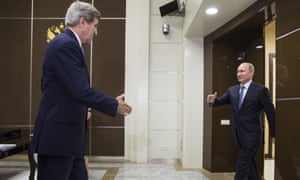
John Kerry and Vladimir Putin

Not pictured: Syrians


As talks begin again in Vienna on ending the Syrian civil war (which is so much more than that), the main issue revolves around whether Bashar al-Asad should stay or go, with the US favoring the latter and the Russians promoting the former. It seems weirdly removed and high-level, and it is, because the realities on the ground make the removal of one man a short-term fix at best, if not entirely irrelevant.

A really interesting and well-reported article in Foreign Policy by James Harkin helps illustrate why. In the article, Harkin talks of how Hezbollah has flooded the area around Damascus, propping up the Syrian army, and training local militias to fights ISIS, Nusra, and other enemies. The militias are largely Shi’ite, Ismaili, and Druze, all of whom are among the main targets for Sunni extremists. Here’s a taste of how complicated it is.

As Syrians retreat to sect, ethnicity, and tribe, Hezbollah’s services as specialists in irregular warfare are in massive demand. This isn’t only true for Syria’s tiny Shiite minority: Many other religious groups have been threatened — but also emboldened — by the crisis. Faced with the rising tide of a vicious Islamism within the insurgency, they are organizing themselves in Hezbollah-like “self-defense forces.” From the Druze in Swaida to the Syriac Christians in rural Homs to the Alawi-led “Syrian resistance” formations in the coastal provinces of Latakia and Tartous, they see themselves as engaged in a life-or-death struggle for their beliefs, and they exist in a fractious, paramilitary relationship to the Syrian state.

In any war, alliances shift and bedfellows that are made are far stranger than in politics. What ISIS has done, among other things, is to further distort who is on the “right” side. It’s easy and correct to say that the battle between ISIS and Asad is a battle between two terrible sides, but what of the other Alawites? What of the Druze who flock to an Asad quasi-ally in Hezbollah, who are also defending Christians but have all but colonized Golan? If the Ismailis side with Asad, who is a monster, against ISIS, who tried to exterminate them, should they end up on the losing side of the civil war if the US gets its way in negotiations?

The point here is that focusing on Asad, while understandable, overlooks the tectonic fractions that created these conditions in the first place. I think it is inevitable that there will be a new map, as Syria and Iraq have, for all intents and purposes, ceased to exist. In Vienna, they are as much a product of diplomatic imagination as they were at the end of WWI. Understanding the new realities on the ground is the only way to eventually find a path toward peace.

Syria, The New York Times Middle East Map, and the Length of History

On Saturday, the New York Times published a neat little article by Nick Danforth about different ways the Middle East- mostly the Levant and Iraq- could have been divided up after WWI.  There were several plans, including the original Sykes-Picot, and one from King Faisal, which at least had the benefit of being drawn up by an Arab. While there is the discomfort in thinking about conquering Westerners deciding what will be done in the region (based almost entirely on how it would serve their own interests), there are a couple times where one senses a frisson of missed opportunity and possibility, an alternative history that wouldn’t have ended with the agony in Syria and Iraq (not to mention Lebanon). A French plan for an Alawite state makes one think this could have all been avoided- the Asads would have been the king of a tiny zone, if at all, and wouldn’t have to hold on with such grim and bloody determination. Independent states around Damascus and Aleppo allow one to envision the latter city still standing, and the two countries at peace, somehow.


Alawite State hugging the Mediterranean. Isn’t it pretty to think so? Image from New York Times


Of course, any of these drawings would have carried with them their own problems, and their own internal contradictions, such as what to “do” about the Kurdish issue, Sunnis and Shi’ites in Iraq, and of course the eventual Zionist issue. Every state would have its own religious and ethnic minorities, as the lines would have to be drawn with infinite angel hairs to give everyone national determination or to make “pure” states, if such a thing were even possible, not to say desirable. And humans being humans, there would always be cause for war.  There was no real solution, perhaps.

That’s really the nut of the matter. The modern Middle East and the Balkans were both born of the same historic moment: when the rise of the nation-state coincided with the death throes of an ancient empire- the Ottomans. They aren’t exactly the same, of course. The Balkans went through a brief Austro-Hungarian phase, but that was due to the long-running collapse of the Ottomans, the Sick Man of Europe.

It’s hard to think about now, but these were places that had a political system in place for hundreds and hundreds of years (the Ottomans began to dominate in the 14th and 15th century). It was a multi-ethnic and ever-shifting empire, with central power waxing and waning, but never disappearing. When it died in the aftermath of WWI, it was suddenly due to be replaced by modern states.

We don’t really recognize that this is a long and uncertain process, but think of it like this: pretend you are reading a history book in the year 3500, or about 1500 years from now. I know there probably won’t be books at that point, but you’re going to be dead by then anyway, so just use your imagination, ok?

You’d read of the 500 years of Ottoman domination, and then the tumult of the 20th century. The Balkans were briefly dominated by the Soviets and Tito’s 3rd-wayism, and the Middle East by colonialism, followed by nationalism and tyranny, followed by religious fanaticism, until it all collapsed, slowly and then suddenly, starting in around 2003. But the thing is, that section wouldn’t be long.

We’re fewer than 100 years since the Ottoman’s collapsed, and while a lot has happened, it always seems like a lot happens when you’re living through it. But we’re still in the last rigor-mortis flicker, the dying tail of that millennial empire. The Soviets mutated the direction of the Balkans, but they were just a blip, a large factor in determining what would happen in the post-Ottoman Balkans, but still a mere factor in that longer story. Everything that has happened in the Middle East is part of that same tale. The mutations of colonialism, nationalism, and religion are just playing a role.

This isn’t historical determinism. No one’s fate was written by the Ottomans. But if we want to look to the future of the region, after the wars and after ISIS, we have to be able to look at the longer story, a region that moved from stagnant empire to the vortex of the modern nationalistic politics in the span of a few scant decades. No matter how the maps were drawn it would take decades or longer to shake out. Understanding this process, and understanding that what comes next won’t look like what came before, can help us avoid the mistakes of the past, the ones that have led to the ruin and pain of the suddenly modern Middle East.