Something to make every day better

Bad news on all fronts, so here’s something that can cheer you up.

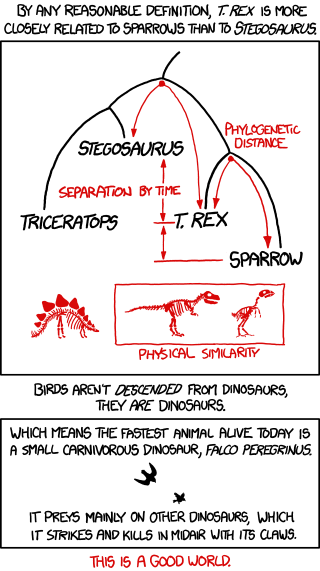
Birds are dinosaurs (this isn’t breaking news; bear with me). It isn’t that dinosaurs “evolved into birds”; it’s that we saw the evolutionary result and called them birds before we knew what dinosaurs were. If you think that’s disappointing, then think about them ripping a fish from the sea or tearing apart a worm with their fearsome claws and beaks or swooping down at 60 mph to grab and devour a hapless vole or basically just fucking with Tippi Hedren. It’s pretty awesome. Randall Munro at xkcd explains it better, as usual.

Birds and Dinosaurs
So how does that make life better? Just start calling birds “dinosaurs”. As in, “Man, Gary, I got like zero sleep. These dinosaurs were making a ton of racket outside my window,” or “Our blueberry bush is doing great, but I can’t keep the squirrels or the dinosaurs away.” You’ll see that makes every day just a little better.

Super-Powerful Neutrinos Are Better Than Elections


You are: barely registering as existing


From Phil Plait, the best thing you’ll read today, about neutrinos traveling from a supernova 9.5 billion light years away, at nearly the speed of light, and hitting the earth with a force so great that if they hit you you’d feel it.

Think about that. Imagine the force to propel a subatomic powerful across essentially the entire history of the universe, from before the earth had even formed, before the storms that brought water, before the tectonic processes that still shape our world had started, through that time, as we slowly formed in this planetary heartbeat, and looked up to the sky, and wondered, and were fearful of its power, and developed tools that let us see it, and even more powerful tools that let us understand it: and these particles shot through uncaring, through distances that we literally can’t imagine, but can somehow record. Fast enough through unchecked infinity so that you’d feel it. You wouldn’t know what, it would probably barely be even the slightest register, but maybe you’d know. Maybe you’ve felt it before, and maybe it was the tiniest prick, and you shuddered. You wondered what it was, what mystery just gave you pause. Have we all felt them? Have we all been riddled with reminders of cosmic indifference?

And do they carry with them the unknowing loneliness of existence? Do they carry a hint of the emptiness? It’s not that you touched the void, after all: the void slammed into you, and passed through like like you were a ghost, the tiniest ephemera. Which, to space, (as Plait reminds us) you are.

Dark thoughts, but in the end, they don’t matter. After all, we’re here, for the shortest breath, and that’s pretty goddamn cool. We get to be here when people can not just learn about, but write sentences like this.

And that mind-stompingly distant galaxy produced a hail of subatomic particles that shot across the cosmos at just a hair under the speed of light, passing galaxies and clouds of dust and gas and heaven knows what else, only to be stopped by a single molecule of frozen water on a tiny blue-green planet, creating a flash of light so faint it took sophisticated technology and advanced science to see it at all.

Remember this next time someone says scientists are dupes or frauds or don’t know what they’re doing.

In which we concede to germs…

Breaking! 

“You’ve been cleaning your hands all wrong. The World Health Organization recommends a 6-step, 42.5 second technique for applying hand sanitizer.” 

You know what, double that. Better yet, make it five minutes. Quit your job if you have to.

Congrats, germs! You win. No one has this kind of time. Even Howard Hughes would find it a distraction from his routine of growing his nails and murmuring. Hope you do a better job with the planet than we did.

The Hum, The New Tree of Life, And The World Beyond

11treeoflife-blog427

You are: barely here. Image from Credit Jill Banfield/UC Berkeley, Laura Hug/University of Waterloo via NYTimes

The old saw about the tree that falls in the forest has weirdly become shorthand for philosophical gibble-gabble, but the question of whether or not it makes a sound is actually a really deeply interesting one. The answer is no, but also yes, but mostly that it depends on what we mean by “sound”.  Its crashing death produces soundwaves, reverberating through the forest primeval, but without anything to pick them up, to transform them from waves into actual tangible sounds that we hear, what are they?

(And yes, there are animals who are hearing the sounds in their own way, but ignore them for now. After all, what’s a rabbit or katydid ever done for you? Nothing, that’s what. They can go straight to hell.)

The very nature of physical phenomena is subjective in a way that highlights and minimizes our tangible place in the world. We can only perceive a very small percentage of what is around us. There is so much light on the invisible spectrum that what we think of as “light” is just a small and not terribly significant part. There is so much life- the enormous majority of life, as the breathtaking new Tree of Life proves once again- that is invisible to us, even as it dominates that planet. Our outsized presence on this planet masks that we’re barely a part of it at all. We go through life blind and deaf to most of what is around us. We’re drunkards in a haunted motel, dimly perceiving that something strange is going on, but not having the capacity to figure out what’s flittering just beyond our stupored senses.

Continue reading

Self-Driving Cars And The Technology Trap

scania_platooningtruckchallenge_still009

Image from Scania via Quartz

Over the weekend, as reported in Re/Code, Ford announced a successful test of an autonomous car driving in the dark- that is, without some of its equipment working. The car was driving without its camera, relying mainly on laser directions (lidar). Basically, it was like a human having to drive after their headlights went out, on a black moonless night. Or a bright one, where it was still hard to see. You know, just night, basically. Anyway, you and I would be in trouble, but the Ford car wasn’t. This is a big breakthrough.

I’m a passionate advocate of self-driving cars. Not professionally, because who the hell cares what I have to say about it, but personally. It makes me sick and angry to think that one moment of distraction by myself or another driver can kill someone I love or ruin their life forever, that a split second of indecision or mistake can have such a shattering impact. I think we’re going to look back at the era of human-driven cars as a time of unimaginable barbarism, where tens of thousands of people a year were killed and tens of thousands more maimed driving these glass and steel bullets at breakneck speeds. Self-driving cars will also be much better for fuel economy– there will be less driving around confused, less sudden braking, and fewer incidences of inefficient driving, the biggest cause of fuel waste.

There are drawbacks of course- system safety (imagine if a hacker breaks in and messes with V2V or V2I communications), a lack of autonomy, massive disruptions to the insurance industry, etc. There are huge political obstacles, as well as cultural ones. There is also the immediate problem that it will could cause huge layoffs in vulnerable sectors while immediately benefitting corporations. That’s a drawback, and one with unsettling human and political ramifications.

Continue reading

Homo Floresiensis: A Not-Incidental Follow-up

homo-floresiensis-009

Sorry, our bad. Image from The Guardian.

In 2004, scientists announced a new relative in our fragile family tree, a (all together now) “hobbit-like creature” known as home floresiensis. It was a small little creature, and there was some evidence that it existed, in the Indonesian jungle, as recently as 12,000 years ago, which would put it not just on the earth the same time as homo sapiens, but in the same era as modern man, as we were beginning to puzzle out farming and society, and creating the modern world.

Indeed, it was even more exciting. There were legends in Flores, where the hobbit was found, of a forest creature, ebu goguIt’s a small creature, sometimes translated roughly as “grandmother” (not literally) or “creature who eats anything”. Older legend had it out there in the jungle primeval, scampering around, always a fleeting glimpse in the mist. It was probably a monkey, or just made up, a tale sifting through the years, but you didn’t have to be a romantic to make the connection. To imagine that not very long ago, one of our distant relatives was still roaming the vast forests, and that our direct and wholly recognizable ancestors would see them. Would they make eye contact? Would there be a dim recognition, a spark of connection? Would there be fear? Would there be hatred? The thought was absurd, but it was tantalizing. There was poetry, and even hope. We could coexist, even as we became dominant.

That didn’t happen. More studies show that floresiensis was wiped out 50,000 years ago, most likely due to man encroaching on its territory. And not the man that was figuring out writing and could recognize a species that was so close to us, even if just in our imagination. It was our species at its most basic, a constant fight for survival and resources. The hobbit was just another competitive ape.

The new understanding of the dates make a lot more coherent sense in terms of the evidence of what we know about modern human dispersal,” says Matthew Tocheri, an author of the study from Lakehead University, Ontario. Over the past 100,000 years, extinction events followed modern humans wherever they went, he said. “It is not always the case the humans are the sole factor,” he added. “But they are often in the right place at the right time to at least be a part of the reason.”

This isn’t to blame our ancestors. That’s what you had to do. It’s just interesting that for millions of years there were many species of humans, intermingling and competing, but having a rough balance. We won, and the rest are all gone.

This is not an incidental follow-up to the global warming post.

Destruction of World Draws Some Headlines

(Potential barely-relevant music to accompany post*)

Yesterday, the news- including this blog– was more or less full of Donald Trump bloviating some nonsense about abortion, before claiming he was misquoted, and all right, everyone is very unfair to him. That’s cool. It’s an interesting thing to talk about, since he is a Presidential candidate. Also drawing some interest is that New York and London might be destroyed way sooner than anyone thought.

Continue reading

Life on Pluto?


image6

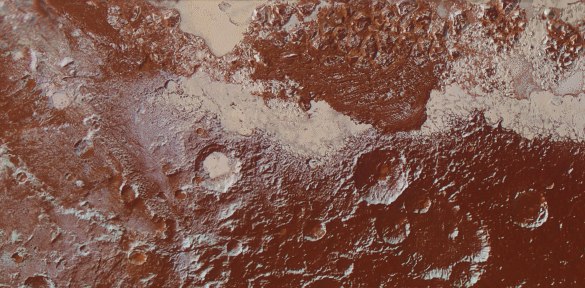
The dark parts are the “heavily craters and ancient terrain of the Ctulhu Region”, and that’s just awesome. Credit: NASA/JHUAPL/SWRI via Scientific American

No, of course not. That’s just clickbait. But as this amazing Scientific American post by Lee Billings highlights, Pluto is far weirder and more inexplicable that we had imagined. If this paragraph doesn’t give you chills, you’re made of sterner stuff that you should be.


The biggest surprises have been Pluto’s surface and atmosphere, which are restlessly active and diverse despite average temperatures of only tens of degrees above absolute zero. Some scientists expected New Horizons would find Pluto to be little more than an inert, sunlight-starved orb. Instead, the spacecraft encountered a world where nitrogen glaciers flow down into plains of frozen methane from towering mountains of water ice. Sunless half-frozen oceans lurk deep beneath the surface, and multiple moons tumble overhead through hydrocarbon-hazed red skies that tinge to blue at sunrise and sunset.

You really owe it to yourself to read the whole piece. What strikes me- beside the haunting beauty of an ancient distant object that has billions of years of scarred and shattering history, without realizing it, and without having any connection to our magnified insignificance- is that the solar system is far stranger and more unexpected than we had even imagined.  Pluto is bizarre. Its moons are bizarre. Its oceans are mind-blowing.

To me, I think that our with knowledge that even the parts of the universe relatively right next to us are capable of enormous surprises, combined with the recent awareness that there are billions of planets potentially capable of holding life, we’ve passed the point where anyone can reasonably say we are definitively alone in the universe. There was no single point where that happened, but we are in the middle of a major turning point for our species.

We almost certainly won’t discover life in my lifetime, the only thing that actually makes me depressed about a finite existence, and we might not ever in the timespan of humans, an end to which we weirdly accelerate. But since there is no way to reasonably of logically think that life can’t exist elsewhere, and since in an essentially endless universe that which can happen almost certainly does, it’s pretty clear we aren’t alone. I think as that awareness seeps in, over the next few generations, regardless of a major discovery, we’ll have to start to really reckon with it, morally.

I don’t, of course, think there is any impact in the knowing that somewhere, there might be life. It won’t affect us directly. But we’ll have to reconcile that with our narcissistic mythologies and increasingly witless eschatologies. That isn’t a bad thing. It might actually be the most incredible development in human history, as breathtaking as nitrogen glaciers, with no measure of man, tumbling silently to a sunless sea.


Sounds From A Sunless Sea: The Mariana Trench Recordings

cssfpexunl4tgjeveyog

If you are here, you’re probably in some trouble

When I was a kid the coolest thing I could think of was the Mariana Trench, the deepest part of the ocean. I used to say, incorrectly, that it was more than two Everests deep- Mt Everest, along with Rhode Island, being a standard unit of measurement at the time (“If you stood everyone in Rhode Island on each other’s shoulders in the Mariana Trench, most would die in terrible agony!”). Learning more, the ocean’s depths just get more amazing, and more inhuman: mud volcanos, liquid sulfur, CO2 vents, and the weirdest creatures in the world, living endless generations without knowing that humans are walking around arguing about sports.

So it is a particularly childlike and adult awe that greets the news of the first sound recordings from that crushing place. They found, much to their surprise, that it wasn’t silent, and that more than that, they heard sounds from all over the ocean. The area acts as kind of a vast echo chamber, with strange and disquieting sounds rumbling through the darkness.

Continue reading