Chicago freight, the new Panama Canal, and The Dominance of Trade

panamacanal2-16-wiki-18894

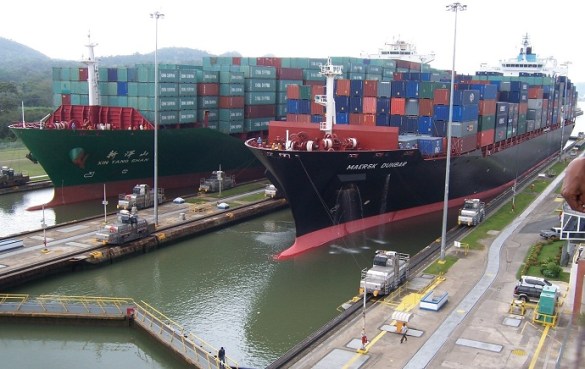
Ships passing through the Panama Canal. We needed a bigger canal, for bigger ships. Hell, dig up the whole country!

After years of delays, mismanagement, disaster, and an economic downturn, the expanded Panama Canal (which saw much worse during its initial construction) is set to open on Sunday. This is a deeper and wider lane for the enormous freighters that have accompanied Asia’s economic rise: the massive sun-blotting  container ships, quarter-mile long, and capable of carrying tens of thousands of tons.

This is extremely important for trade, in a value-neutral sense, because it means that the giant ships, which couldn’t fit in the narrower and shallower original canal, will be able to bypass the West Coast and go directly to New York and other East Coast ports. The ramifications of this quickly trickle down.

Crain’s, the business paper out of Chicago which is not exactly a Sanders-ite rag, talked about the potential impact on this railroad hub. Ships that couldn’t fit the canal would be loaded on trains heading to Chicago, and thence to the east, following the same path that allowed Chicago to be the focal point of empire. Now, though, these ships can get through, which will have a potentially huge impact on Chicago’s economy. About 5% of the Chicago economy is based on railroad freight (Great Lakes shipping is another matter). If Chicago can be bypassed, that’s a lot of jobs that will disappear, thanks to a canal built half a world away.

Of course, no one seems really certain, and anyway, the impact might not be felt for years. Certainly, as the Journal reported, New York isn’t ready for these monster ships: the Bayonne Bridge isn’t tall enough, and it won’t be ready for at least another year.

That’s not to mention that the Canal itself has the hallmarks of a disaster, as epically reported by the Times. The locks are barely wide enough to handle the largest ships, and are almost exactly as long as the ships plus the two tugboats needed to maneuver them. There won’t be any room for error, which given the swirling currents when fresh water meets the ocean, could be a disaster. The tugboat union certainly thinks so. Panama awarded the contract to a rock-bottom bidder, who came in billions below the next-lowest, and it has shown. (The article almost makes you sympathetic with Bechtel, which is a hell of a thing to be.) The concrete has been leaky, and there might not be enough water.


Image from NYTimes. The new locks are 1400 feet. The Neo-Panamax ships are 1200. Tugboats are about 100 each. Snug!

And oh yeah, about that water: it mostly comes from a vast, manmade lake which provides most of Panama their drinking water. The Panamanian canal administrator has literally scolded the nation for drinking too much water, and lowering the levels, making it harder for the ships to pass through.

That seems to me to be the perfect image of the subservience to trade, of its dominance in our lives. A suspiciously rich and powerful bureaucrat, who awarded life-and-death jobs to a shoddy but connected international conglomerate, complaining about its citizens drinking too much water, and not allowing these enormous, inhumanly-scaled ships to pass through a gash cut through a continent, while two great cities thousands of miles away scramble to reconfigure an economy and raise bridges to let them pass, as workers in the cities the goods pass through lose their livelihood, and workers where the goods are made are beaten and starved and robbed.

We make these enormous ships. We dig through continents and connect oceans. We raise bridges. To say that we can’t do anything about the inequity and iniquity of global trade is to give in the free market superstition, the only truly global religion.
 

Waukesha Gets Its Water

lake_michigan_sunrise

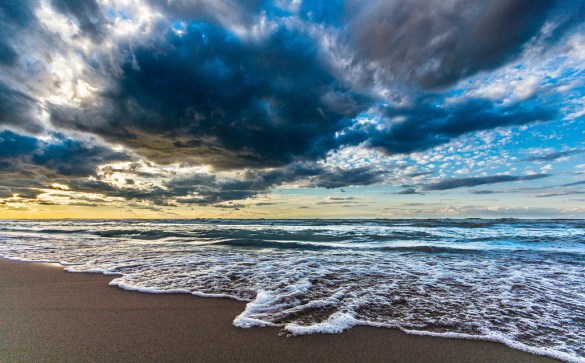
A Great Lakes sunrise for Waukesha. Image from North Country Public Radio

Previous Waukesha posts:

Governors from the eight Great Lakes states agreed Tuesday to allow a Wisconsin city to start pumping millions of gallons a day from Lake Michigan, marking the largest diversion of water from the lakes since Chicago reversed the flow of the Chicago River in 1900.

The unanimous decision favoring Waukesha, a Milwaukee suburb of 70,000 about 17 miles west of the lake, is the first test of a 2008 legal compact intended to prevent thirsty communities or countries outside the Great Lakes region from dipping into the world’s largest source of fresh surface water.

Chicago Tribune

There are two ways to look at this: one is that it is a disaster, a slippery slope, a sluice suddenly opened that’ll eventually compromise the Great Lakes. The other way to look at it is that it showed the Compact, essentially works. The Compact does have allowances, and Waukesha has possibly the strongest possible case: straddling the Basin, poisonous waters, a plan to divert 100% of the water back into the Lakes, etc. And yet they still spent years and years and millions of dollars trying to get the exemption, and their plan was shrunk and compromised. If a city with the best-case scenario for application can barely get it, what chance does Arizona have?

And yet, the flip side of this is that you always start with the easy one. Now don’t get me wrong; I don’t think there is some conspiracy here. But I do worry greatly about water, and the desire to privatize it, and anything that makes it easier to do so can be troublesome. Do you really trust Rick Snyder with your water?

For the most part, protecting the Great Lakes has had a surprising amount of bipartisan support for conservation. Being angry at environmentalists usually stops when it is your resources on the line, and the Lakes are one of America’s great treasures. It’s why staunch conservatives like Tommy Thompson were eagerly behind it. I worry about the new breed, though, who see it as a mission to put everything public in private hands. That Minnesota governor Mark Dayton approved, given the conditions, makes me feel better, but Walker, Rauner, Snyder, et all (including Cuomo) is worrisome. Approving the diversion might be right, and might be essentially apolitcial (it is supposed to be), but given the attempt to parcel off water to the highest bidder, caution is required. I do think Republicans of good faith want to protect the Lakes. I don’t trust those who believe the free market can do it on its own.

Given the need for vigilance, it is disheartening to see that neither the Times nor the Post saw fit to cover this. I know we’re just the Midwest, but this is actually a huge story.

Speaking of, I am working on a much longer non-blog piece about the diversion. If you are a publisher, or know any, and would be interested, drop me a line. Thanks!

Chicago’s “Police Lives Matter” Mini-Rally

wide_lrg_chicago-bungalow-04-ear-2

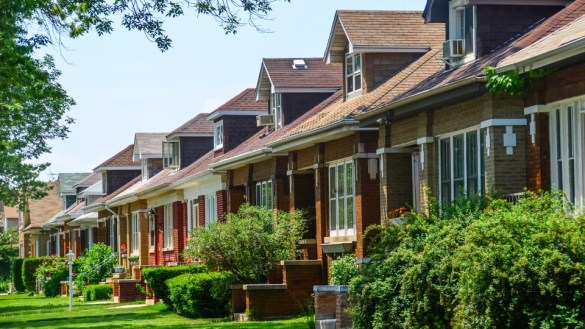
The leafy and quiet Bungalow Belt. Image from architecture.org

A lot of times, in political conversations or (ashamedly) on message boards in the past, when I have revealed that I am from Chicago there is a certain set of assumptions. At least in these forums, it doesn’t have to do with Al Capone or Michael Jordan, but rather an assumed liberalism, and in the era of Barack Obama, something shady and ugly and untrustworthy (depending on if my interlocutor is a right-wing crank or not, of course). But even Obama aside, Chicago has become synonymous with being liberal, because it is a staunchly Democratic city, and “democrats = wild-eyed libs”, even though this has rarely been true. Even now, where the party is as left as it has been since LBJ, it is still essentially moderate.

Chicago has always shown how “Democratic” is not equal with liberalism, except in one very important and telling way. When Old Man Daley was running the city, he was the bane of every liberal. He hated uppity blacks, long-haired kids, loud-mouthed ladies, reformers (especially reformers), and anyone else who wanted to tell him how to run his city. There was a way of doing things, and damn you if you tried anything else. You know what you need? A talking to from the parish priest, that’s what. I knew your father, rest his soul, and he’d be spinning in his grave to see what you’ve done with your life. (Sorry- we almost slipped into a James T. Farrell novel.)

But there was that one way which, to the right, Chicago and other machine-run inherently conservative and anti-liberal cities did seem like liberals, and that was because they made noises toward taking care of minorities. This was pure politics, of course, and was honored more in the breach than otherwise (“the wettest blacks!”), but they distributed jobs and other goods, especially the goods of having a pliant alderman and ward boss, who did what the machine wanted.

For many in Chicago, this was a bridge too far, especially as the black (and Hispanic, but that divide didn’t have deep and angry roots in Chicago) population grew, and the Machine had to pay more attention. The essentially conservative white-ethnic base grew angry, and while they didn’t have the same power, they did have control of the police forces, which more than ever became a private army for keeping the wrong people away from the right ones. This anger culminated in the vicious “Council Wars” that erupted when Chicago elected its first black mayor. We talked about how the leader of the anti-black movement, Alderman Fast Eddie Vrodolyak, was the spiritual ancestor of the Chicago-based Trump movement, a bitter reactionary who knew exactly how to play to the “Silent Majority”, stoking racial fears and hatred.

That’s still around now, despite a reputation for Obama-y liberalism. In this turbulent city, where a violent spring seems to be edging into an apocalyptic summer, the forces of action and reaction are simmering over again. We see this in today’s planned “Police Lives Matter” rally, placed at one of the two hearts of Chicago’s white ethnic redoubt.

These are to take place as a joint effort between the 38th and the 41st wards, on Chicago far northwest side, near the airport, where the city seems to blur into a grittier kind of strip-malled suburbia, bounded by some forest preserves, and row after row of bungalows. They are changing, a bit, with upscale condos in a few areas of Edison Park, but they are what they have been for decades: a mostly working-class area, with a lot of cops and fireman. Rules are they have to live in the city, and they tend to congregate at the far northwest and far southwest. Some people see this as wanting to be as near the suburbs as possible, and a sign of hating Chicago, but I think it’s understandable. It’s a tough job, and I’d probably want to feel like I’m leaving it as well. Consequently, these are safe neighborhoods, with families on the street and decent, though rarely great restaurants, and some great authentic Irish pubs.

But it is in the “police lives matter” rally is clearly the product of angry, racially-tinged reaction. Now, to be clear, police lives do matter. They do great and brave work, dangerous work. As Charlie Pierce said, in an article about a stomach-churning police scandal in Oakland, “Sometimes, I wonder how the good cops, all of them, get up in the morning and go to work. There’s something amazingly selfless in there that’s beyond my understanding.”

This, however, is not a parade for honoring good and great work. It’s a direct sneer at the activists of Black Lives Matter. You can tell it is due to the sickeningly disingenuous prattling of Alderman Anthony Napolitano, a former firefighter who is enjoying his first term.

Asked if Black Lives Matter protesters might object to a catchphrase turning the tables on their group, Napolitano said, “I have no clue why they would. There’s a Black Lives movement. There’s a Police Lives movement. That’s two totally separate things.

“What if someone came up with Puppy Dogs’ Lives Matter?” Napolitano added. “If you want to champion a cause, you should be allowed to champion it.”

This is obvious nonsense. It certainly wasn’t like “X Lives Matter” was a common phrase, and “black” is just the latest entry. Doing any “Lives Matter” is a clear choice to be in direct opposition to them; it is always prefaced with a not-so-subtle “No, actually…”  His fun example is actually more telling than it seems. “You think black lives matter? Fuck you. I think puppy dog’s lives matter.”

(If you think that in the same article, Napolitano set up a “political correctness/common sense” dichotmy, you get zero points for guesswork, because come on. That’s easy.)

There is understandable fear in the city about what is happening, but it is telling that the “police lives matter” support comes mainly from some of the safest neighborhoods. It’s raw tribalism, and you can see how tribalism in Chicago has altered due to the pressures of race. Look at Napolitano. Time was no Irishman, of which there are a lot in the 41st, would vote for a man with a vowel at the end of his name, whether it was Italian or some form of “ski”. But the tribes have coalesced. And this tribe, the Police Lives Matter tribe, is why Chicago will never be a liberal city. The tribe is by definition conservative, and if still nominally Democratic in city politics, essentially socially Trumpian. It’s why even though he can’t win, his rise will mutate politics in the entire country, especially in angry barstools on a fearful and reactionary ring around Chicago.


Waukesha Diversion Week: What Waukesha Wants

Waukesha Diversion Week!

b99727154z-1_20160518204006_000_gp3fmgda-1-0

Image from Milwaukee Journal Sentinel


To the city of Waukesha, that unassuming Milwaukee suburb, the request seemed like a no-brainer, and coming as it did before the Great Lakes Compact was signed, seemed like a sure bet. The aquifer from which it drew its water contained naturally-occurring radium, and the growing community of 70,000 felt that they needed a cleaner and safer source.  Reasonably, they looked not-very-far-east, some 20 miles, to the shores of Lake Michigan, which contains some six quadrillion gallons of water, and provides more than a billion gallons a day for drinking. The initial Waukesha request, at less than 20 million gallons a day, seemed reasonable.

And certainly, it made sense. They were a “collar county”, straddling the Basin, with the eastern part of the county firmly within its natural borders. The Compact provides exceptions for straddling cities and counties, provided that they can meet a strict set of standards.

Wisconsin Counties within Great Lakes Basin

(Images from Waukeshadiversion.org)

Now, if you were the town fathers of Waukesha, you would feel that there is a certain didactic madness to any opposition, a sort of pecksniff tyranny not just of geology, but of pedagogy as well.

Continue reading

The Waukesha Diversion: Geology in Human Affairs

Waukesha Diversion Week. Part I: The Great Lakes And the Future Water Wars

glacier

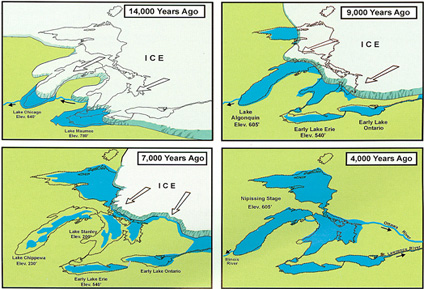
The formation of the lakes. See that 9000 years ago it was draining south. Image from glerl.noaa.gov


I type this late at night, after an evening of losing softball near the shores of Lake Michigan, which has seen us lose more than a little. It’s a warm night, on the stilled brink of a storm, and like many nights, I can hear the clacking rattle of a skateboard. There’s a kid who lives down the street, who nearly every night, walks his skateboard to the hill at the corner, and goes down.  Last year we heard him fall nearly every time, and were impressed by his ability to get back up. A cold-winded winter, in which he practiced most nights, made him better, and after he goes to the top of the hill, he shimmers down with ever more reckless speeds.

I wonder if he knows why, in this flat part of Illinois, in one of the flattest areas in the country, the street has a small hill, no more than 15 feet and low-angled, but for this area, substantial. Why his skateboarding has improved because his parents decided to live on this street, in this town. How the ancient geology of lakes affects his life, and in a real way, the interests that will shape him. If he lived two blocks down skateboarding would have basically been as interesting as cross-country skiing, which is to say: not at all.

But that’s sort of the point of this week’s series on Waukesha: the unseen role of geology, from the crisp edge of a basin to the smallest hill in Illinois. We are beholden to it, and it shapes our politics. It predates us, and it will outlast us, and our little human concerns have to find a way to propitiate geology. Becuase it doesn’t care if we do or not; it’ll keep on shaping out lives, vast and unseen, down to the water we’re allowed to drink.

Continue reading

The Waukesha Diversion: The Great Lakes and the Future Water Wars

lake_michigan_from_big_sable_point_lighthouse

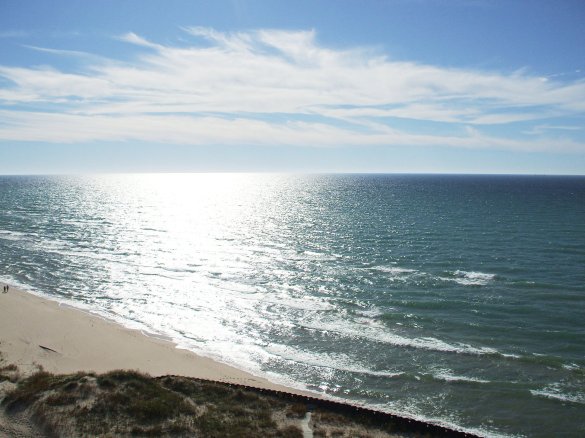
Endless and beautiful Lake Michigan

In 1998, a permit was accepted by the government of the Canadian province of Ontario, following a lightly-remarked-upon 30-day public comment session, to approve a ridiculous and pointless money-making scheme. This approval set in motion a multi-national effort to protect one of the great natural treasures of the world, one that could decide the future of water on an increasingly parched planet, and one that will shape the fate of a harmless Milwaukee suburb, whose destiny lies on its placement just east of the slight bend of a continent, a product of ancient and mute geological forces. It’s a story about our distant past, and one about our every-drawing future.

It was in 1998 that a businessman,  John Febbraro, applied for a permit to have giant tankers scoop up water from the Great Lakes– specifically the giant of the group, the vast and violent Superior– and sail them through Sault St. Marie, down through Windsor, up through Erie and Ontario, into the vast river of the St. Lawrence Seaway, and then to Asia, where a thirsty market would gobble fresh water. (This is detailed excellently in Peter Annin’s Great Lakes Water Wars, a must-read for anyone interested.)

It was an amazing plan, and a ridiculous one, born of a good idea that made absolutely no sense. Febbraro planned to scoop up 427,000 gallons a day, which comes up to around 155,885,000 million gallons a year. That seems like a lot, until, as we see, that comes to about what an average-sized suburb of Milwaukee would need in a 6-month period. That…won’t solve any Asian water problems.

But still, it proved a catalyst. There was a Great Lakes Charter signed in 1985, by the eight US states and two Canadian provinces the have land bordering the states (which yes, includes Indiana). But it turned out that the Charter wasn’t very strong, which is why a plan to take water from the Lakes and ship it around the world could be approved.

The plan provoked outrage, and incredibly enough, action. Pressure- and honestly, the economic infeasibility and ridiculousness of the plan- destroyed Febbraro’s dream. But more than that, it spurred people, Democrats and Republicans, Labor and Conservative, into recognizing that the Great Lakes weren’t permanent, and could be destroyed. Just because the plan to have boats take water to Asia was absurd- and anyone who has watched giant ships sail by, dwarfed by the enormity of this water, could tell you it was absurd- didn’t mean the writing wasn’t on the wall.

After all, if a ship could take water, why couldn’t hundreds? Why couldn’t thousands? Why couldn’t pipelines be built to replenish barren reservoirs in Western deserts? While there was never a plan to make it economically feasible to do so (and many tried, both public and private), it didn’t mean it couldn’t be done. At some point, an economy of scale could take over, and it would make sense to trickle water out of the lakes.

But apres trickle, le deluge? That was, and is, the big fear, which is why in 2008 the Great Lakes Compact was signed. This was a guarantee that no one outside of the Great Lakes Basin could use water without the permission of every state and province in the region. The problem is– one of the problems is– that with the exception of Michigan, none of these states or provinces lie wholly within the Basin. Which means politics takes over.

And that leads us to Waukesha, a city the is a suburb of the Basin-included Milwaukee, but one that is just outside. Waukesha has spent years applying for a diversion, claiming that their source of water, underground wells, is dirty and mostly poisoned, and anyway won’t last them very long, and anyway, besides, they are so close. A swift walk can get you to the Basin; a decent bike ride to Lake Michigan; if you are driving, a day at the lake is like going down the street.

Most of the obstacles to their application have fallen. Last month, the Great Lakes Compact group voted 9-0 (with Minnesota abstaining) to approve the diversion, with serious conditions. Next week in Chicago, the final governor-level meeting will take place, to decide its ultimate fate.

So, this is Great Lakes water week here at Shooting Irrelevance. It’s a story of politics and the environment. It’s a story of the future of water, and how we’ll use it, and most importantly, who owns it. After all, if the Lakes are a public good, why should greedy Chicago (who has the mother of all diversions) luxuriate while citizens in Nevada parch? It’s a story about political geology, and how these ancient forces shape our present. It’s a story of competing activism, in which every side has moral ground. Mostly though, and fully, it’s a story of the Great Lakes, this gorgeous and perfect and tempestuous system. It’s a story about their strength, and their fragility.

When you stand on the southernmost edge of the system, as I often do, at that sweeping curve that defines Chicago, they seem infinite, overwhelming, almost impossible in their magnificence. You can drive for hours and hours, up the coast of Wisconsin, and around the UP, and still have barely covered half the shoreline. They are amazing, and they are not like the ocean, which are essentially inhuman in size. The Lakes, though enormous, are human. We’ve paddled across them for millennia, traded across them, sent great ships to ply them, but also to sink. To sink in their temper, in their violence, in their sudden reminder that they are not ours to do with what we like. It’s a warning, a reminder that there are enormous ships on the bottom of these lakes, the Edmund Fitzgerald and the Carl Bradley, that were swallowed whole. But it is also a fearful warning. There is no consciousness in lakes, but if there were, they would look at the tragedy of the Aral, and ask us to stop and think. They’d remind us that, in our tempers and ill-humors, in our short-sightedness, we can ruin a great gift.

That’s what we’ll be talking about this week; ultimately, the tragedy of competing and rational human interests in the face of unconcerned nature. Hope you’ll enjoy. Here’s a rough schedule.

  • Tuesday: the political geology and geography of Waukesha and the Lakes
  • Wednesday: an analysis of the Waukesha proposal and its opposition
  • Thursday: Activism and the Great Lakes: A Model for Environmental Impact
  • Friday: What it all means; or, the future of water.

Euro 2016, Trump’s Con, and More Quick Hits

norwood-1024x576

Suas an Irish!

  • The Guardian has a fun little article today on Euro 2016, helping Americans choose what team they should root for by finding the closest analogy to a local squad. Ireland was compared to the Buffalo Bills which is…not ideal. Northern Ireland got the Raptors, which is too boring to even be tragic. The analogy for the Cubs was Poland, and I am sure there is a joke there somewhere, but we daren’t touch it. The best description was for Spain, who is your team if you like the Red Sox. “Years without success for one of the sport’s big teams? Check! A resurgence with titles galore at the start of the 21st century? Double check! A nagging feeling that their very best years may be behind them? Check! Check and triple check!” Left out: you’re probably an asshole. 
  • Speaking of the Cubs, as a White Sox fan, let me assure you that, the post at the beginning of the year notwithstanding, we’re never going to speak of baseball again. Bitterly shouting “Big Game James!” every 5th day might be the only joy left in my life.
  • Programming note for next week: we’re going to have a lot of posts on the Waukesha Diversion, which will have a final decision by the end of the month (and it looks like a go). This is a complicated issue, which is key for how we’ll use water in the coming dry years, and really hinges on the role the geography and geology play in our lives. Hope you like Great Lakes stuff!
  • Jim Newell has a smart piece on how Donald Trump might actually bankrupt the GOP by running in places like New Jersey and California. Key line: “There is something about Trump’s personality that makes him believe he needs a marquee media-centric state like California. He probably doesn’t see the typical Republican strategy of cleaning up in the South and the Plains as “flashy” enough for his brand.” This is, I think, correct, and wish Newell had gone a little further with it. The entire idea of Donald Trump, as businessman, is using flash to cover up enormous deficits and kicking the can down the road. Most of us call it lying, but Trump has always known there are a lot of people dumb enough to believe something, and then fail to check on it later (remember his claims that his birth certificate investigators couldn’t believe what they’ve been finding? That’s no different than saying “Everyone says this casino is going to be a huge success!) That’s been the key to his campaign as well. Promises, based on his name and “success”, that everything is going to be good, just believe me. It’s why he keeps saying that he’ll be so Presidential you’ll vomit in terror, ok?   The sell, the con, is to say something is going to be great to hypnotize the gulls and hope they give you money, and then never follow through. The point isn’t to change, but to convince people that you will, and then keep doing it, over and over. He relies on the sunk cost fallacy. People have invested so much that they hope, this time, he means it, and that it’ll pay off. That has worked for him, weirdly, in business. He always flees before the bills come due, usually literally.  I’m not particularly optimistic, but I think that there’s a chance a lifetime of fraudulence could blow up in his face, and the entire image could come shattering down. At the very least, isn’t it pretty to think so?

Recommended Summer Read: Masters of Empire, by Michael McDonnell

51rjmg1ovvl-_sx332_bo1204203200_

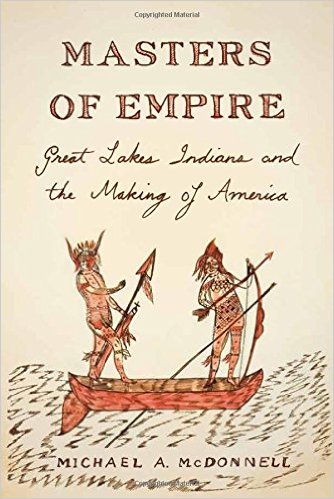
Masters of Empire: Great Lakes Indians and the Making of America, but Michael A. McDonnell

(Buy here)

It must be strange, one would think, to be a background player in your own destruction. But that’s how we understand the great historical clash between Europeans and natives in the Americas- with the exception of some battles, like Pontiac’s Rebellion (and what a loaded word “rebellion” is, implying that he was rising up against some sort of rightful order), or the Nez Perce War, the history is one of dominance versus submission. And to be sure, the Europeans dominated, and eventually destroyed the natives, whether they were in the form of the Spanish, the French, the English, or the Americans.

But that’s far from the whole story. In Masters of Empire, Michael McDonnell, an Australian scholar who has written several books on American history, takes the story from another point of view, one that is far more accurate. This isn’t a “from the Indians’ point of view” story, which is important, but rather he demonstrates how local concerns,  rivalries, and politics weren’t so much shaped by the arrival of Europeans, but how they shaped the formation of empires.

This is a very useful corrective. Using primary, at-the-time sources, McDonnell tells the story of how most of European policy was built around placating the original inhabitants in order to further trade (here it’s important to note that while there was cruelty, enslavement, misplaced moral righteousness, and callous indifference, a policy of extermination didn’t come around in America until it became, well, America). This is a different story than we’re familiar with.

McDonnell skillfully demonstrates how much Great Lakes tribes, especially the Anishinaabeg, who centered around Michilimackinac, played the English and French against each other, making demands, declaring war, rallying troops to fight for or against one side or the other, and generally making themselves indispensable. They were a partner that had to be placated, not a rival to be fought, or worse, a submissive people to be destroyed.

In one of the book’s key elucidations, he demonstrates how the French taking sides in the Anishinaabeg rivalry with the Iroquois, and the English taking the other, was the beginning of the Seven Years War, the first battle of which he positions as the Raid on Pickawillany in Ohio, which was part of an inter-tribal war. The Seven Years War reshaped empire, and the world, and helped create the conditions that led to America. We called the front of that war here the “French and Indian War”, but McDonnell has none of that, rightfully relabeling the conflicts as The First and Second Anglo-Indian Wars.

(Throughout the book, McDonnell uses “Indian” instead of “Native American”, which might make some readers uncomfortable, but I think is more correct. I loathe “Native American”, because it implies a paternalistic adoption after forced extirpation. It basically says “Don’t think of it as America destroying your ancient way of life. You were really Americans all along, and just didn’t know it! You’re welcome!” Indian, obviously, has its problems, but at least it gives some agency.)

This isn’t revisionist history, either. This is how the wars and the policies were seen at the time, by the people living them. The whole history of Europeans on the continent was about managing their relations with the natives, who were skilled politicians, and knew how to get what they wanted in the face of overwhelming military superiority and disease-borne apocalypses.

It’s a great read, and shows how the tribal structure worked, and how lines of kinship influence politics and culture. It’s a powerful look at the Great Lakes during the dawn of the Europeans, and one can imagine the locals, with their intimate knowledge of these great and fearful bodies of water, and the rivers that feed them, shepherding frightened and lost Europeans around. You can get a sense of what the region was like before lines were drawn to signify borders, where activity was centered around the water and hunting grounds.

Indeed, the map shows a pre-state (in the national, not just the “great state of Mississippi!” sense) Great Lakes region, stretching on one end to the St. Lawrence and the Atlantic and the other up through Lake Winnipeg and on to the Hudson Bay. This is how the world was, then, before lines of demarcations chopped it up. It was a world before our obsession with borders shifted the axis, and before we decided that some people were Natives, instead of just, well, natives. It’s a world that had a narrative forced upon it, changing its history ex post facto. McDonnell’s book is a great corrective for that. It shows that these were people, who frequently bent London and Paris to their wills. Their actions shaped the world we live in now, as much as we destroyed theirs.

Lead in the Water: Local Cheats, National Disaster

wilson_avenue_crib_060820

Where the water comes from. Image from Wikimedia Commons

If you’re unaccustomed to the view of Lake Michigan from Chicago, you’ll be surprised to notice several strange objects about a mile out into the lake. Depending on the weather and the light, they’ll look like large ships, before you realize that they aren’t moving, and anyway, seem to be made of stone. As your eyes focus on them, they look like houses, and the romantic among us imagine that they are old lighthouses, steering ships in through stormy western winds. Of course, there aren’t lights on them. What they are, you’ll have explained by a local, the glint of the trivia revealer in his eye, are the pumping stations, where the water that quenches a city is pulled from the vast and ancient lake and brought into the modern metropolis.

If asked why they are so far out, the local, still glinting, will explain that of course, when they were built, the river was still dumping pollutants into the lake, and just the dirty flotsam of millions made the shore and its near environs unsafe. Better to pull from, if not the open blue water where land is no longer visible and directions suddenly and terrifyingly seem to have no meaning, then close enough. This water rumbled through long pipes under water and land, through thousands of miles of pipe north and south, and into our homes.

And as an explosive Guardian report revealed, it’s been poisoned, and those in charge of testing it dodged their responsibility to let people know.

Continue reading

Chicago Gondolas; or, Sure: Why Not?


Pictured: Gondolas! Also Trump Tower. 


After the apocalypse of the last post, I’d still like to come out as being firmly in favor of the weird and kind of cool Chicago Gondola Plan. What I like is that it firmly reimagines Chicago as what it originally was: a river town, built from an impossible idea of dredging a narrow and shallow and sand-chocked river to ford a muddy expanse of swamp in order to make it, eventually, to the Mississippi. It was audacious and ridiculous and it worked. We’ve more or less forgotten that this was a river town, that it was built due to water, due to being at the perfect spot where the Great Lakes basin ends, and the continent shifts imperceptibly toward the Mississippi Basin. It’s that slight hinge, that tectonic blip, that has created the life of the city, and the destiny of million.

So focusing on the river, as the great people at Friends of the Chicago River* do, is an exciting development. And while I don’t quite see the connection between gondolas and Chicago, and while I don’t think they will be “iconic” in the way the Eiffel Tower is (despite the claims of the people proposing the plan), I think it is cool, and will bring even more people to the city.


Pictured: Gondolas! I think this can offer awesome views of the lakefront, the skyline, and the parks. 


What I especially like is that the plan is to go south along the river, to Chinatown and beyond. The area there has seen a bit of an uptick, as we move to clean the river and promote more tourism. Showing people that you can safely go sotuh of Madison is a good way to expand what Chicago tourism means. It won’t solve all the problems, but getting people to conceive of Chicago as more than Michigan Avenue and Wrigley Field is a great start.

(Also, while I love love love the idea of projecting opera on the back of the Civic so people can float up and watch it, I think they are overestimating the general appetite for opera.)


Pictured: perhaps an unrealistic expectation of public enthusiasm for opera. 

*Not to be confused with the ruinous petty-tyrant pecksniffs of the Friends of the Park, who blocked a museum to save parking lots. I’m so angry about this I can’t quite breathe.