A New Blog You Should Read

In a life well and luckily-lived, you get to meet a lot of people who mean incredible things to you. But even in those lives, there are a few who stand out, about whom you consider it a great and good fortune to have intersected with them. There are so many roads and paths, dim alleys and twisted warrens, that every life finds itself plunging down, so when you actually come across someone who changes your life, it’s astonishing.

One of those rare people in my life is Nadja Halilbegovich, and meeting her was lucky in more ways than usual: Nadja is a child of war, trapped in Sarajevo during the monstrous siege, escaping in a fraught journey that ended in America, educated at Butler (go Bulldogs!) and who now spends her life talking to people about the experience of children bombarded by war, whose lives are ripped from them, sometimes physically, but always emotionally, by horrors they can’t comprehend for reasons that never make any sense. Her book, My Childhood Under Fire, is a searing diary of pain, fear, and hope, written as a child who has seen more than most of us ever will.

Nadja’s message of peace, forgiveness, and most importantly, of the strength to live a life full of joy and laughter and chocolate, even while still bearing the scars of war, and the trauma of remembrance, have inspired people around the globe. I don’t know many people with the spirit and the courage and the sly sense of humor and curiosity and intelligence and kindness and intensity of feeling as Nadja, and am honored to call her my friend.

Anyway, she’s blogging now. The message and the lessons she has are sadly always relevant, in all corners of the globe. You should read it.

Newly Translated Gombrowicz Story Makes Certain People Happy

h/t Gregory D. Johnsen, Itinerant. 

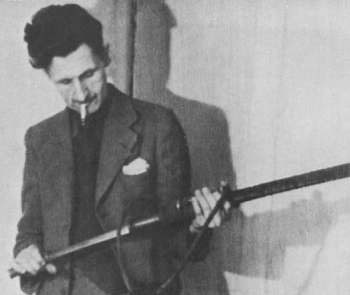
Witold Gombrowicz by Bohdan Paczowski - detail.jpg

The Paris Review  has in its current edition a very short story by Witold Gombrowicz, the greatest modernist, translated for the first time to English, by Tul’si Bhambry. They were also kind enough to put it online for us cheapos.

It’s more of a ridiculous and minor tragedy than a great introduction to his works, but it does manage to touch upon some of his big themes: the way outside perception shapes and molds how we perceive ourselves, and the way we perceive that outside perception, and how our personalities are molded by a million competing pressures. Like in much of Gombrowicz, the physical appearance of the perceived changes, although in this case it is more a direct action rather than some kind of metaphysical mutation.

His work hits on a lot more themes, of course, and the tragedy of Polish history is always just around the corner, even though, as has been said of him, he might be the only major Polish writer of the 20th century whose themes weren’t explicitly Poland.  If you want a very basic summation, he is a comic writer whose ideas revolve around the crushing weight of being alive and aware in an absurd century. His books are uproariously funny and bizarre, terrifying and grotesque, with wild loops of language and phrases that take on a heightened tone of terror through repetition, as if they were in front of a mirror that bends at stretches in impossible contortions. The power of language is a driving obsession as well- the actual transformative power, as it ties in with the awareness that all we are is a collection of ideas about ourselves in the shape of words. But what happens if other people can control those words? If they start saying that you are a child, and everyone believes it, do you transform?

If you want a starting novel, his masterpiece is probably Ferdydurkewhich as I understand is just as much a nonsense word in Polish as it is in English. I would probably actually start, though, with the stories collected in BacacayIt is a great introduction to his ideas, and some of the scenes in the collection are adapted in other novels. Really, you can’t go wrong with anything.

However, his three-volume Diary is, in my mind, one of the great achievements of writing in the last century. Self-obsessed, at times impossibly narcissistic, with wild flights of fantasy, a keen look into the artistic experience, an exploration of the themes that obsessed him, a view of ex-pat life in South America, grudges, loves, creations, mythologies, allusions and illusions. It’s not just a view of a great writer: it is like immersing yourself in writing itself.

ACLU Interview

I mentioned in the post below the Andrew Cohen Atlantic interview with Jameel Jaffar and Brett Max Kaufman of the ACLU, but want to make sure that you are reading it.  It is a very clear and cohesive message of what citizens should not tolerate, and well as a steady-handed evisceration of people who think there is much daylight on this issue between George W. Bush and Barack Obama.    This last part, I think, is hugely important, but do read the whole thing.  (Disclosure: Brett is a good friend of mine.  I’d be interested in this anyway, but even more so when it is delivered so handsomely!)

Anything else you think is important?

In his recent speech at National Defense University, President Obama made a compelling case for the democratic necessity of bringing the nation’s wartime approach to terrorist threats to an end. That necessity applies with equal force in the context of domestic surveillance. Just as President Obama belatedly acknowledged the long-term consequences of short-sighted policies governing the use of drones and other lethal force abroad, there are creeping but grave consequences to a democracy that surrenders its liberties one phone call at a time. Nobody chooses to live in a surveillance state, but a malfunctioning democracy can produce one. Restoring constitutional dignities to their historically privileged role in our system is the best way to defend it.

Don’t worry, Rand- the ACLU’s got this

Friend of the blog and my good buddy Brett Max Kaufman of the ACLU’s National Security Project has an excellent summation of what the ACLU is doing about the NSA, Prism, etc (they are also doing a lot of work on drones and extra-judicial killings).   The ACLU has a personal stake in this too, as Brett explains

The ACLU’s complaint filed today explains that the dragnet surveillance the government is carrying out under Section 215 infringes upon the ACLU’s First Amendment rights, including the twin liberties of free expression and free association. The nature of the ACLU’s work—in areas like access to reproductive services, racial discrimination, the rights of immigrants, national security, and more—means that many of the people who call the ACLU wish to keep their contact with the organization confidential. Yet if the government is collecting a vast trove of ACLU phone records—and it has reportedly been doing so for as long as seven years—many people may reasonably think twice before communicating with us.

One thing I really like is the right of free association.  Obviously- who doesn’t like that right?  But I think it is very clever of the ACLU to be using it.   We live in an age where so many meetings of any type are no longer done face-to-face.  Thinking that there could be a mole in every conversation dampens our ability to speak as political animals.  The argument that it doesn’t matter if you aren’t doing anything wrong doesn’t hold water.  For one thing, we don’t always know who decides what is right.  But on a more basic level, conversation shouldn’t be hampered by the fear of speaking correctly or the terror or being misinterpreted.

I also want to take a moment here to praise the ACLU.  For decades they’ve been a punching bag on the right, despite their firm commitment to Constitutional principles.  There are few bigger applause lines for a Republican politician than to sneer “ACLU” to a crowd.   So it must be somewhat gratifying for them to see that, suddenly, with Obama in charge, Republicans are concerned about the national security state.  The ACLU has been on this for a long time.  They filed lawsuits against George Bush, and were pilloried for it, held up (again) as traitors, commies, terrorist-lovers, un-American, etc.  Now the right has found some common cause, albeit in a cynical matter.  But I would ask them this: just remember you are late to the party.  You are welcome, but be decent enough to find a quiet corner and don’t pretend that you invited everyone, and for god’s sake, don’t insult your hosts.   They’ve been here the whole time.