Good Books Friday: The Rivers of America Series

Note: I’ll be out of town between the 4th and the 15th, in a wilderness repast, with little to absolutely zero connection to the internet or my phone. Posts during this time, written in advance, will be bigger-picture, or more idiosyncratic, rather than directly pegged to the news. If events happen that supersede or negate anything I say, think of these as a more innocent time capsule. Try not to let the country burn down while I’m gone.

A few years ago I was doing a periodic dive into Chicago history, as will frequently happen, and was perusing the relevant section at the local library. Over the preceding few years, I had gotten more and more interested in Chicago as a city built on a lake and river, which we all know, but tend to take for granted. While Chicago is a major port city, for most residents, that takes places completely out of sight. The river and the jawdropping lakefront are for recreation and beauty; they are no longer the economic engine.

So an old book called “The Chicago” caught my eye. It was plain blue, no jacket, but you could tell it was going to have that musty and delicious old book smell, with pages that hadn’t taken a breath in years, if not decades. It was by an author named Harry Hansen, and not knowing too much about it, I put it on the pile. How bad could it be?

It turned out to be a thing of wonder. Hansen was an old-time Chicago journalist, originally from Iowa, who loved the city but looked at it skeptically. The book blended history and the present- or, rather, Hansen’s present, as it came out in 1942, but was clearly written before the outbreak of war. He took us up and down the still dirty and gritty river, which still had grimy industrial buildings and warehouses and factories on most of its grim banks.

But he also took the reader through time. He had the history of exploration, the Kinzies and Du Sable, and the earlier French explorers who found the portage. It was amazing to read, as he’d talk about a place at, say the 31st and Western, on the south branch, and talk about what was there when he had come to the city some 40 years beforehand, when the smoke from the fire could still be detected in memory and the city had yet to celebrate its first century. And, reading it some 80 years later, both waves of history have been lapped, but both are still present in any given spot.

This journey, it turned out, was part of the Rivers of America series, a huge, sprawling, ambitious piece of Americana that spanned nearly 40 years and three publishers. The idea was to tell the history of America through its rivers, those first highways, along which all cities were built. It is a 50-book series, with the first being The Kennebec in 1937, and the final one The American  in 1974. It’s also instructive to think of how much America itself changed over the years. The series takes you from Panama to Alaska, and from Maine to California. It is, fully, American. (Towns End Books and Wikipedia have complete lists)

Continue reading

Throwback Thursday: The CIA and The Killing of Dag Hammarskjold


If this man was killed by the CIA it’s a really big deal, or at least it should be. 


Here’s today’s must-read: Foreign Policy‘s Colum Lynch on the UN reopening an investigation into the Congolese plane crash that killed heroic UN Secretary-General Dag Hammarskjold in 1961. If you want to understand what the early 60s were actually like for actually oppressed people, the opening paragraph has a lot of pretty important keywords.

U.N. Secretary-General Ban Ki­-moon will propose reopening an inquiry into allegations that Dag Hammarskjold, one of the most revered secretaries-general in the organization’s history, was assassinated by an apartheid-era South African paramilitary organization that was backed by the CIA, British intelligence, and a Belgian mining company, according to several officials familiar with the case.

Christ. That’s a rogue’s gallery right there. Basically, in a nutshell, Hammarskjold was working for Congolese independence and security, and try to broker a treaty between the government of the new Congo and the separatists in uranium-rich Katanga, who were backed by the Belgians and other western powers to make sure that the Soviets stayed away (and let’s be honest: to make sure that other riches continued to flow into the right pockets). Hammarskjold believed that the Congo should be one independent nation, and not carved up by colonialists.

Continue reading

Cool Stuff if You Like Chicago, Or Labor History, Or Just Cool Old Stuff

And who doesn’t?


The Chicago River is very pleasant now. That…that wasn’t always the case. 


It’s often remarked that Chicago doesn’t make anything anymore. The city, in addition to being the “hog butcher to the world” and lumber hub between east and west, was throughout its history a major industrial city, drawing workers from around the world to its factories and warehouse, creation dotting the riverfront and radiating into the neighborhoods. Now we’re more known for finance and startups and the normal “transforming city” type businesses. And that’s fine. It’s imperfect, and even cruel, as the city’s new wealth is incredibly uneven. But to say that Chicago is not better off than it was in the 1970s and 1980s, after old man Daley did everything he could to keep Chicago from adjusting to new realities, would be a lie.

That said, there does feel like something has been lost. Into that void comes the Made In Chicago Museum, a new site exploring the things that Chicago used to make. Full disclosure: the site’s creator and collector, Andrew Clayman, is a very good friend of mine, who introduced me to my wife, and who is the best damn shortstop a softball pitcher could hope to have behind him. But I’m promoting this because it is awesome. My friends do a lot of stupid shit that I never write about. It’s a celebration of industry, both high and low, from the most useful to the most ephemeral and whimsical.

Even that stuff, though, stands out because it is long-lasting.  Clayman doesn’t just collect and take pictures of old ice skates, clocks, scales, tins, and other gee-gaws and doo-dads. He celebrates a history of manufacturing. On each page there is a history of the company tht made these items, and as much as possible, the people that worked there.

Let’s take this Ice Skater Sharpener, made by FW Planert and Sons in 1910.

Patented in 1910, this metal clamping device was used to keep an ice skate secure while its blade was sharpened. The manufacturer, F.W. Planert & Sons, was one of the “The Big 3” in the Chicago-dominated ice skate industry of the early 20th century. The other two, family rivals Nestor Johnson and Alfred Johnson, were also headquartered on the Northwest side.

Did you know that Chicago used to dominate the ice-skating industry? Or that there was rivalrous Big 3? I certainly didn’t! Throughout the piece, Clayman talks about Planert, his business, and the people that worked there. He’s dug up archival pictures from newspapers, because, throughout the life of a city, nearly everything has been covered.

One of the cooler parts is that for every manufacturing plant, he tells what is there now (in the case of Planert, it is the trendy Cotton Duck, a restaurant in the extremely hip and foodie-oriented Ukranian Village neighborhood.

It’s sort of elegiac. I’m old enough to remember when Ukranian Village felt sort of rough. It wasn’t, but comparable to the neighborhoods we usually hung out in, it had some hard edges that gave you a glimpsed hint of the city before the great transformations of the 90s and 2000s, of the hard city of Algren and Terkel. Even now, the huge gilded churches remind you that the neighborhood has a history, that it isn’t just a name, that it is where an ethnic group found comfort and solace and work in a new and confusing country.

That works has faded, and the neighborhood is entirely disconnected from the idea of being “Ukranian” in any real sense. Most residents probably barely connect it with the Ukraine, the place. It’s just a name. And that’s fine: cities change. The toil that consumed lives fades into blurry pictures and hardly-understood designations. Factories that defined whole existences become transient restaurants waiting for the next food trend to shut them down.

Into that comes Clayman’s project, which reminds us that these neighborhoods, these streets, these cities, and yes, these anachronistic and old-looking products were all created by people, who devoted some or all of their one short and difficult live to make them. It isn’t romantic; these were hard lives. But they were real lives. There is a weight on every page, a lived weight, which in its own way is a cry against the weightless nature of our new disconnected economy.


Michael Hayden Tells His Side

Penguin Press

In the August/September issue of Reason, Brett Max Kaufman of the ACLU (and of the most alternately triumphant and nervous fanbase in sports) reviews Playing to the Edge, Michael Hayden’s apologia for the post-9/11 security state, and why he would do everything he was able to do to protect us.

But it is not a good sign when your memoir’s central metaphor breaks down in the foreword. Hayden’s conceit is that those who run intelligence have a duty to “us[e] all the tools and all the authorities available, much like how a good athlete takes advantage of the entire playing field right up to the sideline markers and endlines”—the edge. As he’s said elsewhere (he’s been on this kick for nearly a decade), “Playing back from the line protected me but didn’t protect America. I made it clear I would always play in fair territory, but that there would be chalk dust on my cleats.”

The first problem is that if you get chalk on your cleats, it means you’re out of bounds. (Or at least you are in football, Hayden’s obvious inspiration.) That this has apparently gone unremarked to Hayden over the years—even by Dan Rooney, the owner of Hayden’s hometown Pittsburgh Steelers and Hayden’s high school football coach, with whom he watches too many Super Bowls in this book to count—is notable in itself. That it goes entirely unexamined in the book’s numerous invocations of the image is, alas, characteristic.

Worse still is that “taking advantage of the entire playing field” is a pretty odd way to describe the main thing that good athletes do. Of course, spraying one down the right-field line or throwing it deep and wide can sometimes help the team. But they are hardly required to win the game. Hayden never bothers to explain why pushing it to the edge is a main point of his duty as a public servant. Like so much in the book, it is simply assumed that people of good faith will agree.

That’s sort of the whole ballgame: we know what’s best, and you don’t. There is a “trust” factor in intelligence that assumes a one-way relationship. While no state wants entirely transparent intelligence, it is assumed that America should have the same level of secrecy, and the same dom-sub relationship with our intelligence forces, as the most fly-bitten police state in the world. It’s an argument that sounds persuasive on the surface, but can and should be taken easily apart.

Brett, who is one of the best at crafting an argument that is both forceful and legally exacting (sort of a hyperlogical polemicist, employing the best of both world), is the right man to tear it apart.

Karen’s Greenberg’s “Rogue Justice” Review

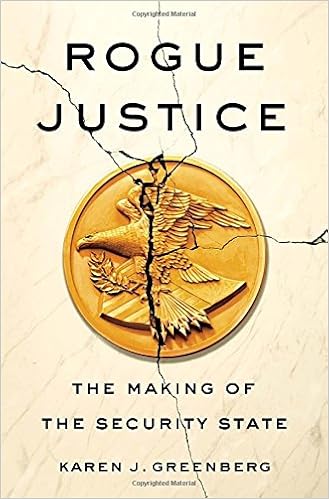
The fine folks at Just Security were kind enough to ask me to review Karen Greenberg’s excellent Rogue Justice, about how we transformed into a security state following 9/11. It’s a great read, and persuasively argued (the book, not my review). One of her key insights, beside the great reporting, is that the decisions made after the attacks fundmentally changed our relationship with the government, in ways we didn’t realize, and that I think will affect the national character for decades.

I’ll have more on the book later on, a few longer essays on some of the themes. In the meantime, here’s the review. Thanks to Just Security, especially for keeping the Huck Finn theme throughout.


This complicity came from careerists worried about rocking the boat, politicians in both parties worried about being painted as weak on terror (with notable and noble exceptions), and to an uncomfortable extent, the general public. The terrorist attacks in 2001 made everyone realize that anyone could be a target, but we didn’t see — or didn’t want to see — that in a very real way, we also became a target of the government. Many of the policies enacted in the wake of 9/11 made everyone a suspect as much as a target. Through official secrecy aided by general indifference, we allowed ourselves to be passively dragooned into being on both sides of a war.

The Borges Retrospective: Borges the Film Critic

The Borges Retrospective:

To make the claim that Borges is well-read is like walking up to a stranger, preparing to brandish your dueling gloves, and proclaiming that water is wet. His vast and endless erudition is, along with his blindness and fascination with Angl-Saxon lore, one of those most striking things about him. There seems to have been little he hadn’t read, and little he didn’t remember. Even after blindness overcame him, he still had the library in his head, and if he didn’t recall a line exactly, could get someone to read it to him by remembering the book, and where it was located on his vast shelves (Hitchens, who has written many times and movingly about meeting Borges, spoke in Hitch-22 about having the honor of reading to him).

(Sidenote: one of the limitation of this series is not being able to talk about everything, so I do want to share his quote on blindness, from “The Other”, in which the old Borges meets his younger self. “When you reach my age, you’ll have almost totally lost your eyesight. You’ll be able to see the color yellow, and light and shadow. But don’t worry. Gradual blindness is not tragic. It’s like the slowly growing darkness of a summer evening.” Has a more beautiful and aching line about the enveloping process of decay ever been written?)

So, given his incredible range of reading, it stands to reason that he’d be a fine literary critic, being able to weave the vast tapestry of the human story into all his writing. What might strike readers as surprising is his proficiency as a film critic in the early days of cinema, as silent movies turned into talkies, and as the medium grew up. It is hard to imagine him as taking time away from his books, but he did, and often. I confess it delights me to imagine the young Borges, sitting in a darkened theater, in the cool the juxtaposes the Buenos Aries summer, head filled with ancient myths and knife-fights, and watching a giant ape palm a screaming blond.

Continue reading

The Borges Retrospective: “The Secret Miracle”

The Borges Retrospective: Part I: Intro.  (I know I said we’d begin with “The Aleph”, but how stupid a thought is that? We’ll end at the Aleph. We were always going to end at the Aleph.)


The great genuis


Think first of the carpenter who picks up a plank, and lays it perpendicular on another one. With careful skill and a substantial brutality, he hammers a cross, setting in motion thousands of years of ecstasy and pain. He unwittingly, doing a job, lays the groundwork for Pere Brébeuf ‘s agony at the roasting pole, and Kateri Tekawitha’s sublime conversion. He sets into motion dramas in lands which he could never imagine.

Think then of the builder who attaches a wooden mane on a great horse, which bears in its womb countless Greeks with a berserk desire for murder. These are the creators of our great dreams, and our great dramas. They build the stage on which we tell our tales. But in one of the greatest stories Borges ever tells, he steps back, and tells the tale not of our great builders, or our blood-covered warriors, but of a man who fell victim to Hannibal, to the Druidic gods, to the madness of Hitler. In “The Secret Miracle”, he tells the story of creation, the story of telling our stories, and makes it more sad and more heroic than any of the great tales.

Continue reading

Tigers and Mirrors and Labyrinths: Borges 30 Years After His Death


(oddly fitting accompaniment to post)

30 years ago, on June 14th, 1986, in Geneva, Jorge Luis Borges slipped into one of his own infinite labyrinths, that terrifying maze without a center: death. The Argentine, one of the great writers of the century whose timespan he almost matched, was just shy of his 87th birthday. On his deathbed, one wonders, did he dream of walking on a riverbank, and coming across his younger self, and talking about the great mystery into which he was entering, treating his death as gently banal, and quoting Chesterton or an obscure Arabic medievalist? And did the younger self somehow have the same dream, that same night?

With Borges, such questions make sense. They are a reflection of his fiction, that great body of short stories, fragments of invented books, reviews of imaginary essays, tattered journals from explorers who never existed wandering lands that fall in the gap between myth and reality. They are tales of gauchos on the pampas and knife fights in dingy bars and Homer being found in the city of the immortals. They are about buying the memory of Shakespeare or seeing the tigers that inspired poets.

And they are about time. They deal with the way history repeats itself, with the same stories playing out time and again, in Greek corridors or South American battlefields. As he said, “It also occurred to him that throughout history, humankind has told two stories: the story of a lost ship sailing the Mediterranean seas in quest of a beloved isle, and the story of a god who allows himself to be crucified on Golgotha.”

Continue reading

Why People Kill: Scott Atran’s “Devoted Actor” Model and Its Critics

atran

Scott Atran image from jjay.cuny.edu

In his first show back after the attacks of September 11th, David Letterman gave a searing and moving monologue, in which he asked a question, simply and bluntly, that had been on many of our minds. (transcript from Crooked Timber).

As I understand it (and my understanding of this is vague at best), another smaller group of people stole some airplanes and crashed them into buildings. And we’re told that they were zealots, fueled by religious fervor… religious fervor. And if you live to be a thousand years old, will that make any sense to you? Will that make any Goddamned sense?

For most of us, the answer was, simply, no. Even for many of us who had studied Islam and terrorism, and had some reasons, and were able to dimly weave analysis in a vain attempt to comfort ourselves or others, the fundamental question of “why”, was unanswerable, because it tied into the “how”. How, exactly, could a person sprint toward self-abnegation? What was going through their mind as they made that long, sickening turn into the buildings?

That wasn’t the first example of suicide bombing, obviously- it was a tactic that we knew from WWII, and was prevalent in other parts of the Middle East, and especially (though barely remarked upon) in Sri Lanka, by the Tamil Tigers. Suicide attacks are different than the willingness to die you see in many soldiers. They are even different from “suicide missions”, like in The Dirty Dozen (which I know is fiction), or other seemingly hopeless situations. Because the goal in those is still, in a way, survival. It’s not the only goal, but nor is its opposite. When looking at it as a semi-global phenomenon, from Sri Lanka to Japan in the 40s (although that was a late-war tactic, and not used that much) to the modern Middle East, we see that it is widespread, but that only makes it more mystifying, not less.

One of the people trying to explain this is Scott Atran, whose remarkable book, Talking to the Enemy, does exactly that: interviews with radicals and burgeoning jihadists, in the Maghreb and the slums of Europe, to find out why they want to fight and kill, and why they are willing to die.

Recently, Atran, along with Hammad Sheik and Angel Gomez, released a paper for Current Anthropology that hones in on the theory of why, which they call the “Devoted Actor Model“.  Here is from the abstract:

This report presents two studies in very different contexts that provide convergent empirical evidence for the “devoted actor” hypothesis: people will become willing to protect nonnegotiable sacred values through costly sacrifice and extreme actions when such values are associated with groups whose individual members fuse into a unique collective identity.

I think this makes sense. Basically, what they are saying is that group pressures and loyalties can tighten under extreme circumstances, especially when the idea of identity is at stake. Atran’s work has largely revolved around this idea of group bonding, and group identity, and how the willingness to subsume your identity into a higher cause. This is prevalent among people who feel like they want to be part of something bigger because what they have is small, based not so much on poverty, but on humiliation (in the slums of Europe or the occupied and broken territories of the Middle East) and a sense of historical wrongness, heightened by group-based reinforcement. This focus on group identity has allowed others to misinterpret his works, I think. A recent excellent article on Atran by Tom Bartlett in the Chronicle of Higher Education talks about some of the critics of his theories, who seem a little prone to hysterics.

With prominence comes criticism, and Atran has suffered his share. Sam Harris fired the most personal broadside after listening to a lecture by Atran. Harris, a neuroscientist known for his advocacy of atheism, deemed Atran “preening and delusional” and wrote that his views were evidence of either “mental illness or a terminal case of intellectual dishonesty.” Per Harris, Atran believes that Islamic extremists who blow themselves up do so “not because of their deeply held beliefs about jihad and martyrdom but because of their experience of male bonding in soccer clubs and barbershops.”

Equally dismissive is Jerry Coyne, a professor of biology at the University of Chicago, famous these days as a thunderous ridiculer of religion. In a blog post titled “Once again, Scott Atran exculpates religion as a cause of terrorism,” he quotes the following remarks by Atran: “[W]hat inspires the most uncompromisingly lethal actors in the world today is not so much the Qur’an or religious teachings. It’s a thrilling cause that promises glory and esteem.” Coyne then addresses Atran directly, caps-lock on to drive the point home: “WHAT WOULD IT TAKETO MAKE YOU ASCRIBE ANY OF THEIR ACTIONS TO ISLAM?”

In many ways, these criticisms are the perfect mirror to our degraded political culture, in which the President is pilloried for not saying “Islamic terrorism” even as he bombs half the known world. It’s very easy to say “it’s because of Islam!”, but while that is true in the proximate sense- and is a clear sickness in much of the Islamic world- that still doesn’t actually explain why. It just sounds like truth-telling, a chest-thumping bullying through any pusillanimous nonsense, when in reality it doesn’t get us any closer to the truth of why people kill. There are a billion Muslims in the world. There aren’t a billion suicide bombers. And it doesn’t explain why Tamils were willing to do the same.

That’s what makes Atran’s work so valuable. He certainly doesn’t actually shy away from the reality of Islam, but he asks what it is that makes these people do this right now. There’s nothing inherent in Islam that commands suicide vests (as the Chronicle article shows, Kurds abhor the idea). Nor is there anything inherent in an occupied people that make them go to such moral extremes. So why in this time and place is there an epidemic of people willing to kill themselves for Islam? What social pressures lead someone into this? What about the modern Middle East, and Europe– not to mention Western China, Central Asia, and other places? (I know that the last two are not indistinct, but still.)

I think work like this is extremely valuable, if we really want to understand the reason why we’re in these wars, personified most gruesomely and atavistically by ISIS. If you want, you can say the somewhat relevant, but still fairly facile statement which is that people are willing to kill themselves because Islam, or whatever is passing for it in certain quarters, is telling them to. That’s true. The real important question then is why do some people listen? Understanding that is the whole ballgame.

Recommended Summer Read: Masters of Empire, by Michael McDonnell

51rjmg1ovvl-_sx332_bo1204203200_

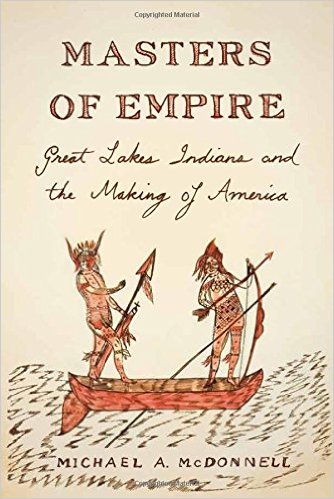
Masters of Empire: Great Lakes Indians and the Making of America, but Michael A. McDonnell

(Buy here)

It must be strange, one would think, to be a background player in your own destruction. But that’s how we understand the great historical clash between Europeans and natives in the Americas- with the exception of some battles, like Pontiac’s Rebellion (and what a loaded word “rebellion” is, implying that he was rising up against some sort of rightful order), or the Nez Perce War, the history is one of dominance versus submission. And to be sure, the Europeans dominated, and eventually destroyed the natives, whether they were in the form of the Spanish, the French, the English, or the Americans.

But that’s far from the whole story. In Masters of Empire, Michael McDonnell, an Australian scholar who has written several books on American history, takes the story from another point of view, one that is far more accurate. This isn’t a “from the Indians’ point of view” story, which is important, but rather he demonstrates how local concerns,  rivalries, and politics weren’t so much shaped by the arrival of Europeans, but how they shaped the formation of empires.

This is a very useful corrective. Using primary, at-the-time sources, McDonnell tells the story of how most of European policy was built around placating the original inhabitants in order to further trade (here it’s important to note that while there was cruelty, enslavement, misplaced moral righteousness, and callous indifference, a policy of extermination didn’t come around in America until it became, well, America). This is a different story than we’re familiar with.

McDonnell skillfully demonstrates how much Great Lakes tribes, especially the Anishinaabeg, who centered around Michilimackinac, played the English and French against each other, making demands, declaring war, rallying troops to fight for or against one side or the other, and generally making themselves indispensable. They were a partner that had to be placated, not a rival to be fought, or worse, a submissive people to be destroyed.

In one of the book’s key elucidations, he demonstrates how the French taking sides in the Anishinaabeg rivalry with the Iroquois, and the English taking the other, was the beginning of the Seven Years War, the first battle of which he positions as the Raid on Pickawillany in Ohio, which was part of an inter-tribal war. The Seven Years War reshaped empire, and the world, and helped create the conditions that led to America. We called the front of that war here the “French and Indian War”, but McDonnell has none of that, rightfully relabeling the conflicts as The First and Second Anglo-Indian Wars.

(Throughout the book, McDonnell uses “Indian” instead of “Native American”, which might make some readers uncomfortable, but I think is more correct. I loathe “Native American”, because it implies a paternalistic adoption after forced extirpation. It basically says “Don’t think of it as America destroying your ancient way of life. You were really Americans all along, and just didn’t know it! You’re welcome!” Indian, obviously, has its problems, but at least it gives some agency.)

This isn’t revisionist history, either. This is how the wars and the policies were seen at the time, by the people living them. The whole history of Europeans on the continent was about managing their relations with the natives, who were skilled politicians, and knew how to get what they wanted in the face of overwhelming military superiority and disease-borne apocalypses.

It’s a great read, and shows how the tribal structure worked, and how lines of kinship influence politics and culture. It’s a powerful look at the Great Lakes during the dawn of the Europeans, and one can imagine the locals, with their intimate knowledge of these great and fearful bodies of water, and the rivers that feed them, shepherding frightened and lost Europeans around. You can get a sense of what the region was like before lines were drawn to signify borders, where activity was centered around the water and hunting grounds.

Indeed, the map shows a pre-state (in the national, not just the “great state of Mississippi!” sense) Great Lakes region, stretching on one end to the St. Lawrence and the Atlantic and the other up through Lake Winnipeg and on to the Hudson Bay. This is how the world was, then, before lines of demarcations chopped it up. It was a world before our obsession with borders shifted the axis, and before we decided that some people were Natives, instead of just, well, natives. It’s a world that had a narrative forced upon it, changing its history ex post facto. McDonnell’s book is a great corrective for that. It shows that these were people, who frequently bent London and Paris to their wills. Their actions shaped the world we live in now, as much as we destroyed theirs.