Better the Infidel Than The Apostate: Medina Bombings and the ISIS Endgame

1cda2d4558af4f23acb0ec1e06156ac6_18

Saudi Press Agency/EPA

It’s been a particularly bloody week in ISIS’s history of violence. Since Tuesday, we’ve seen an attack on Ataturk Airport in Istanbul, a slaughter in Bangladesh that was carried out by radicalized elites, an apocalyptic bombing in Baghdad that was mostly overlooked, and the suicide bombings in Saudi Arabia, including near the Prophet’s Tomb in Medina, Islam’s second-holiest city. As of this writing, ISIS has yet to claim responsibility for the Medina bombings, which means it may not have been an attack planned by ISIS, but rather one “just” inspired by it. However, the wave of bombings throughout Saudi Arabia is indicative of some coordination.

This has led, understandably, to a lot of talk about the next phase of ISIS. Speaking to the CFR last week, John Brennan  “warned that the trajectories for the ISIS religious state, or caliphate, and global violence point in opposite directions. ‘As the pressure mounts on ISIL,” he said, “we judge that it will intensify its global terror campaign to maintain its dominance of the global terrorism agenda.'” The headline to the Times piece linked above captures most of the analysis: “As ISIS Loses Land, It Gains Ground In Overseas Terror.”

I think this is largely true. There’s no doubt that they are doubling down on large-scale overseas attacks, and are mutating to the point where it is hard to say what ISIS even is: is it caliphate-based and centrally-coordinated like pre-9/11 al-Qaeda, or is it franchised out, like Qaeda starting in the middle of last decade? Or, perhaps more frightening, is it just a particularly carnage-based idea?

I think it is the latter, which is why I think we’re seeing the endgame of what ISIS has been. Note that endgame doesn’t mean the world is particularly close to defeating ISIS, mostly because I don’t think “defeating” is even possible. It’s a generational battle to have the ideology be discredited and to have them stop serving as an inspiration for those who feel that life should be offering more.

Because that is what they do: they offer a sense of greatness in a world that seems to have lost its moorings. This doesn’t mean that they only appeal to the poor and dispossessed; if the last 100 years have taught us anything, it is that the truly scary people are the ones who are comfortable and feel guilty about it, or feel that they shouldn’t be comfortable, but be truly great. Think of the middling student who reads Ayn Rand and begins to believe that his relative failure is due to a conspiracy of the weak. That’s the mindset.

That’s why these attacks, during Ramadan, are so important to ISIS, but also represent their eventual breaking apart. Going after Medina, and attacking largely Muslims (the Bangladesh attack partially notwithstanding) is key to their success. That’s how they attract the truly dispossessed, because they further cut up the world, slicing belief into an ever-narrower portion. It’s exciting to say that, yes, the Turks are Muslims, but bad ones. I mean, Ataturk should pay, symbolically, for being secular. It’s thrilling to say that bombing Baghdad is the blood price that has to be paid for a more just world. It’s radical and dangerous to attack the holy cities. That’s the kind of sick passion that inspires people into being radicalized: the idea that they are the most committed. It makes up for a lifetime of drifting, even if (especially if) that lifetime is only 19 or 20 years. A wasted year or two seems longer to the young, and a certain kind of mindset wants to rectify that through absolute purity.

(It’s important to remember that in many ways the modern radical Islamic movement wasn’t kicked off by the Iranian revolution, which was more concurrent, or even by the Soviet invasion of Afghanistan, but by the seizure of the Grand Mosque in Mecca, also in 1979. It’s weirdly a footnote now, but this audacious attack on the corrupt monarchy was inspirational to the future leaders of al-Qaeda.)

Why this represents their eventual breaking apart, though, is the same reason any revolutionary group ends up either coalescing into an actual political entity (Hezbollah) or burning itself out (Zarqawi’s al-Qaeda). The need to up the ante constantly, to keep swimming, means that you’ll alienate more people than you attract. The entire Muslim world seems to be speaking out against the Medina attacks.  The well from which they draw their legitimacy- the well of violence- is the one that will eventually poison them, and they’ll discredit themselves.

It’s a long and uphill battle, and whether through direct coordination or through inspiration, it’s one in which we’re all on the undrafted frontline. As they break apart, and as the slowly lose militarily (and don’t expect progress here to be a straight line), they’ll increase these attacks in an attempt to maintain primacy. It’s no comfort to the dead that this will also be their downfall.

Breaking! Benghazi Was Dangerous Nonsense, Designed to Further Iraq Amnesia

trey-gowdy-e1444225754116

“Now, I may just be a simple southern lawyer…”

What happened at Benghazi on the night of September 11th, 2012, was a tragedy, one borne of the impossible gravitational pull the Middle East has on US politics, an inability not to intervene. There were errors and mistakes, confusion in the fog of a new kind of war, one in which soldiers and civilians dance across a blurred line, and one that the US has not yet learned to fight. Four men, who were dedicated to making the world a better place– to making a land that was not their home a freer and more just place, after the grotesque misrule of Qadaffi– died that terrible night.

What it was not was a political scandal. I’ve been following politics since, at the age of 5, I tried to convince my parents that Mondale was a better choice than Reagan (and I was right, goddammit). Even counting the impeachement trial, and even counting Reagan’s lack of impeachment for Iran/Contra, I don’t know if I’ve ever seen an exercise in politics so cynical, so craven, and so full of errant hypocritical nonsense. The proof?

Ending one of the longest, costliest and most bitterly partisan congressional investigations in history, the House Select Committee on Benghazi issued itsfinal report on Tuesday, finding no new evidence of culpability or wrongdoing by Hillary Clinton in the 2012 attacks in Libya that left four Americans dead.

It’s hard to imagine anything more outrageous than some of the top cheerleaders for the war in Iraq suddenly being brought to tearful anger over the pointless loss of American lives in the Middle East. These men and women gave high-flung flag-drowned speeches about the bravery of Chris Stevens and the other three, and how Obama, (and then Hillary, once it became clear she was running) betrayed that bravery. Suddenly, US lives, slaughtered in a distant land, meant something. Many of these were the same people who objected vociferously, with insinuations of fifth-column perfidy, at showing soldiers’ coffins arriving at Andrews. But these corpses had to be dragged to the roof, rattled by hoarse screaming and soaked in crocodile tears.

Not for nothing, but I think the Venn diagram of “thinks it was tragic what happened in Libya” and “angry at Obama for not invading Syria” has a lot of overlap.

What do these people think will happen? What do they think is the price of intervening around the world?

The answer is they really don’t think about it at all. In a way, I don’t even think this was purposefully cynical, for some of them. They are so hardwired to believe whatever is the most talk-radiofied nonsense possible that they probably honestly think being misleading on a Sunday show after the fact is a capital crime. I know anecdotal Facebook posts are the worst kind of analysis, but I saw people who were asking if this was the “biggest scandal in American history. After all, no one died at Watergate.” The representatives, who have the same sources of misinformation, are little different. Some are cynics. Many are just slickly-packaged balls of hippie-punching anger and cognitive dissonance.

That doesn’t make it better, nor does it excuse the horrible outcome of their actions. Because while it seems that this craven exercise in nonsense is just pointless, it is much worse. Not because it hurt Hillary vis a vis Trump, although it might have. But the cynicism and anger matters.

As the Times said, this investigation took longer and cost more than Congressional investigations in 9/11, into Katrina, into Pearl Harbor, into the freaking assassination of JFK, and certainly than into the colossal lies and idiocy that led us not just into Iraq, but that led to such a bloody disaster.

That matters. It’s an attempt to erase history, to put up such a wall of bullshit over the single greatest US foreign policy disaster of my lifetime, and possibly in US history, given the enveloping chaos that spread over the region in the wake of the invasion (the impact of which can be felt as far away as the Brexit). It’s all part of what Pierce calls “the great mulligan”, the idea that US history restarted on Jan 20th, 2009, and everything that happened afterwards is the fault of Obama.

It’s how craven warhounds like John McCain can say that, in Iraq, Obama “snatched defeat from the jaws of victory.” Because having a country that is so unstable that the only way to prevent its collapse is to keep and indefinite number of troops there an indefinite length of time is, certainly, to be considered a victory. But the facts don’t matter. All that matters is to throw up a smokescreen, pinning all the blame on Obama, the one politician who learned (belatedly, and even then only partially) to resist the Middle East.

That the investigation took so long and turned up so, so little wasn’t a bug. It was a feature. It was the goddamn point. The point was to throw up an impenetrable barrage of lies so thick that we couldn’t see back beyond 2009, couldn’t peer into the wreckage of the early millennium. It’s part of the collective amnesia that the right has been trying, with much success, to inflict on us for almost eight years. They’ve been beating us over the head until we’re too numb to fight back. They know that Benghazi, for impossible and insane reasons, has more political resonance than Iraq. We’re to Never Forget what happened in Libya, and never speak of 2003.

Chaos In London Suggests That Maybe Listening to The Dumb Is A Bad Idea?

Maybe don’t listen to people like this?

Bad political chaos in London today, as the pound continues to plunge, and Leave leaders continue to backpeddle on the bill of goods they sold to the public. It makes one think: maybe fearful race-baiting demagogues who promise great things in exchange for opting out of the modern world maybe shouldn’t be listened to?

Remember, one of the Leave leaders, Michael Gove, said that people in Great Britain “have had enough of experts”, i.e. the people saying that Brexit would be a disaster. Does this sound familiar?

Like Mr Cameron, Mr Gove faced intense scrutiny of his campaign tactics, in particular the claim that the UK sends £350m to the EU every week.

Sky’s political editor Faisal Islam said Mr Gove knew that figure was wrong, and accused him of importing the “post-truth” politics of Donald Trump to the UK. The UK Statistics Authority has said the figure “is misleading and undermines trust in official statistics”, because it is a gross sum and does not account for Britain’s rebate and funding received from the EU. In response to Mr Islam, Mr Gove agreed to have the figure independently audited.

A number of economists do favour Britain’s exit from the EU, among them Andrew Lilico, executive director of Europe Economics, and Patrick Minford of Cardiff University.

Mr Gove opted not to name them, however, preferring to focus on how economists and economic organisations had failed to predict the financial crisis. “I’m not asking the public to trust me. I’m asking them to trust themselves,” he said.

That could easily be Trump, as could Boris Johnson’s and Nigel Farage’s idiot claims that the 350 million pounds per week could go to the NHS, a claim from which they are already saying that they didn’t mean literally. Who could be so preposterous as to hold them to that, now?

The Right in America has long held the same weaponized hatreds of experts who challenge their sacred beliefs, and have been able to turn a reliance on boring stats and figures against opponents who use them. “Experts” are disconnected eggheads who hate real Americans and just want to keep driving around in their Ferraris paid for by your tax dollars. In everything from supply-side economics to climate denial, experts are derided and shunned. The only ones that count are the ones explicitly backing their theories. And even then, they pretend to not be experts, but just walking avatars of common sense.

“Common sense” is the key phrase here, a cousin of Gove’s “I’m asking (the public) to trust themselves.” It’s not that experts can’t be wrong or blinded or biased. They aren’t arguing that. They are arguing that, because they are “experts”, they are inherently biased and wrong, because they are against the people. It’s a way to make people who know what they are talking about as an “other”, an alien, in opposition to common decency. Just like immigrants.

It’s a way to lump together everyone who isn’t in the same fearful corner. It’s an easy tactic used by cruel idiots, from Reagan to Farage, and of course, Trump. They don’t have any facts partly because they don’t care, and partly because there just aren’t any to back them up. Truth doesn’t matter as much as a visceral poke to the reptile brain. If you wonder why Trump did so well when he wasn’t a “conservative”, it’s because he was able to directly appeal to fear. He made a tribal connection by creating a small band of insiders and putting everyone else on the outside, whooping around the encircled wagons. I think that’ll doom him the the general, of course. But the tactic, in a post-national world, is only going to get stronger.

Trump Backs Down on Muslim Ban, Is A Tremendous Liar

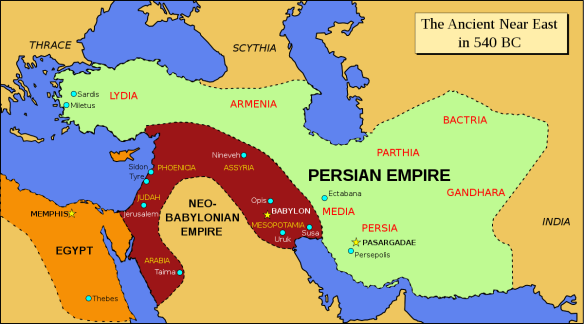
1200px-ancient_near_east_540_bc-svg

Pictured: Well-decided terror countries. Look at them!

Donald Trump, whose major foreign policy trip was to promote his golf course (which will do very well if the markets collapse, so pretty sweet, right?), today seemed to back down on his insane and racist and unworkable plan to ban all Muslim immigrants. He didn’t mean all of them. Just the ones from “terror countries.”

Slate!

The day began with the presumptive Republican nominee appearing to contradict his vow to fully ban Muslims from entering the United States, telling reporters on a golf course in Scotland that he wants to restrict entry by people from a number of “terror countries.” That came after he said that it “wouldn’t bother me” if a Scottish Muslim entered the United States. Which countries would he consider to be “terror countries”? Trump didn’t specify. “They’re pretty well-decided. All you have to do is look!”

Even then though it didn’t sound like Trump was saying citizens from certain countries should be fully banned, suggesting there could be a vetting process that would allow exceptions. “I don’t want people coming in from the terror countries. You have terror countries! I don’t want them, unless they’re very, very strongly vetted.”

WaPo!

Afterward, Hicks said in an email that Trump’s ban would now just apply to Muslims in terror states, but she would not confirm that the ban would not apply to non-Muslims from those countries or to Muslims living in peaceful countries.

This is obviously a very interesting and well-thought-out policy! It’s pretty well-decided which ones are. Just look. Probably Yemen, and Syria and Iraq for sure, and let’s not count out Somalia. Iran, yeah. Saudia Arabia, and maybe the Gulf States. Not Qatar, I like Qatar, I have some very quality people who I did business with. Oman? Eh, better safe than sorry. Mauritius? Never heard of it. But yeah. Morocco, Libya, of course. Indonesia, I remember Bali, so yeah. Malaysia? Are they Muslims? It sounds Asia-y, not Muslim-y. They’re in. Muslims from India? Only if they are from the very terror parts.

Look, you’re going to hear about this, and his promise that he won’t deport every Mexican because “people are going to find that I have not only the best policies, but I will have the biggest heart of anybody” (actual quote!), and you might hear that he is pivoting toward the general. Being all Presidential. He’s backing down from the very keys to his success, and his sworn promises. Presidential!

But what this confirms, once again, is that he’s making everything up as he goes along, because he has literally no idea about anything in the world. “The terror countries” is a perfect example. He can’t be assed to think of anything, so he just makes up a phrase and demands it into meaning. His spokesperson, Hope Hicks (turn out to vote), has to pretend this is an actual policy with actual meaning, because, remember, in Trump world, what he says, no matter how dumb (“until we figure out what’s going on!“)  is contorted into gospel by his surrounding sycophants.

The media might say this is pivoting. It is just another sign of how deeply unserious a man this is.

Trump on Turnberry: Every Campaign Ad From Here On Out

The presumptive Republican presidential nominee Donald Trump poses with a bagpiper as he arrives at his revamped Trump Turnberry golf course in Turnberry Scotland, June 24, 2016. (Photo by Andrew Milligan/PA/AP)

Dude wheezing into a sheep’s bladder is a billion times more dignified. Image from MSNBC

“If the pound goes down, more people are coming to Turnberry, frankly,” he said, referring to the location of his resort. “For traveling and for other things, I think it very well could turn out to be positive.”
-Trump, today, as the world burns.
Issac Chotiner, who is just doing invaluable work at Slate, has a terrific column about Trump’s “absurd, solipsistic” response to Brexit, but he published it too early, before the above statement came out. (He also perfectly describes Boris Johnson as “a slightly sinister and slightly absurd Trump-lite figure”) There is nothing more Trumpian than celebrating chaos simply because it benefits him. This has to lead off every single Hillary ad for the next six months.
Of course, that might not even be the low point of his presser, as MSNBC said:
Trump proceeded to hold a press conference in Scotland, against the backdrop of one of the most important political moments in the modern history of the United Kingdom, where he spoke at great length, and in great detail, about his new golf resort. The Republican candidate boasted about refurbished holes on his course, plumbing, putting greens, and zoning considerations.
This is the least, and therefore most serious candidacy in the history of the Republic. The Leave idea might be transatlantic, and even global (or Western), but I don’t think that will be enough. Hopefully, just Trump being Trump will convince even more people that he is singularly unfit to be on the library board of a bookless town, much less the President. We can only hope.

Chicago freight, the new Panama Canal, and The Dominance of Trade

panamacanal2-16-wiki-18894

Ships passing through the Panama Canal. We needed a bigger canal, for bigger ships. Hell, dig up the whole country!

After years of delays, mismanagement, disaster, and an economic downturn, the expanded Panama Canal (which saw much worse during its initial construction) is set to open on Sunday. This is a deeper and wider lane for the enormous freighters that have accompanied Asia’s economic rise: the massive sun-blotting  container ships, quarter-mile long, and capable of carrying tens of thousands of tons.

This is extremely important for trade, in a value-neutral sense, because it means that the giant ships, which couldn’t fit in the narrower and shallower original canal, will be able to bypass the West Coast and go directly to New York and other East Coast ports. The ramifications of this quickly trickle down.

Crain’s, the business paper out of Chicago which is not exactly a Sanders-ite rag, talked about the potential impact on this railroad hub. Ships that couldn’t fit the canal would be loaded on trains heading to Chicago, and thence to the east, following the same path that allowed Chicago to be the focal point of empire. Now, though, these ships can get through, which will have a potentially huge impact on Chicago’s economy. About 5% of the Chicago economy is based on railroad freight (Great Lakes shipping is another matter). If Chicago can be bypassed, that’s a lot of jobs that will disappear, thanks to a canal built half a world away.

Of course, no one seems really certain, and anyway, the impact might not be felt for years. Certainly, as the Journal reported, New York isn’t ready for these monster ships: the Bayonne Bridge isn’t tall enough, and it won’t be ready for at least another year.

That’s not to mention that the Canal itself has the hallmarks of a disaster, as epically reported by the Times. The locks are barely wide enough to handle the largest ships, and are almost exactly as long as the ships plus the two tugboats needed to maneuver them. There won’t be any room for error, which given the swirling currents when fresh water meets the ocean, could be a disaster. The tugboat union certainly thinks so. Panama awarded the contract to a rock-bottom bidder, who came in billions below the next-lowest, and it has shown. (The article almost makes you sympathetic with Bechtel, which is a hell of a thing to be.) The concrete has been leaky, and there might not be enough water.


Image from NYTimes. The new locks are 1400 feet. The Neo-Panamax ships are 1200. Tugboats are about 100 each. Snug!

And oh yeah, about that water: it mostly comes from a vast, manmade lake which provides most of Panama their drinking water. The Panamanian canal administrator has literally scolded the nation for drinking too much water, and lowering the levels, making it harder for the ships to pass through.

That seems to me to be the perfect image of the subservience to trade, of its dominance in our lives. A suspiciously rich and powerful bureaucrat, who awarded life-and-death jobs to a shoddy but connected international conglomerate, complaining about its citizens drinking too much water, and not allowing these enormous, inhumanly-scaled ships to pass through a gash cut through a continent, while two great cities thousands of miles away scramble to reconfigure an economy and raise bridges to let them pass, as workers in the cities the goods pass through lose their livelihood, and workers where the goods are made are beaten and starved and robbed.

We make these enormous ships. We dig through continents and connect oceans. We raise bridges. To say that we can’t do anything about the inequity and iniquity of global trade is to give in the free market superstition, the only truly global religion.


Brexit Quote of the Night: Labour and Immigration

Via The Guardian

Chuka Umunna, the London Labour MP, said that the referendum result highlighted “particular issues” for the Labour Party adding:

I don’t actually think for a lot of our supporters and voters sovereignty was quite the issue that immigration became. Why did it become such an overwhelming issue in spite of all the warnings of the experts? A lot of people said that you are saying this about the economy but we don’t actually feel we have a lot from that economy for the moment.

This is something, I think, we’re all learning not to underestimate. Economic issues matter enormously, but they matter this year, to an extent, in how they can reframed in an “us vs them” sort of way. The EU has been rent asunder by immigration, especially the Syrian crisis. This is a 100-yr fallout that isn’t just redefining the Middle East, but redefining Europe for a generation. America’s massive annexations in the 1840s are becoming the turning point of today’s politics. The world as we knew it for all of most our lives isn’t falling apart, but it is changing quickly, and when that happens, scapegoats are to be found, and demagogues can rally the dislocated.

I don’t think what happens there is what happens here. Too many differences. But the same issues are coming to ugly play in much of the “developed” world.  We live in the flicker.

Brexit: The US Fallout

ap20512607534

Pictured: the face that millions of people want to be President.

Leave declares victory a few minutes ago, and already the Asian markets are tumbling. Some of this is correction from the huge upsurge in stocks earlier on Thursday as it looked like Remain would win. This proves, again, that the markets are insane and are based on the gut instincts of terrified and greedy children. But regardless.

In the US, this will play out interestingly. I think it will give Trump some ammunition. After all, he supported Leave (as we said, “Leave” is the heart of Trumpism), and Obama, as any sane US president would be, was against it. This will allow Trump to talk about how his vision is correct, how the English (and he’ll probably say English, because he doesn’t know the difference between England and Great Britain and the UK) love him, and how he was really the big factor, even though he was no factor at all. It’ll be a minor coup, mitigated by his arriving in Scotland tomorrow in a miasma of phony triumph, Scotland being the one place that was firmly Remain. I don’t think he’ll have a glowing reception.

(And meanwhile, can we get some coverage on how unbearably tacky it is for a US Presidential candidate to abscond so that he can brag about his new gilded golf course? It’s not entirely Presidential, right?)

But overall, despite the strength this will give the Leave movement in the US, we’re talking about two very different places, demographically. I don’t think the Welsh will turn be too terribly inspiring in Johnstown. Trump’s crowing will hurt him even more in groups in which he is already getting pummeled. If there is economic chaos, globally, due to this, that always hurts the incumbent party, of course, but I don’t think the ramifications will be big enough, quick enough. The EU won’t collapse, and Great Britain was always at an arm’s length, anyway.

It’s still a scary, ugly time.


Brexit, Trump, and The New Dislocation


Make Great Britain, well, great again!


As I type this, ITV (through C-Span) is reporting that the Leave campaign is cruising toward a victory, with an 85% chance at victory. By the time I’m done, it could be a done deal. All night- or in the wee hours, if you are reading this in the immediately impacted areas- the results started to trickle toward the red, toward Leave. Wales, which has benefited enormously from the EU, while still suffering thanks to its postindustrial wreckage, was almost entirely and passionately Leave. England, with a resurgence of nationalism, went heavily toward an exit. Only Scotland kept it from being a total rout.

ITV just called it. It’s over. Brexit is a reality, and the world is a far different place.

It’s been a season of weirdness, on both sides of the ocean, two countries tied umbilically together. For as much as we pretend to be different, and as much as we are, there are real similarities, and they are bubbling to the surface, like some kind of deeply buried and seismically awakened sludge, in this year of simmering discontent and atavistic anger.

It’s impossible to discount what is happening. Throughout the night, there were references to the “white working class”, in cities like Manchester and Cardiff and throughout Wales, and how the Remain camp failed to persuade them that they are better off in a united Europe. I honestly don’t know if that is true they would be, though I suspect it is. But the argument is the same as it is here.

In the US, Trump is essentially in the Leave camp. I mean, he very literally is, having supported it (once he was told what it was). But instinctively, even if he didn’t know what it was, he knew, in his dark heart. He knew that “Leave” encompassed his entire campaign. The heart of Trumpism is a desire to leave the modern world. It’s a desire to leave a world where what once seemed certain and permanent (even if it was only a few generations old) was rapidly changing. It’s a desire to leave the world of complexity and uncertainty and retreat toward blood and soil. It’s the call to retreat disguised as victory.

And yes, that is a powerful message for many, left out of the global economy, punished by market forces that are beyond their control, but clearly in control of those who benefit. It’s a message that resonates because, while it blames “elites”, it really turns anger on those who are weaker (immigrants, Muslims, etc). It’s an extremely seductive howl, a lowing, lusty battle dirge. It accepts failure, but gives in to the desire to burn the world down with it. It’s the truncheon of the race riot manifest in the ballot box.

Both campaigns- Trump and Leave- have had violence as their main currency, or, if not the actual currency, the silver and gold that gives it value. Because when you tell people their country is under attack, and not just from immigrants, but from their children, and their grandchildren (as Satelan chillingly documents), and that they are being enabled by what are essentially quisling politicians, well, then what choice does a patriot have. It’s what led to the murder of Jo Cox. It’s what drives Trump’s supporters, like this terrifying racist. It’s not a policy. It’s sheer emotion.

This emotion is driven by modern dislocation. Yes, we’ve had immigration and a shifting balance of power for decades (it’s still mostly white, and male, but it is shifting). And yes, the UK has been in the EU for decades. But this is still relatively new. Before really the end of WWII an actual political alliance with France would have been insane. Even WWI was more out of the inconsistent European alliances that formed in the wake of Napolean. You don’t have many Englishman who remember France as an enemy, and the Continent as a wholly foreign place, but the memory remains. The memory of Empire remains, as it does, in another form, in America. This loss of identity, tied in with the shifting balance of power through immigration, assimilation, and expanded civil rights, is coupled with the very real economic dislocation of globalization. It all feels like a loss of power, and the personal and political can intertwine easily.

The memory of being on top is still powerful, and can be reanimated up by canny politicians who know how to stir up the blood that has dried in the soil. With sweaty passion and crocodile tears they gift life back into the blood, making it rich and liquid in a suddenly loamy soil, from which can sprout thousands of pairs of thick-booted feet, marching in unison to an old-fashioned martial beat.

It’s transoceanic, baby. Donald Trump doesn’t know anything about the world, but we’re living in his image.

McCain: Obama “Directly Responsible” For Orlando: Dispatches From The Land of Cognitive Dissonance

As we briefly discussed in the Quick Hits, John McCain knew who was to blame for a violent, sexually-confused psychopath buying an assault weapon and pledging vague and meaningless allegiance to a terrorist group.

(via @benjysarlin)

Now, McCain went on to say that he hold’s the President’s policies responsible, not Obama himself. Ben Mathis-Lilley of Slate says that “In summary, John McCain is not going to be the Republican Party’s voice of reason on this one,” but in a way he sort of is. After all, unlike a lot of his colleagues, he isn’t whispering that Obama wanted this to happen (or, like the presumptive nominee, he isn’t shouting it). Unlike Ted Cruz, he isn’t saying that the FBI would have kept up their investigations on Mateen due to a series of incomprehensible and contradictory boasts and the fact that he went to Mecca, indefinitely, if only Obama said “radical Islamic terrorism” every once in a while.

The Cruz line is interesting, because, as Simon Maloy points out, the FBI is doing exactly what Ted Cruz says they should do: investigate anyone who might have any connection whatsoever to terrorism, even if it is specious at best. (Even though he, in theory, is against “Big Government”, and the tyranny of insurance regulations, these sorts of prolonged and rights-denying investigations are ok.) But for Cruz, the FBI would have somehow found something, found a non-existent connection, and arrested and stopped Mateen for a crime he hadn’t committed, for allegiances, even tenuous ones, he had yet to pledge, if only the magic words were uttered. It’s less the obvious anti-democratic and terrifying nonsense here, although that’s important, as it is the level of mental contortions that make even John McCain’s fabulisms look logical.

Obviously, Obama demolished this line of thinking, as he has before, but that doesn’t matter. The words “Radical Islam” have achieved totemic power on the right. Their incantation of it isn’t so much to stop ISIS, but to create a witch’s brew of allegations against Obama. It doesn’t matter that it doesn’t make any sense. In a political climate where certain phrases, like Keystone XL and (of course) Benghzai, take on a meaning far beyond their actual physical weight or strategic merit, the President’s refusal to say a phrase becomes all-encompassing. It becomes an article of faith.

This sort of faith-based fippery of the professional amnesiac is what is driving nearly all of  Republican thinking, especially on foreign policy. They don’t even engage with Obama’s arguments for why he doesn’t say the phrase. There is even a case. Not on their terms, but it is possible to say “Oh, come on- explaining why you won’t say it is basically saying it. At this point, it doesn’t matter if you do or don’t. It’s not like ISIS is waiting for you to say ‘Radical Islam’ before they get really cocky.” But nope. There is no actual debate. They just get angrier and angrier at it, because it is a worldview, not a thought.

This brings us to McCain. He’s running for office, as we said, so he has no interest in being even a semi-decent person, but it’s more interesting that he blames Obama, directly, for ISIS. On one level, that’s politics, of course- he’s not going to blame himself! But it’s also a matter of deeply internalized cognitive dissonance. The right has wholly swallowed up the idea that we were about to win in Iraq, because it was relatively peaceful, until we pulled out, and then ISIS formed. On a very surface level, that makes some sense. It did happen like that, chronologically.

But think about it more. That basically means that our “victory” was such that as soon as we left it all fell apart. Our great triumph was a “peace” held together only by limitless troops staying there from now until infinity. But that doesn’t matter. The myth has, contra Lord of the Rings, faded into history, and become reality. The present started in January of 2009.

The whole right-wing foreign policy mentality consists of this kind of magical thinking. When McCain says that Obama is responsible for Orlando, or when moderate New Jersey governor Chris Christie says that we have to hit them where they live, when they live here, they aren’t fringing out. They are in the dead-center of their mainstream, and, given the reality they have constructed, are acting perfectly reasonable.