Lead in the Water: Local Cheats, National Disaster

wilson_avenue_crib_060820

Where the water comes from. Image from Wikimedia Commons

If you’re unaccustomed to the view of Lake Michigan from Chicago, you’ll be surprised to notice several strange objects about a mile out into the lake. Depending on the weather and the light, they’ll look like large ships, before you realize that they aren’t moving, and anyway, seem to be made of stone. As your eyes focus on them, they look like houses, and the romantic among us imagine that they are old lighthouses, steering ships in through stormy western winds. Of course, there aren’t lights on them. What they are, you’ll have explained by a local, the glint of the trivia revealer in his eye, are the pumping stations, where the water that quenches a city is pulled from the vast and ancient lake and brought into the modern metropolis.

If asked why they are so far out, the local, still glinting, will explain that of course, when they were built, the river was still dumping pollutants into the lake, and just the dirty flotsam of millions made the shore and its near environs unsafe. Better to pull from, if not the open blue water where land is no longer visible and directions suddenly and terrifyingly seem to have no meaning, then close enough. This water rumbled through long pipes under water and land, through thousands of miles of pipe north and south, and into our homes.

And as an explosive Guardian report revealed, it’s been poisoned, and those in charge of testing it dodged their responsibility to let people know.

Continue reading

Trump The Flim-Flam Man and the Judge: The Only Thing Hillary Needs To Talk About

conanmonorail

Pictured: Donald Trump campaigning for the support of the FOP.

There’s a lot of talk that the Hillary Clinton camp hasn’t yet settled on a narrative about how best to handle the unpredictable ravings of the idiot madman against whom she’ll most likely find herself running. If I may be so bold, I think over the last few days he’s provided the clearest opening, and it comes from a combination of his phony real-estate “schools” and the racism that underpins his campaign.

From The Guardian:

A federal judge has given the world an unprecedented glimpse into the ruthless business practices Donald Trump used to build his business empire.

US district court judge Gonzalo Curiel on Tuesday made public more than 400 pages of Trump University “playbooks” describing how Trump staff should target prospective students’ weaknesses to encourage them to sign up for a $34,995 Gold Elite three-day package.

First off, this is an obvious swindle, and there was some evidence in the GOP primary that this was the best hit on Trump, because it got to the heart of his self-image as a great, world-bestriding businessman. It shows him to be a cheap grifter, hitting the flats for their life savings and skipping town. His string of bankruptcies, and the fact that most of his business now is just licensing his name, deflates the basis of his campaign, showing him to be a cheapjack Lyle Lanley, always just one step ahead of the mob.

It’s also when he lashes out the most, and he did so, in a series of tweets and rants against the judge. This is when people say they are “disappointed” with the decision. Not so our Trump.

I have a judge in the Trump University civil case, Gonzalo Curiel (San Diego), who is very unfair. An Obama pick. Totally biased-hates Trump

4:45 PM – 30 May 2016

I should have easily won the Trump University case on summary judgement but have a judge, Gonzalo Curiel, who is totally biased against me.

4:55 PM – 30 May 2016

You’ll notice of course that these came within 10 minutes of each other. Not really a temperate person. The Times already noted how disturbing it is to see a Presidential candidate attack in such a personal manner the judicial branch, but for the real horrorshow, let’s go to this part of a speech.

Trump hit back calling Curiel a “hater”, a “total disgrace” and “biased”. “I have a judge who is a hater of Donald Trump. A hater. He’s a hater,” Trump said at a rally near the courthouse in San Diego. “His name is Gonzalo Curiel. And he is not doing the right thing … [He] happens to be, we believe, Mexican.”

See, it’s the last part that really sets this on a whole new level. There is no way to interpret that except to say that Mexicans are bad, and are aligned against Trump, and are therefore aligned against America. It is absolute naked racism. This case in no way involves, say, a border wall, in which case maybe you could make a (still racist!) case that a Mexican judge would be biased. But not in this one.

Curiel, by the way, was born in Indiana.

This is all Hillary needs to do. His attacks on judges show his thin-skin nd wild intemperance. His quote on “happens to be, we believe, Mexican” should be run over and over in every Hispanic market to make sure his numbers never climb. And his obvious swindle, the details of which are now perfectly clear, should be hammered every day. This is a man who sees Americans as a way to feed his ego and his wallet, and sees everyone else as an obstacle to be removed. Between his venality, his absurdity, and his racism, there’s really nothing more to say.

Donald Trump as Tinpot Strongman

Perfection, of a kind, he was after
And the poetry he wrote was easy to understand;

-Auden, “Epitath on a Tyrant”

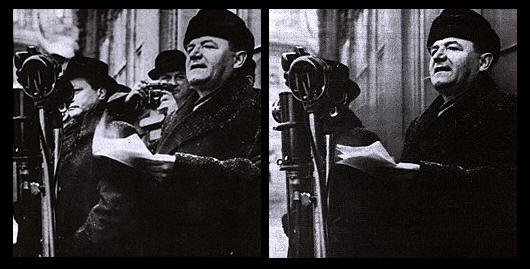
prague-tour-clementis-balcony

The man is gone, but the hat remains. Image from nakedtourguideprague.com

It’s doubtful that Donald Trump would know who Emomali Rahmon was. To be fair, very few Americans do. I was only vaguely aware of him. He’s the President of Tajikistan, a landlocked country in Central Asia that doesn’t come up very much. It’s not considered one of the world’s happiest places. With borders that touch Afghanistan and the rebellious Xinjiang region of China, not to mention its abutting of Jammu and Kashmir, it is in a fairly rough place in the world, and has never enjoyed much stability in the post-Soviet era. That’s about to change, albeit in a way that makes most people uncomfortable.

Rahmon, the President, successfully passed a ballot referendum that scrapped term limits, as well as lowered the age one could stand for President to 30, which by a great coincidence gives his son the ability to run. It’s instituting a President-for-Life plan, and it worked. A low-information campaign (which mostly talked about vague “changes to the constitution”), coupled with a population weary about politics, helped make the referendum a landslide. With 94.4% of the votes, Rustam, the fresh-faced whelping, now has a clear path to 40 years of power. It’s hard to say democracy died in Tajikistan, as it was never fully born. But it’s easy to see that this is how authoritarians act. They tell you not to worry you weary hearts. They tell you it’ll all be better if you just let them take care of it. They tell you that all you have to do is give them power, and things will be fine.

Donald Trump may never have heard of Emomali Rahmon, but both he and his gruesome campaign head, Paul Manafort, know that playbook by heart. They’ve taken the lessons of him and every other tinpot tyrant that has stumpled across history, and brought them to America.

Continue reading

Never Forget: Donald Trump Is A Giant Goddamn Dummy About Climate Change

This very expensive GLOBAL WARMING bullshit has got to stop. Our planet is freezing, record low temps,and our GW scientists are stuck in ice. Jan 1st, 2014

Not a dime’s worth of difference between Hillary and Donald, right?

Never forget that Donald Trump is a man who is stupid enough to believe that if it is cold out, global warming isn’t real.

Never forget that Donald Trump is so galactically goddamn dumb that he thinks extreme and unprecedented weather events, happening with terrifying regularity, are a sign that everything is fine.

Never forget that Donald Trump is such a peabrained dipshit that he literally believes China invented the idea of global warming in order to bankrupt the US.

It’s not that Donald Trump doesn’t believe in anything. It’s that what he believes in is so gigantically moronic that his environmental plans include pulling out of the Paris climate accords, which he wrongly thinks allows foreigners to dictate our climate policy, and to build the Keystone XL pipeline, which he wrongly thinks will have a positive impact on energy independence. He also thinks he can bring back coal, absent market forces. This proves again that he doesn’t understand how things work, whether it is the fungible nature of the energy market, coal, pipelines in general, the Paris accords, or, of course, anything at all.

Kudos, by the way, to the New York Times for not hedging when covering his idiotic “energy speech”, which he used to show his wholly non-existent bonafides. They actually used terms like “repeatedly denied the established science” and “However, the next president will not have the legal authority to unilaterally rescind the climate rules” and “In fact, at the heart of the Paris Agreement are voluntary pledges put forward by the governments of over 190 nations” to contradict him when he said things that were in opposition to reality. This is a good way to cover his truthless campaign.

But really, I don’t think he’s lying, in this case. I think he is genuinely dumb about everything that can’t make him money, and even that prowess is questionable. He’s a rich moron who believes that being born rich means he has everything figured out, as long as he can filter a newspaper through his brain, and doesn’t have anyone around him who says “Donald, you’re a giant goddamn dummy for thinking that snow in New York in January disproves science. The Northwest Passage is now a real thing, you enormous featherweight pinhead.”  He lies about nearly everything, but on other things, he’s just a genuine tiny-brained mouth-breather who couldn’t shoot himself in the ass with a shotgun in a phone booth.

But, you know, not a dime’s worth of difference.

Thiel and Speech

Yesterday, I was a bit flippant about Peter Thiel funding lawsuits against Gawker, mostly because, while I love a lot of the sites like Deadspin and Gizmodo and IO9, Nick Denton is distasteful and outing private citizens for clicks means that the end is pretty deserved. But as Thiel revealed his long game to destroy a media company he (justifiably, since it outed him in 2007) hated, it became clear that this was more than a billionaire vendetta, which is terrifying enough. It’s the blueprint for the destruction of an independent press.

Felix Salmon smartly lays out the dangers in an essay for Fusion.

It gets worse. If Thiel’s strategy works against Gawker, it could be used by any billionaire against any media organization. Sheldon Adelson, Donald Trump, the list goes on and on. Up until now, they’ve mostly been content suing news organizations as plaintiffs, over stories which name them. But Thiel has shown them how to go thermonuclear: bankroll other lawsuits, as many as it takes, and bankrupt the news organization that way. Very few companies have the legal wherewithal to withstand such a barrage.

This is scary because there is no recourse. We all like to laugh when idiots say that their 1st Amendment rights are being stolen because a private company takes down their racist comment on a message board. At this point, on the internet, there are more jackasses ready to pounce on the misconception of what “Freedom of Speech” means than there are people doing the misconcepting. And in a way, that’s what is brilliant about Thiel’s plot. It’s perfectly legal and constitutional, so long as he can find enough cases.

That’s what makes it so terrifying. If a billionaire can come up with enough cases that are plausible enough to not get thrown out, any media company can be bankrupted defending themselves. Unlike with 1st Amendment cases, there is no legal or constitutional recourse. And so what will most likely happen is that media companies won’t want to pay for these lawsuits, so the choice is to fold, or to self-censor.

In every authoritarian country, self-censorship is the more insidious form of silencing. It’s not like totalitarian countries, where there were clear lines. In these semi-states, it isn’t always clear what will get you in trouble. You fear for your life or livelihood, and so don’t go near issues that skirt the danger zone. Then the skirt gets pushed back further and further, and eventually, you don’t even think twice about your silence. It becomes second nature. We have that for national security, here, which is bad and dangerous enough, but not for much else.

Well, Thiel has shown how the monied will be able to impose self-censorship on anyone who wants to continue making money producing content. And if that sounds sterile, it is. If it gets to the point where journalism that offends anyone rich and powerful becomes financially impossible, all we’ll have is content, a set of listicles stomping on the human throat, forever. That this comes against Gawker makes it seem like just desserts. It isn’t. It is, in fact, part and parcel of the Rule of Money, and if we elect a billionaire who has made silencing the press an open part of his platform, the transformation could be complete.

(Update: initial version said “in every totalitarian country” in first sentence of penultimate paragraph, but that wasn’t accurate. Clarifications added)

Yemen and the Big War

mideast-yemen_horo-e1434219654143

Rubble in the beautiful Old City. Image from timesofisrael.

A couple of weeks ago, we talked about the war in Syria as being part of the long arc of Ottoman dissolution, impacted as it was by colonialism, Arab nationalism, the rise of extremism, and other factors. This wasn’t meant to be teleological, or to say that anything was inevitable. Decisions made after the modern fall of ancient empire could have diverted the course of history in any number of ways. But I think it is true that certain conditions are set by the past, whether these are the scars of cultural memory, institutional norms, geographical displacement, environmental relocations, and any number of factors that impact how we live. People act under these conditions, and can change them incrementally, but even “great men” are bound by time and place.

That’s the problem with looking at current events (or history) entirely as decisions made by elites in elegant offices. Those do matter, of course. But we have a tendency to look at those without understanding how those decisions are the outcome of the constraints and the possibilites presented.

That brings us to Yemen, where this is- or should have been- more clear than in most places. Yemen, especially in the north, was shaped by tribal customs developed over centuries. This isn’t a matter of “they were living in the past”; it’s just that government was set by cultural norms. (It’s the same thing in America; our devotion to the cult of states, as if these arbitrary riverine borders mean something, is what allows the weird chaos of the nomination process to seem somewhat normal).  These norms meant wheedling and dealing with tribal leaders and other small groups. It was a very personal and transactional style of politics, based on intricate negotiations. Even a 30-yr autocrat like Ali Abdullah Salih spent most of his time personally placating and playing tribal leaders, depending on what the situation called for.

That’s why this recent report by Peter Salisbury for Chatam House is at once so correct, and so infuriating. (Link is the pdf, here’s the summary.) Salisbury outlines how the post-Salih transition process from 2012-2014 focused entirely on elites, the Hadis and the Houthis, especially in the context of the Middle East “cold war” between the Saudis and the Iranians. These are important factors of course, but in doing so, the rifts on the ground were ignored. What was really ignored were the conditions in which Yemeni politics were played. And because that was ignored, Salisbury argues, the end of the “big war” is just the stage for many little wars, or in his evocative phrase “a chaos state.” Local grievances, the maintenance of which was always the key to Yemeni politics, were ignored, and thus can fire up again.

Salisbury argues that we need to focus on ground-up approaches to nation building, and he is absolutely correct. It makes no sense to focus on what will appease the Sauds and the Iranians equally, and divide the country once again among the elites. What makes sense on the ground is the only way to establish even a rough kind of peace, and to try to staunch a bitter humanitarian disaster. It’s a lesson we fail to learn time and time again. Otherwise, it’s just epauletted men shaking hands on an empty stage while the theater burns down around them.


2016


Please? Image from Melencholia


So, it turns out that billionaire libertarian Trump-supporting James O’Keefe-loving prick Peter Thiel was bankrolling the Hulk Hogan-Gawker trial, in which Hogan was taped during what he thought was a private conversation saying terrible racist things (while having sex with his best friend’s wife). Thiel is using his money to destroy a media company that he doesn’t like, because the media company, who thinks that anything involving a famous person is news, outed him in 2007.

Hogan’s “best friend”, by the way, is “Tampa-area radio shock jock Bubba the Love Sponge Clem”, who you know is just the worst.

This is one of those cases where you have a sliver of sympathy for everyone (except Bubba the Love Sponge), but they are also all reprehensible, and you pretty much just wish the sun would explode.

A New Blog You Should Read

In a life well and luckily-lived, you get to meet a lot of people who mean incredible things to you. But even in those lives, there are a few who stand out, about whom you consider it a great and good fortune to have intersected with them. There are so many roads and paths, dim alleys and twisted warrens, that every life finds itself plunging down, so when you actually come across someone who changes your life, it’s astonishing.

One of those rare people in my life is Nadja Halilbegovich, and meeting her was lucky in more ways than usual: Nadja is a child of war, trapped in Sarajevo during the monstrous siege, escaping in a fraught journey that ended in America, educated at Butler (go Bulldogs!) and who now spends her life talking to people about the experience of children bombarded by war, whose lives are ripped from them, sometimes physically, but always emotionally, by horrors they can’t comprehend for reasons that never make any sense. Her book, My Childhood Under Fire, is a searing diary of pain, fear, and hope, written as a child who has seen more than most of us ever will.

Nadja’s message of peace, forgiveness, and most importantly, of the strength to live a life full of joy and laughter and chocolate, even while still bearing the scars of war, and the trauma of remembrance, have inspired people around the globe. I don’t know many people with the spirit and the courage and the sly sense of humor and curiosity and intelligence and kindness and intensity of feeling as Nadja, and am honored to call her my friend.

Anyway, she’s blogging now. The message and the lessons she has are sadly always relevant, in all corners of the globe. You should read it.

The New Northwest Passage: On Human Ingenuity

Foreign Policy has an interesting article this week about how the US, short of ice-breakers, is falling behind the “Arctic Game” by not having enough giant-icebreakers, like the nuclear-powered ones Russia has or Finland’s LNG-driven vessels. These are gigantic ships, costing over a billion dollars, and taking almost a decade to build. It’s a story of bureaucracy and priorities, as the Obama administration has slowly pushed for more funding, with limited bipartisan support. It seems America is catching up to its duties, as one of the “Arctic nations.”

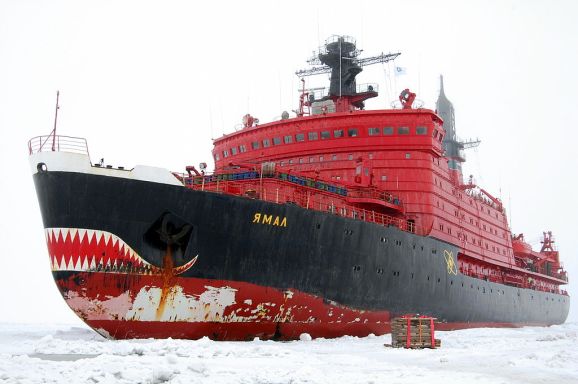
1024px-yamal_2009

A Russian nuclear-powered ice-breaker, seen here devouring the planet. Image from Wikimedia Commons

It’s sort of a strange thing to think about; that residents of Florida or Arizona can consider themselves part of an Arctic nation, but thanks to the ability of great powers to buy and sell land like one does trinkets, America is one. And more than that, as a great power, we’re honor-bound to explore the Arctic, making it safe for oil and gas producers, as well as our navy, not to mention tourist ships. After all, “(T)his summer, for the first time, a cruise ship will sail from Anchorage, Alaska, to New York City, through the Northwest Passage.”

Think about that, and the whole insane scope of the last 500 years comes into focus. The rise of great, globe-stamping powers, the population clash and transfer between Europe and the Americas, the rise of industry and the way it changed the environment, initially imperceptible on a human level, but then suddenly very quickly.

The whole “discovery” of the Americas was an attempt to find a sea passage to the Asian markets. John Cabot probably was the first person (or at least the first famous person; his four-ship crew might argue on “firsties) to die looking for the Northwest Passage. In doing so, though, he claimed much of the northern part of the Canada for England, which eventually set off the fierce wars between England and France, that also pulled in Spain and the Dutch. These wars, particularly the Seven Years War, sparked by inter-tribal rivalry between the Annishabeeg and Iroquois, helped create the crucible in which the United States was formed, and was later able to buy Alaska from Russia, as if the concept of owning land that people lived in was an inarguable right. These wars helped, as wars always do, spur the industrial advances that changed a planet.

And so, here we are, not too long in the scope of things since John Cabot- who was actually Giovanni Cabato, but in his famous voyage he sailed for the King of England, so we can’t be having any excess vowels, by god- possibly died looking for the Northwest Passage. All it took was pumping poison into the air and sea. All it will take to exploit this discovery is billions of dollars and enormous ships, powered by nuclear energy, so that we can dig up more oil and gas. Cabot was just a little early, was all. We’ve finally achieved the dream.