Indiana Tuesday: It’s All Over But The Guttural Howling of Diseased Sewer Rats

On most mornings, if I’m not feeling too lazy, I have the privilege of walking along Lake Michigan, up here in Evanston, where the southernmost portion of this vast and ferocious lake system begins its final curve. This morning it was incredibly clear and impossibly still, where there isn’t the slightest movement in the air, nothing to stop the rising sun from gently pushing away the final hint of the dawn’s early chill.

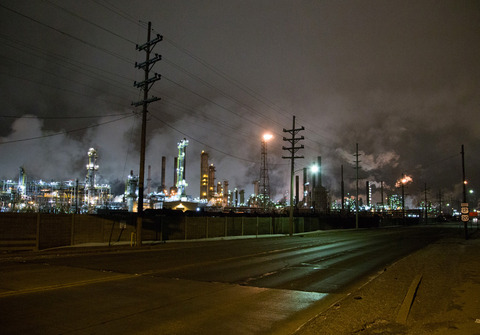
On a morning like today, Chicago’s stunning skyline looms in all its roaring glory. And past that, further southeast, where the lake curves, you can make out the hulking outline of one of the giant Great Lakes freight ships, leaving the port on the far south side. And beyond that, beyond what is usually hidden by clouds, you can just barely make out a puff of smoke rising from the sprawling industrial areas of Indiana, that bizarre and wrecked land where hints of ancient prairie still poke out among the post-industrial poverty, the rows of tumbledown houses and cracked roads, the cheap glitz of casinos, the belching smokestacks, and the sunshine, normally shrouded by haze, that glints and shatters on dirty rivers. It’s here, the far bitter end of the rust belt, where the American dream first crashed and broke, where the horrible forces of the global economy first poisoned then wrecked a land and people. And it’s here, in Indiana, where Donald Trump, the gaseous avatar of America’s inchoate anger, can all but clinch the most terrifying nomination in our nation’s history.

whiting-in-wide-shot-smalljpg

“Is this hell?” “No, it’s Indiana”

Read more about Indiana and the end of the line

Continue reading

Chicago in a Turbulent Spring

Displaying 20160416_100458.jpgDisplaying 20160416_100458.jpgwaveland

NBC Chicago: The first shooting of the weekend happened at 4:45 p.m. Friday, when a 1-year-old girl was shot in the neck while riding in the backseat of a car with her family. Her aunt and cousin were in the car in the 5400 block of W. Le Moyne in the West Side Austin neighborhood when someone fired shots at the car from a silver vehicle, police said. A bullet went through the trunk and back seat, striking the baby in the neck, though authorities originally said she was hit in the head.

On Friday evening, a still chilly night that blithely foreshortened a pleasant lakeside walk, my wife and I went to a get dinner at a restaurant we had never been, on the far north side, where Chicago begins to blend into Evanston and Skokie. It was a neighborhood joint, a burger and pizza place, with a bar area but also filled with families. During dinner, Allison started to talk about the damning report on Chicago police, the endemic racism that course through it, and the casual brutality employed by far too many of its members. It’s a report whose outline comes as a surprise to few, but whose depth has shocked many. What was blithely assumed can no longer be ignored, and the Mayor, the venal Rahm Emmanual, is racing to appoint the finest blue-ribbon task forces to study the problem. I looked around the bar, and a few policemen, and realized that this was a cop bar. Not a grim and hard one, but for police and their families. There was the motherly camaraderie of dealing with tough jobs, that faint hardness mixed with the middle-class comfort of one of the few strong unions left. We decided not to talk about the report, for fear of hurting someone’s feelings, or making a scene, and just being seen as outsiders. We sat back and watched the Hawks win, exchanging high-fives and jokes, with new friends, and never gave it another moment’s thought.

“C.P.D.’s own data gives validity to the widely held belief the police have no regard for the sanctity of life when it comes to people of color,” the task force wrote. “Stopped without justification, verbally and physically abused, and in some instances arrested, and then detained without counsel — that is what we heard about over and over again.”

Saturday dawned beautiful, and taking the 7:00 train into the city to meet friends for a softball tournament, you could feel the city stretching out, coming alive. At the beautiful park, with its old clock tower outlined against the endless lake, hundreds of people jogged and rode bikes, played tennis, and relaxed in the morning beauty of a city freed from winter. The human form, long since hidden in winter fastness, re-emerged, unstretching lithely across the long lakeside track that hugs Chicago from north to south. We won a game, lost a game, but mostly just enjoyed being out, drinking some beers and busting chops. It was illegal to drink at the park, of course, but so what? No cop would ever give you trouble unless you were being obnoxious about it. There wasn’t even a reason to hide our cans or shade the minor scofflawing. Our thoughts were as untroubled as the infinite blue sky.


  • At about 8:15 a.m., a 28-year-old woman got into a fight with another woman in the 6400 block of S Langley in the city’s West Woodlawn neighborhood on the South Side. The woman pulled out a gun and fired shots, striking the victim in the right knee before fleeing. The victim was taken to Advocate Christ Medical Center where her condition was stabilized.

  • Less than 15 minutes later at 8:28 a.m., two men were in the 6100 block of S Bishop in West Englewood when a white SUV pulled up and a person inside the car fired shots before fleeing. A 23-year-old man was shot in the right ankle and a 27-year-old man was shot in the left thigh, according to police. Both were taken to Stroger Hospital where they were in stable condition.

  • A 30-year-old man was in the 2000 block of E 71st St in the South Shore neighborhood at 11:20 a.m. when someone fired shots from inside a passing white SUV, police said. He sustained a gunshot wound to the ankle and was taken to Christ Medical Center, according to police.

Sunday broke with more of the same; a cloudless brunch and a picnic along the lake at the Northwestern campus, where college students, who could sense the end of the year with every degree the day got warmer, ran around in various stages of frisbee-flinging undress. Our wine still illegal, but the understated assumption is that we are invulnerable, protected by the brightly-lillied day and our unremarkable skin. There was a brief and friendly argument about upcoming CTU strikes, and whether they are agitating for real progressive change, some of the last real defenders of the public sector, or if they were pushing for unsustainable benefits. It was a lively and friendly back and forth, until it died down, with nothing agreed upon, and no reason for there to be.

The sun is not the luxury of the comfortable; it shines on everyone. The whole of the city unfurled in its glory, after a dull winter and a spring that feinted in frustrating fits and starts. Jackson and Washington Parks, on the south side, were as full as anywhere. But there is a trap, a grim pallor that conspires to occlude. The sun is the same; life is not. There is always the awareness, one that I can’t even comprehend, that life can change so quickly, whether from a stray bullet or a badge. It’s privilege to be unconcerned by either, except in extreme situations, privilege that is far more valuable than any that are merely monetary. Being able to take cloudlessness for granted is a Chicago- is an America- that is alien to so many people.

The wine eventually ran out, and with it, the weekend. Walking home I reflected that throughout the days spent, I had never seen nor heard a wave. There was a windlessness that belied the rough power of the lake, the endless storms caught inside it, ready to roar. There was a dishonest calm, made truthful only by its impermanence. The waves will come back.


Time And the Endangered River; Or, The Public Good Is For Chumps, And You’re Not a Chump, Are You?

mer2016_map_revised_small-500x382

Image courtesy of americanriver.org. Support it!

Yesterday, the good people at American Rivers released their annual “Endangered Rivers” report, ranging from the Green-Duwamish in Washington to the highly-contested Apalachicola-Chattahoochee-Flint basin in the southeast, where Atlanta gets most of its supply, and which is the darkhorse candidate for “first actual US water war”.  Rivers on it include major ones like the St. Lawrence, the Susquehanna, and the San Joaquin.

The culprits are what you’d expect: outdated dam systems, the paving over of floodplains which leads to excessive runoff, over-tapping, poor upstream management, and pollution. Often, these work in concert to dry up rivers and posion what is left. A lot of this was done in good faith, or ignorance. Dams were needed, and land had to be built on. The effects of this took years to see, but now the bill is coming due, exacerbated by the multiplying impact of climate change.

Rivers are our heritage. They are how we traveled the nation in its early days. The original West, just beyond the mountains, were based around river cities like Pittsburgh, Cincinnati, and St. Louis. Chicago is Chicago because the convergence of the Lakes, the Des Plaines, Illinois, and Mississippi connected the bulk of America with the Atlantic. But decades of expansion, development, and pollution, and overuse have threatened many of our main waterways. Vast ecosystems are being destroyed, and we’re undercutting our own water supplies. There have been people banging on heroically about this for decades, with some great successes. But the vastness of the problem needs bigger solutions.

Continue reading

Cruz, Sanders, and The Weirdness of Wisconsin

Wisconsin, with its proud progressive tradition, its long history of student activists, farmer/labor axis, its revulsion at organized money and the power it can wield, and its basic Midwest decency, gave Bernie Sanders his biggest win in a long time last night, and keeps his momentum alive long enough to continue to pull Clinton to the left. This is good: she can win from the left. Triangulating isn’t the best strategy this year. Clinton needs to use that sort of historic Wisconsin coalition moving forward, bringing it into the fold of her equally-important base. If she can do that, she can  have a thumping victory regardless of her opponent.

Meanwhile. Wisconsin, with its tradition of right-wing ideological purity and resentment against the liberal coalition, gave Ted Cruz the victory he needed to almost certainly force a contested coalition. This wasn’t a rebuke to Trump being “rude”: in a state where Governor Walker becomes more popular by giving away the environment, destroying labor, and having grandmothers arrested because their singing gives him the vapors, the sneering Cruz is a perfect fit. He speaks the language of overlapping resentments that drive the party, and have found perfect expression in Wisconsin. What a weird state.


Really, you have all three? That’s amazing! 


I’ve been driving up to Wisconsin for years, and have always gotten a kick out of this sign, but as far as I can remember it is only recently that they put the “open for business” at the bottom. That’s such a Walkerian way to describe one of our most beautiful and lake-filled areas. Business is obviously important, but Walker’s definition of “open” is pretty much the same as Big Bill Thompson’s in Chicago: come on in, boys. The place is yours. Don’t even bother wiping your feet or not polluting the lakes. Clear cut what you want, just kick something back upstairs. (That’s not to insinuate that Walker is getting money out of all this. He just does it because he likes it. Give me Big Bill any day).

If you want to know everything base and venal about Scott Walker and the Wisconsin Republicans, remember that the literally wanted to edit the Wisconsin Idea to remove anything about the human spirit, and put in language about the state’s workforce needs.

The mission of the system is to develop human resources to meet the state’s workforce needs, to discover and disseminate knowledge, to extendknowledge and its application beyond the boundaries of its campuses and toserve and stimulate society by developing develop in students heightened intellectual, cultural, and humane sensitivities, scientific, professional and technological expertise, and a sense of purpose. Inherent in this broad mission are methods of instruction, research, extended training and public service designed to educate people and improve the human condition. Basic to every purpose of the system is the search for truth.


(lines are Walkers’ proposed edits)

This is the part of Wisconsin for whom Ted Cruz has the most appeal. This wasn’t a return of Midwest decency or a revolt against Trump’s ill-manners. It was a revolt against the idea that the poor and working class have any purpose other than to make the rich even richer. That’s Walker’s Wisconsin. The only nice thing about this is that it is going to revive Walker’s image as a national player, even though it only confirms, once again, that he is only capable of winning elections in the conservative Milwaukee County suburbs. So seeing him get smacked down again now that his usefulness is up will be gratifying.


Politicization and Privatization: Rubio Excuses Flint

heres-marco-rubio-awkwardly-grabbing-for-a-drink-of-water-in-his-state-of-the-union-rebuttal

Good lord, you’d think if anyone knew the importance of an abundant supply of drinkable water, it’d be Marco Rubio.

The most interesting and enraging moment of last night’s debate- ok, except for the ridiculous juvenalia, which wasn’t so much a moment as a permanent state of affairs- was when the Fox moderators finally asked about the Flint water disaster. Only Rubio was brave enough to jump on it.  He defended Gov. Rick Snyder- whose complicity and cruel indifference become more clear by the day- praising him because “(h)e took responsibility.” Marco said, correctly, “I don’t think anyone woke up one morning and said, ‘let’s…poison someone.'”

Continue reading