
Lead in the Water: Local Cheats, National Disaster

wilson_avenue_crib_060820

Where the water comes from. Image from Wikimedia Commons

If you’re unaccustomed to the view of Lake Michigan from Chicago, you’ll be surprised to notice several strange objects about a mile out into the lake. Depending on the weather and the light, they’ll look like large ships, before you realize that they aren’t moving, and anyway, seem to be made of stone. As your eyes focus on them, they look like houses, and the romantic among us imagine that they are old lighthouses, steering ships in through stormy western winds. Of course, there aren’t lights on them. What they are, you’ll have explained by a local, the glint of the trivia revealer in his eye, are the pumping stations, where the water that quenches a city is pulled from the vast and ancient lake and brought into the modern metropolis.

If asked why they are so far out, the local, still glinting, will explain that of course, when they were built, the river was still dumping pollutants into the lake, and just the dirty flotsam of millions made the shore and its near environs unsafe. Better to pull from, if not the open blue water where land is no longer visible and directions suddenly and terrifyingly seem to have no meaning, then close enough. This water rumbled through long pipes under water and land, through thousands of miles of pipe north and south, and into our homes.

And as an explosive Guardian report revealed, it’s been poisoned, and those in charge of testing it dodged their responsibility to let people know.

Continue reading

Never Forget: Donald Trump Is A Giant Goddamn Dummy About Climate Change

This very expensive GLOBAL WARMING bullshit has got to stop. Our planet is freezing, record low temps,and our GW scientists are stuck in ice. Jan 1st, 2014

Not a dime’s worth of difference between Hillary and Donald, right?

Never forget that Donald Trump is a man who is stupid enough to believe that if it is cold out, global warming isn’t real.

Never forget that Donald Trump is so galactically goddamn dumb that he thinks extreme and unprecedented weather events, happening with terrifying regularity, are a sign that everything is fine.

Never forget that Donald Trump is such a peabrained dipshit that he literally believes China invented the idea of global warming in order to bankrupt the US.

It’s not that Donald Trump doesn’t believe in anything. It’s that what he believes in is so gigantically moronic that his environmental plans include pulling out of the Paris climate accords, which he wrongly thinks allows foreigners to dictate our climate policy, and to build the Keystone XL pipeline, which he wrongly thinks will have a positive impact on energy independence. He also thinks he can bring back coal, absent market forces. This proves again that he doesn’t understand how things work, whether it is the fungible nature of the energy market, coal, pipelines in general, the Paris accords, or, of course, anything at all.

Kudos, by the way, to the New York Times for not hedging when covering his idiotic “energy speech”, which he used to show his wholly non-existent bonafides. They actually used terms like “repeatedly denied the established science” and “However, the next president will not have the legal authority to unilaterally rescind the climate rules” and “In fact, at the heart of the Paris Agreement are voluntary pledges put forward by the governments of over 190 nations” to contradict him when he said things that were in opposition to reality. This is a good way to cover his truthless campaign.

But really, I don’t think he’s lying, in this case. I think he is genuinely dumb about everything that can’t make him money, and even that prowess is questionable. He’s a rich moron who believes that being born rich means he has everything figured out, as long as he can filter a newspaper through his brain, and doesn’t have anyone around him who says “Donald, you’re a giant goddamn dummy for thinking that snow in New York in January disproves science. The Northwest Passage is now a real thing, you enormous featherweight pinhead.”  He lies about nearly everything, but on other things, he’s just a genuine tiny-brained mouth-breather who couldn’t shoot himself in the ass with a shotgun in a phone booth.

But, you know, not a dime’s worth of difference.

The New Northwest Passage: On Human Ingenuity

Foreign Policy has an interesting article this week about how the US, short of ice-breakers, is falling behind the “Arctic Game” by not having enough giant-icebreakers, like the nuclear-powered ones Russia has or Finland’s LNG-driven vessels. These are gigantic ships, costing over a billion dollars, and taking almost a decade to build. It’s a story of bureaucracy and priorities, as the Obama administration has slowly pushed for more funding, with limited bipartisan support. It seems America is catching up to its duties, as one of the “Arctic nations.”

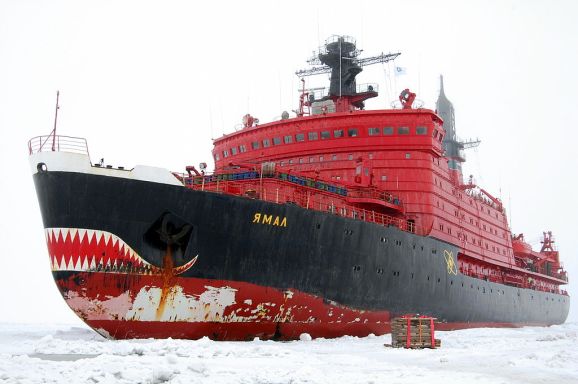
1024px-yamal_2009

A Russian nuclear-powered ice-breaker, seen here devouring the planet. Image from Wikimedia Commons

It’s sort of a strange thing to think about; that residents of Florida or Arizona can consider themselves part of an Arctic nation, but thanks to the ability of great powers to buy and sell land like one does trinkets, America is one. And more than that, as a great power, we’re honor-bound to explore the Arctic, making it safe for oil and gas producers, as well as our navy, not to mention tourist ships. After all, “(T)his summer, for the first time, a cruise ship will sail from Anchorage, Alaska, to New York City, through the Northwest Passage.”

Think about that, and the whole insane scope of the last 500 years comes into focus. The rise of great, globe-stamping powers, the population clash and transfer between Europe and the Americas, the rise of industry and the way it changed the environment, initially imperceptible on a human level, but then suddenly very quickly.

The whole “discovery” of the Americas was an attempt to find a sea passage to the Asian markets. John Cabot probably was the first person (or at least the first famous person; his four-ship crew might argue on “firsties) to die looking for the Northwest Passage. In doing so, though, he claimed much of the northern part of the Canada for England, which eventually set off the fierce wars between England and France, that also pulled in Spain and the Dutch. These wars, particularly the Seven Years War, sparked by inter-tribal rivalry between the Annishabeeg and Iroquois, helped create the crucible in which the United States was formed, and was later able to buy Alaska from Russia, as if the concept of owning land that people lived in was an inarguable right. These wars helped, as wars always do, spur the industrial advances that changed a planet.

And so, here we are, not too long in the scope of things since John Cabot- who was actually Giovanni Cabato, but in his famous voyage he sailed for the King of England, so we can’t be having any excess vowels, by god- possibly died looking for the Northwest Passage. All it took was pumping poison into the air and sea. All it will take to exploit this discovery is billions of dollars and enormous ships, powered by nuclear energy, so that we can dig up more oil and gas. Cabot was just a little early, was all. We’ve finally achieved the dream.


Ecuador’s Radical Proposal: The Poor Shouldn’t Be Destroyed By A Moving Earth

Almost 600 are dead in the desperately poor nation of Ecuador, which has billions of dollars of damage from an enormous earthquake. President Correa?

Among the measures he announced in a televised address late on Wednesday:

  • The sales tax is to be increased from 12% to 14% for one year only;

  • People with more than $1m in assets is to pay a one-time sum equivalent to 0.9% of their wealth;

  • Anyone who earns more than $1,000 a month is to pay the equivalent of one day’s pay; anyone getting more than $2,000 pays two days and so on, up to $5,000 a month and five days’ worth

  • Unspecified state assets to be sold

Although I can’t comment on the specifics, this seems to be fundamentally fair. It seems, in fact, to be the basis of society. These measures aren’t going to bankrupt anyone, but they will help a country rebuild itself, and help protect the people who are most affected by the devastation.

That’s the thing about natural disasters: we do like to say they are the great equalizer, and it is true that the earth, sliding its enormity under our feet, is wholly unconcerned with checkbooks. A millionaire will die in a collapsed building just as much as a poor man.

But it isn’t really equitable. Someone with assets can withstand the destruction of their house. They won’t have lost everything. They won’t go hungry in the streets. They won’t have their world suddenly torn away by these ancient rumblings. If they survive the initial disaster, they’ll be fine.

And that’s good! But that’s exactly the point: no one should have all their hope ripped away by something like this. A poor person who has lost everything in a warren of collapsed brick and ragged steel is just as faultless as the person who is doing fine. Society is built around protecting everyone from the random cruelty of fate. A society where the vulnerable can be shattered and the rich entirely cosseted is, strictly, elementally unfair. That’s why what Correa is doing is both radical and needed. It’s how a society pays for itself. It’s inarguably just.

This is going to be more and more of a big deal, as the ravages of climate change become more and more apparent, and the storms and droughts fiercer. It’s the poor who will pay first. The people who benefitted from the Industrial Age will be the most protected (I include myself in that). And this wasn’t an earthquake; it’s an own goal. When we talk about the economic costs of combatting climate change, the question we are asking isn’t “how much should we spend” but “do we believe in justice, or just the rule of money?” Correa has provided a template, one that simply and radically insists we’re all in this together.


Time And the Endangered River; Or, The Public Good Is For Chumps, And You’re Not a Chump, Are You?

mer2016_map_revised_small-500x382

Image courtesy of americanriver.org. Support it!

Yesterday, the good people at American Rivers released their annual “Endangered Rivers” report, ranging from the Green-Duwamish in Washington to the highly-contested Apalachicola-Chattahoochee-Flint basin in the southeast, where Atlanta gets most of its supply, and which is the darkhorse candidate for “first actual US water war”.  Rivers on it include major ones like the St. Lawrence, the Susquehanna, and the San Joaquin.

The culprits are what you’d expect: outdated dam systems, the paving over of floodplains which leads to excessive runoff, over-tapping, poor upstream management, and pollution. Often, these work in concert to dry up rivers and posion what is left. A lot of this was done in good faith, or ignorance. Dams were needed, and land had to be built on. The effects of this took years to see, but now the bill is coming due, exacerbated by the multiplying impact of climate change.

Rivers are our heritage. They are how we traveled the nation in its early days. The original West, just beyond the mountains, were based around river cities like Pittsburgh, Cincinnati, and St. Louis. Chicago is Chicago because the convergence of the Lakes, the Des Plaines, Illinois, and Mississippi connected the bulk of America with the Atlantic. But decades of expansion, development, and pollution, and overuse have threatened many of our main waterways. Vast ecosystems are being destroyed, and we’re undercutting our own water supplies. There have been people banging on heroically about this for decades, with some great successes. But the vastness of the problem needs bigger solutions.

Continue reading

Mississippi Bending: The Michigan Convergence


chicagoskylinemirage

Image via The Chicagoist and Seth Brown


If you were standing on the Lake Michigan’s eastern shores late this February, on a day unusually warm and clear for that bitter month, you would have seen the Chicago skyline, distorted and strange, rising up over the far horizon. Nearly 60 miles of lake separate these two shorelines, and visibility is essentially impossible. But due to a temperature inversion that caused a bending of light and water, the skyline rose up from the depths, grotesque and squat, but still visible, in a place where it manifestly should not be.

If you were to stand in the same place today and turn your gaze southward, you might see a similar, though distinctly more frightening illusion: that of the country folding in on itself, bending at some Mason/Dixon line of the national soul, and falling forward, imposing a grim Mississippi on Michigan. It isn’t just that the two states have primaries today. It’s that the vision of one of the parties is to create a deracinated owner’s paradise, the kind found in the south, and impose it on America’s working heartland.

Continue reading

Political Dictionary

Via ThinkProgress

From Los Angeles, where the sun shines year round, if you can catch a glimpse…

Republicans took control of the air quality board in February, and new members have not been shy about their intentions to bring a more industry-friendly approach to pollution control. All seven of the board’s Republicans voted to dismiss Wallerstein, narrowly beating out opposition from the board’s five Democrats and one independent.

“With every rule-making and regulation we need to be looking at the economic impact as well as the environmental impacts,” Dwight Robinson, a Republican councilman from Lake Forest and a new member to the board, said in an interview earlier this week.

“Industry-friendly approach to pollution control” is the direct political translation of “learn to hold your breath, sucker”.

Politicization and Privatization: Rubio Excuses Flint

heres-marco-rubio-awkwardly-grabbing-for-a-drink-of-water-in-his-state-of-the-union-rebuttal

Good lord, you’d think if anyone knew the importance of an abundant supply of drinkable water, it’d be Marco Rubio.

The most interesting and enraging moment of last night’s debate- ok, except for the ridiculous juvenalia, which wasn’t so much a moment as a permanent state of affairs- was when the Fox moderators finally asked about the Flint water disaster. Only Rubio was brave enough to jump on it.  He defended Gov. Rick Snyder- whose complicity and cruel indifference become more clear by the day- praising him because “(h)e took responsibility.” Marco said, correctly, “I don’t think anyone woke up one morning and said, ‘let’s…poison someone.'”

Continue reading

Sounds From A Sunless Sea: The Mariana Trench Recordings

cssfpexunl4tgjeveyog

If you are here, you’re probably in some trouble

When I was a kid the coolest thing I could think of was the Mariana Trench, the deepest part of the ocean. I used to say, incorrectly, that it was more than two Everests deep- Mt Everest, along with Rhode Island, being a standard unit of measurement at the time (“If you stood everyone in Rhode Island on each other’s shoulders in the Mariana Trench, most would die in terrible agony!”). Learning more, the ocean’s depths just get more amazing, and more inhuman: mud volcanos, liquid sulfur, CO2 vents, and the weirdest creatures in the world, living endless generations without knowing that humans are walking around arguing about sports.

So it is a particularly childlike and adult awe that greets the news of the first sound recordings from that crushing place. They found, much to their surprise, that it wasn’t silent, and that more than that, they heard sounds from all over the ocean. The area acts as kind of a vast echo chamber, with strange and disquieting sounds rumbling through the darkness.

Continue reading

The Big Story

Want to read four quick sentences that outlay a hugely disproportionate percentage of the problems the world will be facing over the next few decades?  Of course you do!

Egypt’s president has warned Ethiopia that “all options are open” in dealing with its construction of a Nile dam that threatens to leave Egypt with a dangerous water shortage.

Speaking in a live televised speech before hundreds of supporters on Monday, Mohammed Morsi said Egypt was not calling for war, but it is willing to confront any threats to its water security.

“If it loses one drop, our blood is the alternative,” he said to a raucous crowd of largely Islamist supporters that erupted into a standing ovation.

Ethiopia’s $4.2 billion hydroelectric dam, which would be Africa’s largest, challenges a colonial-era agreement that had given Egypt and Sudan the lion’s share of rights to Nile water.

So, what do we have?  The shrinking pie of natural resources compounding older dilemmas about resource distribution?  Those issues being further compounded by largely-arbitrary* colonial borders and agreements signed by people long-dead and in unjust power?   An ideologically-driven leader standing at the bloody intersection of democratic trappings and atavistic impulses leading a people unsure how to interact with the modern world?   Sure- and hey, sport: let’s add in plain old racism!

There are those who think Morsi is a clown or is dangerous or is transitory.  No one really knows what is coming next.  But as this shows, in the long run, it doesn’t matter.  Our politics are played against a background of demographics and ecology, and that background is falling apart.  The actors are spouting lines from other plays and half-remembered commercials and the audience is storming the stage with nooses and their cousin’s scripts.    That’s the world we’re rushing headlong into, where wars over water will, and have already, erupt, and to many of us it will seem overnight.

But all this has been brewing, and it is made worse by nationalism and the power of lines.  This is my water.  This is yours, chief, and don’t get greedy.  It is foolish to imagine that colonial machinations and the whims of Empire aren’t still reverberating around the our rapidly-drying history.  Egypt is just one of the coming flashpoints.   Three things, generally intertwined, that we as a species have never really learned to incorporate into our ideas of society are the implacability of nature (and that it doesn’t care about us, or anything), the weight of history, and the surge of demographics.   If we don’t want to hear more and more of these stories, we might want to learn to deal with them.

*I admit that Egypt, Ethiopia, and the Sudan have lines that are more complicated and older than colonial era, but there is still a lot of Kitchener fingerprints on the situation, and much of Africa and the Middle East was drawn in European parlors.