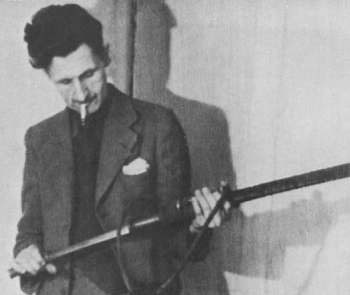

Strictly speaking, this is not needed. The Administration takes aim at city developmental features that rip up comunities.
Strictly speaking, this is not needed. The Administration takes aim at city developmental features that rip up comunities.
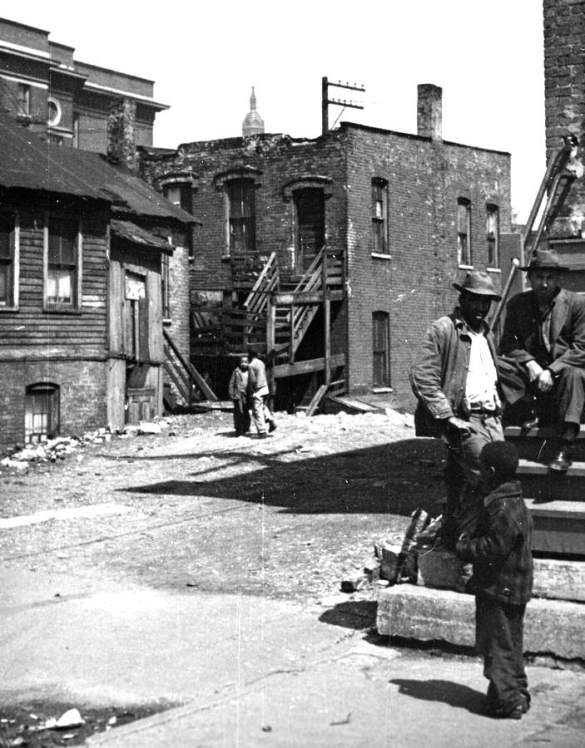
A neighborhood set to be destroyed to make the 290 in Chicago. Image from WBEZ
We’re talking about the building of highways is one of the hidden racial histories in the US, and much more.

You don’t actually need a paradox to understand Trump’s lies.
In an essay yesterday for The Atlantic, Connor Friedersdorf tackles the question of media bias against Trump, particularly in light of his “Obama founded ISIS” claims. The thrust is that some people are upset that the media was deliberately twisting his words to be their most literal, and therefore their most easily disprovable. I’ll readily admit that when I saw the headline last week during a brief moment of internet connectivity, I rolled my eyes a bit, assuming (oddly, I know) that this was an obvious bit of rhetoric and the palpitations were of the clickbait variety.
Friedersdorf does a good job demolishing that, showing how Trump doubled and tripled down on it, and, most importantly, how he’ll say anything at any given time, to inflame some audiences and then claim he was doing no such thing, and it’s frankly disgusting of you to think otherwise, ok? The basic thrust is that Trump says so many outrageous and insane things (Ted Cruz’s loathsome father killed JFK) that the media has to evaluate everything like a policy statement, and debunk it as such.
It’s an interesting question about the role of the press, and to dig into it, I think it is helpful to look at Chicago politics in the 60s and 70s, at another straight-shooting authoritarian who frequently made no sense: Da Mare, Richard Daley.
Earl Bush, the long-serving press secretary for Richard J. Daley, wasn’t like most of the people surrounding the old man. He wasn’t a Bridgeport crony brought up in the rough-and-tumble world of South Side Irish politics, where loyalty and cunning were prized over book smarts. He was well-educated, and was considered to be “Daley’s translator.” He’s probably best remembered for chiding reporters who covered the mayor to play fair, in a way: “Don’t print what he said. Print what he meant.”
It is a line that’s easy to mock, but it actually raises some interesting questions. Daley was far from dumb, and was himself educated (putting himself through law school while climbing the machine ranks and raising a brood), but he had a tortured relationship with the language. What he meant to say often came out garbled, and nonsensical. So, for reporters covering him, what was there to do? On the one hand, they had a duty to convey the policies and politics of City Hall, and not just get a cheap laugh over a syntactical slip, the kind we all make when speaking, some more so than others. Reading the unedited transcript of nearly anyone can be cringeworthy. On the other hand, seeing the unvarnished mind of our political leaders is a service.
On the other hand, seeing the unvarnished mind of our political leaders is a service. We get to see how their minds work, or don’t, and how much they struggle to connect their talking points with any actual thought (think Marco Rubio here). Sometimes, you get a great quote out of it, one that seems more Freudian than Kinseyian. The best example of this is when Daley said of reports of police brutality in the city: “The policeman is not here to create disorder; he’s here to preserve disorder.” That seemed to encapsulate the role of the police in the racial powderkegs of the 1960s.
On the other hand…you know what he meant. Should reporters gleefully transcribe something that is the opposite of what he meant? The above quote seems to reveal a hidden truth, but that is metaphorical, and not legalistic. If Daley had said “I ordered the police to beat the hell out of the Negro” and then Earl Bush said “no no- he clearly meant to say ‘treat them well, the Negro'”, you print the former, for sure. But when it is just a slipup? Is making it clear what a subject means a distortion, or is it observance of the truth?
I personally think it is the duty of any reporter to make sure that they print what is meant, even if they report what is said. But what happens when you have a man like Trump? To say he’s a liar is far too faint. All politicians lie (especially when they say they will never lie to you). It’s part of the job. By definition, you have to please far too many competing constituencies to always tell the truth 100% of the time. It’s impossible. And to an extent, we all know that’s acceptable.
But with Trump is is a different thing altogether. He isn’t so much lying as running an entirely 100% truthless campaign. The entire campaign is a fake, of course, an attempt to make someone who couldn’t pass a basic civics test and who can’t be bothered to learn anything about the world into a President. He himself is entirely truthless, as he sees everything in the world in relationship to himself, and interprets it to how it will benefit him and how he can use it as self-aggrandizement. That’s why he can’t go two sentences without bringing it back to himself; his own empty ego is the sole basis of his knowledge.
So the media should do what Connor was getting at: print what he says, and ignore what he pretends to mean. Or, report that too, and show how it is in direct contradiction with what he just said, and repeated. Trump is a man who thinks that being rich alchemizes his idiot proclamations into truth, so run with that. If he says “Obama probably killed MLK”, investigate it, and show how wrong and idiotic Donald Trump is. Don’t let him get away with saying “I never said that, and anyway, when I said it, it was a joke, ok, but I never said it.” He thinks his off-the-cuff lies are correct when he says them (because he says them) as much as he believes it is correct when he later claims to have never said anything. He gets away with this because he’s been surrounded by flunkies his entire adult life. Every statement is timeless and unalterable truth, until he decides to alter it, and then it was never said. Evaluate them like that. Don’t give him any room. Don’t treat this like normal. Print everything the way it was meant.
Note: I’ll be out of town between the 4th and the 15th, in a wilderness repast, with little to absolutely zero connection to the internet or my phone. Posts during this time, written in advance, will be bigger-picture, or more idiosyncratic, rather than directly pegged to the news. If events happen that supersede or negate anything I say, think of these as a more innocent time capsule. Try not to let the country burn down while I’m gone.

A few years ago I was doing a periodic dive into Chicago history, as will frequently happen, and was perusing the relevant section at the local library. Over the preceding few years, I had gotten more and more interested in Chicago as a city built on a lake and river, which we all know, but tend to take for granted. While Chicago is a major port city, for most residents, that takes places completely out of sight. The river and the jawdropping lakefront are for recreation and beauty; they are no longer the economic engine.
So an old book called “The Chicago” caught my eye. It was plain blue, no jacket, but you could tell it was going to have that musty and delicious old book smell, with pages that hadn’t taken a breath in years, if not decades. It was by an author named Harry Hansen, and not knowing too much about it, I put it on the pile. How bad could it be?
It turned out to be a thing of wonder. Hansen was an old-time Chicago journalist, originally from Iowa, who loved the city but looked at it skeptically. The book blended history and the present- or, rather, Hansen’s present, as it came out in 1942, but was clearly written before the outbreak of war. He took us up and down the still dirty and gritty river, which still had grimy industrial buildings and warehouses and factories on most of its grim banks.
But he also took the reader through time. He had the history of exploration, the Kinzies and Du Sable, and the earlier French explorers who found the portage. It was amazing to read, as he’d talk about a place at, say the 31st and Western, on the south branch, and talk about what was there when he had come to the city some 40 years beforehand, when the smoke from the fire could still be detected in memory and the city had yet to celebrate its first century. And, reading it some 80 years later, both waves of history have been lapped, but both are still present in any given spot.
This journey, it turned out, was part of the Rivers of America series, a huge, sprawling, ambitious piece of Americana that spanned nearly 40 years and three publishers. The idea was to tell the history of America through its rivers, those first highways, along which all cities were built. It is a 50-book series, with the first being The Kennebec in 1937, and the final one The American in 1974. It’s also instructive to think of how much America itself changed over the years. The series takes you from Panama to Alaska, and from Maine to California. It is, fully, American. (Towns End Books and Wikipedia have complete lists)
And who doesn’t?

The Chicago River is very pleasant now. That…that wasn’t always the case.
It’s often remarked that Chicago doesn’t make anything anymore. The city, in addition to being the “hog butcher to the world” and lumber hub between east and west, was throughout its history a major industrial city, drawing workers from around the world to its factories and warehouse, creation dotting the riverfront and radiating into the neighborhoods. Now we’re more known for finance and startups and the normal “transforming city” type businesses. And that’s fine. It’s imperfect, and even cruel, as the city’s new wealth is incredibly uneven. But to say that Chicago is not better off than it was in the 1970s and 1980s, after old man Daley did everything he could to keep Chicago from adjusting to new realities, would be a lie.
That said, there does feel like something has been lost. Into that void comes the Made In Chicago Museum, a new site exploring the things that Chicago used to make. Full disclosure: the site’s creator and collector, Andrew Clayman, is a very good friend of mine, who introduced me to my wife, and who is the best damn shortstop a softball pitcher could hope to have behind him. But I’m promoting this because it is awesome. My friends do a lot of stupid shit that I never write about. It’s a celebration of industry, both high and low, from the most useful to the most ephemeral and whimsical.
Even that stuff, though, stands out because it is long-lasting. Clayman doesn’t just collect and take pictures of old ice skates, clocks, scales, tins, and other gee-gaws and doo-dads. He celebrates a history of manufacturing. On each page there is a history of the company tht made these items, and as much as possible, the people that worked there.
Let’s take this Ice Skater Sharpener, made by FW Planert and Sons in 1910.
Patented in 1910, this metal clamping device was used to keep an ice skate secure while its blade was sharpened. The manufacturer, F.W. Planert & Sons, was one of the “The Big 3” in the Chicago-dominated ice skate industry of the early 20th century. The other two, family rivals Nestor Johnson and Alfred Johnson, were also headquartered on the Northwest side.
Did you know that Chicago used to dominate the ice-skating industry? Or that there was rivalrous Big 3? I certainly didn’t! Throughout the piece, Clayman talks about Planert, his business, and the people that worked there. He’s dug up archival pictures from newspapers, because, throughout the life of a city, nearly everything has been covered.
One of the cooler parts is that for every manufacturing plant, he tells what is there now (in the case of Planert, it is the trendy Cotton Duck, a restaurant in the extremely hip and foodie-oriented Ukranian Village neighborhood.
It’s sort of elegiac. I’m old enough to remember when Ukranian Village felt sort of rough. It wasn’t, but comparable to the neighborhoods we usually hung out in, it had some hard edges that gave you a glimpsed hint of the city before the great transformations of the 90s and 2000s, of the hard city of Algren and Terkel. Even now, the huge gilded churches remind you that the neighborhood has a history, that it isn’t just a name, that it is where an ethnic group found comfort and solace and work in a new and confusing country.
That works has faded, and the neighborhood is entirely disconnected from the idea of being “Ukranian” in any real sense. Most residents probably barely connect it with the Ukraine, the place. It’s just a name. And that’s fine: cities change. The toil that consumed lives fades into blurry pictures and hardly-understood designations. Factories that defined whole existences become transient restaurants waiting for the next food trend to shut them down.
Into that comes Clayman’s project, which reminds us that these neighborhoods, these streets, these cities, and yes, these anachronistic and old-looking products were all created by people, who devoted some or all of their one short and difficult live to make them. It isn’t romantic; these were hard lives. But they were real lives. There is a weight on every page, a lived weight, which in its own way is a cry against the weightless nature of our new disconnected economy.

The most interesting thing about this is that Trump actually thought that “most corrupt candidate ever!” was like an official designation. She made history! 73 corruptions!
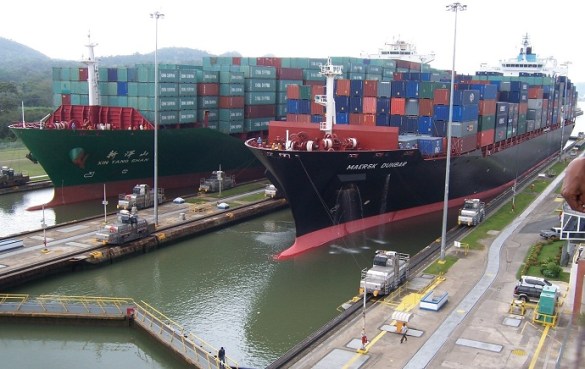
Ships passing through the Panama Canal. We needed a bigger canal, for bigger ships. Hell, dig up the whole country!
After years of delays, mismanagement, disaster, and an economic downturn, the expanded Panama Canal (which saw much worse during its initial construction) is set to open on Sunday. This is a deeper and wider lane for the enormous freighters that have accompanied Asia’s economic rise: the massive sun-blotting container ships, quarter-mile long, and capable of carrying tens of thousands of tons.
This is extremely important for trade, in a value-neutral sense, because it means that the giant ships, which couldn’t fit in the narrower and shallower original canal, will be able to bypass the West Coast and go directly to New York and other East Coast ports. The ramifications of this quickly trickle down.
Crain’s, the business paper out of Chicago which is not exactly a Sanders-ite rag, talked about the potential impact on this railroad hub. Ships that couldn’t fit the canal would be loaded on trains heading to Chicago, and thence to the east, following the same path that allowed Chicago to be the focal point of empire. Now, though, these ships can get through, which will have a potentially huge impact on Chicago’s economy. About 5% of the Chicago economy is based on railroad freight (Great Lakes shipping is another matter). If Chicago can be bypassed, that’s a lot of jobs that will disappear, thanks to a canal built half a world away.
Of course, no one seems really certain, and anyway, the impact might not be felt for years. Certainly, as the Journal reported, New York isn’t ready for these monster ships: the Bayonne Bridge isn’t tall enough, and it won’t be ready for at least another year.
That’s not to mention that the Canal itself has the hallmarks of a disaster, as epically reported by the Times. The locks are barely wide enough to handle the largest ships, and are almost exactly as long as the ships plus the two tugboats needed to maneuver them. There won’t be any room for error, which given the swirling currents when fresh water meets the ocean, could be a disaster. The tugboat union certainly thinks so. Panama awarded the contract to a rock-bottom bidder, who came in billions below the next-lowest, and it has shown. (The article almost makes you sympathetic with Bechtel, which is a hell of a thing to be.) The concrete has been leaky, and there might not be enough water.

Image from NYTimes. The new locks are 1400 feet. The Neo-Panamax ships are 1200. Tugboats are about 100 each. Snug!
And oh yeah, about that water: it mostly comes from a vast, manmade lake which provides most of Panama their drinking water. The Panamanian canal administrator has literally scolded the nation for drinking too much water, and lowering the levels, making it harder for the ships to pass through.
That seems to me to be the perfect image of the subservience to trade, of its dominance in our lives. A suspiciously rich and powerful bureaucrat, who awarded life-and-death jobs to a shoddy but connected international conglomerate, complaining about its citizens drinking too much water, and not allowing these enormous, inhumanly-scaled ships to pass through a gash cut through a continent, while two great cities thousands of miles away scramble to reconfigure an economy and raise bridges to let them pass, as workers in the cities the goods pass through lose their livelihood, and workers where the goods are made are beaten and starved and robbed.
We make these enormous ships. We dig through continents and connect oceans. We raise bridges. To say that we can’t do anything about the inequity and iniquity of global trade is to give in the free market superstition, the only truly global religion.
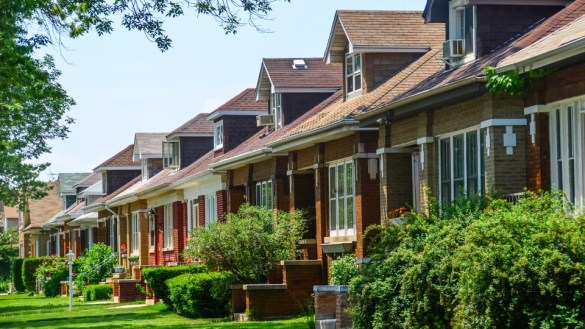
The leafy and quiet Bungalow Belt. Image from architecture.org
A lot of times, in political conversations or (ashamedly) on message boards in the past, when I have revealed that I am from Chicago there is a certain set of assumptions. At least in these forums, it doesn’t have to do with Al Capone or Michael Jordan, but rather an assumed liberalism, and in the era of Barack Obama, something shady and ugly and untrustworthy (depending on if my interlocutor is a right-wing crank or not, of course). But even Obama aside, Chicago has become synonymous with being liberal, because it is a staunchly Democratic city, and “democrats = wild-eyed libs”, even though this has rarely been true. Even now, where the party is as left as it has been since LBJ, it is still essentially moderate.
Chicago has always shown how “Democratic” is not equal with liberalism, except in one very important and telling way. When Old Man Daley was running the city, he was the bane of every liberal. He hated uppity blacks, long-haired kids, loud-mouthed ladies, reformers (especially reformers), and anyone else who wanted to tell him how to run his city. There was a way of doing things, and damn you if you tried anything else. You know what you need? A talking to from the parish priest, that’s what. I knew your father, rest his soul, and he’d be spinning in his grave to see what you’ve done with your life. (Sorry- we almost slipped into a James T. Farrell novel.)
But there was that one way which, to the right, Chicago and other machine-run inherently conservative and anti-liberal cities did seem like liberals, and that was because they made noises toward taking care of minorities. This was pure politics, of course, and was honored more in the breach than otherwise (“the wettest blacks!”), but they distributed jobs and other goods, especially the goods of having a pliant alderman and ward boss, who did what the machine wanted.
For many in Chicago, this was a bridge too far, especially as the black (and Hispanic, but that divide didn’t have deep and angry roots in Chicago) population grew, and the Machine had to pay more attention. The essentially conservative white-ethnic base grew angry, and while they didn’t have the same power, they did have control of the police forces, which more than ever became a private army for keeping the wrong people away from the right ones. This anger culminated in the vicious “Council Wars” that erupted when Chicago elected its first black mayor. We talked about how the leader of the anti-black movement, Alderman Fast Eddie Vrodolyak, was the spiritual ancestor of the Chicago-based Trump movement, a bitter reactionary who knew exactly how to play to the “Silent Majority”, stoking racial fears and hatred.
That’s still around now, despite a reputation for Obama-y liberalism. In this turbulent city, where a violent spring seems to be edging into an apocalyptic summer, the forces of action and reaction are simmering over again. We see this in today’s planned “Police Lives Matter” rally, placed at one of the two hearts of Chicago’s white ethnic redoubt.
These are to take place as a joint effort between the 38th and the 41st wards, on Chicago far northwest side, near the airport, where the city seems to blur into a grittier kind of strip-malled suburbia, bounded by some forest preserves, and row after row of bungalows. They are changing, a bit, with upscale condos in a few areas of Edison Park, but they are what they have been for decades: a mostly working-class area, with a lot of cops and fireman. Rules are they have to live in the city, and they tend to congregate at the far northwest and far southwest. Some people see this as wanting to be as near the suburbs as possible, and a sign of hating Chicago, but I think it’s understandable. It’s a tough job, and I’d probably want to feel like I’m leaving it as well. Consequently, these are safe neighborhoods, with families on the street and decent, though rarely great restaurants, and some great authentic Irish pubs.
But it is in the “police lives matter” rally is clearly the product of angry, racially-tinged reaction. Now, to be clear, police lives do matter. They do great and brave work, dangerous work. As Charlie Pierce said, in an article about a stomach-churning police scandal in Oakland, “Sometimes, I wonder how the good cops, all of them, get up in the morning and go to work. There’s something amazingly selfless in there that’s beyond my understanding.”
This, however, is not a parade for honoring good and great work. It’s a direct sneer at the activists of Black Lives Matter. You can tell it is due to the sickeningly disingenuous prattling of Alderman Anthony Napolitano, a former firefighter who is enjoying his first term.
Asked if Black Lives Matter protesters might object to a catchphrase turning the tables on their group, Napolitano said, “I have no clue why they would. There’s a Black Lives movement. There’s a Police Lives movement. That’s two totally separate things.
“What if someone came up with Puppy Dogs’ Lives Matter?” Napolitano added. “If you want to champion a cause, you should be allowed to champion it.”
This is obvious nonsense. It certainly wasn’t like “X Lives Matter” was a common phrase, and “black” is just the latest entry. Doing any “Lives Matter” is a clear choice to be in direct opposition to them; it is always prefaced with a not-so-subtle “No, actually…” His fun example is actually more telling than it seems. “You think black lives matter? Fuck you. I think puppy dog’s lives matter.”
(If you think that in the same article, Napolitano set up a “political correctness/common sense” dichotmy, you get zero points for guesswork, because come on. That’s easy.)
There is understandable fear in the city about what is happening, but it is telling that the “police lives matter” support comes mainly from some of the safest neighborhoods. It’s raw tribalism, and you can see how tribalism in Chicago has altered due to the pressures of race. Look at Napolitano. Time was no Irishman, of which there are a lot in the 41st, would vote for a man with a vowel at the end of his name, whether it was Italian or some form of “ski”. But the tribes have coalesced. And this tribe, the Police Lives Matter tribe, is why Chicago will never be a liberal city. The tribe is by definition conservative, and if still nominally Democratic in city politics, essentially socially Trumpian. It’s why even though he can’t win, his rise will mutate politics in the entire country, especially in angry barstools on a fearful and reactionary ring around Chicago.
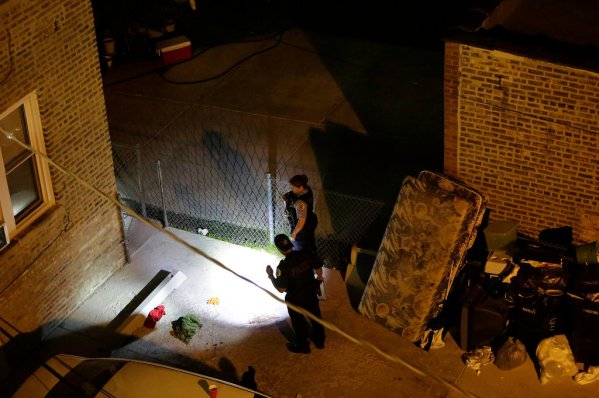
Image from NYTimes
On Sunday, anyone who subscribes to the New York Times (or fine, reads it online, in which it is a huge multi-media piece) saw a huge, front-page special report on the violence in Chicago over Memorial Day weekend, in which more than 50 shootings left six people dead as the long and hot summer juddered into a violent beginning. This has already been an apocalyptic year in Chicago, for reasons we’ll explore as the summer moves on.
The story is a series of excellently-reported rapid-fire vignettes, weaving in and out of the shootings, which are of course concentrated almost entirely on the south and west sides (though three of the fatalities, oddly, are up north, one near O’Hare). This is where I admire the Times piece, as it only briefly mentions that most of Chicago is very peaceful, and many of us are not touched even obliquely by violence. It instead portrays the city as a nightmare of murder, of random gunfire, of targeted killings and counter-killings, as a place of escalating violence where nihilism runs the streets and decent citizens live in expectation of being next. It’s easy for those not affected by it to shrug it off, saying that there are two Chicagos. The Times piece forces us to confront as a problem for the city, not just a problem somewhere in the city. It removes all remove.
To me, one of the most striking parts is the reaction people have to being shot. “Babe, they shot me” or “I’ve been shot!” I know- what else are you going to say? But I imagine for many of us our reaction would be bewildered terror, an inability to comprehend what is going on. One minute we are watching TV in our homes or standing on the porch or driving down Lake Shore, and the next, gutshot and bleeding. I doubt I’d understand what happened when a stray bullet caught me. That everyone in the story is instantly aware is a sure signifier of the huge gulf in our lives, the shame of Chicago, and of a country that has bred this vicious nihilism.
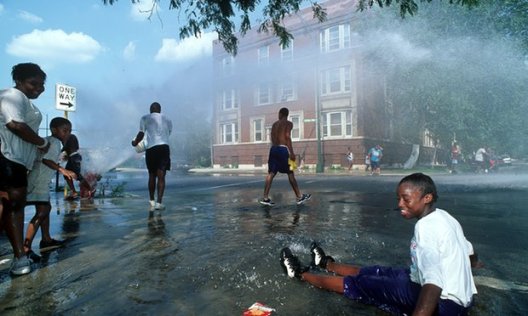
Lesson learned, apparently. Image from The Guardian.
Our last post talked about how we’ve been cheating on lead tests in much of the city, and it is the poor who suffer the most, which has startling implications for Chicago’s violent criminality. But water has always been a political tool.
As outlined in Royko’s Boss, still required reading for anyone interested in how cities work, or just in great writing, in the hot summer of 1966, firemen started turning off hydrants in poor black neighborhoods on the south and west sides, while letting children play in them in white areas. This led to rioting, and old man Daley reacted, as he did, with programs that missed the point entirely. He started bussing in giant moving pools to all the poor areas. As Royko said:
Now there was a program, and Daley liked it. Give them water. He had a whole lake right outside the door. Even before the riots ended a few days later, City Hall had embarked on a crusade to make Chicago’s blacks the wettest in the country.
This was a perfect encapsulation of the problem: quick fixes which ignore the systemic injustice, as if shutting off the fire hydrants was the first provocation, and not the last straw.
I think we’ll see the same thing here. I wouldn’t be surprised if Chicago does an orgy of quick spending to give every family a filter. It’s ignoring of the underclass until the problem becomes untenable, and then offering quick-hit solutions and hoping it’ll go away. Like lead leeching from antique pipes, though, it never actually does.
 Shooting Irrelevance